


Likes
Comments
Share


@Hashy
Follow
********************************************
Week 6 Early flower (week 2 flower)
********************************************
Light cycle=12/12
Light Power=75w 31%
Extractor controller settings (during lights on).
High temp= 26c
Temp step=0c
High Rh= 58%
Rh step=0%
Speed max=10
Speed min=1
Extractor controller settings (during lights off).
High temp= 20c
Temp step=0c
High Rh= 60%
Rh step=0%
Speed max=10
Speed min=1
Smart controller settings (during lights on).
Lights on=9.00am
Radiator on= -19.0c
Radiator off=+19.5c
Smart controller settings (during lights off).
Lights off=9.00pm
Radiator on=-18.0c
Radiator off=+18.5c
VPD aim=0.9-1.3
DLI aim=30-35
EC aim=0.8-1.5
PH aim=6.0-6.5
💧💧💧💧💧💧💧💧💧💧💧💧💧💧💧💧
NPK= 10-10-20
Method= Automatic
Feed= Flower nutes
Neutralise=0.1ml/L
Katana Roots=0.2ml/L
Plagron bloom=5ml/L
Plagron Power buds=1ml/L
Easy Ph down=0ml/L
(1ml=24 drops, 1 drop=0.04ml)
Easy Ph Up=0.083ml/L
(1ml=24 drops, each drop is 0.04ml)
Ec=1.35 PH=6.4/6.3
Runs=10
Run times=3mins (0.7L/0.35L each)
Gap times= 17mins
Total runtime=30mins(7L/3.5L each)
Total flowrate= 0.233L/min(0.116L/min each)
Auto start time=10.00am
Auto stop time=1.03pm
💧💧💧💧💧💧💧💧💧💧💧💧💧💧💧💧
********************************************
********************************************
📅15/3/25 Saturday(Day 36)
📋
📅16/3/25 Sunday(Day 37)
📋replaced batteries in wifi temp/humid sensor.
📅17/3/25 Monday(Day 38)
📋
📅18/3/25 Tuesday(Day 39)
📋 Small defoliation and leaf tuck.
💧
Automatic Flower nutes
Ec=1.35 PH=6.4/6.3
Volume=9L
Volume left=2L
Volume used=7L(ml/min)
Volume each=3.5L(ml/min)
Runoff.
Total runoff=L
Ec= PH=/
💧
📅19/3/25 Wednesday(Day 40)
📋
📅20/3/25 Thursday(Day 41)
📋
📅21/3/25 Friday(Day 42)
📋H=53cm D=12cm Dli=37.8 PPFD=875
Raised light, increased power to 100w
H=53cm D=24cm Dli=31.1 PPFD=719
********************************************
Weekly roundup.
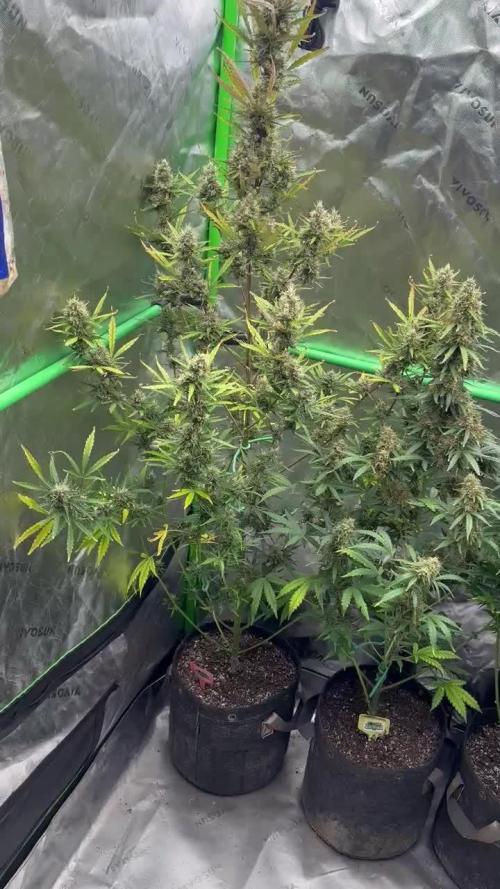
📋 This should be called tall bastard, she stretched 19cm this week and got extremely close to the light. I'd imagine she has about another week left of the stretch.
Back soon.
Take it easy.
********************************************

Likes
37
Share


@GrownwithLED
Follow
After germinating the seeds are transplanted into small pots with soil (see tutorial in VIDEO above). The soil is prepared with water mixed with a little bit of BIO NOVA Roots (0,5 ml/l), which aids the development of the seedling. Transplanting is very easy now, because they have grown a STRAIGHT tap-root while hanging during the SERIOUS' WAY of germination. This straight root allows for easy potting of the seeds. Simply make a little hole in the center of the soil with your pinky finger and carefully place the germinated seed with the white root pointing DOWNWARDS into the hole. Best is to lay it onto one side-wall of the hole with the seed shell right at the surface. Then I push the other side inwards and enclose the whole root with soil. At the end only the top of the seed-shell peeks out of the soil. IT IS VERY IMPORTANT to plant the seeds NOT TO DEEP into the soil. The seedling only needs extra strength to work itself upwards thru the soil and you run the risk of the soil drying out and the seed dying off. When you PLANT THE SEED VERY SHALLOW into the soil (=with the top of the seed-shell still peeking out) your seedling can grow out right away and you have a small plant already 24 hours after putting the seed into the soil.
The small seedling sometimes still has the seed-shell on its 'head', it normally falls off by itself, but sometimes you have to carefully help and take it off with your finger nails. Be careful to NOT clip of the seedling accidentally when you do this!
The seed-shall has an inner lining, which feeds the small seedling when it germinates. This inner lining sometimes gets tangled around the stem of the small seedling after the shell has fallen off. This little skin MUST be taken off the stem right away! Once it dries up, it gets hard and can strangulate the seedling around the stem. In order to avoid this, the skin must be taken off as soon as possible! I show it in the pics above and also made a video about taking off the inner lining of the seed.


Likes
16
Share


@Ganjagrandaddy
Follow
Day 43 flowering today. She is still looking rough from the calmag issue but is doing ok in general. Her buds are still forming nicely but lack of anything takes its toll . she smells sweet/skunky at the moment but her nugs are solid now. so sad i fucked up on her with the cal mag miss. She looks close to being done now so will be watching her trichs. come on girl bulk up.

Likes
3
Share


@jaydee702
Follow
Nuggets are heavy and frosty they can go little longer tho still some clear tricomes and white pastilles should be prime next week They are frosty and glittery more every day now so almost ready.


Likes
30
Share


@Silverback_Guerilla
Follow
10/23:
I fed today with One, sweet & sticky, signal, beastie bloomz, silica, and a little Ca/Mg
10/27:
Fed today with one, signal, sweet & sticky, silica, beastie bloomz, kangaroots, and humic acid.
Lowered the lights to no more than a foot from any cola..most are 7-9" away.

Likes
10
Share


@IrieOrganicVibes
Follow
November 25- December 4
11/25
Started germinating 3 seeds
11/26
Planted 3 seeds in my super soil
12/02
All 3 seeds sprouted
12/03
Started using Fish Shit
All 3 seem to be doing well and loving the Fish Shit
Likes
11
Share


@artems
Follow
Marker is thriving, with a hearty appetite. It's even begun to display vibrant leaf color changes, looking absolutely stunning! 🌿🌈 Keep up the good work!

Likes
4
Share


@TheGreenGroomer
Follow
🌱 Week 2, Day 2 of veg! The plants are looking happy and healthy overall. The one with the snapped taproot is catching up slowly and seems to be growing fairly well. I’m currently feeding them 300 ppm at a pH of 5.8, and they’re getting about 300-350 PPFD of light. Excited to see how they progress!
Likes
2
Share


@Ultraviolet_
Follow
Nirvana is interpreted as awakening from the illusion of separation and the limitations of time and space, effectively "seeing" the underlying code of existence. In Buddhism, Nirvana is described as the "unconditioned" (asankhata), a reality beyond dependent origination (cause and effect). This aligns with the concept of a fundamental, timeless "code" that exists before material manifestation. Some interpretations equate the stillness of Nirvana with the quantum vacuum, a state of "zero energy" which, however, holds unlimited potential for manifestation.
In quantum mechanics, a quantum system remains a "wave" of possibilities until observed. The "on-demand" aspect is often linked to the ability of a highly developed, enlightened consciousness (a "pure observer") to collapse this wave into a desired state, interacting directly with the underlying quantum reality. This view implies that by breaking free from the ego and mental conditioning, one gains mastery over the energetic, or vibrational, foundation of reality. The feeling of oneness in nirvana is explained through [quantum entanglement], suggesting all things are connected, and therefore, an enlightened mind can interact with any point in the universe. Traditionalists might argue that Nirvana is not about gaining control or having the power to "manifest on demand" (which can be a function of ego), but rather the total cessation of craving and the surrender of the ego, bringing an end to the desire to control reality.
The spiritual path is an evolution from being controlled by the "code" (samsara/suffering) to understanding the code and, eventually, becoming the author of one's own. With the awareness of how "code" functions, one takes full responsibility for their life, making conscious choices rather than reacting impulsively. Thoughts, words, and actions are purposefully aligned with higher values (truth, love, purpose), effectively rewriting one's destiny.
Humidity of the air dictates the moisture in the medium, which dictates the rate of pull from the terracotta stakes, 16 in total.
Soil-Plant-Atmosphere Continuum (SPAC): An ecological concept referring to the pathway of water moving from the soil, through the plant, and into the atmosphere.
Terracotta (unglazed, low-fired clay) is highly porous, acting as a breathable, permeable membrane that transports water based on the moisture gradient between the potting medium (soil) and the surrounding air. White terracotta and brown terracotta often have different pore sizes and overall porosity, primarily driven by differences in clay composition, impurities, and firing temperatures. While both are considered porous, brown terracotta often has higher iron content and impurities that behave as fluxes, affecting how the pores form during firing, while white terracotta is generally derived from more refined clays, with smaller pores making it more suited to pure water.
This mechanism is driven by capillary action and evaporation. When the surrounding soil is dry, the terracotta acts as a wick, pulling water out of the pot and into the soil. If the soil is very saturated, the terracotta absorbs water from the soil and allows it to evaporate from its outer surface, increasing the drying rate of the soil. Terracotta tends to keep the potting mix at an optimal saturation point, wicking up more water when the outside surface evaporates water into the air. The greater the difference in moisture between the soil and the outside air, the faster the water transfers through the ceramic. In low humidity and hot weather, the evaporation rate from the terracotta surface is high, creating a rapid drying effect. Newer terracotta pots often have a denser, lighter-toned structure that is less porous than traditional, red-orange terracotta, slowing down the moisture transfer rate. Over time, dissolved salts from fertilizer or tap water build up and block the pores, reducing the permeability of the clay. Water is all that is used or needed, thanks to the biochar and the massive storage bank of nutrients. Just waiting until something creeps up.
Clay pot irrigation (Ollas), an ancient farming practice, utilizes this property by burying unglazed jars in the soil, allowing water to slowly seep into the surrounding soil only when the soil dries out.

Likes
28
Share


@Cronos
Follow
Hello everyone, I am new here.
This is the second time I grow and first time in living soil, previous was organic.
Learned some experience from a super guru at seedsmans.
# Planted:
05 Jan. 2022
Germination in Root Riot plug.
# Transplanted:
Day 4
Pot:
12 gallons smart pot
Living soil kit (thehighchameleon.com):
- Worm compost
- Mealworm guano
- Biochar
- Bat guano
- Zeolite
- Volcanic basalt
- Endomychorize Glomus Intraradices
- Bacillus Amyloliquefaciens
Bacteria/insects (biogrowi.fr):
- Phytoseiulus and California predatory mites
- Nématodes (Stenema, b-green, Mier-run)
Worms:
Eisenia Foetida, Hortensis and Andreï.
Companions plants (RQS):
- Cerastium
- Marigold
- Alfalfa
- Red Clover
- White Clover
- Chervil
- Peppermint
- Lavender
- Coriander
- Chamomile
- Yarrow
- Lemon Balm
- Sweet Basil
- Borage
# Day 9:
Made Avocado tech:
- Pumpkins and leeks from Bokashi bin
- Almend nuts
Feed pot with 4 liters of AACT:
- 5 liters water
- 5 ml molasse of sugar can
- 125 grams vermicompost
- 12.5 grams nettle
- 12.5 grams horsetail
- 5 grams growing guano
- 5 grams fish hydrolyzate
- 5 grams epson salt
The day after I gave AACT, the leaves started praying so I switched light and VPD settings to veg.

Likes
92
Share


@DogDoctorOfficial
Follow
🌱 Week 2 Report: The Journey Evolves 🌱
Grow Fam, the adventure is in full swing! 🌟 The Gorilla Melon from Fast Buds is out and shining its light, and the Papaya Zoap has made its debut in the Cannakan, bringing with it a story that adds even more depth to this incredible run.
When the universe speaks, we listen. 🍈✨ I didn’t plan on popping Papaya Zoap from Sweet Seeds just yet, but sometimes things just have a way of aligning. After a few other seeds didn’t germinate, I felt an inner pull toward this special strain. As it turns out, the universe had something beautiful in mind! Just days later, my brother @daggadna also began germinating the same genetics—gifted to us during Spannabis. Was it a coincidence? I don’t think so. 🌱 This is more than just a grow now—it’s a journey with purpose, guided by synchronicity and connection. I can already feel the magic building up with this one, and I can’t wait to see where this road takes us!
Now, onto the Papaya Zoap… something tells me this plant is going to take us on a ride we didn’t expect but absolutely needed. 💚 Let’s make something incredible, Brother Dagga—this one’s going to be legendary.
Gear Updates: All Systems Go 🚀
This week, everything’s dialed in perfectly with the TrolMaster system. Shout out to the incredible DSH-2U Humidity Station! 🌬️ This tool is giving me precision control over the RH (relative humidity) ranges in the room, keeping the environment just right for my babies. Having that accurate readout and control allows me to maintain optimal levels for each stage of growth. It’s like magic—you plug it in, set the desired ranges, and let it do its thing! 🌡️
By monitoring and adjusting humidity levels on-the-fly through the TrolMaster app, I can ensure the environment remains stable, and that means happier plants and healthier growth! No more guessing games. From anywhere—whether I’m working in the garden or chilling out—I can track and tweak it all. Heck, I could be on the toilet and still have complete control over my room! 😂
The AMP-3 Precision Meter has been running 24/7 in my water solution, giving me real-time updates so I can make any corrections when needed, right from my phone. This tech has taken my grow to another level. ✨
Nutrition Update: Keeping It Balanced 🍃
As for feeding, we’re sticking with the basics to give the plants what they need, without overloading. Right now, I’m running:
• Regulator: 0.15ml/l
• Startbooster: 0.25ml/l
For now, I feel like this is the sweet spot—just enough to encourage root development and early growth without overloading them. I’ll be adjusting the feed as we go deeper into the grow, keeping an eye on how they respond. You know me, always tweaking and improving along the way!
Shoutouts & Gratitude 🙌💚
Huge love to everyone following along—whether you’re here on Grow Diaries, over on YouTube, or on IG. Your support keeps this journey alive, and I am so grateful for every comment, like, and message! Special shoutout to my sponsors for fueling this project:
• Nutrition: @aptusholland @aptus_world @aptus_es @aptusbrasil @aptus_thailand @aptus_portugal @aptususa_official @aptusplanttechnz @aptusplanttechaus
• Controls: @trolmaster.eu @trolmaster.eu.support @trolmaster.support @trolmaster.agro
• Soil: @promix_growers_eur @promix_cannabis @promixmitch
More to come soon, and you won’t want to miss it! 📺 I’m also documenting everything on my YouTube channel, and I’ll be sharing behind-the-scenes content on IG, so hit that subscribe button and follow along. Let’s grow together, fam!
Growers Love to All 💚
The love and support from the grow community is something I never take for granted. This journey wouldn’t be the same without all of you! I’m so honored to be part of this amazing community, and I can’t wait to share more updates and insights along the way. Remember, this isn’t just about growing plants—it’s about growing together. 🌱
Until next time, stay positive, stay inspired, and keep pushing forward!
This week’s shoutout is dedicated to the synchronicity of life, my growing community, and of course, Papaya Zoap and Gorilla Melon. Let’s see what magic we can create together!
#HighFrequency #PositiveVibesOnly #PapayaZoap #GorillaMelon #TrolMaster #InBalanceWithNature #GrowLife #AptusTruePlantScience #GrowersLove


Likes
4
Share


@UrbanBoer
Follow
I cannot believe it, 14 days to go then I am going to harvest, I am confident that I would of flushed Lamby quiet thoroughly, for some reason weed needs it’s roots to flushed if you want a super smooth smoke, I wonder if fruit was the same as weed, would we flush the roots to get such tasty and juicy fruit or veggies, or would we bare with that sourness. The real test will be on the 15th of December when it comes to my test smoke, then I shelf Lamby until January after returning from the festive season, by then I would have achieve top tier curing.
Likes
5
Share


@ChiloteAnonimo
Follow
Día 01 de su octava semana de flora.
Pandemia kush y la Trimosa x mimosa sin apical se van a cortar a mediados de esta semana.
El resto por cuestión de tiempo voy a apurarlas cortandolas en 10 días más.

Likes
23
Share


@SirSmokeALot333
Follow
Week 9 :
Day 59 :
Hey all
So week 9 started and some of the lady’s are bulking up , like Westcoast O.G and some of the Strawberry Pie . But the Westcoast O.G in the picture gonna be first one to harvest and also gonna give me some fat dense buds , i can see that clearly 🤤.
About the Gelatos I am a bit dissapointed cause all of them 3 are like normal plants with no strong structure or a big yield sign . I hope the taste gonna prove me wrong cause I like this strains , one of my favorites . I also can’t wait to try this Westcoast O.G and Strawberry Pie again , I growed them both on one of my last runs and they turned out pretty good , especially Strawberry Pie 🍓.
I hoping for a 25-30 g per plant , but I guess this gonna be a hard one this time.
Like my Gorilla Glue the only one Sativa in the tent but also the slowest in growing flower and she’s eaten much lesser than the her indica sisters . But wow she got s crazy fruity smell with full of crystals on her .
Cream Cookies she growed so fast in the last week , that she has come close to the other ones . I think this strain is a very fast bloomer , my last one was ready on day 69 from seed to harvest with a good amount of amber . Also a very flavoury strain 🍪
Yesterday I started to feed them Batguano , this should bring some green healthy leafs again and fat smelly buds .
My first Chem on the picture is really hungry right now , I started a bit late for her but this should be ok .
Updates coming
Likes
99
Share


@Sativagrad
Follow
The competition is coming to an end and I did not have time to harvest, I want to wait another week, I will approximately get about 2 kg. I really liked this unforgettable experience of growing this variety)) There were no problems, except for a huge 3.5 meter growth)) The smell is on the whole area, I will soon enjoy sugar flowers))

Likes
3
Share

@momothehobo
Follow
Still flushing this week, I plan on chopping this Friday! As always, the girls on GrowWithJane:
1) https://growithjane.com/growlog/fb420-original-gorilla-zkittles-yellow-342ve
2) https://growithjane.com/growlog/fb420-original-gorilla-zkittles-green-ubh4l
3) https://growithjane.com/growlog/fb420-original-gorilla-zkittles-blue-0wj77
4) https://growithjane.com/growlog/fb420-original-gorilla-zkittles-white-c6ovz
5) https://growithjane.com/growlog/fb420-original-gorilla-zkittles-pink-50csd


Likes
8
Share


@Squaregrouper
Follow
The three triple cheese plants are growing at the same rate at the exact same height... They are all from three separate seeds I grew these from seeds they are not clones... But I must know that triple cheese has a problem with cloning.? I finally got three clones to root outdoors but to be fair I did not dedicate a lot of time on getting clones.

Likes
19
Share


@adam_pawloski87
Follow
Let’s Go Day 81!!!! This week went real great 2 Ogreberrys are hanging to dry and also the Bruce Banner is too after there 48 hr of darkness! The 3 other Ogreberrys began flush on Monday so finish out this week of flush and one more week of flush after that an they will get the chop too! But stay stunned for next week , we’re not done yet so keep them eyes peeled!! Y’all have an amazing productive day as well as a great week ! Peace love an positive vibes to everybody Cheers 😶🌫️💨💨💨💨💨🤙🏻

Likes
54
Share


@BudXs
Follow
Well, it looks as if one of the 3 plants is a male. I live in denial for one more day and then I toss it. Not sure which plant it is, as I painted over the strain names when I painted the cups grey. Smooth. So I will find out soon. Otherwise, good weather and some good growth. Roots are balled up at the bottom of the dutch bucket reservoir, Im sure, because I let the drip go dry for a day or two and the plants were droopin (coco)
