


Likes
Comments
Share


@GERGrowDesigns
Follow
Harvest Day !
The Green O Matics looking Phenomenal . They Produced Tasty and Hard Smelling Buds which are Covered in Frosty Ice with Nice Colours .
Never Thought These Genetics would Flower so good After the Problems they got every day . They looked unhealthy the whole Grow .
Lights 200w
20/4

Likes
9
Share


@BavarianBudmeister
Follow
ENGLISH VERSION BELOW
Wie ich im letzten Update geschrieben habe, fällt dieses hier etwas größer aus und enthält auch mehr Fotos und Videos.
Die Pflanzen haben sich gut entwickelt, waren aber mittlerweile zu groß für ihre kleinen Töpfe und zeigten Anzeichen von Wurzelstress. Ich habe sie daher in 9-Liter-AirPots umgetopft, die ich noch von einem alten Projekt übrig hatte. Als Substrat verwende ich eine 70/30-Mischung aus Canna Coco Professional und Peligran Perlite von Knauf. Ich liebe dieses Zeug – man kann es praktisch nicht überwässern. Die Wurzelballen habe ich mit etwas Mycotrex von Biotabs bestreut. (Mycorhizzae)
Um ehrlich zu sein: Ich war einfach zu faul, neue Stofftöpfe zu kaufen, also dachte ich mir, warum nicht die alten AirPots wiederverwenden :-) Mal sehen, wie sie sich darin machen.
Ich habe die Pflanzen auch in ihre „endgültige“ Umgebung gestellt – ein 120x120-Zelt (4×4 für meine imperialen Freunde ;-) – und ab jetzt werden sie über meinen geliebten Ebbe-/Flut Eigenbau versorgt. Ich habe es vor 10 Jahren gebaut, und es ist immer noch ein echter Segen. Einmal am Tag werden die Pflanzen mit Nährlösung aus einem 200-Liter-Tank (52 Gallonen) geflutet. Leider bedeutet das auch, dass ich euch nicht mehr sagen kann, wie viel Nährlösung jede Pflanze genau bekommt – sie nehmen sich einfach, was sie brauchen.
Das neue Zelt wird mittels eines AC Infinity Controller 69 klimagesteuert, sodass ich die Bedingungen deutlich besser im Griff habe. Ich versuche, einen VPD von etwa 1,2 zu halten. Die Klimaanlage ist auf 22 °C (~71 °F) eingestellt und der Luftbefeuchter hält die Luftfeuchtigkeit bei etwa 62 %.
Offtopic:
Ich musste eine große Lemon Orange-Mutterpflanze räumen, um Platz für die vier Humboldt-Mädels zu schaffen. In den nächsten Tagen werde ich sie zurückschneiden müssen.
Was demnächst ansteht:
In den nächsten Tagen werde ich die Pflanzen toppen. Die abgeschnittenen Spitzen werde ich versuchen, als potenzielle Mütter zu bewurzeln – vielleicht ziehe ich ja ein DNA-Los :-).
Meine Frage an euch diese Woche:
Mit welchen Substraten und Bewässerungssystemen habt ihr schon herumexperimentiert – und was hat euch am meisten überzeugt? Schreibt es mir gerne in die Kommentare!
_________________________________________________________________________________________________________________________________________________________
As I wrote in last weeks update this one will be a bit bigger and contain more photos.
The plants were coming along nicely but the were to big for their tiny pots and showed some root stress. I transplanted them into 9 Liter AirPots which I had laying around from an old project. The substrate is a 70/30 mix of Canna Coco Professional and Peligran Perlite from Knauf. I love this stuff. You basically can't overwater it. I sprinkled the root balls with some Mycotrex from Biotabs (Mycorhizzae)
Tbh I wast just too lazy to buy new fabric pots so I thought why shouldn't I use these old AirPots :-) We'll see how they perform.
I also placed the plants in their "final" habitat which is a 120x120 (4×4 for my imperial friends ;-) and from now on they get fed by my beloved DIY-Ebb and Flow system. I built this 10 years ago and it's still a charm to have. Once a day the plants will get "flooded" with nutrient solution from a 200 L (52 gallon) tank below. Unfortunately this also means I can't tell you how much nutrient solution they received anymore as they just take as much as they need.
This tent is climate controlled by an AC Infinity controller 69 so I should be able steer them way better. I try to keep them at a VPD of around 1.2. I have my AC set to 22°C (~71°F) and my humidifier keeps the tent around 62%.
Offtopic:
I had to evict a big Lemon Orange Mom to make space for the 4 Humboldt girls. I will have to cut her back in the next days.
Upcoming: I'm going to top them in the next few days I will try to keep the tops as potential mothers if I hit the DNA lottery :-).
My question for you this week: With which substrates and watering systems have you messed around so far and what did you like the most? Please tell me in the comments

Likes
8
Share


@Farmer1
Follow
Very good smell mix of gaz and exotic fruits,the buds are Soo compact!hope the weather will not be too humid 🙏

Likes
4
Share

@DogDoctorOfficial
Follow
# 💙 Project Blue Tent – Week 12
## 🥒 Pickle Lemon Haze F1 – Pheno B
### 🌸 Another Girl, Another Story, Another Ridiculously Frosty Week! ❄️📸
Hello everyone, and welcome back to another chapter of Project Blue Tent! 💙🌱
And honestly, my friends...
WHAT IS HAPPENING INSIDE THIS TENT?! 😂❄️
Every week, I think we're going to run out of ways to describe how beautiful these girls are becoming.
And every week, they prove me wrong.
The flowers are developing beautifully, the frost is becoming increasingly impressive, and the whole ecosystem is looking absolutely fantastic.
This week, we're giving Pickle Lemon Haze F1 Pheno B her individual spotlight.
And she certainly has something worth showing!
We spent some time behind the camera again, creating three detailed photo stacks from hundreds of individual photographs. We ended up with stacks containing 299, 299, and 333 photographs respectively.
That's 1,931 individual frames across the three stacks.
Yes, my friends, that's a lot of photographs for one girl! 😂📸
We also made a few environmental adjustments this week. We've brought the temperatures down slightly and increased the output power across the lighting setup.
The overall approach remains the same: observe, adjust when necessary, document the results, and give the plants the stability they need to continue developing.
So, let's take a closer look at Pheno B and see what she's showing us this week!
## 🌸 WEEK 12 – PHENO B IS LOOKING OUTSTANDING
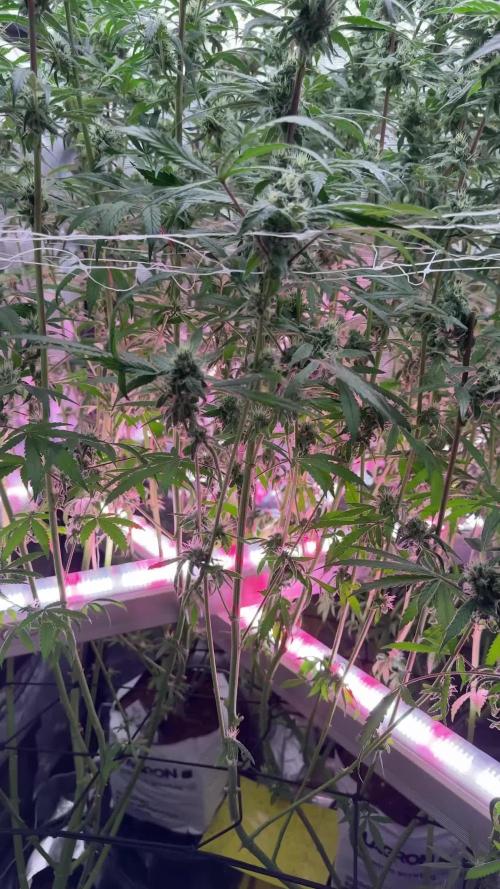
Pickle Lemon Haze F1 Pheno B continues to impress.
She's approximately 145 cm tall, and the plant structure we've established over the previous weeks is now supporting the flowering development beautifully.
The major training work is behind us. The canopy is established, the SCROG nets are providing support, and the flowering sites are developing throughout the plant.
We're no longer in the stage of trying to build the structure.
We're watching the structure do its job while the flowers continue to develop.
And that's one of my favourite transitions in a grow diary.
You spend weeks working on the plant's architecture, making decisions about topping, training, canopy management, and defoliation.
Then you reach a point where you can step back and appreciate the result.
That's where we are now.
The plant is looking beautiful, the canopy remains organized, and the flowers are giving us plenty of reasons to keep the camera close.
And the frost?
Oh, the frost! 😂❄️
## ❄️ THE FLOWERS ARE STEALING THE SHOW
Let's get straight to the obvious.
These flowers are becoming seriously photogenic!
The close-up photographs reveal the intricate details of the developing buds, the prominent pistils, and the trichomes covering the flowers and surrounding sugar leaves.
There's something special about reaching this stage of flowering.
From a distance, you can appreciate the plant's overall structure and how the flowering sites are distributed throughout the canopy.
But when you get close enough to examine the flowers properly, there's an entirely different level of detail to appreciate.
And that's precisely why I enjoy macro photography.
It lets us document the small details that are easy to miss when we're simply looking at the whole plant.
Pheno B is giving us some beautiful subjects to work with, and I wanted to capture that as clearly as possible.
So, instead of taking a handful of photographs and moving on, we spent more time creating detailed photo stacks.
And I think you'll understand why when you look at the results.
😂📸🌸
## 📸 THREE PHOTO STACKS – 931 PHOTOGRAPHS IN DETAIL
This week, we created three separate photo stacks of Pickle Lemon Haze F1 Pheno B.
Here's the breakdown:
- Photo stack 1: 299 photographs.
- Photo stack 2: 299 photographs.
- Photo stack 3: 333 photographs.
That's a combined total of 931 individual frames!
Each stack represents a considerable amount of work, both behind the camera and during post-processing.
And this is where patience becomes essential.
Focus stacking involves combining photographs taken at different focus distances to increase the depth of field in the final image.
When working with macro subjects, the area in focus can be extremely narrow. A small change in focus can bring one section of a flower into sharp detail while leaving another section outside the focus plane.
By combining multiple frames, we can capture more of those details in a single final image.
Of course, the results depend on the source photographs and how well the stacking process handles them.
But when everything comes together, the finished image can reveal a remarkable amount of detail.
And that's what I wanted to achieve with Pheno B this week.
Three stacks.
Hundreds of frames.
One very photogenic girl.
And plenty of frosty details to appreciate! 😂❄️
## 🌿 SAME TENT. SAME ECOSYSTEM. HER OWN STORY.
One of the defining features of Project Blue Tent is that we're documenting the plants individually while keeping their shared growing environment consistent.
The plants share the same tent, reservoir, irrigation system, lighting environment, nutritional program, and general cultivation approach.
That gives us an opportunity to observe their development side by side.
And the similarities remain fascinating.
The plants have developed remarkably similar structures, and their flowering progression has been impressively consistent.
But that doesn't mean the individual diaries are interchangeable.
Each plant deserves her own record, photographs, observations, and development history.
That's why we're documenting Pheno A, Pheno B, and the other cultivars separately.
Even when the plants look remarkably similar, their individual details remain worth recording.
For Pheno B, this week's story is about her continued flower development, the close-up photography, and how she looks following the latest environmental adjustments.
She's sharing the same ecosystem as her sisters, but she's still the star of this particular report.
And today, we're giving her the attention she deserves!
💙🥒🌸
## 💡 LIGHTING – INCREASING THE OUTPUT
We made another adjustment to the lighting setup this week, increasing the output power across the lighting equipment.
The main LEDs continue to provide the primary illumination from above, while the two LumiFlora 150W full-spectrum under-canopy fixtures supplement the lower portions of the canopy.
The under-canopy bars remain arranged in the X-cross configuration beneath the plants.
With the structure now established, this arrangement gives us another aspect of the growing environment to observe as flowering progresses.
We're interested in how the different parts of the canopy develop under the combined lighting arrangement.
At the same time, we've increased the lighting output, so we're keeping an eye on the overall environment and the plants' response.
It's important to remember that increasing light output doesn't automatically guarantee a particular result. The response depends on the conditions around the plants and how they develop over time.
That's why we're documenting these adjustments rather than assuming what the outcome will be.
We make a change, monitor the conditions, and observe.
And Pheno B will continue to be part of that story.
## 🌡️ ENVIRONMENT – SLIGHTLY COOLER CONDITIONS
Alongside the increase in lighting output, we reduced the temperatures slightly this week.
It's a small but meaningful part of the latest environmental adjustments.
Lighting and temperature are connected, so whenever we change the lighting setup or its output, we need to consider the wider environment rather than looking at each setting in isolation.
We're keeping an eye on the day and night temperatures, relative humidity, solution temperature, and substrate temperature while the plants continue flowering.
The idea isn't to keep changing everything for the sake of it.
It's to make deliberate adjustments and then observe how the environment settles.
The latest readings have been updated in the GrowDiaries record, so the conditions listed there are the reference for this week's report.
And that's another reason I appreciate keeping detailed records.
When we look back at the end of the project, we'll be able to see not only how the plants developed, but also which environmental changes took place along the way.
## 🕸️ SCROG AND CANOPY STRUCTURE – THE FRAMEWORK IS THERE
The SCROG structure continues to provide support as the flowering branches develop.
The first net helped us distribute the canopy, while the second net provides additional support to the established structure.
The earlier topping, training, and defoliation also remain important parts of this plant's story.
Those interventions helped us create the architecture we're looking at today.
And now, we're allowing that structure to do its job.
We don't need to keep moving branches simply because we can.
We don't need to keep reshaping a canopy we've already established.
The important thing now is to monitor the plant, observe how the flowers develop, and make adjustments only when there's a genuine reason.
Sometimes the most satisfying part of cultivation is seeing the results of work you completed weeks earlier.
You train the plant, give her time to respond, and eventually you get to appreciate the structure that training helped create.
That's exactly what we're seeing with Pheno B.
## ✂️ DEFOliATION – LETTING THE EARLIER WORK SPEAK
The substantial defoliation performed in the earlier weeks also remains part of this story.
At the time, opening the dense canopy made a dramatic difference to the plant's appearance.
Now, we can appreciate the structure that remained after that work and how the plant has continued developing.
The flowering sites are visible throughout the canopy, the branches are supported, and the plant has had time to respond to the earlier interventions.
This is why I believe it's important to think carefully about timing.
There is a time to train.
There is a time to remove foliage.
There is a time to provide support.
And there is a time to stop interfering and observe.
For Pheno B, the major structural work has already been done.
Now we're concentrating on the flowering development and the way the plant responds to the environment we've established.
## 🌬️ AIRFLOW – SUPPORTING THE ENTIRE CANOPY
The airflow arrangement remains an important part of the shared ecosystem.
With a substantial canopy, we want air moving through the upper, middle, and lower portions of the plants rather than allowing stagnant pockets to develop.
The earlier canopy management helped open the structure, while the circulation equipment supports air movement throughout the tent.
The under-canopy lights also make it important to keep the lower portion of the growing space in mind when assessing the overall environment.
We're looking at the complete picture.
Lighting, temperature, humidity, and airflow all interact.
The goal is to maintain a balanced environment rather than focusing on one parameter in isolation.
And as the plants continue developing, we'll keep monitoring those conditions and making adjustments when needed.
## 💧 IRRIGATION AND DRAINAGE – KEEPING THINGS CONSISTENT
The irrigation and drainage systems remain part of the established setup.
The recorded watering volume is approximately 1.6 litres per plant over 24 hours.
Because the plants share the reservoir and irrigation system, maintaining a consistent approach across the tent is an important part of this project.
We continue observing how the plants are responding and monitoring the system's operation.
The idea is simple: maintain the established setup, record what happens, and avoid unnecessary changes when everything is working as intended.
Good equipment should make our lives easier.
It should help us maintain consistency while allowing us to concentrate on the plants themselves.
And that's exactly the approach we're continuing with this week.
## ⚗️ NUTRITION – THE CORRECT PLAGRON RECIPE
The nutritional program remains unchanged this week.
We're using the PLAGRON Hydro line, with Green Sensation included in the current recipe.
The previous reports are also being corrected where necessary to ensure that Green Sensation is recorded accurately instead of Hydro Roots.
For this week's report, the recipe is:
- PLAGRON Hydro A — 2.2 ml/L
- PLAGRON Hydro B — 2.2 ml/L
- PLAGRON Power Buds — 1 ml/L
- PLAGRON Green Sensation — 1 ml/L
- PLAGRON pH Plus — 0.03 ml/L, as recorded
- PLAGRON pH Minus — 0.03 ml/L, as recorded
The recorded pH is 6.01, and the EC is 2.24 mS/cm.
As the recipe has remained unchanged, we're continuing to record the measurements and observe the plants rather than inventing an explanation for every variation.
The important thing is to document what was actually used, keep the record accurate, and monitor how the plants develop.
That's what makes these diaries useful when we eventually look back at the complete project.
## 🌡️ CURRENT BLUE TENT CONDITIONS
The GrowDiaries record for this week has been updated with the latest environmental readings.
The reference measurements shown in the current record include:
- Cultivar: Pickle Lemon Haze F1
- Phenotype: Pheno B
- Flowering: Week 12
- Height: Approximately 145 cm
- Light schedule: 12/12
- Day air temperature: 27°C
- Night air temperature: 27°C
- Relative humidity: 59%
- pH: 6.01
- EC: 2.24 mS/cm
- Solution temperature: 25°C
- Substrate temperature: 24°C
- CO₂: Approximately 666 ppm
- Pot size: 8 litres
- Watering volume: Approximately 1.6 litres per plant per 24 hours
- Under-canopy lighting: 2 × LumiFlora 150W full-spectrum fixtures
- Under-canopy arrangement: X-cross configuration
- Nutrient line: PLAGRON Hydro
- Green Sensation: 1 ml/L
The temperatures have been reduced slightly, and the lighting output has been increased for this week's update.
The values above reflect the updated record rather than the older Week 11 measurements.
## 🔬 FOUR PLANTS, FOUR STORIES
This is something I want to keep emphasizing throughout Project Blue Tent.
Yes, the reports share some common elements.
That's intentional.
The plants share the same ecosystem, so it makes sense that their reports will cover the same environmental systems, lighting arrangement, irrigation setup, and nutritional program.
But the individual reports are not simply copies of one another.
Each one focuses on a different plant and documents her own development.
For Pheno B, we have the three photo stacks, her individual flower development, and her response within the shared growing environment.
For her sisters, we'll continue documenting their own characteristics and the details that make each plant worth following.
The shared conditions provide context.
The individual observations give each diary its purpose.
And that's what makes the project interesting.
We're not trying to manufacture differences where there are none.
We're documenting what we actually see.
Sometimes that's variation.
Sometimes it's remarkable uniformity.
And sometimes it's a tent full of plants that look so similar you have to remind yourself that they're not clones!
😂💙
## 🔭 LOOKING AHEAD – MORE TO OBSERVE
As we continue through flowering, I'm particularly interested in watching how the flowers develop under the updated lighting arrangement and slightly cooler environmental conditions.
We'll keep observing the canopy, the flowering sites, and the details that become visible through the macro photography.
We'll also continue recording the environmental measurements and maintaining the shared nutritional program.
The next stage will bring more opportunities to document the plants and compare their development over time.
But we're not going to rush ahead.
We have the structure.
We have the established ecosystem.
We have the equipment in place.
And now we have the time to observe the results.
That's what we're here for.
## 💙 FINAL THOUGHTS – ANOTHER BEAUTIFUL WEEK FOR PHENO B
My friends, Pickle Lemon Haze F1 Pheno B is looking absolutely outstanding.
The flowers are beautiful, the frost is impressive, and the close-up photography has given us another opportunity to appreciate the intricate details of her development.
We created three photo stacks from 931 individual photographs, made some environmental adjustments, increased the lighting output, and continued maintaining the established ecosystem.
Nothing about this week required us to reinvent the entire setup.
Instead, we made deliberate adjustments, updated the records, and continued observing.
And that's an important part of cultivation.
You don't need to make dramatic changes every week to make progress.
Sometimes you simply need to understand what you're seeing, record it properly, and give the plants time to respond.
Pheno B is sharing her environment with her sisters, but her individual story is still unfolding.
And I'm looking forward to documenting every step of it.
The canopy is established.
The flowers are developing.
The trichomes are giving us plenty to admire.
The photography is looking beautiful.
And the whole ecosystem continues to be the foundation of this project.
So, for now, we're going to keep doing what we've been doing.
Observe.
Measure.
Document.
Adjust when necessary.
And appreciate the beautiful plants we're fortunate enough to follow.
💙🥒🌸❄️
## 🙏 A HUGE THANK YOU
A huge thank you to Zamnesia for making Project Blue Tent possible and giving us the opportunity to document these Pickle Lemon Haze F1 cultivars individually.
Thank you to PLAGRON for the Hydro nutrient line supporting the project, including Green Sensation as part of the current nutritional recipe.
Thank you to Mars Hydro for the irrigation and drainage equipment helping us maintain consistency throughout the tent.
A massive thank you to Zamnesia for the Phytonaut LED lighting, curved scissors, and clip fans that continue playing important roles in the project.
And a special thank you to LumiFlora for the under-canopy lighting that we're exploring as another part of our cultivation setup.
Thank you to GrowDiaries for providing the platform where we can document the experiments, share the photographs, and record the lessons we learn along the way.
And finally, thank you to everyone following Project Blue Tent! 💙
Your support makes sharing these individual chapters even more enjoyable.
Pickle Lemon Haze F1 Pheno B is looking beautiful, and I'm delighted to have another week of her journey documented.
Until next week...
Keep growing.
Keep learning.
Keep observing.
And keep appreciating the details!
Growers Love, happy growing, and take care everyone! 🌱💙🥒❄️

Likes
2
Share


@MiyaguiOkPolilla
Follow
Las semillas fueron plantadas correctamente en el sustrato previamente inoculado con tricodermas. Un riego abundante cubre su manto y el humidificador llena el aire creando una niebla atractiva para los brotes que vendrán.
Likes
10
Share


@Aleks555
Follow
Hello, everyone! 🖐️ This week has been going well too. 🌲 The Christmas trees are growing. I have pruned off almost all the leaves, leaving just a few. I am watering it with plain water. I think it will be ready by the end of the week. Wishing good luck to everyone who is honest and sincere.
Likes
80
Share


@Zengrower
Follow
The HighCloudz is in her last few days now. On the last inspection the trichromes were almost 100% cloudy and my plan is to harvest her in 2 days. This has been a great grow and I'm glad she recovered from my feeding mistake. Sure the leafs could have looked better but the flowers are really awesome. I'm not planning on doing anything special the next couple of days. No stressing or light deprivation, just let her enjoy the last days in the GTools ✌️☘️😊
Likes
3
Share


@Takeaims
Follow
Defo going keep going with f1 I have more still growing and there the biggest plants I've had thanks zameizia you guys are amazing
Likes
7
Share


@Guerillafarm
Follow
Day 94 Harvesting and making Hash with the cut leaves.
5weeks of veg and 9,5weeks of flowering
Pot size 6L

Likes
12
Share
@IberianRootcraft
Follow
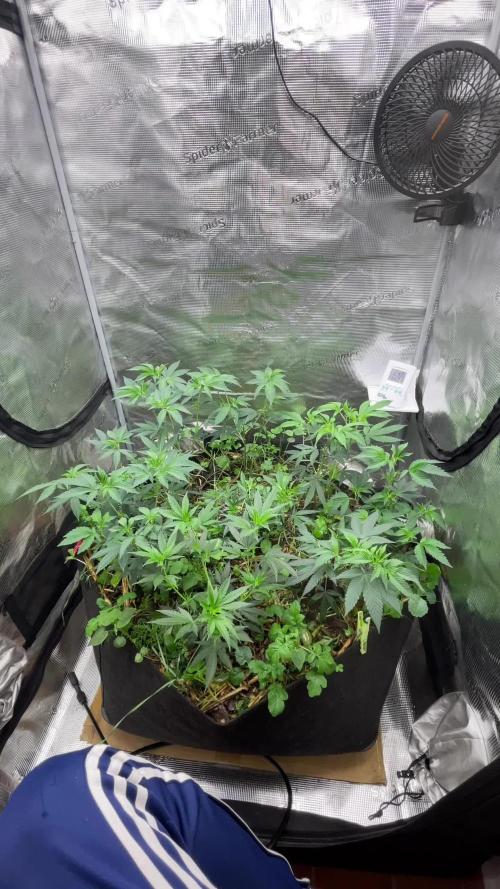
Light defoliation to level out the canopy. Supebuff Cherry 26 & Strawberry Guava are pushing way ahead, I did some training on them too.
Colorado Nightshifter is already cloned, RS11 is still recovering…
The Runtz is the smallest one and I already have a clon so I’m just applying LST.





Likes
8
Share


@Franz1234567
Follow
Next week next experiences. Stop training and let the girls freedom. Hope they will appreciate that and boost buds as much as they can.
Likes
37
Share


@Roberts
Follow
Mandarin XL autoflower is finally starting to shoot pistils. She is overdue on a solution change. Everything is going good and I will get to a change this weekend. Nothing else to report at the moment. Thank you Gen1:11, Medic Grow, and Ganja Farmer. 🤜🏻🤛🏻🌱🌱🌱
Thank you grow diaries community for the 👇likes👇, follows, comments, and subscriptions on my YouTube channel👇. ❄️🌱🍻
Happy Growing 🌱🌱🌱
https://youtube.com/channel/UCAhN7yRzWLpcaRHhMIQ7X4g

Likes
4
Share


@Hazeterpz
Follow
Still stretching like crazy and no flower or sex showing in site
Had a little fun with the filter 🤪
My ec at that moment was at 0.8-0.9
Likes
76
Share


@wolfvb
Follow
Week 6: here we go!
So been smooth ride so far only had to do an emergency lst to the runtz to prevent her from getting burned by the light hopefully it will not be so stressful for her.
The pineapple express is also going for the stretch also.
Only the blue cheese are contented with her hight no stretching! But she worries me a bit with her leaves as she seems to grow only 3 fingers, hopefully nothing bad though!

Likes
2
Share


@eldruida_lamota
Follow
Venga familia que ya viene la cosecha de estas Pink Runtz de RoyalQueenSeeds , que ganas que tenia ya de darles machetazo.
No veas que pinta que tienen estas plantas.
Las flores aparte se ven bien resinosas, y con unos tonos muy llamativos.
a sido una genética con la que disfruté mucho cultivarla, es algo complicada cultivarla pero merece la pena si eres cultivador con experiencia no te será problema cosechar.
Hasta aquí es todo , espero que lo disfrutéis, buenos humos 💨💨.
Likes
7
Share


@Ereks007
Follow
It's been a smooth grow year ..I am only using flora nova ...and pro tekt. Silica ..water is from local tap ..filtered with rv filter. There is movement og ,fatso bx1 x wilson, sunset sherbert x Sunday driver x Natrual Born Killer strains ....thanks for viewing
Likes
8
Share


@Weedganja420
Follow
Muy buenas amig@s!!
Me encanta el olor que desprende esta cepa!
Esta en su fase de engorde y se nota por dias.
Lleva 16 dias a 12/12 horas ya que las tengo con feminizades y les cambie el fotoperiodo

Likes
21
Share


@m0use
Follow
***Sponsored Grow*** = Medic || https://medicgrow.com || Grow = ***Sponsored Grow***
Plants still looking good from last week, the yellowing has seemed to stop spreading, still some dull green in some leaves, I think I was under feeding them, but runoff says otherwise. Noticed some more pink/purple stems on the plants and decided to increase the phosphorus content in the feed by mixing in half grow and half bloom from the nutrient lineup. I'd use the PK booster I have but its to high in K for my liking. The entire lineup is very high in K. mixing grow and bloom gives a NPK ratio of 7-7-14 then done 1:1 equal parts.
Grow=8-4-15
Bloom=6-10-14
Boost=1-15-30
Run off was a bit high for my liking but only seeing minimal signs of nutrient burn. Still watering once with feed and runoff and then later in the week with water and no/little runoff for my watering cycle.The number in the nutrient section are wrong but the EC and ratio are correct. Also impressed the roots have started popping out the bottom of the container already after only being transplanted for a week. Good root growth on these ones.
Lights doing well. The V1 spectrum is good on the medic grow mini sun-2's 240w. No issues so far, dimmed at 80%
.
Till next week.
***Sponsored Grow***
Official Website: https://medicgrow.com/
Facebook:
https://www.facebook.com/medicgrowled
Twitter:
https://twitter.com/medicgrow
Instagram:
https://www.instagram.com/medicgrow420/
YouTube:
https://www.youtube.com/channel/UCNmiY4F9z94u-8eGj7R1CSQ
Growdiaries:
https://growdiaries.com/grower/medicgrowled
https://growdiaries.com/grow-lights/medic-grow

Likes
1
Share


@tigerbomb
Follow
la seconda pianta ossia quella che non era ermafrodita è stata impollinata solo nel ramo in diretto raggio del ventilatore, forse avrei potuto pensarci, comunque ho 12 semi, per il resto non ho trovato molti semi e sono soddisfatto nel complesso, la pianta non ermafrodita ha avuto un esplosione di tricomi, veramente piena, per altro le cime sembravano pesare molto, per adesso stanno seccando, di muffa ne ho trtovata poc e niente

Likes
2
Share


@UrbanBoer
Follow
I am not happy with this strain, but I blame myself, I dried it to quick, allowed a lot of airflow in the dry closet when I should of kept the airflow as minimal as possible, slower you dry the bud, the better the result when it it comes to bud size, aesthetics, aroma, smoothness and when smoking it, the taste on your pallet will be fantastic. However I am hopeful when I bake this strain, I will be amazed 😇
Likes
71
Share


@TOTEM
Follow
Day 29: She’s growing fast now. I’m trying to keep her short with continuous LST. I think I saw the first pre-flower on day 28.
Day 30: There were too many leaves, so I did a huge defoliation to free up lower branches.
Day 31: She reacted in the best way possible to the defoliation. Look at the amazing growth from 4:30AM to 11AM. 😜 Later that day I did a SUPER CROPPING (hyper would be better) on EVERY branch I could see. I know, that’s a crazy, fool, move, but if I don’t do stuff like this I’m not happy. Many hearts for you, lovely Stress Killer. I know you hate me now, but it’s for your best interests!
Day 32: Recovering from super cropping.
Day 33: Almost totally recovered, creating new branches, strengthening existing ones and showing new pre-flowers. Veery nice!