Likes
27
Share
Well I chopped this lady today at week 11 day 5 she smells and looks fantastic Smoke review : The hit is very smooth due too the extra long flush I did , and although the smell isn't great yet because it's now right at the start of cure , It's a nice body glow with an intense head trip with a mellow bubble , And that is after a small bong , I really like it , I would recommend growing this and would grow again , thanks for reading and following if that was you , Stay medicated and be bless Jah Rastafari blessing and love And the buds are nice and dense , will update once dry and cured :)
Likes
2
Share
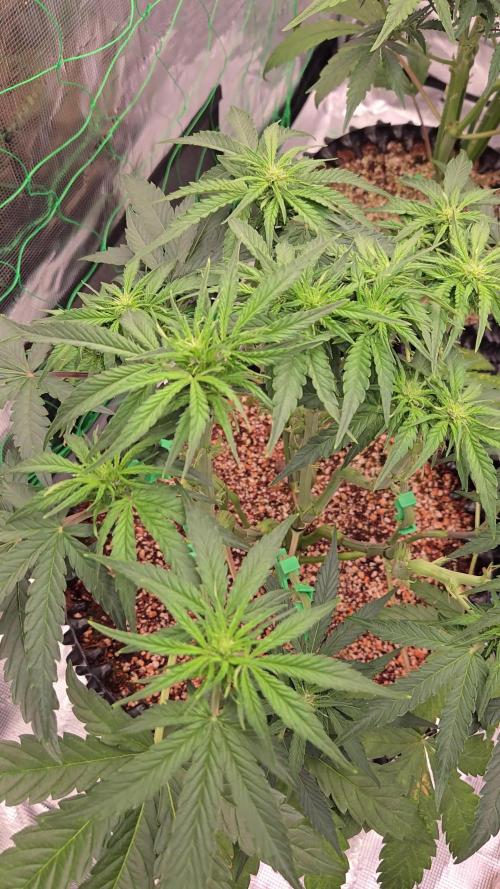
Planta esta reagindo bem ao LST e a poda top que fiz. Sendo automática acredito que mais uma semana começa a floração. Por enquanto mantive o fertilizante de vegetativo.
Likes
31
Share
Welcome to 📅 Day 22 of veg 4/5/2021 and boy am I happy with the growth on the girl under the MH TS1000 she is growing fast and strong and that's just what I want to see later today I will be mixing a new batch of nutes but that's about it Update 📅 Day 25 of veg 4/8/2021 she is still growing very fast under the TS 1000. I have done some more LST as she grows. I have noticed some problems in the leaves but it is very little and I hope it will not get worse only time will tell. Happy growing and keep your stick on the ice 🏒
Processing
Likes
31
Share
@Sider79
Follow
Some Faded bottom leaves . Temps are lower . Not sure if my questions are seen but moving forward with my first Auto Blow Dream grow.
Likes
18
Share
Week 14 water change Wednesday 3/6/20 Last (3 weeks) ph5.3 ppm1050 New 100L ph7.1 ec0.2/ppm100 22c 20ml sil ph9.2 ec0.3/ppm150 22c Roots 150ml ph8.8 ec0.3/ppm150 Ph dwn 6ml ph5.9 ec0.3/150ppm 22c B1 600ml (6ml/l) ph5.6 ec/650ppm 22c A1 600ml ph5.6 ec/1000ppm 23c Thursday 4/6/20 ph5.9 1050ppm 23
Likes
45
Share
My homework. Rubisco regeneration is intrinsically linked to nitrogen supply because Rubisco is a major sink for nitrogen in plants, typically accounting for 15% to over 25% of total leaf nitrogen. The regeneration phase itself consumes nitrogen through the synthesis of the Rubisco enzyme and associated proteins (like Rubisco activase), and overall nitrogen status heavily influences the efficiency of RuBP regeneration.Structural Component: Nitrogen is an essential building block for all proteins, and the sheer abundance of the Rubisco protein makes it the single largest storage of nitrogen in the leaf. Synthesis and Activity: Adequate nitrogen supply is crucial for the synthesis and maintenance of sufficient Rubisco enzyme and Rubisco activase (Rca), the regulatory protein responsible for maintaining Rubisco's active state. Nitrogen deficiency leads to a decrease in the content and activity of both Rubisco and Rca, which in turn limits the maximum carboxylation rate, Vmax, and the rate of RuBP regeneration Jmax, thus reducing overall photosynthetic capacity. Nitrogen Storage and Remobilization: Rubisco can act as a temporary nitrogen storage protein, which is degraded to remobilize nitrogen to other growing parts of the plant, especially under conditions of nitrogen deficiency or senescence. Nitrogen Use Efficiency (NUE): The allocation of nitrogen to Rubisco is a key determinant of a plant's photosynthetic nitrogen use efficiency (PNUE). In high-nitrogen conditions, plants may accumulate a surplus of Rubisco, which may not be fully activated, leading to a lower PNUE. Optimizing the amount and activity of Rubisco relative to nitrogen availability is a target for improving crop NUE. Photorespiration and Nitrogen Metabolism: Nitrogen metabolism is also linked to the photorespiration pathway (which competes with carboxylation at the Rubisco active site), particularly in the reassimilation of ammonia released during the process. To increase RuBisCO regeneration, which refers to the process of forming the CO2 acceptor molecule Ribulose-1,5-bisphosphate (RuBP) during photosynthesis, the primary methods involve optimizing the levels and activity of Rubisco activase (Rca) and enhancing the performance of other Calvin-Benson-Bassham (CBB) cycle enzymes. Biochemical and Environmental Approaches: Optimize Rubisco Activase (Rca) activity: Rca is a crucial chaperone protein that removes inhibitory sugar phosphates, such as CA1P (2-carboxy-D-arabinitol 1-phosphate), from the Rubisco active site, thus maintaining its catalytic competence. •Ensure optimal light conditions: Rca is light-activated via the chloroplast's redox status. Adequate light intensity ensures Rca can effectively maintain Rubisco in its active, carbamylated state. •Maintain optimal temperature: Rca is highly temperature-sensitive and can become unstable at moderately high temperatures (e.g., above 35°C/95F° in many C3 plants), which decreases its ability to activate Rubisco. Maintaining temperatures within the optimal range for a specific plant species is important. •Optimize Mg2+ concentration: Mg2+ is a key cofactor for both Rubisco carbamylation and Rca activity. In the light, Mg2+ concentration in the chloroplast stroma increases, promoting activation. •Manage ATP/ADP ratio: Rca activity depends on ATP hydrolysis and is inhibited by ADP. Conditions that maintain a high ATP/ADP ratio in the chloroplast stroma favor Rca activity. Enhance Calvin-Benson-Bassham (CBB) cycle enzyme activity: The overall rate of RuBP regeneration can be limited by other enzymes in the cycle. •Increase SBPase activity: Sedoheptulose-1,7-bisphosphatase (SBPase) is a key regulatory enzyme in the regeneration pathway, and increasing its activity can enhance RuBP regeneration and overall photosynthesis. •Optimize other enzymes: Overexpression of other CBB cycle enzymes such as fructose-1,6-bisphosphate aldolase (FBA) and triose phosphate isomerase (TPI) can also help to balance the metabolic flux and improve RuBP regeneration capacity. Magnesium ions, Mg2+, are specifically required for Rubisco activation because the cation plays a critical structural and chemical role in forming the active site: A specific lysine residue in the active site must be carbamylated by a CO2 molecule to activate the enzyme. The resulting negatively charged carbamyl group then facilitates the binding of the positively charged Mg2+ion. While other divalent metal ions like Mn2+ can bind to Rubisco, they alter the enzyme's substrate specificity and lead to dramatically lower activity or a higher rate of the non-productive oxygenation reaction compared to Mg2+, making them biologically unfavorable in the context of efficient carbon fixation. The concentration of Mg2+ in the chloroplast stroma naturally increases in the light due to ion potential balancing during ATP synthesis, providing a physiological mechanism to ensure the enzyme is activated when photosynthesis is possible. At the center of the porphyrin ring, nestled within its nitrogen atoms, is a Magnesium ion (Mg2+). This magnesium ion is crucial for the function of chlorophyll, and without it, the pigment cannot effectively capture and transfer light energy. Mg acts as a cofactor: Mg2+ binds to Rubisco after an activator CO2 molecule, forming a catalytically competent complex (Enzyme-CO2-Mg2+). High light + CO2) increases demand: Under high light (60 DLI is a very high intensity, potentially saturating) and high CO2, the plant's capacity for photosynthesis is high, and thus the demand for activated Rubisco and the necessary Mg2+ cofactor increases. Mg deficiency becomes limiting: If Mg2+ is deficient under these conditions, the higher levels of Rubisco and Rubisco activase produced cannot be fully activated, leading to lower photosynthetic rates and potential photo-oxidative damage. Optimal range: Studies show that adequate Mg2+ application can enhance Rubisco activation and stabilize net photosynthetic rates under stress conditions, but the required concentration is specific to the experimental setup. Monitoring is key: The most effective approach in a controlled environment is to monitor the plant's physiological responses e.g., leaf Mg2+ concentration, photosynthetic rate, Rubisco activation state, and adjust the nutrient solution/fertilizer to maintain adequate levels, rather than supplementing a fixed "extra" amount. In practice, this means ensuring that Mg2+ is not a limiting factor in the plant's standard nutrient solution when pushing the limits with high light and CO2. Applying Mg2+ through foliar spray is beneficial to Rubisco regeneration, particularly in alleviating the negative effects of magnesium (Mg) deficiency and high-temperature stress (HTS). While Mg can be leached from soil, within the plant it is considered a mobile nutrient, particularly in the phloem. Foliar-applied Mg is quickly absorbed by the leaves and can be translocate to other plant parts, including new growth and sink organs. Foliar application of: NATURES VERY OWN MgSO4 @ 15.0g L-1 in a spray bottle. Foliar sprays are often recommended as a rapid rescue measure for existing deficiencies or as a supplement during critical growth stages, when demand for Mg is high. Application in the early morning or late evening can improve absorption and prevent leaf burn. The starting point [of creativity] is curiosity: pondering why the default exists in the first place. We’re driven to question defaults when we experience vuja de, the opposite of déjà vu. Déjà vu occurs when we encounter something new, but it feels as if we’ve seen it before. Vuja de is the reverse—we face something familiar, but we see it with a fresh perspective that enables us to gain new insights into old problems.
Likes
5
Share
Ab der 3. Woche wurde die Pflanze nicht mehr besprüht und so die relative Luftfeuchtigkeit auf ca. 45-50 % gesenkt. 💧 Der Basis Dünger Sensi Grow von Advanced Nutriens wurde nochmal um 0,5ml erhöht. Wahrscheinlich die letzte Düngung für das Wachstum .. mal sehen wann die Vorblüte erscheint 😃🌱
Likes
13
Share
All are cruising along now. Three are vegging in 3.9 pots, one (Euphoria) is flowering ON the autopot system and one (or two?) Divine Indica is still in the 1 gallon for now.
Likes
9
Share
📆 Semana 3 El stretch llega a su fin y las plantas comienzan a concentrar su energía en el desarrollo floral. La estructura formada durante las semanas anteriores queda bien establecida, con múltiples puntas bien expuestas y una copa uniforme que aprovecha eficientemente la luz disponible. Los grupos florales empiezan a ganar tamaño y densidad, mientras los pistilos se multiplican en todos los puntos de crecimiento. Durante esta semana se introduce Bloom Booster para acompañar el inicio de la fase de engorde y favorecer una formación floral más intensa. ⚡ EC: 1.6 💧 pH: 6.2–6.5 🌡️ Agua: 21°C 🌫️ Humedad: 40–45% 💡 Intensidad: 900–1000 PPFD 🔥 Nota: La tercera semana marca el comienzo del desarrollo floral activo. Una nutrición equilibrada y la incorporación de potenciadores de floración en este momento ayudan a maximizar el número y tamaño de los futuros cogollos. Seguimos creciendo fuerte 💪!
Likes
23
Share
@cadur
Follow
LSTd Mr Squatty. He so very small, decided he's a "he" even though he's not. Growth all-be-it slow is very even, like a well made bed. As long as it's slow I'm okay to wait but all in, it will do what it's gonna do.
Likes
25
Share
@Kakui
Follow
Veg15, han crecido como 2 centímetros desde el transplante, aún no necesitan riego, desde ahora regaré cada 3~4 días, cuando el sustrato este un 80~90% seco, han estirado un poco desde que subí la distancia del LED y bajé su intensidad, mañana haré Main Lining. Veg16, hoy se torturaron las plantas con Main Lining, se cortó arriba del segundo nodo y se cortaron también las hojas de un dedo bajo el primer nodo, las plantas que tenían suficiente crecimiento de les hizo LST también, cuando se apague la luz se efectuará un spray foliar con B-52, y mañana un nuevo riego. Veg17, riego con 5.5 pH y EC 1.8~1.9, se regaron con 1.5 litros y no se obtuvo drenaje, próximo riego tendrá que ser con más cantidad de agua para obtener drenaje, el agua se calentó a 23 grados y se oxigenó antes de regar, mañana se ajustará el LST ya que siguen creciendo muy bien. Veg18, hoy solo se ajusto el LST, siguen creciendo bien. Veg19, ajuste de LST, nada más que anotar. Veg20, siguen creciendo, talvez hay que ajustar la cantidad de luz DLI. Veg21, tuve que poner una estufa para aumentar la temperatura en el indoor y bajar la intensidad del LED a un 50% para alcanzar un DLI óptimo. Hoy haré ajuste de LST y revisar la humedad del sustrato.
Processing
Likes
Comments
Share
Dear Grow community, The three RG automatic have grown very well and have so far no complaints. They love the temperature and dont need much water. They have grown very fast and already have a light smell.
Processing
Likes
9
Share
Likes
1
Share
@Pestitel
Follow
Amazing experience with the Mix Pack, I will try it again next summer for sure. Love the variety.
Likes
7
Share
3º SEMANA DE FLORACION -DE LA 2º SEMANA A LA 3º -''LA PODA'' DE LOS 21 DIAS
Likes
3
Share
I got some dark brown spots on the leaves after vita race , connected plagron and they told me I can spray it better in the morning as evening so the plant can absorb all the nutritions