


Likes
13
Share
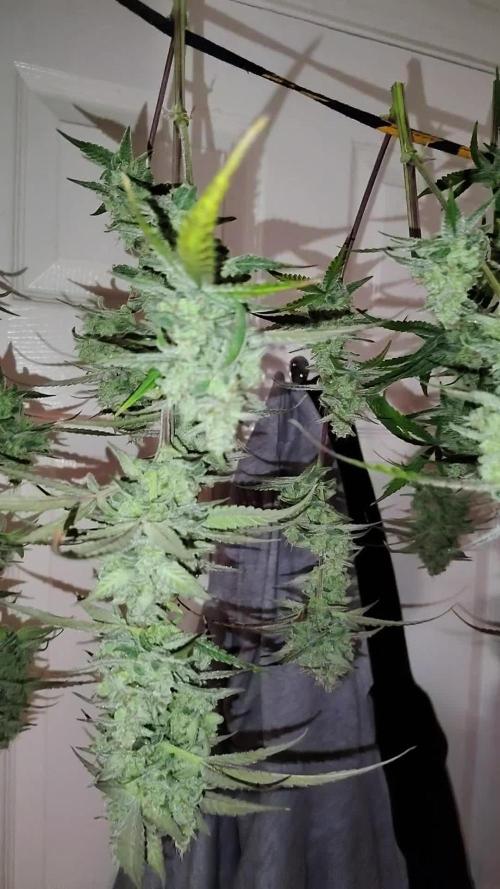

@Scottydarkmoonbuds
Follow
Honestly this was a really great grow the only thing I had an issue with is foxtailing on the main top kola but that's because I couldn't raise the light anymore lol but all the other buds knuckled perfectly and are wonderful.

Likes
12
Share


@Cooky_420L
Follow
10' sem de flo... 70' jours ,, Ayez 2 plantes sont prête à être coupé A2 et B1 d'ici un à deux jours..
Suivra A1 dans une semaine et B2 sera la dernière.
Dommage que je sais pas quoi comme variétés , j'espère qu'elle sera bonne 🧘♂️🌞
Bonne continuation à vos projet les p'tites ✋️ vertes 🌱🌞🌱🌱
Likes
45
Share


@Ultraviolet
Follow
"Mens Dei"
What can be made to expand, airy and loose, can also be made to contract, dense and tight.
Trichomes do not discriminate, although we like to think of trichomes' primary purpose as being to get us high; they are there to provide photoprotection (sunscreen). Trichomes apply themselves based on area dimensions; the more area = the more trichomes in order to protect. Different from density: Trichomes, the resinous glands on plants, are often produced in response to stress, including high light intensity. This increased production can lead to denser trichome coverage on the plant, stress, stress, stress, stress is the signal. There is a certain beauty in watching the large water-filled buds once swollen to the brim slowly shrink during drying, as the surface areas contract, the trichomes just cluster up to form denser and denser coatings, already dense from high light intensities, UVB exposure, and IPS, and every other stressor I could tweak. Trichomes, the resinous glands on cannabis plants, are often produced in response to various forms of stress. These stresses can be environmental, like excess light(HIL) or UV-B radiation, temperature fluctuations, or drought, or mechanical, such as wind, pruning, or even the weight of the plant's own buds. The plant reacts to these stressors by increasing trichome production as a defensive mechanism to protect itself and its valuable compounds like THC and CBD. In essence, cannabis plants perceive stress as a threat and respond by producing more trichomes as a way to protect themselves and their valuable compounds. Several studies have shown this. Not so much a "master" grower as a master of stress.
Psssst.
Trichomes fill with "antioxidants," including THC.
Ant"ox"idants,
The production of antioxidants in plants is intricately linked to their oxidative apparatus.
The plant has limited oxidative capacity/apparatus. During daytime photosynthesis, a large percentage of that oxidative capacity is tied up in protecting the plant.
During the night, plants alter their metabolic pathways. This leads to a far more focused production of specific antioxidants, like THC. Plants also produce antioxidants during the day to scavenge ROS made from photosynthesis. The differential ROS production by blue and IR light can have significant biological consequences. For example, high levels of ROS induced by blue light can lead to cell damage and death, while lower levels of ROS produced by IR light may be involved in beneficial cellular signaling pathways. Long nights under the IR (very low ROS), the boost in cellular respiration, and the boost in energy production. In a perfect world, I'd give the plant a shock treatment of 60DLI in 4 hours and give her the other 20 hours to perform cellular respiration under IR. The stress of those 4 hours would be rigorous and full of stress abound, 1800-2000ppm CO2 is easy for a couple of hours during daylight, it's maintaining it that's hard, but 4 hours is very doable with nothing but a little extra "carbon sugar" in your medium every other night during the first 4 weeks of flower.
In my opinion, you only need to jack CO2 for those first 4 weeks of flower to see maximal output, after that it's all about trichome preservation, everything else comes second. Without the temps to assist with metabolism, CO2 is reduced to normal levels along with temps 4-5th week of flower.
Buds are primarily composed of water. Developing flower buds, like other plant tissues, require a significant amount of water for growth and turgor pressure, which helps maintain their structure and firmness.
Turgor pressure in plant cells is primarily generated by osmosis, but transpiration plays a crucial role in maintaining it.
The optimal internal leaf surface temperature for photosynthesis at 1800-2000ppm CO2 is likely in the upper range of 97°F, meaning ambient would need to sit at 102°F-ish or thereabout for full metabolic utilization. That's putting your transpirational pulling force x5 x6 maybe x7 of what it would be if she were cruising at 68F.
"My buds won't fatten, what can I do!!"
Crank it. If your purpose was to blow up a balloon as fast as you can, as much as you can, would you use 2x force or x5 Force to do so? Bad analogy, but you get the idea. Kiss.
Optimize photosynthesis & VPD by day, cellular respiration by night.
TECHNICALLY:
"While transpiration and cellular respiration are both ongoing plant processes, they are not neatly separated into day and night. Both processes occur both day and night, though at different rates and with different emphasis. Transpiration, the release of water vapor from plant surfaces, is primarily driven by sunlight and photosynthesis during the day, but it also continues at a lower rate at night. Cellular respiration, which provides energy for the plant, occurs continuously, both day and night. "
A leaf can perform cellular respiration and photosynthesis simultaneously. During daylight hours, plant cells utilize both processes: photosynthesis to produce glucose and oxygen, and cellular respiration to break down glucose and release energy for the cell's needs. The products of photosynthesis (glucose and oxygen) are used as reactants in cellular respiration, while the products of cellular respiration (carbon dioxide and water) can be used in photosynthesis.
The limiting factor is the oxidative capacity; the less a leaf is utilizing photosynthesis, the less oxidative capacity it uses, and the more it can perform cellular respiration.
Even if a leaf is not in an optimal photosynthetic position, it can still utilize respiration to its full capacity during daylight hours. Kinda too much info to explain when some asks if they should defoliate or not, yeah add calmag or some shit.
BUT Only 10% ATP can be processed through photosynthesis and carbon capture.
90% of ATP is processed when the plant's oxidative capacity becomes available (NIGHTTIME). Cellular respiration relies on the process of oxidation to generate energy. Specifically, the final stage of cellular respiration, called oxidative phosphorylation, utilizes oxygen as the final electron acceptor to produce a substantial amount of ATP, the cell's primary energy currency.
Factors such as oxygen concentration, glucose availability and temperature will all impact the amount of aerobic respiration an organism will perform.
See you next grow, *twiddles thumbs*


Likes
4
Share


@Mr_Green79
Follow
Meine Mutter wollte schon immer eine Cannabis Pflanze haben.
Jetzt wo es hier legal ist (Juhu) hat sie eine von mir bekommen.
Die Peanutbutter cookies von Pure Intenso war bis jetzt eine, die am besten wachsene Pflanze bei mir deswegen habe ich mich für diese Sorte entschieden , und weil meine Mum auch sehr gerne Kekse backt... 😁
Mal hoffen das es Ihre Tomaten überleben..
Natürlich bekommt Ihr freund auch noch eine verpasst...
Ich bekomme wöchentliche Bilder von Ihr damit Ich das dann hier rein stelle..
Normale Erde für die Wachstumsphase mit Perlite und Würmer Humus

Likes
33
Share


@Damonkey
Follow
All plants are ready to come down now will be harvested in the next couple of days. As it ends in the tent there’s one Banana one 10th and the skunk Hero in joint position for best looking flowers, I really couldn’t pick between them so I guess all have lots to offer across phenotypes and it really is mostly good. The other banana and -0th are by no means bad oh they’re really nice too. The Genetics surely do pass the test for me. If you want to be sure what you grow will be of decent quality Ethos really are worth a try. Harvest this month will be bountiful, beautiful, aromatic and will fuck you up😉😂 all three had phenos that grew really nice dense flowers, the ones that’ll light up your eyes as you open up your stash pot.


Likes
16
Share


@TheWeedPimp
Follow
A really good plant. Gave a okay yield.
60g dry all covered in resin! Smells really funky little citrus but also very 🧀


Likes
24
Share


@Firepharmer
Follow
Rock hard buds Miicrobialmass for the win and the new led is killer. The knobs like knots grow out of the sides of the buds are something to look at wow !!! Monkey berries is in flushing mode , slurricane won’t be far behind in the next week or 2 I’ll flush


Processing
Likes
33
Share


Processing
Likes
9
Share


@Tokologo
Follow
Day 73, took another batch if clones three days after taking the 2nd batch so now I have 80 clones that will root in 11 to 14 days.
The sun is hot again back to +30C° day temps, I was to lazy to take individual photos of my mother plants.
I'll give the plants 10 days to recover from the stress from taking cuttings.
Day 75, last day in the tent for my mother plants, tonight there going inside boxes for 3 day of darkness so that the plants forget the 18 hrs veg lighting to follow the sun.
2nd batch of clones to veg for a week before going outside to flower.
Mothers in boxes they will come out on the 24th September


Likes
5
Share


@69XINEYESEEKAYX69
Follow
Haven't been remembering to post weekly updates! Everything is going great the auto flower girls are budding nicely and the other ladies are starting to flower nicely I'm giving alternating nutrients using a few different fox farm nutrient feed charts with my own take on them from notes an suggestions. This is the part that is so enjoyable but so stressful!


