




Likes
8
Share


@Kitties_and_Colas
Follow
We decided on Pineapple Express (by Grower's Choice) as our summer strain this year, we veg anything going outside under 16hrs ..We only get 15hrs at peak light(Far North/East, Canadian border) and this prevents any pre-flowering and possible revegging downtime. We're going to flower 4 plants indoors ASAP (to ensure we don't run out )and bring 3 out to the field in about 2-2.5 months...

Likes
33
Share


@NuggetPawn
Follow
Howdy,
This week has gone well, plant seems healthy with no noticeable deficiencies. My res leaked because a tube I had in the back was in the wrong place but all is sorted now. Thinking it was a crack in the tub, I drained it... So I had to replenish with a new set of nutes which I'm going to drag out for another 5/6 days.
PPM's are steadily dropping and PH is increasing so shes definitely ready for a richer feed.
Also learned about different TDS with the whole 0.5/0.7 conversion rate.
When topping for the 3rd time, I was a little too rough with one of the colas and it snapped without me realizing. I noticed about 2 hours later by which time it had already dried out a bit, its still alive but the growth is stunted.
Added a bit of PK as I noticed a few fan leaves had purple stems, cleared up within 2 days and back to lime green 🙃🌱
Update 22/08 - Day 30 from Sprout.
Changed out res as PH kept dropping and leaves started to go very slightly yellow. New nodes are already growing well, 3 times bigger than 2 days ago.
I think I'm going to flip on or around the 6th of September, which means a total of 45 days veg, or 6 and a half weeks. Next couple of weeks will just be about pruning lower leaves and some HST/LST. Might get a scrog net, tried using a tomato hoop but the one I have is shit...
Going well so far anyway!

Likes
7
Share

@DogDoctorOfficial
Follow
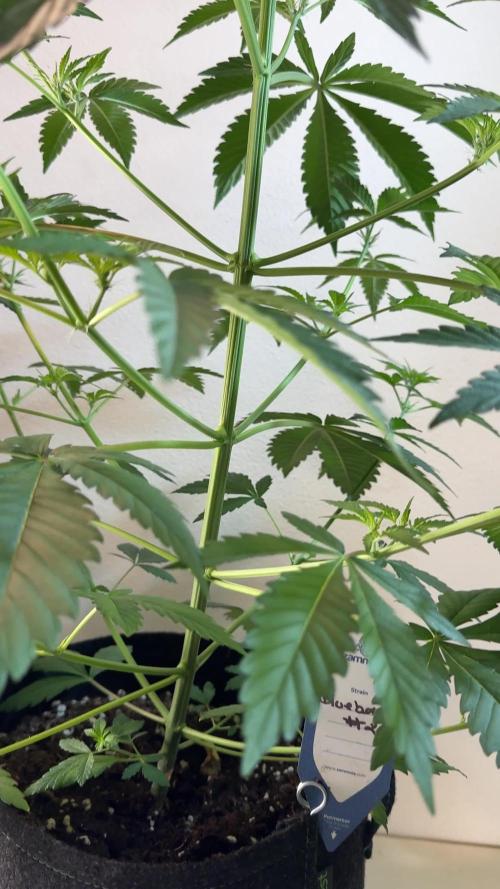
🌺 Week 1 Flower – Full Speed Into Bloom
Grower’s Journal – BlueBerry by Zamnesia Seeds | Entry 006
The shift has begun, and our BlueBerry girls didn’t wait for permission.
By the end of the week, they were already showing pistils popping and bud sites forming, not just the promise of flowers, but flowers beginning to shape up already.
We’re still in what some would call pre-flower, but let’s be honest:
These girls are on the move.
⸻
🌱 Structure, Height & Symmetry
Both girls are clocking in around 57 cm, with near-mirror symmetry in structure and development.
Their growth is tight, lush, and beautifully balanced, like they were clones of each other.
📣 Shout out to Zamnesia
This is what great genetics look like.
Stability, vigor, and uniformity that shows their heritage proudly.
⸻
🌍 Genetic Roots – A Quick Nod to the Legend
We touched on it before, but it’s worth a reminder, BlueBerry is more than a name. It’s a landrace-influenced legend, blending Thai, Afghan, and Purple heritage into a profile that’s nostalgic, rich, and full of stories.
This isn’t just a plant.
It’s a revival of history, growing in a modern tent.
⸻
Nutrient Transition – Start Booster Out, Top Booster In
As we move into flower, we’ve adjusted the feeding plan accordingly:
🌼 Current Feed (per liter):
• Regulator – 0.15 ml
• CalMag Boost – 0.25 ml
• 💧 All-in-One Liquid – 1 ml
• Top Booster – 0.25 ml (NEW this week)
Why Top Booster now?
Because with bud sites forming, we’re shifting the nutrient profile to support:
• Phosphorus + Potassium demands
• Bloom hormone signaling
• Tight flower stacking
It’s a small change, but the timing is everything.
And the girls are loving it.
⸻
Environmental Stats – Riding the Heat Wave
• Room Temp: 31°C
• Humidity: 50.3%
• VPD: 2.23 kPa
Yes, it’s a little high—but we’re monitoring closely.
Plants are adapting well, leaves are still perky and expressive, and the structure remains lush.
✅ Coming soon:
AC unit incoming to help dial this environment into a more stable and optimal range. Until then, the genetics are showing great resilience.
⸻
💨 Airflow, Extractions & Gear Overview
Even with summer heat, airflow remains dialed:
• Exhaust:
• 6” Spider Farmer inline with carbon filter — managed via Spider Farmer GGS Controller
• 6” AeroFan inline with carbon filter — connected to TrolMaster Tent-X
• Intake:
• 6” fresh air intake, passive-cooled and filtered
• 💡 Lighting:
• Black Series 600 LED (Zone 1)
• ThinkGrow Model One LEDs (Zone 2)
Both managed by TrolMaster ecosystem, alongside:
• 🧠 CO₂ Sensors
• Temp/Humidity Probes
• 💡 PPFD Sensors for real-time light data
📹 Video Room Tour Available
We’ve uploaded a generic grow room tour this week, showcasing the entire grow setup, including gear, layout, controllers, and environment flow.
⸻
🌸 What’s Next – Stretch & Structure
We expect:
• Stretch to continue in the next 10–14 days
• Node stacking to tighten
• Early trichome shimmer possibly appearing toward Week 2–3
This is a critical window for:
• Monitoring internode spacing
• Light height and spectrum adjustment
• Fine-tuning VPD as flowering kicks into high gear
⸻
🚫 What Not to Expect Yet:
• No defoliation or major training—structure is too delicate right now
• No aggressive boosts—flower development is just beginning
• No topping or stress—focus is now on upward and outward bloom formation
⸻
💬 Final Thoughts – BlueBerries in Bloom
This run has always been about balance:
Classic genetics. Modern precision. Beautiful biology.
With pistils out and the tent full of energy, it’s time to watch this legendary strain write her next chapter.
From landrace roots to LED-powered flower—our BlueBerries are in full stride.
Let them shine. 🌸✨
With love, care, and growing admiration,
Your ever-faithful garden friend
DD (DogDoctor)🌱💚
📲 Don’t forget to Subscribe and follow me on Instagram and YouTube @DogDoctorOfficial for exclusive content, real-time updates, and behind-the-scenes magic. We’ve got so much more coming, including transplanting and all the amazing techniques that go along with it. You won’t want to miss it.
• GrowDiaries Journal: https://growdiaries.com/grower/dogdoctorofficial
• Instagram: https://www.instagram.com/dogdoctorofficial/
• YouTube: https://www.youtube.com/@dogdoctorofficial
⸻
Explore the Gear that Powers My Grow
If you’re curious about the tech I’m using, check out these links:
• Genetics, gear, nutrients, and more – Zamnesia: https://www.zamnesia.com/
• Environmental control & automation – TrolMaster: https://www.trolmaster.eu/
• Advanced LED lighting – Future of Grow: https://www.futureofgrow.com/
• Root and growth nutrition – Aptus Holland: https://aptus-holland.com/
• Nutrient systems & boosters – Plagron: https://plagron.com/en/
• Soil & substrate excellence – PRO-MIX BX: https://www.pthorticulture.com/en-us/products/pro-mix-bx-mycorrhizae
• Curing and storage – Grove Bags: https://grovebags.com/
⸻
We’ve got much more coming as we move through the grow cycles. Trust me, you won’t want to miss the next steps, let’s push the boundaries of indoor horticulture together!
As always, this is shared for educational purposes, aiming to spread understanding and appreciation for this plant. Let’s celebrate it responsibly and continue to learn and grow together.
With true love comes happiness. Always believe in yourself, and always do things expecting nothing and with an open heart. Be a giver, and the universe will give back in ways you could never imagine.
💚 Growers love to all 💚

Likes
35
Share


@ISCA_Abi_In_Da_HOoD
Follow
Im Come back .
Je suis de retour comme Gandalf .
Fillere selam .
Sweet Seed
Mandarine Zikittlez Fast
Strawbery Cola Sherbet Fast
Non game no pain


Likes
5
Share


@Pi_growing
Follow
Tag 29 beginn der Blütenwoche 5
Mir sind die jojos ausgegangen musste etwas mit Draht nachhelfen.
Ansonsten machen sie sich wunderbar einen ganz ganz leichten mag mangel haben vereinzelte Blätter gezeigt also hab ich die dosis auf 13ml pro 10 liter erhöht.
Erst morgen gibt es frisches wasser da war mir noch zu viel drin im Tank das sollen sie erstmal leer machen trinken ja locker 8 liter am tag.
Allmählich kommt einem auf ein leichter Duft entgegen wenn man das zelt öffnet und optisch werden sie auch immer schöner 😁

Likes
22
Share


@bypado_farm
Follow
Day 17:
They are growing well and healthy
Callmag foliar everyday when the lights are off
Day 19:
Watered each plant with 0.4L with nuts
827 ppm, 1759 us/cm, 1.7 EC
Day 22:
Watered each plant with 0.5L with nuts
1010 ppm, 2148 us/cm, 2.1 EC
Did some defoliation and lst aswell


Likes
13
Share


@CanarianGrow92
Follow
Last week of veg for the Fast Version A from super sativa seeds club.
We added 1 more biotabs to the soil, we also added some startrex and some silicium Flash!!
1 more week and we flower both, version A and B

Likes
48
Share


@Northern_Ent
Follow
June 29: looking good at the start of a new week. Hot again and risk of thunderstorms so the plants are up against the house tonight.
Plant has reached lowest of three rungs on the tomato cage and I’m trying to get a few colas to go around on the outside.
July 1: Happy Canada Day. Warm again today with a risk of thunderstorms.
July 2: cool today (about 12 C high) so watered with 27 C water in morning to help keep things growing.
Also topped fourth time to make the 16 cola manifold. This is the best way to shape photoperiod plants…all the work is up front and it produces nice uniform buds that are easy to process during harvest.
Two stems on the piece that broke are healthy but smaller than the others. Should even out with time.
Watered with full nutrient mix.
July 5: looks good. I was gone for a couple of days after the last round of topping and just noticed today that I had done seven and had missed one which has now been dealt with.
Likes
19
Share


@gottagrowsometime
Follow
Really happy with my yield. 70 grams doesn't look it. But adding up 14 plants i nearly push 1400g.. so overall I'm a happy chappy..
Love MSNL. I've lots to hit on their list.
I've another GDP auto going
Thc bomb auto & Purple haze auto. (I've like 6 hazes going atm so I'll run this later)

Likes
33
Share


@EeyoreTheHomie
Follow
DAY 73: The Lucky Charms is just starting to come out of the stunting from potting her up, and should be ready to double in size with the new room and the stretch in early flower. Very excited to see how she transforms. The clone cut I took off the LC has still yet to root, but looks very good, so I'm hoping to get another go at this strain, with more TLC.
Since my flowering room is currently full, I'm still waiting on potting the White Widow up. Since the White Widow is still in veg I've just been LST'ing the hell out of her. And she's been handling it super well. She's a Bondage Queen lol.


Likes
13
Share


@Highguyz
Follow
Going too switch plants too a 48x48x80 with two full spectrum 1000 watt defoliated last night

Likes
15
Share


@Organic473
Follow
Flushing her, she smells amazing. First time growing this girl and she's already one of my favorite. I will not water her for the rest of the week to begin the drying process.

Likes
16
Share


@TerpDaddy
Follow
Things are looking real good now. Blueberry is in full stretch and she’s gonna be a big girl. Grapefruit coming along real nice after early struggles. I am having some issues with light burn on my blueberry, but I think it’ll be alright.
Absolute explosive growth from the blueberry monster this week. She’s up to 43 inch and I’m loving the spacing she has. As you can see, not very much lst going on here, but that’s how I like it.
Grapefruit has been chugging along real nice. Just starting to flower now and she’s a bushy gal. I’m really looking forward to the flowering weeks ahead. I think these two are gonna be pretty.
Likes
6
Share


@dwotTV
Follow
Kicked the Critical Kush out to let the Lemon AK have the tent to itself to finish. Tall, strong, some yellow leaves think it might be a ph issue, flushing a bit and continuing to trim and monitor, it's not widespread and the plant is otherwise healthy.
Did a little trim and LST on day 48 to help it take up the extra space that is suddenly available.
Likes
2
Share


@TEKNOGROW
Follow
CONTEST SWEET SEEDS
SWEET SEEDS
SWEET GELATO
GROWER ADRY
www.teknogrow.it
Instagram @teknogrow


Likes
3
Share


@Kushizlez
Follow
Day 54-64 (June 14th-24th)
(Day 55) I got a good look at all of the plants in the dark and all of them are quite faded out except for black garlic and the blueberries. Running multiple different strains that all feed differently would be a nightmare on a larger scale!
(Day 56) Everything is looking on point and happy. Plants are drinking about a liter of water every 36 hours.
(Day 59) Jack Herer #1 has some of the most wild looking foxtails I’ve ever seen. Not a very desirable trait but it’s cool to grow. It’s smell is pure bliss, it’s now matured to a mango funk. I will do a more in depth look at each strain after dry.
Jack #2 is starting to pop fresh nanners. I think it is from stress due to lack of nutrients and/or heat stress from where it is in the tent. Both jacks are feeding really hard I’ve noticed. If these bananas get any worse I will just harvest early.
Blueberry #1 is developing miniature seeds in its calyx’s and is starting to foxtail like crazy. It almost looks like it’s reveging. Earlier in the season I pulled off an entire bud that was covered in developing seeds but I couldn’t find anymore after that. I will likely find a few bag seeds in this pheno and Jack #2.
Blueberry #2 is still terpless and frostless but it’s really starting to fill into it’s structure now. It’s getting impressively dense but that all it has going for it. This one needs to go 65-70 days at least.
BAOGC #1 is so beefed up and chunky I love it. The main cola will be a good 6 grams and the lowers are thick gram nugs too. I will let this one go until day 65
BAOGC #2 is much smaller but a super hard feeder. It was one of the first to start yellowing. This pheno is pretty average in my opinion. It stacks a little tighter but has small buds
TWOG #1 has this strange velvety look to it’s frost, something I’ve never really seen before. Although it’s a little on the leafy side. It filled out super early and is ready to harvest now. Both are fading out with black streaks on the leaves.
TWOG #2 checks every box for quality so far. This might be the perfect strain and I’m sad I didn’t get a clone of it. The only thing wrong with it is the long trichome stalks and lack of resin heads. It is also an early finisher. I will probably take both TWOGs down on the 21st.
Black garlic is just mouthwatering. This plant literally looks wet with resin. It was super airy at first but slowly filled out to the point it’s one of the denser plants in the tent. Cant wait to smoke this stuff.
(Day 63) Well, every plant in here is looking done except the jacks and blueberry #2. Since I’m harvesting my other tent tomorrow I might as well give everything the chop before I risk bagseeds. I’m going to give a final watering right now and harvest tomorrow. I’m going to be drying in my flower tent kept between 60-65F and 60-65% RH. I will do a full plant hang to extend the dry time for as long as possible.
Guess that’s a wrap then. I will give a detailed breakdown of my errors and final thoughts on the run next week after the dry is completely done. ✌️

