


Likes
Comments
Share


@Growrnotashowr
Follow
Buds are fattening and the smell is a mix of gas, berries and something else funky I cant put my nose on it

Likes
91
Share


@Salokin
Follow
Hi Growmies,
I'm excited to share some big news today! Although there have been some unexpected twists, it's all part of the incredible journey of gardening.
I've just completed the harvest, a tad earlier than initially planned, due to finding a bit of mold in one of the buds. Despite this minor hiccup, the trichomes were already at a decent 10% to 15% amber. So, all things considered, the timing ended up being pretty spot-on. The harvested weight was a solid 609 grams after trimming, which is quite a feat!
A lesson learned for next time: perhaps I let her grow a few too many buds, leading to a denser canopy than ideal. But on the bright side, the aroma is absolutely divine. I sampled an airy bud that had dried a bit, and wow, it packs a stronger punch than its clone mother. And the flavor? Pure, unadulterated cheese – no hint of pineapple here!
Now, the anticipation builds for the final dry weight, which I should know in about 3-4 days. It's always exciting to see the fruits of our labor fully realized.
A huge thanks to everyone who's been following along on this journey. Your interest and support mean the world.
And now, the adventure continues! I've started on Epic Buzz by Anesia Seeds. The diary for this new chapter is up and running, and the seedlings have already sprouted, marking the beginning of another exciting phase.
(https://growdiaries.com/diaries/185718-grow-journal-by-salokin)
I can't wait to share more updates with you all. Here's to the continued growth and learning in our gardening adventures!

Likes
8
Share

@GREENPHOENIX6262
Follow
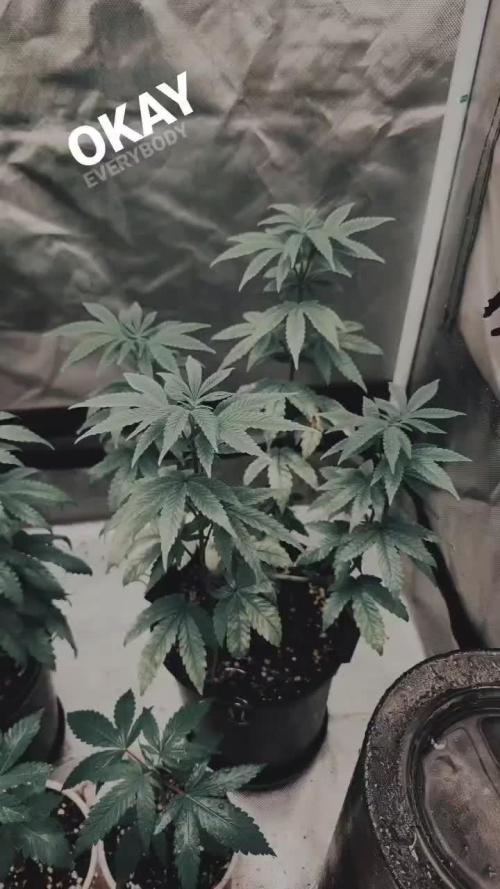
04/19 - They are recovering accordingly after flush - Still has some yellowing but most of their green has returned - transplanting into 5 gallon pots by the end of the week - these will be a short run - No cloning - running as mothers through out the entire grow.
04/26 - Unfortunately these have locked out and are no longer vegging, I will keep the dairy up for research purposes but I will donate these to the fellow grower that runs outdoors.

Likes
38
Share


@PolishFarmer
Follow
Hello! We are in week 7 now. Girls going so well, they looks so happy :) They get more light from yesterday I hang mh ts 600 so all together is 50k lumens now :) So proud of them atm and hopefully will be like that until the end :) how do you like my grow? Let me know what you thinking :) thanks for your attention! Take care guys!
Update Day 45 i found a little dark points on some od the leafs. I recive its cal and mag deficiency. I check soil pH was 5.9 🙈 i rise it up to 6.5 and waiting for results:)

Likes
9
Share


@Scilef
Follow
Daily report:
Day 1.
Watering: NO
Stats:
Humidity: 70%
Temp: 27.2
Notes: I want to see how often should I water Heracles. I fucked up with pH and maybe with watering frequency. I want to fix that. Also set the board to 100%.
Day 2.
Watering: NO
Notes: Defoliation went a bit too aggressive, but it looks fine and I hope that it will help weaker stems to grow faster. I will let Heracles to heal tonight and feed her only tomorrow's morning.
Day 3.
Watering: 5.7 pH 1550 ppm (1.25 l + CalMag) && 5.8 pH 1320 ppm (2.3 l + CalMag) + 5.7 pH 1120 ppm (1.6 l + CalMag) Total 5.15 l => 5.9 pH 1720 ppm (1.25 l)
Notes: This morning pot was completely lightweight and dry. Heracles looks amazing.
Day 4.
Watering: Night - 5.8 pH 1190 ppm 3.5 l (+CalMag) => 6.0 pH 1890 ppm 0.7 l
Notes: New leaves still has yellow marks between veins. I don't know what should I do with that - neither MgSO4 foliar nor CalMag in the mixture helped. Currently 1.5 days is the comfy period for feeding schedule.
Day 5.
Watering: NO
Notes: I found signs of overfeeding (and not only me found that), so next mixture will be less concentrated to let Heracles relax. Also, I bounded all tallest stems to the net to place all the grow spots at the same height.
Day 6.
Watering: Morning - 5.7 pH 761 ppm 4.5 l (0.75% of Base +CalMag + 1 l of plain water) => 6.1 pH 1750 ppm 1.1 l
Notes: I am still trying to create a flat screen of greens. Very excited of flowering stage, it's almost here. But wtf is going on with ppm in drainage?!
Day 7.
Watering: Night - 5.8 pH 1040 ppm 4.0 l (0.75% of Base +CalMag) => 6.0 pH 1930 ppm 0.8 l
Notes: I am run out of a free space in my growbox. Why does not blow starts?

Likes
19
Share


@Organic473
Follow
The pictures speaking for themselves...added some plants that would go to seed after being cross bred with Khalifa Kush. This week onward the girls would be fed black strap molasses for taste and big bud.
Likes
3
Share

@BunnyBud
Follow
Week 3 – Vegetative Stage | Tester Log
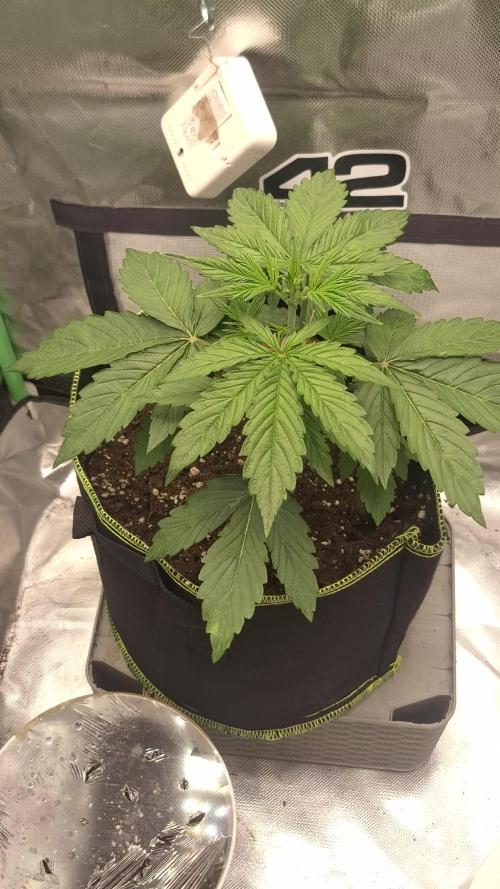
The plant has now entered week 3 of vegetative growth. A light feeding schedule with base nutrients and CalMag supplementation was introduced early to support healthy metabolic activity.
The plant shows good vigor and compact morphology, with short internodal spacing and symmetrical lateral development, indicating efficient light exposure and stable growth. Leaf color is mostly uniform healthy green.
A slight observation: the new emerging leaves show very light yellowing on the tips. At the moment it’s unclear whether this is caused by light proximity or a very mild nutrient excess, but it remains minimal and will be monitored and adjusted if necessary.
The seedling was kept under 12h light during the first week for acclimation, then switched to 18h light, which is currently maintained to optimize vegetative growth.
Overall the Sticky Orange XXL Auto continues to show healthy and stable early development going into the next growth phase. 🌱
Processing
Likes
1
Share


@BloodBath
Follow
Sour wiz came out amazing. Not many problems during her grow. Each pheno came out really different but that’s from my doing. I trained each plant differently to see what the difference would be. Responds really well to stress and training. I can’t tell you in words how great the flowers are. They’re literally coated in trichomes and smell and taste so damn good. Fruity sweet gasoline. Enjoy and thanks everyone who looks and follows.0


Likes
48
Share


@CrazyHorse
Follow
So girls look amazing, A.N.Q. will be ready in time of a week for A.L.K. it is 3,5 week more to harvest.
If you like my effort hit a button and start Follow Me !! :D
Likes
52
Share


@Ultraviolet
Follow
The cannabis strain Grape Guava can be a purple strain, depending on its specific phenotype and genetic makeup. While not all phenotypes of Grape Guava are purple, some variations, such as the Zatix Grape Guava, are noted for their striking purple appearance due to the genetic expression of anthocyanin pigments.
https://www.youtube.com/watch?v=cKdVmdoKJ5k
In a garden of green, Grape Guava gleams,
With its fruity aroma, enchanting dreams.
Clusters of grapes, guava's sweetness ignite,
A strain so divine, in purple and white.
Euphoria whispers, a lush fruity haze,
Grape Guava's embrace, a tranquil daze.
Off and away.@1400ppm. The increased CO2 allows plants to thrive at higher temperatures, which in turn necessitates higher humidity to maintain the ideal VPD for healthy growth and transpiration. 80F -5F = 75F LST with 70% RH = 0.72 kPa. Higher temperatures and humidity promote rapid growth, nutrient uptake, and photosynthesis while maintaining a lower stress level. Temperature influences the rate of enzymatic reactions involved in aerobic respiration. Enzymes, such as those involved in glycolysis, the Krebs cycle, and the electron transport chain, work most efficiently at an optimal temperature range. In low temperatures, enzymatic activity will slow down, thus reducing the rate of aerobic respiration. In high temperatures, enzymes can become denatured, thus impairing their function and stopping the process of aerobic respiration. Glucose is the primary fuel for aerobic respiration. The rate of aerobic respiration increases with the availability of glucose, as it is the starting point for glycolysis. If glucose levels are low, cells may rely on alternative energy sources such as fatty acids or amino acids , but these processes may yield less ATP or be less efficient. To determine this effect, carbon dioxide volume was measured (as carbon dioxide is an output of aerobic respiration)
18/6 with the 6 being IR. The near infrared (IR-a) borders around 700nm up to 1400nm @ photon par flux density of 1.8 instead of darkness, keeping temps overnight a neat 77F-80F.
Think of my tent as a lung. What goes in must come out. When the rate of air going out exceeds the amount of air coming in, it creates a negative pressure. Tent concaves (bends in). If set up correctly, your RH will begin to drop slowly to the desired level you set, and the extraction turns off when it reaches desired% RH. The plant, as it performs cellular respiration, will always be releasing more water into the air, so the RH% of the tent overnight will always increase, so long as oxidative phosphorylation is occurring. As soon as the RH% creeps back up to 55%, the extraction turns back on, over and over. This creates a strong pressure differential which will work wonders on your grow. Replicating high and low-pressure fronts in nature. Critical for oxygen diffusion at the critical time of peak cellular respiratory function..
Moisture will not transfer from a saturated atmosphere to another if that air is already at or above its saturation point, meaning the air can't hold any more water vapor. Once I understood that water is produced as a by product during cellular respiration, specifically at the very end of the electron transport chain (ETC) where electrons are finally transferred to molecular oxygen, the higher the RH of the air, the more resistance there is for more moisture to be added to that environment, and effects the ease with which it does so. But none of that water comes from the pot; it's pulled from the air. If you run high daytime RH, your medium/pot is 100% reliant on transpirational root pull to move water. ZERO evaporation happens across the atmosphere if the tent air has high RH%, the medium cannot release its water through evaporation. Once a canopy develops, light no longer slowly wicks and evaporates from the topsoil. The Soil-Plant-Atmosphere Continuum (SPAC) describes the continuous pathway and process of water movement, driven by a gradient in water potential, from the soil, through the plant's roots, stem, and leaves, and finally evaporating into the atmosphere through transpiration. There is evaporation, there is transpiration, and then there is evapotranspiration; Evapotranspiration (ET) is the combined total of two processes: evaporation (water lost directly from soil and surface water into the atmosphere) and transpiration (water released from plants to the atmosphere through their leaves). Evapotranspiration represents the total amount of water that moves from the medium into the air. There is no such thing as a medium with too much water, only a medium that retains too much for too long.
The water must always flow efficiently from one atmosphere(Medium) to another(Air) in a timely manner. Moisture is a critical factor for bacterial growth and decay. Dictating how long it's allowed to sit in any one location for any given period is a key preferred control. To ensure a net reduction in a bacterial population, the rate of removal (ET) must exceed the rate of bacterial growth (decay rate), which is often modeled as a growth rate for the specific bacterium under the given conditions. By optimizing daytime VPD, we also optimize conditions for bacterial growth to explode exponentially above 77°F.. If water is allowed to sit in a medium without an escape within a timeframe, nothing good will happen. IF High RH is maintained overnight as well as during the day, placing 100% of water movement at the behest of daytime transpiration, roots can only pull where they can reach, and if soil is compressed above a certain point, moisture will become trapped in a medium with no way of moving day or night. This will begin the countdown for decay to take hold. When water stagnates in a medium, it loses oxygen, creating anaerobic conditions that foster the growth of harmful microorganisms like bacteria and fungi, which can produce toxins and disease vectors.
Thigmomorphogenesis, the process by which plants respond to mechanical stimuli like touch by altering their growth and development, results in significant morphological changes to improve survival against mechanical perturbations. This complex response involves sensing touch and initiating physiological and genetic responses, leading to changes in form and structure over days or weeks. The process is triggered by physical forces such as wind, rain, or touch. Plants adapt to these stimuli by changing their shape and structure, which may include slower growth, thickened stems, or altered leaf development. Plants possess sophisticated mechanisms to detect even subtle mechanical stimuli and initiate responses. A variety of molecules, including calcium ions, jasmonates, ethylene, and nitric oxide, are involved in signaling these mechanical inputs. Touch can induce the expression of genes that encode proteins for calcium sensing, cell wall modification, and defense mechanisms. A plant exposed to constant wind may become shorter and sturdier. A plant that is touched frequently might grow more slowly to conserve energy and develop thicker cell walls. These changes increase a plant's resilience and ability to survive in harsh environments.
Let's get Thiggy with it.
Likes
6
Share


@Rockymountainhigh
Follow
Oh baby there she goes making resin. She is growing at 7000ft the sun is strong and windy. She is a beast and I hope she is going to turn red/purple.

Likes
1
Share


@maxpain
Follow
Week was great buds getting bigger smell getting stronger .this pic is last day before week 8 .. so much Trichromes....😍😍.... 🐐


Likes
16
Share


@BudsBanditUK
Follow
What can I say. She has gone from smallest to biggest plant in the tent. So many baby buds on her. She is now starting to smell nice. This plant has grown totally naturally without any training at all. She look briliant.
Likes
14
Share


Likes
9
Share


@DeepRootsGrowTrees
Follow
KICKASS AUTO by KANNABIA
Week#7 May 14th-21st
Week #2 Flower
This week she stretched about 2 inches she's right at 19 inches she also continues to grow side branches she really a nice looking bushy plant. Dark green color trichomes are starting to form on her buds and leaves and she's starting to fill in you can see the white hairs and start off little buds on her. She is doing great outside!! Stay Growing!!
Kannabia.com Kickass Auto

Likes
2
Share


@Albanymedicinalgarden
Follow
Everybody is looking happy and healthy. Applied cover crop to Glueberry OG and regret not doing the rest now. No signs of stress

Likes
6
Share


Likes
7
Share


@TheNotoriousWeed
Follow
Esta es la segunda semana cambia a las bases de la floración y las chicas se comportan de manera exelente ya han sexado todas. Saludos y buena semana colegas


