Likes
Comments
Share
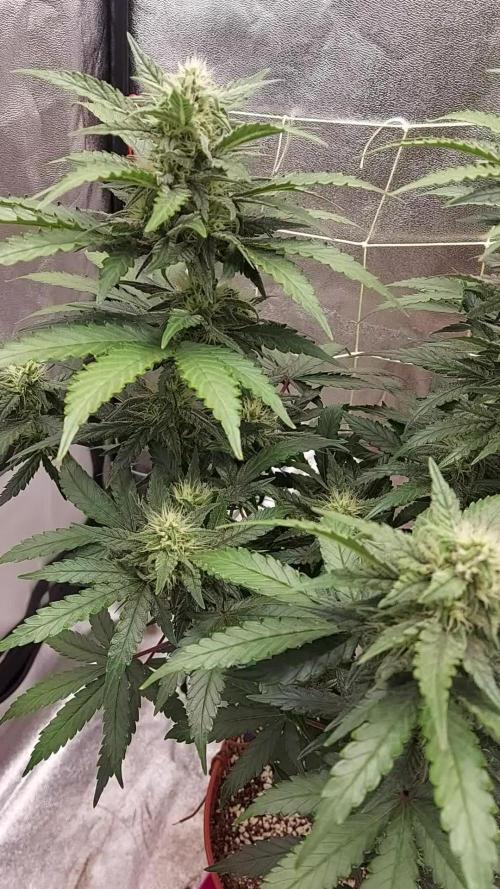
Eccoci qui... Finalmente dopo uno stop per il lavoro torno ad aggiornare il diario con il capitolo finale... Su questa genetica ho voluto mettere de bimbe e sono rimasto veramente strabiliato dalla stabilità e similarità che hanno avuto tra di loro, le cime sono di un altro pianeta con questi pistilli che esplodono formandone altri in maniera verticale davvero molto bella!! Grazie ad Anesia Seed e ad Xpertnutrients per la collab e a tutti per il supporto🔥🌲❤️ NE VERRANNO DELLE BELLE
Processing
Likes
5
Share
(Bloom test week) I decided to put both plants into bloom to determine the sex of each one. The Right hand plant was a Male (sad times) the left plant however is a winner and is looking super healthy , i have now switched the lights back into veg at the end of this week, aiming for another 3-4 weeks of veg.
Likes
35
Share
Who’s got it @chedderbob112 chedders Fukin got it 😎🏴󠁧󠁢󠁳󠁣󠁴󠁿112
Likes
9
Share
@Roberts
Follow
Mintz Runtz automatic has been growing great up until the last 2 days she showed some spotting on the leaves. I did a solution change today. So that should be resolved. I will also be adding the Elufah Saturn 240 under canopy light when she starts stretching. I did lst the top several days ago. The plant is growing very compact at the moment. Hopefully she stretches out and fills the tent by the end. Thank you Spider Farmer, Spliff Seeds, and Elufah. 🤜🏻🤛🏻🌱🌱🌱 Elufah (Power by Growpros solutions) UAP1500,Die-cast radiator and featuring an optical lens design(Uniform PPFD),150W,PPE3.0μmol/J,PPFD1500umol/s/m²,Use the verified commercial-grade spectrum;Full/Epar Boost Spectrum adjustable,A very excellent grow light; By entering the discount code, you can enjoy an additional 10% price reduction when making the purchase. Amazon discount code:SAVEURCASH10 product Link:https://a.c1ns.cn/uap1500 Thank you grow diaries community for the 👇likes👇, follows, comments, and subscriptions on my YouTube channel👇. ❄️🌱🍻 Happy Growing 🌱🌱🌱 https://youtube.com/channel/UCAhN7yRzWLpcaRHhMIQ7X4g.
Likes
7
Share
@darcness
Follow
Substantial growth in the roots. Should hit flower in the next week or two.
Likes
10
Share
Saw some excellent lateral growth from their branches in the last week. Been removing fan leaves from main stem to allow meristems to grow more. I was using kelp in a foliar to induce apical dominance but have since removed it from the girl's regimin with the hopes of flowering beginning soon.
Likes
20
Share
Not particularly growing for speed or any dedicated reason this time round, just adding water and a abundande of positivity, gotta admit I do like the autoseed logo. Off we go again into the magical forest. (Arthrospira platensis) cultivated in high-alkaline, mineral-rich water in Kailua-Kona, Hawaii. It is renowned for having a higher nutrient content, including more carotenoids and essential fats, compared to other spirulina brands. It is frequently cited as a "complete food" due to its dense concentration of proteins, vitamins, minerals, and pigments. The nutritional profile of standard dried Spirulina platensis biomass. 3kg of spirulina powder has an approximate NPK ratio of 10-2-1 (or 10% Nitrogen, 2% Phosphorus, and 1% Potassium). Here is the breakdown of the nutrient content for 3kg of powder: Nitrogen (N): ~300g (10% of total mass) Phosphorus (P): ~60g (roughly 2% of total mass) Potassium (K): ~30g (roughly 1% of total mass) 3kg of spirulina powder is more than enough nitrogen for 4 cannabis plants in a 100-gallon pot—in fact, it is likely excessive and could cause severe nutrient burn or toxicity if not properly managed. Spirulina has a very high protein content (46% to 63% dry weight), which translates to a significant nitrogen source. It is often described as a 5-1-1 NPK fertilizer. 3kg (3000g) of powder in 100 gallons means 30g per gallon. General organic recommendations for potent amendments (like frass) are often around 1–3 tablespoons per gallon. 30g of powder is roughly 2-3 tablespoons, making this a very high-strength application rate if added all at once. Balance this with calcium/magnesium, and organic nutrient delivery in soil growing can lead to deficiencies in these nutrients. Not all of that 100 gallon is used, so figuring out precise measurements was ballpark, but there is about 10kg of engineered biochar in that pot. Mostly in the top half. Ideally, I'd have 25kg in a full active 100-gallon, but......... don't mess with something that is not broken. Roots do not utilize the entire 100 gallons. This has been a couple of years of trial and error, mostly error. The amount of cations you can add in grams depends entirely on the specific cation exchange capacity (CEC) of your biochar and the type of cation being added. Biochar CEC values vary widely, typically ranging from 4 to over 300cmolc/kg. Multiple Biochars in use, ranging upwards of 100cmolc/km. Different cations have different atomic weights Potassium K+ 39.1g/mol. Calcium Ca2+ 40.1g/mol. Magnesium Mg2+ 24.3g/mol. Nitrogen NH4+ 18.04g/mol. You get more nitrogen bang for your buck. It all depends on the CEC of the biochar you use, but brrrrrrrrrr roughly I'm looking at 500-600 grams worth of elemental cation exchange capacity, give or take. That's just for the biochar alone. Elemental cation exchange capacity refers to the ability of materials—such as soil, minerals, and biochar to adsorb, hold, and release positively charged ions Ca2+, Mg2+, K+, Na+, Al3+, and Zn2+. This capacity is a critical measure of nutrient availability in soil and energy density in electrochemical systems. Added calmag 2:1 to complement spirulina. Calcium (Ca): Approximately 150g - 300g of elemental calcium. Magnesium (Mg): Approximately 75g - 150g of elemental magnesium. So long as pH stays in 6.3 to 6.7 ish, the plant will unlock hydrogen. Plants will be able to cycle CEC for their own needs. Hydrogen ion pumping (proton pumping) is a fundamental mechanism used by plant roots to facilitate the cycling of nutrients within a medium's Cation Exchange Capacity (CEC), directly increasing nutrient availability. A growing medium's Cation Exchange Capacity (CEC) does not contribute directly to Electrical Conductivity (EC). CEC represents potential nutrient storage, while EC represents active nutrients in the water/soil solution. A medium with a high CEC can hold many nutrients, but if there is no water present, the EC will be low. 98% of plant nutrient uptake comes directly from the soil solution. 2% of nutrient uptake is directly from soil particles. Nutrients held on exchange sites (CEC) are not directly measured by EC until they are released into the soil solution through exchange with other ions (e.g., hydrogen ions from roots or fertilizer). Plants source the H+ ions (protons) used in cation exchange primarily by exuding carbon sugars into the rhizosphere, then microorganisms perform root respiration, which reacts with soil water to form carbonic acid H2CO3 that dissociates into H+ and bicarbonate. Roots also actively pump out H+ ions directly to acidify the rhizosphere, plants trade hydrogen produced through metabolism for essential nutrients held by the soil. In plant cells, the H+ (protons) used in proton pumping across the plasma membrane come primarily from the cytoplasm (cytosol). The protons are derived from internal cellular sources, including metabolic processes that release H+, and the regulation of intracellular pH homeostasis. Distilled water is highly useful in managing the electrical conductivity (EC) of a growing medium by allowing for precise control over nutrient concentration and assisting in the mobilization of nutrients from the cation exchange capacity (CEC) into the active, plant-available nutrient solution. Just add water & positive energy. Potential hydrogen. pH. + - , potential charge balance for hydrogen. So long as there is adequate oxygen in the soil and air and water moves at a decent interval, its practically impossible for the pH to skew in a soil that is taking in oxygen and releasing CO2 and nitrogen, I say practically, but meh, even with plenty of oxygen, the process of converting ammonium NH4+ to nitrate NO3- by bacteria releases hydrogen ions H+, which directly causes acidification (lowering pH). While water movement is necessary, consistent water moving through the soil can leach away basic cations Ca2+, Mg2+, K+, Na+, leaving behind acidic hydrogen and aluminum ions, causing pH to drop, especially in humid regions. High levels of CO2 in the soil (from intense respiration) dissolve in soil water to create carbonic acid, H2CO3, which lowers the pH. (barometric pumping removes that possibility) The pH in a cannabis cultivation environment, particularly in hydroponic or soilless setups, will often naturally drift towards acidic (lower pH) over time. Understand how to know when to lime the pH back up. Complex but critical. Once I understood this it helped ease the pain of understanding pH. Base saturation directly reflects the percentage of CEC occupied by base cations. Generally, as base saturation increases, soil pH increases because fewer acidic cations, H+ and Al3,+ are present on the soil colloid surfaces. At a pH of 7 or higher, the soil colloids are saturated with base cations, resulting in a base saturation of 90+%. While many sources include Sodium Na+ as a base cation, some calculations focused specifically on plant nutrients (like in some nutrient management contexts) may focus solely on the "Big 3": Ca2+, Mg2+, and K+. However, in soil science and CEC (Cation Exchange Capacity) measurements, sodium is usually included in the definition of total base cations, making it the "Big 4" base cations. At a pH around 5.5, soils often have a 45–55% base saturation, while a soil with a pH between 6.5 and 6.8 generally has an 80–90% base saturation. Base saturation is considered a reliable, albeit complex, indicator of soil fertility and the degree of soil weathering, acting as a crucial metric in soil classification and management. Once you take full control of the pH, so long as there is oxygen, and one keeps tabs on base saturation levels. Its near impossible for anything to go wrong. All you are essentially doing is adding water and waiting for any sign of deficiency. Not so much growing as eliminating the possibilities of things going sideways. Can't over or under water, can't skew pH, can't go anaerobic. Everything runs in optimal cycles, watering every 2 to 3 days or as required, depending on the rate of combined ET. A little warmer, a little drier, but never short on water. All the nutrients are already there in the medium, we still focus on the water, just not adding salts, but to mobilize nutrients held in the Cation Exchange Capacity (CEC) and move them into the active soil solution for plant uptake, the best supplements to add to water are fulvic acid, humic acid, or seaweed/kelp extract. Liquid solutions with high concentrations of essential trace elements. Distilled water has no alkalinity or minerals to help buffer or release nutrients. Adding these supplements turns the "empty" water into an active agent that forces nutrients off the CEC colloids into the solution for plant uptake. When to water? When Electrical Conductivity of soil gets low. No water, no conductivity.
Likes
10
Share
Smells are wonderful. Might get some seeds from one of them. The short one is nothing to write home about but i really love the grapefruit smell coming from the taller gal.
Likes
14
Share
Looks like a sunny week this week, have taken the lowest branches off the ones that appeared at the first node. Rearranged greenhouse so plant gets direct sunlight’s from 8:30-18:30 each day
Likes
29
Share
Hello, 28.10. Day 58 of flower. LOL. Auto Seedins! LOL I mean, anyone else falling in love with these colorful buds? And yes, some headbud leaves re even in sunlight lila.??? What a plant, im on my knees. 30.10. Day 60 of flower... 70 days the breader says... Ok, i see only milky trichomes. But that massive. With greatings from the unexpected colorful Trans Syberia... 😛 💪
Processing
Likes
38
Share
February 2, 2021 (Week 4, Day 29): The plants grew enough overnight to top at the third node. This is the second and last time I'll be topping these plants - this is the Nebula method of manifolding. I also took off the second node of each growth stem as well as the original fan leaves. I've pressed them in my plant press to save the memories of my experience with my first grow. I also redid the LST on every plant. The new growth sites I've pinned to the fan leaves. I really enjoy doing LST, it's quite therapeutic to figure out just how to support the plant without harming it. I think I am getting great lateral growth so far. The main growth stems are swelling a lot at the bases. Medium is still wet from yesterday - lightly tilled about a half inch of top soil. I've turned down the humidity another 5% this week. I'll keep it there most likely until I start the flowering cycle. Averaging 60% rH and 78℉. Plants are happy, and I am happy. 😸 February 3, 2021 (Week 4, Day 30): Plants are looking good this morning. The nitrogen toxicity in Unknown 2 is beginning to subside. Now Unknown 1 seems to be having a nitrogen toxicity as well - slight leaf curling at the ends with a very lush and dark green color. I am assuming this soil is still very hot. As I've lowered the humidity I suspect more nutrients are being sucked in through the roots instead of transpiration through the leaves. I think the plants are going to take a little bit to get used to the hot soil, but I bet once they do they'll be as happy as ever. Medium is still slightly moist this morning, no watering. I tilled a half inch of top soil again to keep everything aerated. Most likely will water tomorrow or the next day. My LST seems to be holding nicely. I tied down Unknown 2's first growth tips as the fan leaves have finally straightened out after the topping yesterday. New growth tips are emerging nicely from the third node of each lateral stem. Averaging 60% rH and 77℉. Nothing else to report for today. February 4, 2021 (Week 4, Day 31) : Growth looks good overnight. I think this second topping is confusing the plants a bit. Lots of bulking of the stems, but not much lateral growth. I have a feeling they'll take off over the next few days. They're still growing really well. I posted a grow question last night having to do with little white bead-like structures growing on the surfaces of the leaves on every plant. I was concerned it may be a mold or fungus starting to grow. I did a bunch of research and it seems to be early trichome development called "sessile glands". I still have the question open and I am trying to get confirmation. Really hoping if they're trichomes that's a good sign that these plants are going to be frosty. I uploaded some pictures to show the development. Over night they started to grow everywhere on the leaves - hopefully they really are just trichomes and I am being over-vigilant. Better safe than sorry. I watered the plants today without nutrients; 3 liters per plant pH'd to 5.8. Runoff sitting at ~6.5 pH now which is much better. I'll continue to run 5.8 pH solution until I see the pH of the soil come down to at least 6.2-6.3. Tomorrow I'll most likely have to defoliate a bit and tie down the second sets of growth stems, as they're beginning to stretch and grow vertically. Averaging 60% rH and 76℉. Happy growing all! 😸 February 5, 2021 (Week 4, Day 32): The plants are exploding with growth now. I defoliated the fan leaves from the first node on every plant and tied down the growth stem for lateral growth. These plants are meaty as hell. The stems are thickening really quickly and I am getting tons of foliage and stem growth. The third nodes are starting to come around. I think I figured out the "mold" issue I thought was starting. They're definitely trichomes, not mold. I touched the leaves that were sparkling and my fingertips got sticky, oily, and reeked of weed - so that's great news. The smell in my grow room is getting stronger every day. While defoliating this morning I found my first pre-flowers on Gelato 1! It looks like all the plants are female, but Gelato 1 threw some pretty pistils at me to get my attention. Seems like the plants are reaching maturity. Depending on growth over the next few weeks it may be time to switch to flower soon! I am aiming for about 16" in veg before switching. Seeing these pre-flowers made me so anxious for flowering. Unknown 1 and Unknown 2 are doing great as well - all the signs of the nitrogen toxicity have subsided. Unknown 2 has more trichomes on the leaves than any of the other plants, and its foliage is a beautiful deep green. They are either different phenotypes or different strains entirely as the two of them are growing and looking quite different. Unknown 1 is much lankier so I suspect a different strain. Unknown 2 is especially squat and I suspect it's 100% indica or close to it. Medium is still wet. Averaging 60% rH and 77℉. No other news today. February 6, 2021 (Week 4, Day 33): Last 24 hours I have seen at least an inch of lateral growth per growth stem on each plant. These girls are absolutely loving life from the looks of it, they're growing incredibly fast. I redid a bunch of LST today. Had to move every tie up one node. Medium is still moist. Lightly tilled half inch of top soil. Gelato 1 is shooting out more pre-flowers. Thanks to my wife we have new friends that have joined us in the smart pots. 😸 Averaging 60% rH and 75℉. Happy weekend everyone! February 7, 2021 (Week 4, Day 34): These girls are chugging right along. Tons of great lateral growth every 24 hours at this point. Having to adjust LST pretty much every morning to accommodate for the crazy growth. Gelato 1 is a freak of nature - the fan leaves are gigantic. Defoliated again today; took the fan leaves from the third node of each plant. Will be defoliating the first node of the secondary growth stems tomorrow most likely. Medium is slightly moist. Tilled the soil again. Will be watering tomorrow morning most likely. There's still a little dropping at the ends of the leaves so I will hold off on nutrients until all nitrogen toxicity has subsided. Averaging 60% rH and 77℉. Nothing else for today. February 8, 2021 (Week 4, Day 35): Watered today with 3 liters of 5.8 pH filtered water per plant (no nutrients) - runoff around ~6.7-6.8 pH. Will most likely resume nutrients upon next feeding depending on how the plants look. Defoliated entire first node from center four growth stems and tied down third nodes. Readjusted outside LST. The plants are almost to the outside of the pot which is when I'll switch to vertical growth. Unknown 1 is very close to being let loose, it's also pre-flowering now. Gelato 1 is now covered in pre-flowers - it's definitely a happy plant. Unknown 2 is still the runt of the group but also appears to be almost 100% indica by how stout it is. It's showing sex but no pistils yet. All three plants seem to responding well to mainlining and the stress isn't making them skip a beat. Stems are getting huge. I downloaded an app on my phone to check how well my lights are doing and, if the readings are accurate, I am very impressed with these lights. I've read cannabis can handle around ~65 DLI, so I am right where I need to be. Averaging 60% rH and 78℉. That ends week 4 of veg. Time is flying. Hoping to switch to flower in two weeks for a total of six weeks in veg. Getting super stoked to switch over! Happy growing everyone! 👽
Likes
3
Share
@PapaTerps
Follow
AlienZ Automatic - Greenhouse Seed Co. Day 53 - watered with 2L of RO tap water, mixed with the defined nutrients and pH'd to 6.3. I wasn't sure how she was going to perform in such a small pot after the topping, but she has done so well!! She has six clear budsites that are well spaced out and even at canopy level 💪🏻 she is also starting to develop her bud sites so her aroma has started to fill the tent 🙌🏻 so far I'm really impressed with this one! She is showing signs of over watering, even though I have let her dry back to almost 5% moisture content of the soil, so I'm going to let her dry back to 2% and then only water her with 1L for her next watering in about 4 days time 🤞🏻
Likes
13
Share
@Lfuego22
Follow
Day 18 veg from clone Water temp 69.6 Ph 5.9 Ppm 724 Ec 1.6 Room temp 66.8 Light temp 74.4 Humid in room 48 Over light 42 Day 19. Full flush. PT 1 Start ppm of RO (filtered/nestle) 146 Ph 7+ Final ppm 880 Ph 5.9/6.0 Temp 70° Room humidity 50% Light 45% Light heat 73.0 Room heat 68/70 depending on if heater on or off
Likes
10
Share
I removed few fan leaves to increase stems development
Likes
12
Share
3 plantas colhidas e mais uma ou duas semanas colhidas as 2 que faltam, na verdade acho que uma semana colh uma e mais uma semana se precisar de outra. Duas primeiras plantas secas deram 45 gramas secas, ao final da secagem informamos os totais, me peso umidi foi estimado não pesei efetivamente. Duas plantas secas mais 40 gramas , ao todo até agora 85 gramas 4 plantas . Vou totalizar e quando a última sair ajusto os valores pois acho que ele vai mais de uma semana ainda.
Likes
5
Share
@Do_it_Dan
Follow
So last week for this girl she's come a long way and I'm very impressed tbh, she's fattening up nicely, just the ripen I'm waiting on, can't wait for the flavour profile on this one, happy growing and stay green ✌️ 💚 👌
Likes
2
Share
@DulliGrow
Follow
Moiniii, hier gibs nur Fertige Erfolge aufgrund von Faulheit.
Likes
6
Share
@Ninjabuds
Follow
The Runtz plant is moving along it does have a really weird growth pattern I almost wandering if I have a deformed seedling the roots are very healthy giant big white roots shorting out the bottom the pot but can’t seem to get the leaves to look healthy they are very sensitive to hum This week was very smooth sailing I topped all the plants this week.
Likes
2
Share
🍮 Chem Brûlée – Pheno A Week 9 | Small? Maybe. Beautiful? Absolutely. ❄️🔥 Welcome back to another week of the 8×8 Adventure! 💚🌱 And this week, Chem Brûlée Pheno A has something very simple to say: You don't have to be the biggest plant in the room to be one of the most beautiful. At approximately 126 cm, she certainly isn't the smallest plant in the garden. But she's also not trying to become the biggest. She's simply doing her thing. Growing. Flowering. Stacking. And increasingly covering herself in frost. And honestly... she's beautiful. 🍮❄️ 🌱 A Quick Look Back Chem Brûlée Pheno A continues to be one of those plants that has developed her own identity throughout this adventure. From the beginning, we've watched her establish a strong structure and gradually transition from producing plant architecture to putting more and more energy into flowers. Last week, we gave her a little selective cleanup. Not because the calendar told us to. Not because we wanted to make her look "perfect." But because some leaves had simply reached the end of their useful contribution, while opening a little space around the canopy made sense. And that's the approach we're continuing with. Read the plant. Respond to the plant. Then let her grow. This week, the result is becoming increasingly obvious. The plant is settling into flower. And the flowers are becoming the stars of the show. 🌸 The Flowers Are Taking Over This is where Chem Brûlée really starts to shine. The developing flowers are becoming much more pronounced now, with increasingly defined structures throughout the plant. Those beautiful white pistils are still reaching out from the flowers, but something else is becoming much harder to miss. The frost. ❄️❄️❄️ The resin coverage is building. Looking at the close-up photographs, you can see that the sugar leaves and developing flowers are becoming increasingly coated. We're still not at the finished product, of course. There is plenty of flowering time ahead. But we're definitely entering that stage where you can start seeing the plant's character developing through the resin. And that's one of my favourite transitions in the entire grow. Early flower is exciting because the flowers appear. Mid flower becomes exciting because suddenly you start seeing what those flowers might become. Chem Brûlée is entering that territory now. ❄️ Frost Is Coming If I had to choose one word for this week's photographic update... Frost. 😂❄️ The resin production is becoming increasingly visible, and the close-ups really capture it. Those developing flowers are surrounded by sparkling trichome-covered surfaces, while the pistils continue creating that beautiful contrast against the green foliage. It's still early enough that the plant has plenty of work to do. But we're getting the first real glimpse of what makes this phenotype special. And I have to admit... I could probably spend far too much time standing there with the macro lens looking at her. One photograph becomes ten. Ten becomes twenty. And suddenly I've been standing in the jungle taking pictures of one flower for half an hour. 😂📸🌿 But that's part of the fun. 🌿 She Doesn't Need to Be the Biggest One thing I really want to emphasize with Chem Brûlée Pheno A is that I'm not judging her against the tallest plants in the room. Yes, there are girls in the 8×8 Adventure who are taller. Some have stretched more. Some occupy more physical space. But that's not the only measurement of a successful plant. Chem Brûlée has created her own structure. She's filling the space she's been given. She's producing flowering sites throughout that structure. And now those flowers are developing beautifully. That's what matters. A phenotype doesn't have to win the height competition. She just needs to show us what she can do. And she's doing exactly that. 🔬 Her Structure Is Becoming More Interesting The further we move into flowering, the easier it becomes to understand the architecture she created earlier in the run. The branches are now carrying developing flowers rather than simply supporting vegetative growth. The spacing between the flowering sites gives us a good view of the individual structures, while the remaining foliage continues supporting the plant through this important stage. And this is where the earlier selective training and cleaning start making more sense. We're no longer trying to create the plant. The plant has already created herself. Now we're simply supporting the structure she chose. That's something I really enjoy about this run. The grower starts with an idea. The plant then says: "That's nice... but here's what I'm actually going to do." 😂 And our job is to adapt. ✂️ Selective Cleaning – Keep It Sensible The selective defoliation from last week has left the plant with a little more breathing room without compromising the healthy canopy. And we're going to continue treating defoliation as a tool rather than a scheduled event. If a leaf is blocking an important flowering site... we can remove it. If a leaf is damaged or no longer contributing... we can remove it. If a part of the canopy is becoming unnecessarily crowded... we can open it. But if a healthy leaf is doing exactly what we want it to do? Let her work. 🌿 There's no reason to remove healthy foliage simply because we're in flower. The goal is balance. Enough foliage to support the plant. Enough space for light and airflow. And enough openness to avoid creating unnecessary dense pockets around the developing flowers. It's a living canopy, not a haircut appointment. 😂✂️ 💨 Airflow & Flower Development As the flowers continue increasing in size and density, airflow becomes increasingly important. The room is carrying twelve different plants, and every phenotype creates its own microclimate. That's another reason I like keeping an eye on canopy density rather than treating every plant identically. Chem Brûlée has plenty of foliage, but we're keeping an eye on the areas where leaves and flowers begin getting too crowded. A little extra space can help air move through the plant. And as the flowers continue developing, that's something I definitely want. We're not trying to eliminate every gram of humidity from the room. We're simply trying to avoid unnecessary stagnant pockets around increasingly dense flowers. Healthy airflow is part of the overall strategy. 💡 Light – Give the Flowers What They Need The lighting setup continues providing the room with strong overhead illumination, while the additional inner and under-canopy lighting helps support areas that naturally receive less light. And Chem Brûlée's structure gives us plenty of interesting angles to work with. The developing flowers aren't all sitting at exactly the same height. They're distributed throughout the plant. That means the combination of canopy structure and supplemental lighting becomes particularly useful. The objective isn't simply: "More light." It's: "Useful light reaching as much of the productive plant as reasonably possible." And that's an important distinction. More isn't automatically better. We're looking for balance between light intensity, temperature, CO₂, nutrition and plant health. Right now, she appears very comfortable with the environment she's receiving. ⚗️ Feeding – No Need to Reinvent Anything The feeding strategy remains consistent with last week. We're continuing with: 🌱 Plagron Terra Bloom – 2.2 ml/L 🌱 Plagron Green Sensation – 1 ml/L 🌱 Plagron Power Buds – 1 ml/L 🌱 Plagron Sugar Royal – 1 ml/L With Lemon Kick / pH Plus used as required to maintain the target pH. Current solution: ⚗️ pH – approximately 6.0 ⚡ EC – approximately 2.0 mS/cm And once again, I'm not interested in changing something just because another week has passed. She's growing. She's flowering. She's producing resin. She's maintaining beautiful foliage. Those are all good reasons to stay consistent. The plants don't receive extra points for having their nutrient recipe changed every seven days. Sometimes the best adjustment is: no adjustment. 🌡️ Current Environment The room continues running with a remarkably stable flowering environment: 🌡️ Day temperature – 29°C 🌙 Night temperature – 25°C 💧 Relative humidity – 60% 🥥 Substrate temperature – 26°C 💦 Solution temperature – 25°C ⚗️ pH – ~6.0 ⚡ EC – ~2.0 mS/cm 💨 CO₂ – 639 ppm 💡 Light schedule – 12/12 ? Pot size – 15 L 💧 Watering – approximately 1.3 L/plant/24h The environment remains stable, and that stability is particularly valuable now. We're moving further into flower. The flowers are becoming denser. Resin production is increasing. And consistency gives the plants the opportunity to focus on development rather than constantly adapting to environmental changes. 🌙 Day vs Night One thing I continue paying attention to is the relationship between the daytime and nighttime conditions. We're running around 29°C during the day and 25°C at night, giving us a noticeable but controlled temperature difference. That daily rhythm is part of the overall environment rather than something we're looking at in isolation. Temperature, humidity, light intensity, CO₂ and plant transpiration all interact. And that's why I prefer looking at the room as a system. You can change one number and accidentally change several other things along with it. For now, the system is behaving nicely. So once again... don't fix what isn't broken. 📸 Behind the Lens This week's photographs really made me appreciate her. The wider photographs show the plant's overall structure. But the close-ups? That's where she really starts showing off. The developing flowers are becoming increasingly complex. The pistils are still beautiful and prominent. And the resin is beginning to give the flowers that characteristic frosted appearance. There are moments where I look through the camera and think: "Okay... now I see you." 😂❄️ That's what makes documenting a grow so rewarding. The plant changes gradually enough that when you see her every day, you don't always notice how much has happened. Then you compare photographs from previous weeks... and suddenly the difference is obvious. 🌿 My Little Jungle And honestly, I'm having an absolute blast with this run. There are twelve plants in there. Twelve different personalities. Twelve different structures. And now twelve different flowering stories developing in front of me. I walk into that room and sometimes feel like I'm Tarzan wandering around his little jungle. 😂🌿 Checking flowers. Looking underneath leaves. Watching the canopy. Taking photographs. Looking for anything unusual. And most importantly... learning. That's what this entire adventure has become for me. Every plant teaches something. Every phenotype gives us another comparison. Every week gives us another opportunity to adapt. And Chem Brûlée Pheno A is teaching us that beauty doesn't need to come from size. Sometimes it's sitting right there in the flowers. Covered in frost. Waiting for you to notice. 🔮 Looking Ahead The next week should be another interesting step forward. I'm expecting: ❄️ Increasing resin production 🌸 Continued flower swelling ? Further pistil development 🌿 Healthy foliage supporting the flowers 📈 More definition and density throughout the developing colas And what am I planning to do? Honestly... Not much. 😂 I'll continue observing. I'll keep the environment stable. I'll maintain the current feeding strategy while watching her response. I'll clean selectively if the plant gives me a reason to. And I'll keep photographing her. Because at this stage, patience is becoming increasingly important. We've built the structure. We've established the flowers. Now we let Chem Brûlée put the work into them. 🍮 Small? No. Her Own Kind of Beautiful. That's probably the biggest message I take from this week. Chem Brûlée Pheno A may not be the biggest girl in the room. But stand in front of her. Look closely. Look at the flowers. Look at the structure. Look at the pistils. Look at that frost beginning to build. She's doing her thing. And she's doing it beautifully. There is no reason for her to compete with another phenotype. She doesn't need to be taller. She doesn't need to be wider. She doesn't need to stretch another twenty centimetres just so we can call her impressive. She's already impressive. Because she's becoming herself. And that's exactly what this 8×8 Adventure is all about. 💚 One More Week, One More Lesson Every week I become more convinced that growing is less about controlling plants and more about learning how to understand them. We create the environment. We provide the light. We provide the nutrition. We provide water. We make adjustments when necessary. But ultimately... the plant decides what she's going to become. Chem Brûlée Pheno A has made her decision. She's going to be elegant. She's going to be beautiful. She's going to build flowers. And apparently... she's going to get very, very frosty. ❄️🍮🔥 And I am absolutely here for it. 🙏 Thank You As always, thank you so much to everyone following the 8×8 Adventure. 💚 Every week, this project becomes another little lesson in genetics, observation and patience. A huge thank you to GrowDiaries for giving us the space to document this journey and share it with the growing community. Thank you to Zamnesia for the Chem Brûlée genetics and for giving us the opportunity to discover what these phenotypes can become. Thank you to Plagron for the growing media and nutrition supporting the plants throughout this adventure. Thank you to Future of Grow LED for providing the lighting powering this jungle. Thank you to LumiFlora for helping illuminate those lower and inner flowering areas. And thank you to TrolMaster for helping us keep an eye on the environment behind the scenes. And finally... thank you to everyone following along. Whether you're here every week, dropping comments, asking questions, taking inspiration, or simply enjoying the photographs... thank you. 💚 This adventure has become so much more than twelve plants growing in one room. It's twelve different stories. And Chem Brûlée Pheno A has another beautiful chapter for us this week. She may not be the biggest. She doesn't need to be. She's beautiful. She's building frost. She's developing her flowers. She's doing exactly what she needs to do. So let's stop comparing her to everyone else... and simply let her shine. Because she deserves it. 🍮❄️🌸🔥 Growers Love, my friends. 💚🌱 See you next week in the jungle. 🌿📸