


Likes
Comments
Share


@Ultraviolet
Follow
I gave Isopropyl alcohol 70% equal parts water, 1 tsp cayenne, and kept enough for multiday application, what little population of aphids is left I shall catch them the next morning, opening the tent 10 min before lights on the clovers have yet to open, all the aphids hiding on the undersides are easily visible, still none ever went near cannabis plant. Clovers are far tastier it seems.
The alcohol kills on contact, the idea was to saturate the leaves with a light foliar application, and once I was done I ran it through the canopy with my hands, making sure as much of the clover surface came in contact with the iso, once done, I turned on the fans and evaporated it quickly. The beautiful thing about Isopropyl is that it evaporates rapidly at room temperature, way below boiling point leaving behind zero residual so nothing seeps its way into root zones unless you spill it there.
It is a magical solvent that leaves no trace that it was ever there.
Resonant Frequency:
A resonant frequency is the natural vibrating frequency of an object and is denoted as ‘f’ with a subscript zero (f0). When an object is in equilibrium with acting forces and can keep vibrating for a long time under perfect conditions, this phenomenon is resonance.
In our daily life example of a resonant frequency is a pendulum. If we pull back the pendulum and leave, it will swing out and return at its resonant frequency. Objects combine to form a system, this system can have more than one resonance frequency. The resonant frequency is termed as the resonance frequency.
The phenomena of resonant frequency used in the series circuit when the inductive reactance (XL) is equal to the capacitive reactance (XC). If the value of supply frequency is changed, we can observe that the value inductive reactance (XL) and capacitive reactance (XC) is also changed.
Inductive reactance (XL) and capacitive reactance (XC) are inversely proportional to each other. When we increase the frequency, the value of XL increases, whereas the value of XC decreases. When we decrease the frequency, the value of XL decreases whereas the value of XC increases.
At series resonance, when XL = XC. The mathematical equation of resonant frequency is:
XL = 2πfL; XC = 1/2πfC
XL = XC
2π f0L = 1/ 2πf0C ; f0=1/2π sqrt{LC}
Where f0 is the resonant frequency, L is the inductance, C is the capacitance
How to Calculate the Resonant Frequency of an Object?
An object exposed to its resonant frequency can vibrate in symphony with the sound. The wavefronts pushing on the object will arrive at just the right time to push the object with greater and greater amplitude in each cycle.
To get a clear idea of this concept one of the best examples is pushing a friend on a swing. If you push the swing randomly, the swing will not move very well but if you push the swing at a specific time, the swing will get higher and higher.
Another example to find the resonant frequencies is to place the object next to a speaker and place a microphone attached to an oscilloscope next to the object. Then play the sound in the speaker at a given volume, and then without changing the volume slowly change the frequency.
Now observe the oscilloscope, you will observe that at certain frequencies the amplitude of the wave, is proportional to the volume of the sound that the microphone is able to pick up.
The frequency that is caught by the microphone will be greater than at surrounding frequencies. These are the resonant frequencies and are detectable as the sound energy absorbed by the object is re-emitted more efficiently at these frequencies. The precise moment that constructive interference happens the amplitude of the wave will spike at the precise frequency emitted.
Q: Compute the resonant frequency of a circuit whose inductance is 25mH and capacitance is 5mu F?
A: Known values are,
L = 25mH = 25 x 10-3 H
C = 5mu F = 5 x 10⁻⁶ F
Formula for resonant frequency is,
f0= 1/2π sqrt{LC}1/2π√L
f0=1/2 ͯ 3.14√ (25 ͯ 10-3 ͯ 5 ͯ 10-6)
= 450.384Hz
Why Neodymium?
Ferromagnetism is an exciting phenomenon observed in certain materials, known as ferromagnetic materials, that can retain their magnetization even after removing an external magnetic field. Ferromagnetic materials can become ferromagnets and interact strongly with other magnets and magnetic fields. A characteristic of ferromagnetic materials is their magnetization ability, distinguishing them from paramagnetic and diamagnetic materials, where weak magnetism exists temporarily.
This unique property allows for making permanent magnets widely used in various applications such as motors, generators, speakers, and data storage devices. The ability to generate and maintain a magnetic field without the need for a constant external source of power makes ferromagnets highly valuable.
An alloy of neodymium, iron, and boron discovered in the 1980s is ferromagnetic, yielding permanent magnets over 1000 times stronger than anything ever seen before.
The name neodymium comes from the Greek neos didumous, which means "new twin."
Neodymium magnets are made of an alloy of neodymium, boron, and iron. This allows them to simultaneously store impressive amounts of magnetic energy while being highly resistant to demagnetization.
Because iron oxidizes quickly, neodymium magnets are coated to prevent rust from accumulating.
The attraction between two neodymium magnets is so strong that if placed close enough together, they can collide and shatter.
Neodymium magnets have an unusually high-temperature resistance, and they can even withstand heat exceeding 200 degrees Celsius.
N50UH 1-1/2"OD x 1.065"ID x 3/8"

Likes
36
Share


@Silverback_Guerilla
Follow
THURSDAY 11/29:
I'm in love with Gertrude. She's in full beast-mode now. Growing a couple inches per day. She's gonna be a producer.👈
Gretyl is growing, but not as quickly as I'd like. Doubt she's ever gonna get very big..
I foliar fed a few times and did a photo session.😍
FRIDAY:
Gertrude is still growing vertically, but also packing on the pistils!!!!!!!😁
Gretyl is actually starting to stretch a bit, too.
I foliar fed a few times and spun them around.
SATURDAY:
I fed them today with about 1/3 gallon of bloom nutes, plus a little extra boomerang for the N.
Gertrude is the tallest plant in the garden and there's no sign she's slowing down at all! Every one of her branches is growing an inch a day at least. I'm hoping she's a monster, but at the same time, I'm not looking forward to having to supercrop her. I'd so much rather not do any bondage....really uglies up the photos....but I keep growing dissimilar strains and always have an uneven canopy...
Gretyl is now directly under the quantum board, and on a throne, so she's about 18 inches from the light. Hoping to kick her into high gear.
SUNDAY:
Gretyl perked up a little more and might have even grown a little!
Gertrude is still stretching!
MONDAY:
I foliar fed them a few times and moved them around a little. Gretyl must have soil drainage problems..she kinda wilts for a day following every watering...I started probing her pot today and will continue to do so for a few days.
TUESDAY:
Gretyl looked horrible today. I probed the hell out of her soil again and fed her about 12oz of ph'd water with boomerang, calimagic, kangaroots, and some powdered bat guano. If she doesn't perk up in the next day or so, I'll assume she's rootbound and transplant her into a 5 gallon pot with more perlite in the mix.
Gertrude also looks like she has some drainage problems, but not too terribly bad. I probed her soil today and also gave her about 8oz of the same solution.

Likes
3
Share


Likes
89
Share


@BioBuds
Follow
This is the sister diary of the Runtz showdown, in which we pit two great performing strains created by two highly acclaimed and respected breeders, in a duel to the death.
This diary features the RUNTZ XL AUTO strain by SweetSeeds. In the meantime, all seeds have germinated and seemed to have a level start.
Also here we loaded the grow with our magical intentions as we sowed on Imbolc, the celebration day of the Goddess of spring: Bridget.
We cant wait to see where this will lead us. Both strains will have the exact same conditions, lighting, care and nutrition.
The Lights
Also here we use our trusty Mars Hydro SP-3000, where we are trying to get over 600 grams (2x gram per watt) we succeeded almost on the previous grow, where we got to 1.5 grams per watt.
We are starting in the regulars when these strains have only 4 to 5 weeks left to go, to double up on the 18hr light schedule.
The Soil
Our trusty organic super soil recipe which I will include in the images
The Genetics
SweetSeeds Runtz XL
Variety: SWS88
Indica: 47,1%
Sativa: 52,5%
Ruderalis: 0,4%
THC: 17-25%
CBD: 0,5%
Indoor Yield: 400-550 g/m²
Outdoor Yield: 50-175 g/plant
Indoor/Outdoor Harvest: 8 weeks from germination
Height: 60-120 cm
Effects: Relaxing, Stimulating, Creativity
Taste: Sweet, Fruity
Thank you for following us again and all the support on our previous grows! We love you!
Hug Biobuds and Sunshine.

Likes
21
Share


@Hazeberg
Follow
Day 43: I pulled the LED to the most possible height and she keeps stretching, thus I had to bend the main branch with LST clips to keep some distance to the LED to avoid light stress.
Day 44: Today was cleaning day of the reservoir and a new set of nutrients are applied. I'm quite curious how they support her. I also removed some foliage.
Day 45: I noticed some tip burn at the leafs of the main bud. So I checked the PH in the reservoir and noticed, that it is off and adjusted it. I hope this supports her. Also, it might be a bit of light stress, as she is pretty close to the light (~ 25 cm). Nothing else to do today.
Day 46: I refilled the reservoir today. As I noticed, that the PH was off the last time, I lower now the PH from 6.4 to 5.6. This should also support her to consume the nutrients, as I use 50% coco.
Day 47: Nothing to do, today.
Day 48: I removed some fan leafs.
Day 49: Last day of the week. She is really thirsty now. I decided to lower the humidity to 65% to get a VPD of around 1 kPa. Let's see, how this will work out in the next week.
--------------------------------------------------------------
You also like to get some seeds from Fast Buds?
You like a 15% discount?
Just use the following code on your next order: CSYIJC
Happy growing
--------------------------------------------------------------
🙏 Thanks for visiting and follow for daily updates 🌱


Likes
1
Share


@fabialien
Follow
Semana del 9 al 15 de septiembre 2024.
Estas Autos BSF van con todo, muy vigorosas, excepto una blueberry y una Orange Blossom que van un poco lentas.

Likes
4
Share


@Tropical_Growerz
Follow
The plants are healthy. The Fastberry is getting a nice color. The Zkittlez has stayed smaller than the others, I was looking for a compact variety. The Rhyno Rider is very spread out, as are the Grapefruit and the G14s. The Stardawg is a little later than the others, I think.
Likes
6
Share


@XanHalen
Follow
Nov 29:
They seem to be accelerating in veg growth but I see a small portion of the leaf on the smaller plant either grew in mutated or somthing cut it, I haven’t seen a single bug in the box so I don’t think it’s that but you never know, and the bigger plant has some issues near the base of its stem, I noticed it before I did the LST and now I’m wondering if I should have addressed that issue before starting the LST. Let me know what you guys think!
Dec 2:
Walked into the room and noticed a faint smell, wasn’t any smell last night when I started the LST on the slower girl. Further inspection showed some white pistols on the bigger girl, I believe she is the culprit for the smell as the other seems about a week behind. They are both now LST‘d and leaf tucked. Enjoy the pics and vid’s!
Dec 6:
I have tied down some of the longer chutes on the bigger plant (will see in week 5 update) to create more airflow and light penetration as I didn’t even realize how bushy the stem and node sections had gotten. I have also cut the chutes coming off the first true leaf. I don’t think I will make any cuts to the smaller one as it’s already a slower growing pheno. Going on a trip starting the end of week secede to late week 8, so I have a automatic feeder coming from Amazon, and I will continue using it through flower to reduce open tent time.

Likes
24
Share


@el_cultivito
Follow
Added yellow sticky fly traps to all cubes as a preventative measure to avoid infestation of fungus gnats. So far none have been spotted.
Defoliated and did a little more LST to all the plants to open up the center and give more light to lower shoots.
Blue Dream 3 and Chemdawg 3 started showing some discoloration on the leaves (yellowing around the veins) and also the leaf tips curling down.
Did some research and came up with this...
Possible diagnosis:
- Yellowing around leaf veins could be a sign of Magnesium or Iron deficiency
- Leaf tip curling down could be a sign of Nitrogen Toxicity.
- Both could be caused by improper ph balance in water
Possible solutions:
- Applied Botanicare CalMag+ as a foliar feed and added some to the reservoir. CalMag+ contains Calcium, Magnesium and Iron.
- Diluted nutrients in reservoir to lower amount of nitrogen being fed to plants. Was feeding them at 1300ppm, lowered it to 1050ppm
- Tested runoff and saw it was coming out at 5.4pH so I increased the pH in the reservoir to 6.0. Now the runnoff is testing at 5.7pH, meaning that my rootzone is in the optimal range of 5.5-5.8
Well wait and see how the plants react to these slight tweaks. Hopefully we start to see a nice healthy even green again.

Likes
61
Share


@WhiteEdge
Follow
23.04.2024
Continue into week 8
Replaced all filters in the system and cleaned them.
Mixed a new batch with the following components:
20+25ml AN Connoisseur Bloom A+B
Total volume: 34 liters
Electrical Conductivity (EC): 1.0
Target EC for this week: 0.8-1.0. Adjustments will be based on plant observations.
Performed one long misting session (3 minutes).
Environmental Conditions:
Outside temperatures going up, today is raining but this week start higher temps and humidity
Wedding Cheesecake: One girl is gonna finish in this week, Two others probably in next. Frutti terps in this, Two pheno in total from 3 girls'
Tropicana Cookies: Phenomenal strain; One girl is going to finish this week and second couple days after . Two pheno in Tropicana's girls
Purple Lemonade: Tall plants, massive producer, all three girls will be in 9 week provably. Here so far all three girl share same characteristics and bud structure
Beautiful and high odor in the room!
Lighting Parameters: PAR Map: Maximum PPFD is 950, minimum PPFD is 650.
VPD: Ranges from -1.1 to -1.2.
Daytime Temperature (DT): 23-24°C.
Nighttime Temperature (NT): 19-20°C.
Leaf Temperature: 21-22°C.
Light Distance: 45-55 cm from the plants.
CO2 Levels: 700+ ppm.
HLG Scorpion Diablo: Set at 70%, positioned at a 45-55 cm distance.
Girls drink less water, so for this week and till the end of flowering new misting timing's
Daytime: ON for 70 seconds, followed by 30 minutes OFF.
Nighttime: OFF for 70 seconds, followed by 35 minutes OFF.
Nutrient Tank (NT):
pH: Maintained between 5.80 and 6.00. Stable PH, small drifting up and downs
EC: 1.05.
Temperature: 19-21°C
25.04.2024
TrolMaster toys arrived! Purchase new DST2E, DSP2E, DSH2E, AMP3+probes. Another DSH2E and DSP2E ordered to complete this grow box!
Replaced all filters in the system and cleaned them.
Mixed a new batch with the following components:
25+30ml AN Connoisseur Bloom A+B. Total volume: 17 liters
Electrical Conductivity (EC): 1.05
Tomorrow Tropicana Cookies harvest! Put bucket with this girl on separate line for flushing
Wedding Cheesecake also finish soon, probably in next week, Wednesday think...
Purple Lemonade still need full week or more...Exceptional odors
Temps and humidity outside start to raises, hope i will finish this run before Tropical heat
Lighting Parameters: PAR Map: Maximum PPFD is 950, minimum PPFD is 650.
VPD: Ranges from -1.0 to -1.1.
Daytime Temperature (DT): 23-24°C.
Nighttime Temperature (NT): 19-20°C.
Leaf Temperature: 21-22°C.
Light Distance: 45-55 cm from the plants.
CO2 Levels: 700+ ppm.
HLG Scorpion Diablo: Set at 70%, positioned at a 45-55 cm distance.
Daytime: ON for 70 seconds, followed by 30 minutes OFF.
Nighttime: OFF for 70 seconds, followed by 35 minutes OFF.
Nutrient Tank (NT):
pH: Maintained between 5.80 and 5.95. Stable PH...
EC: 1.05.
Temperature: 19-21°C
26.04.2024
Connect TrolMaster components into the Tent-X system. Program DSP2E, Temperature DST2E, Humidity DSH2E, as well as the AMP3 sensor with PH and EC probes, are all in place.
After calibrating the probes, AMP3 module works perfectly! It has a quick response in measurements, is accurate, and I am very happy about the possibility of online monitoring of liquid values.
After day off use i can tell that all readings are very consistent, compared with Milwaukee, totally without all over the place measurements. Perfectly steady and on spot receding!
The Program device runs flawlessly all day, and I hope it has solved all the problems I had with DH48-S timers.
The humidity control operates without errors throughout the day, and it’s nice to see in the app when the module is active.
Raise light as much as i can..50-55cm from canopy. Set off misting time from 30min to 35min @ day time , and from 35min to 45min @ night time
Flush Tropicana Cookies' for one more day, tomorrow harvest, prepared tent for drying with humidifier , ventilation and temperature and humidity controllers
PAR Map: Maximum PPFD is 850, minimum PPFD is 500.
VPD: Ranges from 1.0 to 1.1.
Daytime Temperature (DT): 23-24°C.
Nighttime Temperature (NT): 19-20°C.
Leaf Temperature: 21-22°C.
Light Distance: 45-55 cm from the plants.
CO2 Levels: 700+ ppm.
HLG Scorpion Diablo: Set at 65%, positioned at a 50-55 cm distance.
Daytime: ON for 70 seconds, followed by 35 minutes OFF.
Nighttime: OFF for 70 seconds, followed by 45 minutes OFF.
Nutrient Tank (NT):
pH: Maintained between 5.80 and 5.95. Stable PH...
EC: 1.05.
Temperature: 19-21°C
28.04.2024
First harvest in this run! Tropicana Cookies No1 is a winner.) First Tropicana Cookies is harvested on 89 day from seed. Total 55 days off flowering.
Fast flowering indeed as fast in vegetative stage. Cut this girl in branches and hang upside-down in smaller tent for drying
Set RH @ 55% , temperatures not able to control so they will be something around 20-21 in drying tent
Second Tropicana will be chopped within a couple off days. Checking trichomes with microscopes can tell that one Purple Lemonade is also going to finish in next days
Somme lady's will take full 9 weeks or so..
Lowering light intensity, EC in tank start to raise slowly so i will start to adjust according to condition. Currently 0.85EC is perfect strength i think
PAR Map: Maximum PPFD is 850, minimum PPFD is 550.
VPD: Ranges from - 0.9-1.0
Daytime Temperature (DT): 23-24°C.
Nighttime Temperature (NT): 19-20°C.
Leaf Temperature: 21-22°C.
Light Distance: 45-55 cm from the plants.
CO2 Levels: 700+ ppm.
HLG Scorpion Diablo: Set at 65%, positioned at a 45-55 cm distance.
Daytime: ON for 60 seconds, followed by 30 minutes OFF.
Nighttime: OFF for 60 seconds, followed by 35 minutes OFF.
Nutrient Tank (NT):
pH: Maintained between 5.80 and 5.95. Stable PH...
EC: 0.85.
Temperature: 19-21°C
Week 8 off Flowering in Summary
80 litter off RO water,
120ml+150ml AN connoisseur A+B
45kW electricity in total for light, Pumps and AC Infinity Fans. 42kW for Light + 2kW Dehumidification + AC Infinity ventilation
Week start @ 1.1EC, nutrient strength., week finish with 0,87EC
Tropicana Cookies is first harvested on day 89 from sprouting , week 8 off flowering
Purple Lemonade is on second place with harvest on day 91, last day off 8 week off flowering
PH was stabile and move from 5.70 min to 5,9 max.
Light distance for this week - 50-55cm from tallest top , PPFD levels around 900 in center, trough whole week. Lowest reading 500 @ corner
Temperature are from 20c at start off day to 24.5c max at some points.
Night temps around 19.5-20c. Outside humidity is generally low
This week i have install TrolMaster AMP3 sensor and humidity, temp and program devices
Day RH is moved from 45% to 55% max, at night times drop to 45-48%
Lighting Parameters: PAR Map: Maximum PPFD is 900, minimum PPFD is 650.
VPD: Ranges from -1.0-1.1.
Daytime Temperature (DT): 24.5°C.
Nighttime Temperature (NT): 20°C.
Leaf Temperature: 22°C.
Light Distance: 45-55 cm from the plants.
CO2 Levels: 700+ ppm.
HLG Scorpion Diablo: Set at 65%, positioned at a 45-55 cm distance.
Daytime: ON for 70 seconds, followed by 25 minutes OFF.
Nighttime: OFF for 70 seconds, followed by 35 minutes OFF.
Nutrient Tank (NT):
pH: Maintained between 5.8 and 6.1
EC: 0.87-1,1.
Temperature: 20-21°C
Likes
5
Share

@psychonaut420
Follow
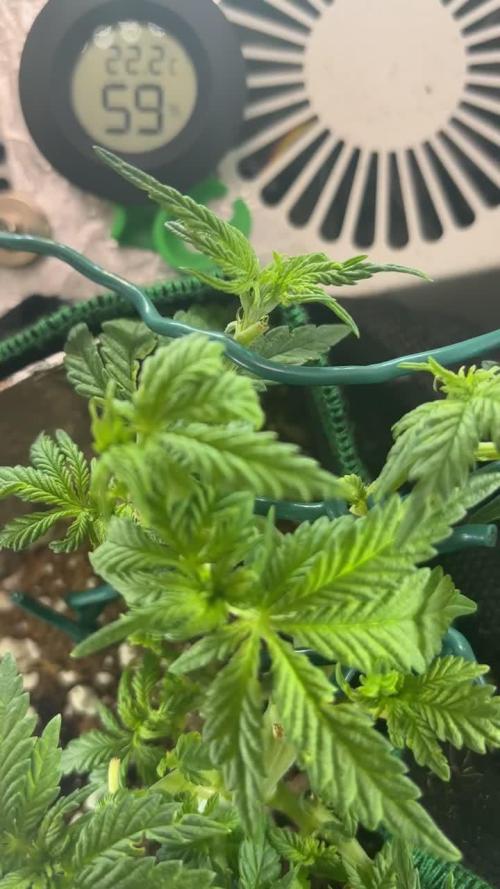
Decided ima leave her in vegataive stage till she recovers some more from the lst/hst been using cannacure to help with the mystery pests and deformed leaves have been seeing her start to regenerate and new growth is visible thinking week 7 or 8 till I switch her to 12/12 light schedule to flower bit streaching side branches and smaller side branches off the side branches are forming
Likes
8
Share

@BluntTrauma416
Follow
Nights have went down to 4°c with most at 8° c
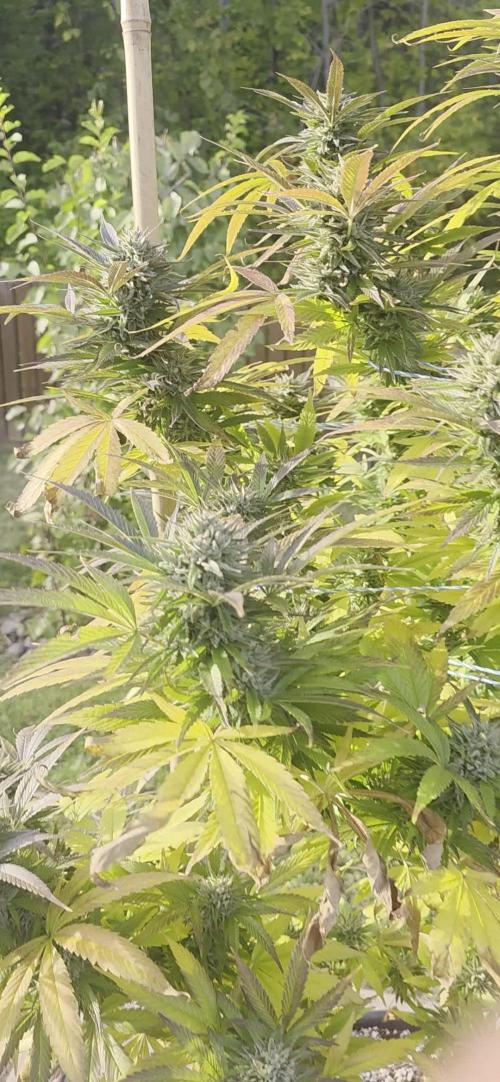
but going up to 12- 13° c at night with daytime around 21°c . Took pots off concrete , put them on some boards to raise them off the ground. Scenescense kicking in for sure lots of yellowing. As long as it hasn't hit your sugar Leaves you're good. And the buds themselves use the sun to ripen.. you don't need the leafs for photosynthesis. At this point for bud ripening. Still using los cost plant therapy 10ml per 900 ml water.. because of high relative air humidity at night.. and morning dew. I've been losing a leaf blower to get the dew off. In the beginning, I was just shaking the buds. Today is week 8. I have milky trichomes and bunch still not as milky as i would like.. with the odd amber trichome.
Likes
3
Share


@Ninjabuds
Follow
It’s day 27 from seed for all the plants in the photo sea of green. Let’s call it the battle of the strains summer 2025. All of the plants are starting to have visible differences. I’m already starting to tell witch plants are more sensitive than others.
Likes
2
Share

@MuckmanMelts
Follow
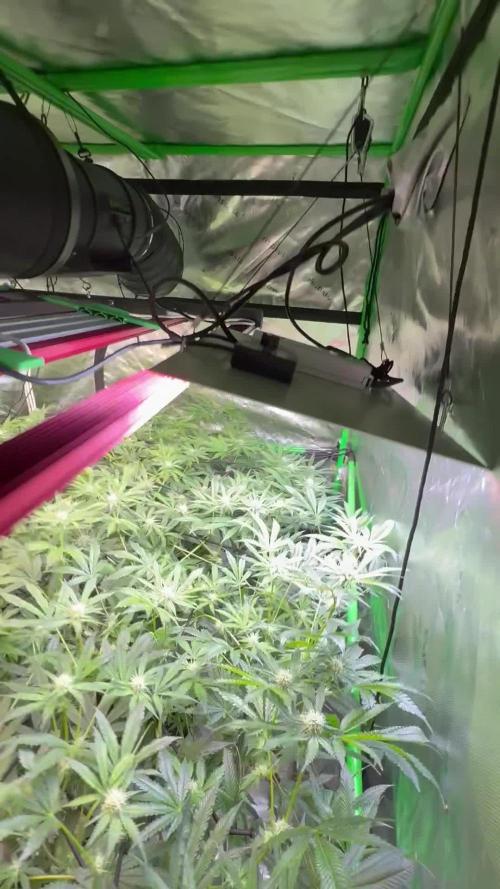
Insane! Added hlg r spec 200w boost the footprint. Let me show you my field of a scrog


Likes
30
Share


@Grower_Of_Persia
Follow
week intel:
we are going through slowly
stresses :
just a little E.C stress around 1.4 once a week
feeding:
i feed them 3 times this week with this order :
day 1 : i feed them heavy with silicate +base nutrients(calcium & micros + Bloom) about 700 ppm - 1.4 e.c to cause a little stress.
day 3 : i feed them low dose of Feeding Booster around 327 ppm - 0.64 e.c to let them recover a little but not fully recover still a little stress will caused.
day 5 : i feed them with low dose of Top-Max + B-52 around 255 ppm - 0.5 e.c to let them recover the stresses to get ready for another stress next week.
guide of the week :
know your plant tolerance limit of E.C stress once you saw the very very little yellowing on tips of leaves , that's the sign to don't go further , never reach that limit if you want a high quality buds, in my case tolerance is 1.4 and i'll reach to that level only once a week to cause precision stress , love your plants and have a happy growing!
Likes
5
Share


@Ninjabuds
Follow
I'm really happy with the gas tax x obama runtz plant is doing. It started out so small, I wasn't sure if it was gonna make it. But lately it's taken off. The leaves are a lot bigger and the colors are so vibrant. I can tell it's happy and healthy now.
Well, it's Christmas again. This year feels a little different, though. Maybe it's the snow blanketing everything, or the way the tree lights up the whole living room. Either way, it's cozy and warm, even when it's freezing outside. I'm really looking forward to seeing what Santa brings. I hope I get that new video game I've been wanting. But most of all, I can't wait to spend time with my family. We always have so much fun
This past week was a good one for the plants. They started the first week of their stretch, and they've already grown a decent amount. I can really see them filling out. It's cool to watch them grow so fast. I can't wait to see how big they get by the end
I always get a little worried at this stage, like they're not gonna get as big as I want them to. But then I remember how they always end up surprising me. By the end, they're always perfect.
Likes
5
Share

@Trety
Follow
Day 56
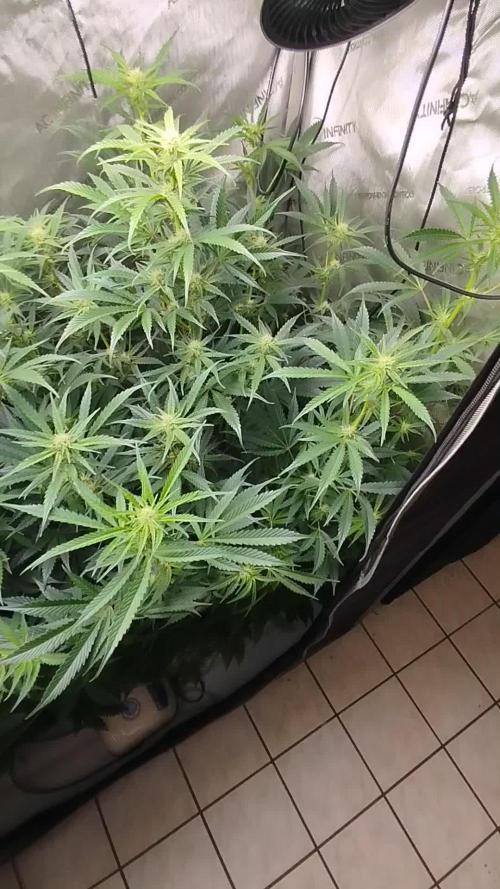
Well, the Kiwi wasnt done stretching 😂
Still same settings. Only switched to bloom nutrients.
The icendnbaked couldnt recover sadly, since she swapped into flower.

Likes
38
Share


@PolishFarmer
Follow
Hello! We are in week 7 now. Girls going so well, they looks so happy :) They get more light from yesterday I hang mh ts 600 so all together is 50k lumens now :) So proud of them atm and hopefully will be like that until the end :) how do you like my grow? Let me know what you thinking :) thanks for your attention! Take care guys!
Update Day 45 i found a little dark points on some od the leafs. I recive its cal and mag deficiency. I check soil pH was 5.9 🙈 i rise it up to 6.5 and waiting for results:)
Likes
6
Share


@BudeCo
Follow
Feliz com o retorno das meninas que revegetaram na 3 semana de floração.
Ficaram por 15 dias com luz 24h.
Agora já estão novamente com 3 semanas de 12x12. Recuperação Ok.
Mas devem ficar com aspecto de rabo de raposa no final da floração.


