Likes
Comments
Share
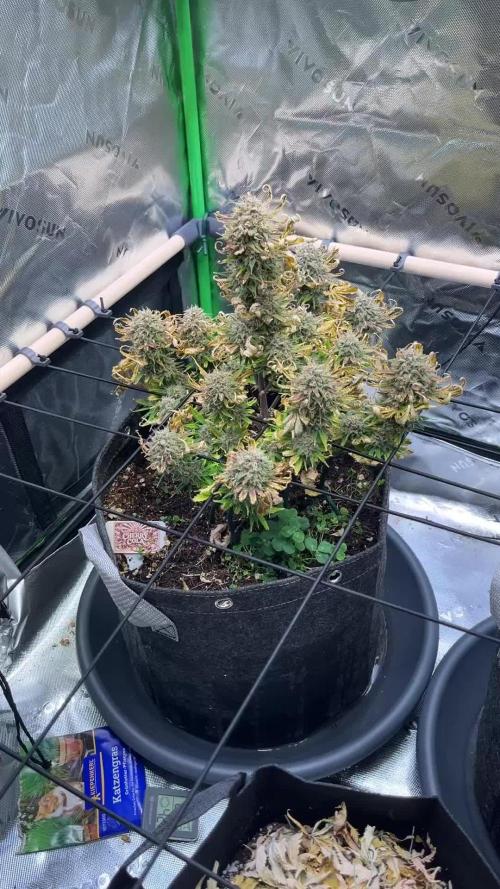
planted in July it started to grow uniformly with very fragrant leaves of Sicilian lemon peel you can smell the citrus notes in the pre-flowering leaves I enjoyed its very fresh zkitty phenotype which tended between the sour green apple and the gaseous lemon the variety is particularly susceptible at high temperatures and is the only one that on the fourth day without water this summer literally twisted its leaves on itself variety that had some problems with leaf problems but the yield was excellent with rock hard buds! THE AMAZING TERPENES THE BEST IN THE WHOLE GARDEN. GROWING SCENTS: green apple organic citrus peel TERPENES: THOSE WHO SMOKE THEM ARE STUNNING.🙌🙌😍 the complexity and flavor of zsrawberry begins with a very deep hit of hearty heavy spicy smoke which soon reveals itself as a fresh lemon zest surrounded by nutmeg spice followed immediately by the sweetness and fruit of zkitty swallowed the smoke closes with a note of completeness of the three perfectly balanced flavors that tends towards diesel, strawberry spice and a dream of blackberries and redcurrant fruit salad, lemon peel with an acid finish and a round spice of aged jam😵😭😭😍
Likes
13
Share
@BigDaddyK
Follow
Watered today ( Monday ) 5L of solution then 3 L of plain water to lower the runoff down from 2.8 to 2.3 (EC) , had a defoliate to open out the branches a bit , smells very naughty... Thursday - Watered 5 litres of 2 ml per litre Terra bloom caught runoff at 1.8 EC
Likes
71
Share
Greetings, fellow growers! Week 5 has brought us to a pivotal moment in our Anesia pheno hunt journey as we embark on the transformative process of topping our thriving beauties. Let's delve into the world of topping and explore the magic behind this essential technique. Topping is a fundamental aspect of plant training, involving the removal of the apical meristem, or main growth tip, to encourage lateral growth and bushier plant development. By snipping away the topmost growth, we redirect the plant's energy towards the lower branches, stimulating new growth and increasing overall yield potential. It's like giving our plants a strategic haircut, with the promise of fuller, more abundant foliage in return. But topping isn't just about increasing yield – it's also about promoting a more balanced and uniform canopy, ensuring that light penetration is maximized and no precious photons go to waste. With each well-placed snip, we're sculpting our plants into lush green masterpieces, ready to flourish under the glow of our Future of Grow LED lights. Speaking of lights, maintaining optimal environmental conditions is key to our plants' success. That's why we've raised our TDS to 420 and adjusted our pH to a precise 5.8 using our trusty Blue Lab Guardian monitor. This advanced monitoring system allows us to keep a close eye on nutrient levels and pH fluctuations, ensuring that our plants receive the perfect balance of nutrients for optimal growth and health. It's like having a guardian angel watching over our garden, guiding us towards horticultural excellence. And let's not forget the satisfying sight of water droplets glistening on freshly topped plants. These tiny droplets are more than just a visual treat – they serve as a gentle reminder of our care and attention to detail, ensuring that our plants receive the hydration they need to recover and thrive. It's a moment of zen in the midst of our bustling garden, a testament to the beauty of nature and the joys of cultivation. With each passing week, our Anesia pheno hunt grows more exciting, and I can't wait to see what the future holds. Stay tuned for more updates, more growth, and more green goodness as we continue to cultivate joy and growth together in our Green Oasis! Genetics Red Banana Pudding = RBP Apricot Oreoz = AO Zoomiez = Z Future#1 = F https://anesiaseeds.com/ Plant nutrition - Aptus Holland - https://aptus-holland.com LED Photons - Future of Grow - https://www.thefuturofgrow.com/ Controls - Trol Master - https://www.trolmaster.eu/ Watering - Autopot - https://autopot.co.uk/ Tent - Mars Hydro - https://marshydro.eu/ Love and attention - Me, myself and i As always thank you all for stopping by, for the love and for it all , this journey of mine wold just not be the same without you guys, the love and support is very much appreciated and i fell honored and blessed with you all in my life, With true love comes happiness. Always believe in your self and always do things expecting nothing and with an open heart , be a giver and the universe will give back to you in ways you could not even imagine so More info, the ocasional give-away and exclusive updates from all my adventures can be found - links in the profile description Friendly reminder all you see here is pure research and for educational purposes only Growers Love To you All 💚
Likes
2
Share
Hoy cvumplen su primer mes de floracion, e notado que en una al aplicar scrog y vario estres a las ramas se ve como genera mejores cogollos que las semas que casi no moleste, la mas alta se ve un poco flaca con cogollos llenos de tricomas pero no tan gordos, esperare a floracion final
Likes
58
Share
Week 7 is begonnen en ze wordt heerlijk verwend. Ze groeit lekker door, de toppen worden groter en ze ruikt nu al zeer sterk. Helaas heeft ze wat gele bladpunten gekregen, ik denk dat ik haar overvoed heb en de aptus voeding iets te veel van het goede was, dus vanaf nu geef ik haar alleen nog plagron zoals gewoonlijk. Ik ben zeer tevreden over de spiderfarmer sf-1000, geen geluid, laag energieverbruik, weinig warmte en intense zonnestralen. Topnotch. Laten we zien hoe ze zich in week 7 verder weet te ontwikkelen.🧐 Ik zal gedurende de week nog verse foto's updaten. 📷 ✌️🏼
Likes
5
Share
@Kinghaze
Follow
Week 7 of flower This is the last week the lady's will get nutrients. I will flush them 1 week with flawles finish from advanced nutrients. The mutant is not much, but from the 3 blue zushi the mutant smells the most sweet very candy like. The plan is to make fresh frozen bubble hasj out of it. All the plants are looking great and the resin production is very high. They are not the biggest buds but they are very dense. The blueberry cupcake is slightly further then the blue zushi , if i check the trichomes. Can't wait till i can smoke it 🍀✌️
Likes
12
Share
Likes
14
Share
Likes
6
Share
- lock outs - dimmed light and nutes again drastically ____________________________________________ light- and watering schedule: see photos now: 12 plants 2 x Auto Orange Bud > Dutch Passion (early80's) 2 x Haze Berry Automatic > Royal Queen Seeds (2018) 2 x Auto Bubblegum > TH Seeds (late 80's) 2 x Original Auto BubbleGum > Fast Buds Company (late 80's) 1 x Strawberry Pie Auto > Fast Buds Company 1 x Gorilla Cookies Auto Seed Stockers (2015) 2 x Auto White Widow x Big Bud > Female Seeds setup + strategy: 18 seeds 3 x Auto Orange Bud (early80's) 3 x Haze Berry Automatic (2018) 3 x Auto Euforia (late 90's) 2 x Auto Bubblegum > TH Seeds (late 80's) 2 x Auto Bubblegum > Fast Butts (late 80's) 2 x Strawberry Pie Auto 1 x Gorilla-Cookies Auto (2015) 2 x Auto White Widow x Big Bud setup: 18 x gronest 2 liter 60 cm x 120 cm x 180 cm (2 x 4) growtent 4 l humidifier 25 watt axial fan 15 watt clip fan ro-filter bath room with a 50 watts room fan (-> carbon filter not necessary) ...and a lot of odds and ends. grow strategy: max yield by stressing with: 1. tiny shoes (2 l fabric pots standing on 3 plastic rings (4 cm) for max oxygen) 2. tiny growspace (18plants on 0.72 sqm) 3. many strains (8 strains) 4. annoying neighbourhood (mixing old - i.e. bubblegum (late 80's) - with young- i.e. hazeberry (2018) - genetics) 5. no stress by light or food or water 6. unintentionally too much food plus: - no lst - no hst - just leaf tucking - positioning bigger strains (euphoria, orange bud, haze berry) or just bigger phenos on less intense light spots (end of tent + edges) - music-rotation: 24 hrs reggae (for sativas) - 24 hrs classicals (because it's scientifically proofed) - 24 hrs traditionals from the hindukush region (for the indicas) max efficiency (min electricity - max yield): - light: 23 h on - 1 h off - keeping the distance of 18" (45 cm) and dimming to the right par (lux) - value depending on growing stages (see sheet: beginning 185 par ( 10000 lux/100 watt )/end 340 par ( 18000 lux/175 watt )) => ends up in approx. 170 watts in average over max 15 weeks temperatur management: - using approx. max. half of what the lamp can do keeps temperature low: my tsl 2000 is pulling max. 360 watts of the wall - i need only 175 watts, results in less temperature than using a 175 watts lamp - adjusting the temperature by using a humidifier outside of tent: blown in humidity is soaking degrees and is transported out by fan, works much better than doing the same with pure air summer extreme: no humidifier: 36°C / 35 rh - with humidifier: 29°C / 65 rh works for 1-2 weeks of real hot summer days, no mould, no signs of stress in two summers germination: seeding in waterglass spraying "basic"-water: ro-water (22 ppm) + calmag to 180 ppm every 4 - 8 hours until sprouted man versus fungus gnat: 5 days before seeding i'm running the tent with "basic"-watered pots as if there were plants inside - led on, fans on, humidifier on. Fungus gnats coming with the soil might take the chance to come out now for breeding. i'm waiting with a 9 mm rifle. in the past i found 6 gnats in 2 of 8 x 50 l biobizz lightmix bags coming out of the soil. i could eliminate every single gnat successfully ;) rotating harvest: the little ones will be harvested completely when ready. at this point only the top branches of the big ones will be cut...and the new (basic-watered) pots of the new grow will move into the tent. 2-3 weeks later the secod half of the big ones will be cut and the second half of the new grow will move in... nutes: biobizz / soil: biobizz lightmix bloom,grow,topmax,activera,algamic + aminopower instead of bio heaven (too expensive) individual feeding schedule/once a week: veg: 200 - 600 ppm bloom: 600 - 900 ppm water: ro-water with: veg: 100-150 ppm calmag bloom: 150 ppm calmag
Likes
44
Share
@SooSan
Follow
13 jours de 12/12 OK il y a du changement ! Dans la partie du scrog vertical le stretch n’a pas été assez fort J'ai donc abandonné la culture verticale pour cette fois J'ai donc fusionné le bas de la tente pour avoir un espace de 90x60x90 Le ts1000 a été retiré pour laisser la place aux barres du FC-E 4800 Et bien sur gros LST pour gagner en surface et gagner 20 à 30cm de hauteur Vu qu’il y a 16 plantes mais que sur growdiaries on ne peut mettre que 8 variétés j'ai divisé en 2 diaries pour le bas de la tente 1️⃣ 🏠 90x60x90 ☀️ FC-E 4800 => puissance a 20% 🍁 1x Black Bomb / Philosopher Seed 2x Amnesia Lemon / PEV Seeds 1x Blueberry / PEV Seeds 1x Blueberry / 00 Seeds 1x Wappa / Paradise Seed 1x Dark Phoenix / Green House Seed 1x Quick Sherbet / Exotic Seeds 1x Mango Cream / Exotic Seeds 1x Banana Frosting / Sensi Seed 1x Hindu Kush / Sensi Seed 4x Fast Mix / Sweet Seed 📎 https://growdiaries.com/diaries/122084-grow-journal-by-soosan 📎https://growdiaries.com/diaries/124052-grow-journal-by-soosan 2️⃣ 🏠 30x60x50 ☀️TS1000 => puissance a 50% 🍁 4x Quick Sherbet - Exotic Seed 📎 https://growdiaries.com/diaries/122080-grow-journal-by-soosan
Likes
26
Share
Hi guys So wer on week 9 of flower and I have just started ripen by general hydroponics GHE, never use this before but herd good things about it, I just want it to get a early fade as I don't want the trichomes degrading. Pheno 1 is starting to fade natraul and is well on its way, buds are dense sticky and are falling over due to weight. Pheno 2 has started its fade and buds are just as dense there just bigger and the same with pheno 3 its just lacking the fade to be harvested for my liking. Humidity and temps are good and all is going well. I will update in few days once the ripner takes affect 😁 Happy growing guys 👌💪💚 Hi guys just and update....Next Wednesday is chop day! FINALLY chop days come around 🙈🤣🤣🤣 i really can't wait now, buds flopping over here n there, swelling, stinking, stickiness everywhere lol. Thanks for all your comments and likes 💚💚💚 i cant wait to impress you with my next run and diary, I got something special for you guys, a limited edition, only 500 packs released 😊. Message for more info on my next run. Full nutrient line up, genetics and light and equipment to be confirmed. Day 59 of flip and day 5 of ripner. Hi guys the ladys are doing really well as you can see and starting to show me there true colours 💜💚💜💚. This is not a sponsored grow in anyway, I paid for everything for this set up. I am giving you a personal review as a customer who got these things to use. I highly recommend everything I used and as a first time photo seed grower and scrogger I have done brilliant and if it wasn't for good quality products I think I would of struggled lol so shout out to @marshydro @acinfinity @biobizz and @simplysouvenirs @ghe Your products produce good quality and nice environments for growing top quality meds 👌👍
Likes
22
Share
@OGgrows
Follow
the plant continues to stretch throughout this week. slight increase in flowering and growth feeds.some defoliation this week. good week everyone 🙏💚🌱
Likes
4
Share
All at the ending week 1 and now at the start of week 2 and all now showing pre-flower pistol's and all looking great day 8 into flower
Likes
17
Share
@TooQuiikk
Follow
Let me start by saying, I'M SO GLAD I DIDN'T CHOP! THESE BABIES ARE GAINING SOME SERIOUS BULK! I can not wait to see them finish out, It's really testing my patience, but I notice more bulk every single day! It's about time to get the chop, they are maturing really quick and I love it. The smells are absolutely insane!!!
Processing
Likes
3
Share
Slight mishap on one of my plants. A SIP had cracked and wasn’t holding water unbeknownst to me. She as drooping bad, once I flooded her and got her into a new SIP she perked right back. I did quite a bit of defoliation, cut back fan leaves that were shading buds.
Likes
20
Share
Week 6 2nd week of flowering: Slowly but surely, the whole thing had taken shape. And in the way I'm usually used to. "Sow love, reap happiness." Hello dear plant friends, please forgive me for my time delay in the grow diary. A lot is happening in real life for me right now and I had to get used to it. Unfortunately, one of my beloved cats died suddenly for a reason unknown to me. A long-time friend and companion. And in addition, I am very busy modernizing my grow room, expanding capacities and the current grow also requires a lot of attention, as I am passionate about new crazy training methods. All this distracts me from my grief and the loss of my dear furry friend and helps me a lot to get back on my feet mentally. Well, I don't want to keep you in suspense any longer, so here's a little preview of what will change and why.... 🤩 But that was only a short fitting and both lamps will of course come in a new generous Homebox 100 Q + I think the time has now come for me to leave the tried and tested old shell and go new exciting ways. I feel ready for the next challenges in this wonderful field of gardening. Dear people, be curious about what is to come. I can't wait to share it all with you. And now back to week 6 and last summer's Grow... Enjoy! 😊 And again my Biotabs was my secret weapon: the fermented compost tea an outstanding game maker. I usually start at the end of flowering week 2 and combine it alternately with the enchanting Bio PK - Booster from Biotabs until shortly before the end. I am firmly convinced that these two components complement each other super nicely.
Processing
Likes
26
Share
@rhodes68
Follow
9/14 Week 9 and she is doing fine Little vid she is center Nuets not changing for now 9/15 Ok major changes Brought up the alternate tent and placed her in it alone under a 150w Mars This is a test to see if we can help the crowding issue in the Flower tent Video enjoy 9/16 Doing well but some white tips are saying we gotta reduce the salts so will be dropping CT nuets 10% and upping PK to 2.5 Extra space is really doing them well Defoliation again tonight the war on stemmed leaves has begun 9/17 Held a meeting of the minds and decided the best course of action is to flip the light schedule so I can feed them more appropriately, twice a day. Leaving nuets as they are as this will drop pot EC. Setting the alarm for the AM before lights out at 7:30 and changing the sched to 6AM-6PM summer is done no need for current schedule. Lights be out from 7:30AM to 6AM long I know but should not bother them. 9/19 Lights on girls feed buds look fine Video enjoy
Likes
4
Share
Likes
16
Share
Seedling managing 93F 30%RH, around 20 DLI. Vpd is in the 3's. No I don't recommend. Signum Magnum. "A great sign appeared in the sky a woman clothed with the sun with the moon under her feet and on her head a crown of twelve stars. Sing ye to the Lord a new canticle: because He has done wonderful things. Glory to the Father, and to the Son, and to the Holy Spirit As it was in the beginning, and now, and ever shall be, world without end." The plant nutrient nitrogen exists in forms with both positive and negative charges. Ammonium (NH4+)(immobile in soil)(Cation) has a positive charge, while nitrate (NO3-) (highly mobile in soil)(Anion)has a negative charge. Nitrogen is unique among plant nutrients in that it can exist in both positively charged (ammonium, NH₄⁺) and negatively charged (nitrate, NO₃⁻) forms in the soil. This makes it a special nutrient. In that it is responsible for providing balance for reactionary trade offs when it comes to ph. Because ph itself in the medium will always slowly drift towards acidicity, such is nature. 80% of nitrogen should be nitrate and no more than 20% ammoniacal nitrogen. Ca, mg, and K are the big 3 cations related to soil composition, pH & base saturation. When nitrogen is in the form of ammonium, it can compete with calcium, magnesium, and potassium for absorption sites in the plant root. This competition can lead to a reduction in the uptake of these other essential nutrients. Nitrogen, particularly in its nitrate form (NO3-), can increase soil acidity, which can also affect the availability of calcium, magnesium, and potassium. The form of nitrogen applied (ammonium vs. nitrate) can influence its interactions with other nutrients. Ammonium nitrogen can have a more pronounced negative effect on the uptake of calcium, magnesium, and potassium compared to nitrate nitrogen. Common forms of ammonium nitrogen include ammonium ion (NH4+), urea, and ammonium compounds like ammonium nitrate, ammonium sulfate, and ammonium phosphate. Common forms of nitrate nitrogen include potassium nitrate (KNO3), sodium nitrate (NaNO3), calcium nitrate (Ca(NO3)2), and ammonium nitrate (NH4NO3). Phosphorus is an essential plant nutrient, and its availability in the soil is strongly linked to the presence of oxygen. Plants primarily absorb phosphorus as phosphate (PO4), and oxygen is a key component of this molecule. Furthermore, the availability of phosphorus in the soil can be impacted by factors like soil aeration and temperature, which in turn affect the oxygen supply to the roots. Phosphorus uptake in plants is most critical during the early stages of growth, particularly within the first few weeks of plant development. Young plants actively growing tissues have a high demand for phosphorus. They may absorb up to 75% of their total phosphorus requirements within the first few weeks of vegetative growth, with up to 51% of uptake happening overnight, primarily in the first few hours or early nightfall. ⑨Anaerobic root respiration, or respiration without oxygen, is detrimental to plants because it's less efficient and produces toxic byproducts, leading to reduced energy production, nutrient uptake issues, and ultimately, root damage and plant stress. ⑨Anaerobic respiration, unlike aerobic respiration, doesn't utilize oxygen as the final electron acceptor in the electron transport chain. This results in a significant drop in the amount of energy (ATP) produced, which is necessary for various plant functions, including growth, nutrient uptake, and maintenance of cellular processes. ⑨In the absence of oxygen, plants produce byproducts like ethanol and lactic acid during anaerobic fermentation. These byproducts can be toxic to the roots and inhibit their function, ⑨When oxygen is depleted in a medium, the pH tends to decrease (become more acidic) due to the production of metabolic byproducts. This is particularly relevant in biological systems where aerobic respiration relies on oxygen as the final electron acceptor. ⑨When oxygen is scarce, plants may switch to anaerobic respiration. This process produces carbon dioxide (CO2) as a byproduct. ⑨CO2 dissolves in water to form carbonic acid (H2CO3). This acid lowers the pH of the medium, making it more acidic. ⑨Anaerobic conditions can impair a plant's ability to regulate its internal pH, leading to a drop in cytoplasmic pH and potentially cellular acidosis. ⑨The change in pH can also affect the availability of certain nutrients to the plant, as pH influences the solubility of micronutrients like iron, manganese, zinc, copper, and boron. ⑨The lack of oxygen in the plant medium leads to a decrease in pH due to the production of carbon dioxide during anaerobic respiration and impaired pH regulation within the plant. In plant cells, cellular acidosis, a drop in the internal pH of the cytosol, is a significant stress response, particularly during conditions like flooding or hypoxia. This acidification can be triggered by a decrease in oxygen levels, leading to the production of metabolic byproducts like lactic acid and CO2. The plant's ability to tolerate and recover from these conditions depends on its cellular mechanisms to regulate pH and mitigate the effects of acidosis. When plants are subjected to low oxygen environments, such as those experienced during flooding, anaerobic metabolism, which produces lactic acid and ethanol, becomes the primary source of energy. This can lead to a build-up of these acidic metabolites in the cytosol, causing a drop in pH. OXYGEN Atomic oxygen (single oxygen atom, O) is the lightest form of oxygen, as it has the lowest mass of the oxygen molecules. Oxygen also exists as a diatomic molecule (O2) and an allotrope called ozone (O3), which have higher masses due to the number of oxygen atoms combined. Atomic Oxygen (O): This refers to a single oxygen atom, which is the most fundamental form of oxygen. Molecular Oxygen (O2): This is the common form of oxygen we breathe, consisting of two oxygen atoms bonded together. Ozone (O3): This is an allotrope of oxygen, meaning it's a different form of the same element, consisting of three oxygen atoms bonded together. Since atomic oxygen has the fewest oxygen atoms, it naturally has the lowest mass compared to O2 or O3. Ozone (O3) Lifespan: Ozone has a relatively long lifespan in the stratosphere, particularly at lower altitudes. For example, at 32 km in the middle latitudes during spring, ozone has a lifetime of about 2 months. Oxygen (O) Lifespan: Atomic oxygen, on the other hand, has a much shorter lifespan. At the same altitude, its lifetime is about 4/100ths of a second. Ozone-Oxygen Cycle: The ozone-oxygen cycle involves the rapid exchange between atomic oxygen (O) and ozone (O3). UV radiation can split molecular oxygen (O2) into atomic oxygen (O), which then reacts with O2 to form ozone (O3). Ozone can also be photolyzed by UV radiation, creating atomic oxygen again, which can then react with O3 to reform O2. Dominant Form: The partitioning of odd oxygen (Ox) between ozone and atomic oxygen favors ozone in the lower stratosphere. This means that a much larger proportion of odd oxygen exists as ozone than as atomic oxygen, especially in the lower stratosphere. Recombination: Atomic oxygen has a high energy and reactivity. When it encounters another oxygen atom, they can combine to form O2. This process releases energy, contributing to the heating of the atmosphere. Ozone Formation: Atomic oxygen can also react with molecular oxygen (O2) to form ozone (O3). Ozone plays a significant role in absorbing harmful UV radiation. Other Reactions: Atomic oxygen can react with various other molecules in the atmosphere, like nitrogen (N2), water (H2O), and carbon dioxide (CO2), forming different compounds. UV light below 240nm (peak 185nm) creates ozone (O₃) through a process called photolysis, where UV light breaks down dioxygen molecules (O₂) into single atomic oxygen atoms (O). These single oxygen atoms then react with other oxygen molecules to form ozone (O₃). Specifically, UV-C light with wavelengths shorter than 240 nm can cause this photolysis. UV light with wavelengths between 240-280 nm, (peak 254 nm) breaks down ozone (O₃) into dioxygen molecules (O₂) and atomic oxygen atoms (O). 280nm does not have the energy potential to break apart the stable bond of (O₂) into enough (O) to make (O₃) At ground level, atomic oxygen (single oxygen atoms) has a very short lifespan. This is because it's highly reactive and quickly combines with other molecules to form stable diatomic oxygen (O2) or other compounds. While the exact timeframe varies depending on the specific circumstances, its lifespan is typically measured in nanoseconds or picoseconds.