


Likes
Comments
Share


@Ultraviolet
Follow
Voltage, also known as electric pressure, electric tension, or (electric) potential difference, is the difference in electric potential between two points. In a static electric field, it corresponds to the work needed per unit of charge to move a test charge between the two points. In the International System of Units (SI), the derived unit for voltage is named volt.
The voltage between points can be caused by the build-up of electric charge (e.g., a capacitor), and from an electromotive force (e.g., electromagnetic induction in generators, inductors, and transformers). On a macroscopic scale, a potential difference can be caused by electrochemical processes (e.g., cells and batteries), the pressure-induced piezoelectric effect, and the thermoelectric effect. Since it is the difference in electric potential, it is a physical scalar quantity.
A voltmeter can be used to measure the voltage between two points in a system. Often a common reference potential such as the ground of the system is used as one of the points. A voltage can represent either a source of energy or the loss, dissipation, or storage of energy.
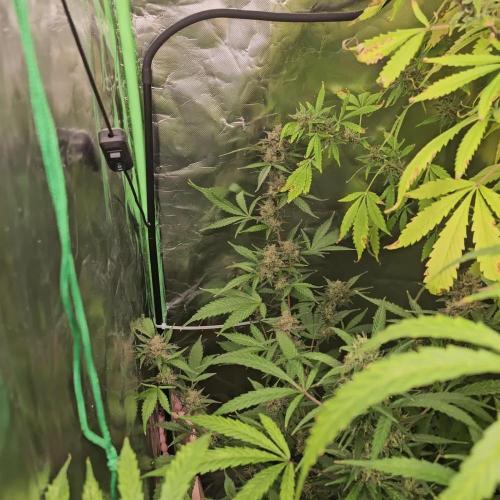
Dropping the temps will slightly raise the humidity, air holds less % water the colder it is. Lights on 25-35rh% the same water content will spike to 50rh% + at night just by dropping the temps.
At night all the juice photosynthesis has been storing up is mashed and mixed up to make all the goodies we need for bud, water is used to transport all these things everywhere, like little solvent transport devices, once a nutrient/protein has been delivered to destination the plant needs to get rid of all this excess water molecules it was using to transport. The only solution at night is to spit it back out into the air at night. During the peak of flower, this can catch a grower unaware, with a 4x4 full tent it can be a challenge to control all that moisture exhaust overnight especially if you're really pushing the limits.
Got my first full whiff of the smell of purple lemonade, always surprises me how accurately the smell fits names, the dominant terpenes in the Purple Lemonade weed strain are carene, linalool, limonene, and myrcene. Carene gives this strain its sweet, citrus flavor and some woody notes, whereas the linalool I recognize so well from Granddaddy Purp. Myrcene has been shown to have sedative qualities while bringing musky, earthy elements to the flavor profile.
Trichome production started to ramp up, and the plant that grew taller/closer to UV showed noticeably thicker coatings. The taller plant shows slight yellowing of lower leaves, and the smaller plant is green and lush but the buds are slightly less progressed, interesting.
I super-cropped the main stem of the tall one just over a week ago (clean). I expected it to be the one slightly behind in development.
The plant has roughly 10-15% "Total resources" that it keeps in case emergencies arise. Reserves if you will.
My rationale behind breaking anything goes hand in hand with slowing things down as production is lost due to the time it takes to repair damage.
I recall watching a YouTube video, where a curly hair gentleman would super crop in a manner to damage but not disrupt using a twisting method, using fingers and thumbs placing them close together one goes clockwise other counter clock this varies a lot depending on the thickness of stem but what you wait for is a tiny snap, it may take several rolls to weaken if walls are tough I found. No snapping or bending of the stem, you want just to fracture it but not puncture this way the xylem and phloem channels remain flowing,the damage is repaired almost instantly and the 10-15% is dispatched with very little repair time. Everything in the general vicinity of the stress will now grow stronger so as to prevent further similar damage.
This is why I had expected the tall one to lag behind in development once I had cropped it but low and behold it worked and the tall one has slightly more developed buds.
The effects of birdsong on plant life may at first glance be far-fetched. Nigh on ten years ago an article appeared in Nexus Magazine on the discovery or invention of a method of growing plants using bird sounds. Christopher Bird and Peter Tompkins describe the development of Dan Carlson’s Sonic Bloom in their book The Secret Life of Plants. Many others have, it seems, recognized the role of birdsong in the growth of plants, and influenced or directly helped Carlson to develop his invention.
Dan Carlson’s desire to see that no one need be hungry through shortage of food sought to understand the optimum growth of plants. He discovered that plants also feed from ‘the top down’ as well as the roots. Underneath all leaves are pores called stomata which open to take in nutrients and moisture from the air. Carlson’s observation that the more bird life there is on the farm, the more abundant is plant life, has been echoed by farmers throughout history, except in modern times. Where there is little bird life, plants are stunted, and dwarfed. Nature has the birds sing at dawn and dusk, which dilates the stomata, and so feeds the plants. One can immediately see the importance of trees.
The development of Sonic Bloom was to create birdsong, which is played to the plants, while a foliar nutrient is sprayed onto the plants at the same time as they are being stimulated by the sound, to enhance their growth. This method produced fantastic results in the amount of abundantly nutritious produce from one plant, often in poor soils and in drought conditions. Carlson showed that the breathing leaves of plants are the source of the nutrient intake for growth. This of course is also true for humans—the breath is food. We shall discourse on this on another occasion. Plants transfer nutrients to the soil via this breathing, and Carlson showed that his plants improved the soil and helped earthworms proliferate.
The secret of Sonic Bloom was the development of the music of the same frequency as the dawn chorus of the birds. With the help of a Minneapolis music teacher, Michael Holtz, a cassette was prepared. It seems that both birds and plants found Indian melodies called ragas delightfully suitable. This is actually quite profound, although the American farmers, especially women, who had to endure this music whilst it was played to the plants, found it irritating. Holtz found the “Spring” movement of Vivaldi’s The Four Seasons appropriate and concludes: “I realized that Vivaldi, in his day, must have known all about birdsong, which he tried to imitate in his long violin passages.
Holtz, it is related by the authors Bird and Tompkins, also realized that the violin music dominant in “Spring” reflected Johann Sebastian Bach’s violin sonatas broadcast by the Ottawa University researchers to a wheat field, which had obtained remarkable crops with 66 percent greater yield than average, with larger and heavier seeds. Accordingly, Holtz selected Bach’s E-major concerto for violin for inclusion on the tape. “I chose that particular concerto,” explained Holtz, “because it has many repetitions but varying notes. Bach was such a musical genius he could change his harmonic rhythm at nearly every other beat, with his chords going from E to B to G-sharp and so on, whereas Vivaldi would frequently keep to one chord for as long as four measures. That is why Bach is considered the greatest composer that ever lived. I chose Bach’s string concerto, rather than his more popular organ music, because the timbre of the violin, and its harmonic structure, is far richer than that of the organ.
Birdsong has long been loved but also studied with reference to the musical scale and harmonics. As Holtz deepened his study he said, “I began to feel that God had created the birds for more than just freely flying about and warbling. Their very singing must somehow be intimately linked to the mysteries of seed germination and plant growth.
The spring season down on the farms is much more silent than ever before. DDT killed off many birds and others never seem to have taken their place. Who knows what magical effect a bird like the wood thrush might have on its environment, singing three separate notes all at the same time, warbling two of them and sustaining the others.
Tree and bird life are essential to Earth's existence, which Carlson, Holtz, and others have shown, but indeed others see and feel. “Plants”, says Steiner, “can only be understood when considered in connection with all that is circling, weaving, and living around them. In spring and autumn, when swallows produce vibrations as they flock in a body of air, causing currents with their wing beats, these and birdsong, have a powerful effect on the flowering and fruiting of plants. Remove the winged creatures, Steiner warns, and there would be stunting of vegetation. Nothing more needs to be added here.
It has been said that you cannot hurt the humblest creature or disturb the smallest pebble without your action having a reaction upon something else...You cannot think of an evil thought, no matter how private, without it having an effect upon somebody else. Whatsoever you do in life sets up some form of resonance.
When I say the morning chorus of the birds awakens the earth I mean that the characteristic song of the birds sets in motion a series of vibrations which react upon other forms of life. Remember, the soil of the earth is full of living microorganisms. The plants are also living organisms. You, yourselves, are living organisms. Now, this is the beauty and wonder of it all—when one aspect of nature has been moved into a state of resonance it immediately relays its vibrational motion to something else.
So when I say the dawn chorus awakens the earth I literally mean what I say. I do not suggest that the earth would come to a standstill without the bird song, but I do mean that life on earth would be sluggish and ineffectual without that first instigating outburst of vibrational power poured forth at just the right pitch and tone to set off a chain effect.
I know some of you will say, what happens in those parts of the world where there are no birds? Well, what does happen? Very little, I assure you. The hot deserts and the polar regions where there are few, if any, birds are not renowned for their wonders of nature. It is as though they are asleep. Nothing grows, few things live. Little resonates and there is a great stillness over everything.
You see, that outburst of sound just before dawn is like the little lever that works the bigger lever which turns the wheel which moves the machine…and so on. Never underestimate small things.
Animals are blessed with instantaneous and unthought-out wisdom. They are in direct contact with the divine, and they act and live as though they are fully aware of it. Men are also in contact with God, but most of them act as though they have never heard of God because they are largely veiled from their divine center by their own thinking minds, of which they are so proud.


Likes
2
Share


@smokeycropping
Follow
- LAS PLANTAS ESPERANDO SU CORTE YA NO SE ALIMENTAN MAS QUE AGUA SU LAVADO A LAS DEMAS QUE QUEDAN
- NO SE VEN CARENCIAS NI EXCESOS
- el hps de 600 MANTIENE MI AMBIENTE SIN MAYORES INCONVENIENTES
- TRICOMAS YA CON UN 20 % AMBAR LISTAS PARA EL corte!!

Likes
40
Share


@ZoobZoob_farmZ
Follow
ce jour 27:11:2021 j'ai pratiqué au peut de défoliation mais j'ai malheureusement cassé une branche vue le stade de développement je pense tenté la bouture mais j'ai des doute car bien abimé
👍Description
White Widow Automatic Female Cannabis Seeds
Hybrid. (Brazilian Sativa x South Indian) x NL Special x Afghan Lowryder. Fast, robust and very frosty. Earthy, hash-like aroma and taste.
By crossbreeding our original White Widow with NL Special and Afghan Lowryder, we created White Widow Automatic. This autoflowering variety has a short life cycle and provides above average yields that are covered in frost. Its NL Special heritage also ensures that this strain is well prepared for growing outdoors in colder climates.
As with our other autoflowering strains White Widow Automatic is short and bushy and grows one main cola with a couple of side branches. From about half way through flowering she will be covered in frost, making sure that even the smaller buds are potent. This strain can go from seed to harvest in 9 weeks, but will usually take around 11. Outdoors White Widow Auto can reach a height of around 150 cm and yield up to 85 grams per plant. Optimal indoor yields were obtained under a 18/6 light cycle.
She has an earthy, hash-like incense aroma and taste. This hybrid variety has a strong indica effect and provides a potent, couch-locking body stone. Medicinally, White Widow Automatic is highly effective against stress and depression and chronic pain.
https://marshydro.eu/products/100x100x180cm-grow-tent/
https://marshydro.eu/collections/ts-series/products/ts-1000/

Likes
6
Share


@Greenline
Follow
Smell kind of strawberry champagne And sorbet. Super sweet And fruity.definitely 9 week. In week 5-7 start to put some weight on it but in 7-9 still put more and more 3 layer of trellis and they didn’t make it :))) all of them start to fall down. A little problems in veg cuz I was using organic guanokalong than I switched to mills (the best I think in the European market at least) they to great results. I was using them before, I was growing zkittlez than and same shit fucking great results,I definitely recommended mills full line. Try it and see for your self.I hope that post help you in a way other and you make an idea how that strain develops in flower. Oh yah she stretched till week 4-5 so be aware when you put them in flower. For ipm program I use atlantica full line all of them bio extracts and they make it. I was fighting with trips and you all know how hard is to fight with them. Not even 1 sign of trips after a few weeks of atlantica ipm. Anyway I definitely recommend this strain and I will grow again and again alongside with others for sure.

Likes
11
Share


@BruWeed
Follow
🍀13/07 - Empieza su séptima semana en semana en etapa de floración.
🍀Esta llena de tricomas, cada semana le agrego el Top Bud que ayuda mucho.
🍀Estoy tratando de que la temperatura en el armario sea baja, en algunas fotos se nota que de apoco estan tomando color violeta.
🍀No tuve problemas hasta el momento, dentro de dos semanas ya la podo.
🍀La planta entera esta en un 60% ambar.
🍀Esta cumpliendo 86 dias de vida en total desde su germinación.
🍀En estos dias seguire subiendo más imágenes de como viene.
🍀🇦🇷😶🌫️Podes seguirme en Insta gram como @bruweed_arg🍀🇦🇷😶🌫️

Likes
24
Share


@Doubleb84
Follow
Great harvest! Ended up a little shy of 12 ounces from the two plants, all super dense sticky top buds!! It’s smooth, flavorful and strong! Love it!

Likes
25
Share


@GODSGIFT_2005_JM
Follow
🍼Greenhouse Feeding BioGrow
⛺️MARSHYDRO
The ⛺️ has a small door 🚪 on the sides which is useful for mid section groom room work. 🤩
☀️ by VIPARSPECTRA (models: P2000 & XS 2000)

Likes
26
Share


@TheCannaProphet
Follow
-Start of Week 7-
8/30- Here we go...Week seven should end with ALL the ladies in flower, I hope! The Seedsman Zkittles #3 is the 'last girl out' having been a week behind the others. The Seedsman Gelato OG in Natures Living Soil is not as robust as its sister in the SOHUM Living Soil. They are both visually extremely similar in appearance except the one in Sohum is roughly 25% bigger!...interesting!
The ladies received Compost Tea for breakfast @ 1/2 gallon each but before I fed them I added 1 cup of Diatomaceous Earth to each pots medium which I worked into the soil by hand (this will cut the Fungus Gnats and any other undesirables in the medium to shreds! Muahaha!😈) then watered it in with the tea. The Crystal Meth #1 is showing nitrogen toxicity and possibly the Purple Lemonade #1 as the Crystal Meth #1's leaf tips are 'clawing' and she's deep green. The Purple Lemonade #1's also really dark and shes got some yellowing of a few leaves happening but no 'clawing'. I'm just going to let her eat as she's a short, stocky little biatch with some heavy, stanky buds forming!. The FastBuds genetics are appearing to be very sensitive to nutrients, more so than the Seedsman strains which haven't shown any real issues other than being slower to flower and BUSHY as hell!😁
*On a side note, I popped nine photo-period beans today- Dutch Passion Power Plant, White Widow & Meringue / Archive's Poochie Love and some Blueberry Skunk from bag seeds🙏
8/31- I moved the fans directions to avoid too much wind on the girls this morning as it was blowing pretty hard on the Crystal Meth #1 and Zkittles #1. Going to put pot elevators under all the fabric pots today to allow any water/nutrients to drain out and not be reabsorbed. Gave the Crystal Meth #1 a 2 gallon flush with straight de-chlorinated water ph'd to 6.8 to try to leech out some of the nitrogen from her. I gave the other ladies a lite water if they felt dry and tucked shade leaves on the Gelato OG's, Zkittles and Purple Lemonade's. Conditions in the 4x8 are right on point for Week 7: 64-82 deg., 65-70% RH and a 11.1 VPD
Heights as of 8/31-
FastBuds:
Purple Lemonade #1- 14"
Purple Lemonade #2- 19"
Crystal Meth #1- 24
Crystal Meth #2- 19"
Seedsman Seeds:
Gelato OG #1- 24"
Gelato OG #2- 21"
Zkittles #1- 17"
Zkittles #2- 21"
Zkittles #3- 20"
9/1- Lite water: 2 1/2 gal. de-chlorinated water ph'd to 6.7 @ 74 deg. divided evenly between all but Purple Lemonade #1 as she was still very moist and the Crystal Meth #1 which got flushed with 2 gal. of 6.4 ph de-chlorinated water @ 74 deg. I did a heavy defoliation on the Crystal Meth #2 taking off all the crappy looking shade leaves that were damaged from the ph'd imbalance she had. I also defoliated both the Seedsman Gelato OG's and Zkittles #1 & #2 as they are SO bushy and leafy they needed it to get the light down into their canopies.
9/2- The FastBuds Purple Lemonade's are displaying to vastly different phenotype's with #1 growing short, squat with THICK indica leaves and the darkest green color. #1 also is exhibiting fox tail structure on her buds which are extremely resinous already. The #2 Purple Lemonade is tall with wider node spacing, a traditional bud structure with the flowers exhibiting rich purple hues contrasted by snow white pistils...beautiful! Both ladies have an extremely pungent citrus aroma to them! The Gelato OG's are both putting their energy into the multitude of bud sites that both have and both are tall, bushy plants with multiple branches although the #2 in SOHUM Living Soil is doing slightly better than #1 in Natures Living Soil. The FastBuds Crystal Meth's are both stacking nicely although the #2 will never be the beautiful specimen her sister is I'm hoping she'll finish out with a decent yield of quality smoke. The Seedsman Zkittles #1 & #2 are both doing well, both into flower with their buds just starting their development. The #3 Zkittles is doing her best to catch up to her sisters but is still about a week behind them, just coming out of pre-flower.
Gave all the girls a drink of de-chlorinated water which had a ph of 6.7 @ 75 deg.. I evenly divided 4 gal between them, then went over all tucking leaves.
9/4- Gave all the girls 5 gal. of de-chlorinated water ph'd to 6.7 @ 74 deg. with 3 tbsp/gal of unsulphured molasses added to it and divided evenly between all. Daily branch coaxing and leaf tucking. The FastBuds ladies are all way ahead of the Seedsman girls and are well into flower. I'm guessing that the FB's will be harvested within the next 7-10 days and the Seedsman's 1-2 weeks later. All the Seedsman plants are doing fantastic! They're all bushy with good color and a ton of budsites!
9/5- Cleaned the pre-filter on the Terra-Bloom carbon filter as it was clogged. Watered all today with 4 gal de-chlorinated water ph'd to 6.6 @75 deg. with 5 ml/gal CalMag+ added. Goodbye Week 7...Here we go into the home stretch!!!


Likes
32
Share

@Kirsten
Follow
Blackberry Moonrocks is building some nuggets! They are looking extremely frosty! Starting to show some purple hues which is very pretty. Here's what I did this week.
I used Ecothrive dry amendments to replnish the soil. I did the top dressing on 12.9.25. It consisted of the following amendments;
💚 1/2 TBSP Bloom
💚 1/2 TBSP Life Cycle
💚 1/2 TBSP Diatomaceous Earth
I watered the top dress in with 3.5L of dechlorinated water PH'd to 6.5 with;
💜 2ml Trace
💜 2ml Flourish
PH: 6. 5
PPM: 335
16.9.25:
I watered with 2L of dechlorinated water PH'd to 6.4 with;
💜 2ml Trace
💜 2ml Flourish
PH: 6.4
PPM: 558
I'm keeping her hydrated. The lighting could certainly be better, but it is what it is.
The plants just were totally different sizes, so this next run, plants are planted around the same time due to this issue. The newest run I am implementing is a SOG again, as that worked best.
The fungus gnats have really incresed since I did a watering of the whole tent.
I have some more sticky traps set out, and I will not water for several days.
Once it has dried the top soil, I will add some more Diatomaceous Earth to the top 5cm.
Thank you for stopping by this week and hanging out in the comments 😁💚✌️😊🧡

Likes
2
Share


@GroloCup
Follow
Week 2 underway and she's developing accordingly. Everything is in the soil so we continue to just let her sip from the reservoir thru the wicks. I'm still misting the top of the soil to make sure she's getting enough to drink.


Likes
77
Share


@Roberts
Follow
FBT 2309 is growing really good. I just changed her to ph water yesterday, to start her flush week. She is loaded with trichromes, and has a very nice aroma. Which is a sweet berry fruity smell. Everything is looking great. Next update will be the harvest. Thank you Fast Buds, Gen1:11, and Medic Grow. 🤜🏻🤛🏻🌱🌱🌱
Thank you grow diaries community for the 👇likes👇, follows, comments, and subscriptions on my YouTube channel👇. ❄️🌱🍻
Happy Growing 🌱🌱🌱
https://youtube.com/channel/UCAhN7yRzWLpcaRHhMIQ7X4g
If anyone needs to purchase fastbuds here is a link for my affiliate program
https://myfastbuds.com/?a_aid=60910eaff2419
Likes
5
Share


@Losweed
Follow
The plants react well to pk 13/14 !! We are in the seventh week and the flowers begin to grow !! The plants have very long sonnets and have on average 10 12 plantations!


Likes
12
Share


@Northstar_cannabis
Follow
11/17 started the flush until harvest. Plain tap well water, ph of well water is 7.3- 7.6
Pistols are orange and shrinking. Sugar leaves have a beautiful red on the edges and almost a red hue to the buds. It's a large yield plant for sure, large dense buds. Lives up to the name pound cake!
Likes
6
Share


@Staffedition
Follow
Привет друзья.
Наше знакомства продолжается с новым сортом автоцветущих растений от Smail_Seeds сорт .TROPICANNA POISONZKITTLEZ XL AUTO Reg.
Сегодня растению 97 дня.
Шишки налились очень хорошо😀
Вы всё сами видите.
Скоро будут феминизированные
Сорт выводим сами.
Смотри мой профиль, у нас всегда есть что то интересное.
Не забудь поставить лайк❤️, если понравилась как прошла неделя
И читайте наш TELEGRAM: https://t.me/smail_seeds
#Smail_Seeds 😀


