


Likes
Comments
Share


@AsNoriu
Follow
Day 15 since seed touched soil.
Ducks are very very very slow to develop. Maybe slowest strain i ever grew. Most look nitrogen overfed , dont want to grow at all ...
Will be forced to leave them for one more week at home. Other strain goes out this friday .
Autumn not far ... Not a big hope with this one ;)))
Day 19. They went out !!! Hope summer is long ....
Happy Growing !!!

Likes
10
Share


@mutantfarmer
Follow
😎Shalom brothers! Another week has passed and I am glad to share the results with you again. This week I continued to do all sorts of experiments testing my girl for strength. We survived lst, defoliation and cloning. And I also added 30 watts of red light with a wavelength of 630nm, using Samsung 351LH diodes.This spectrum enhances flowering, and helps the plant to form internodes with shorter distances, which will give more growth points for future buds.
👌Let's start with nutrition. I changed the frequency of watering, now my plant is watered 6 times for 20 minutes during daylight hours, every 3 hours.
This week I made a nutrient solution with the following recipe:
Water 183 ppm, 8l
Silicon 4ml
Сalmag 1.5ml
GHE Flora: Gro 7.5 Micro 5 Bloom 2.5
pH down 5.5 ml
Total 669 ppm, 5.6 pH
💪About training. Let's start with LST:
Low stress training, abbreviated as LST (LowStressTrainig), is similar to the art of bonsai except for cannabis plants. This is a special technique of bending and tying plants to give them the desired shape.
LST will also help you get a lot of massive buds by leveling the crown of your plant so that the lighting is more effective on it. Using LST will help you increase your yield and is surprisingly fun.
😈The following I did defoliation:
Pruning leaves or defoliation is an old Japanese technique that has been kept secret for a long time. The main goal is the intensive development of the tree, that is, in one year the tree goes through a two-year growth cycle.
This method consists in partial removal of leaves. Classically, only deciduous trees are subjected to such an operation. But, it is quite possible to do this with some tropical plants and not only, in order to bring them out of a prolonged period of dormancy.
Defoliation leads to a decrease in the size of leaves and an increase in their number. As a side or positive effect, the rejuvenation of the crown can be considered, that is, new and fresh foliage appears, which will be better preserved and will have a more attractive appearance and bright color.
👊And as promised, I'll tell you about stimulants:
GHE Root Booster - a natural supplement for the growth of the root system; promotes the growth and development of a rich, healthy root system. The preparation contains vitamins, enzymes, organic and humic acids that stimulate root growth without synthetic additives.
GHE Fulvic - Soluble humates (humic and fulvic acids) contain a huge amount of natural components that stimulate plant growth, as well as enhance nutritional ingredients. Fulvic acid is the substance that does all the hard work: converting nutrients into a form readily available to plants, which increases the efficiency of the nutrients.
RasTea Bio-Energy SPELL is a universal 100% organic stimulant for improving metabolism based on highly concentrated and highly purified humic and fulvic acids in combination with vitamins, amino acids, polysaccharides, extracts and extracts from plants, ensures better absorption of nutrients by plants. The unique formula activates the natural potential of plants, which has a beneficial effect on all stages of development, increasing stress resistance, growth intensity and yield.
I give all three stimulants one sheet at a time, and since they are somewhat similar, I give them in turn.
👽Well, see you next week. This will be the last week of the growing season, we will go through another workout, take a break from stress and go to the bloom.


Likes
16
Share


@SKUDUDUBAW
Follow
Cette variété n’est pas à recommander pour les débutants car les plantes ont besoin d’un climat parfait pour évoluer. La saveur et la forme des buds est magnifique et incomparable


Likes
25
Share

@wolfvb
Follow
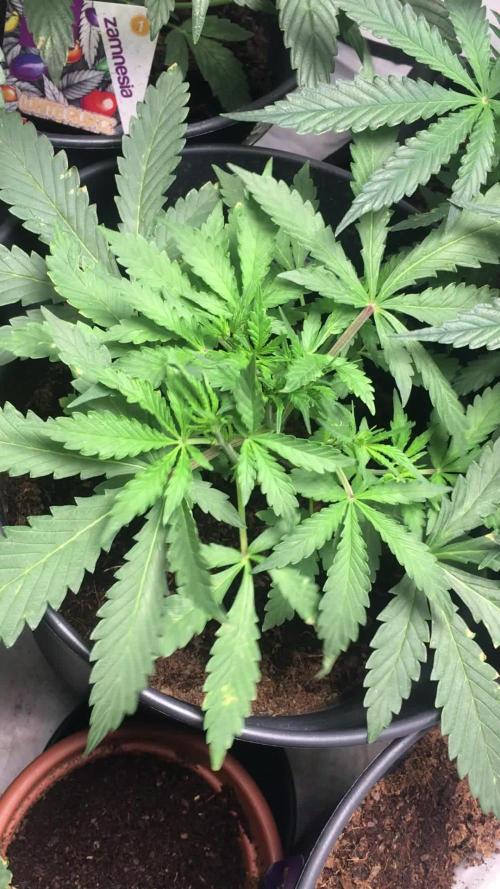
She responded very well to the toping and now we are going strong into week 4, been a smooth ride so far. Even through the cold days
16.01.26
Smooth week so far

Likes
20
Share

@DogDoctorOfficial
Follow
Grow Report — Nectar Drip
GrowDiaries Week 10 (Actual Week ~6–7 from Seed)
First things first, a small clarification for anyone following the diary closely.
On GrowDiaries this report appears as Week 10, but in reality the plants are around week 6–7 from seed. The reason is simple: the first entry in the diary was created during germination and no photos were uploaded at that moment, so the timeline shifted a little on the platform.
So for accuracy:
plants are currently around week 6–7 from seed and well into early flower.
Now let’s talk about what has been happening.
⸻
Quick Recap
For anyone just arriving to the diary, here’s the short version of the journey so far.
The goal of this run has always been simple:
grow healthy plants, observe them carefully, and share the process honestly.
The environment has been kept stable and relatively simple:
• 12/12 from seed
• balanced feeding schedule
• steady environmental control
• minimal intervention unless the plants ask for it
Up until now we mostly focused on guiding growth and observation, allowing the plants to express themselves naturally while keeping the canopy organized.
And they are doing exactly that.
⸻
This Week — The Garden Is Exploding
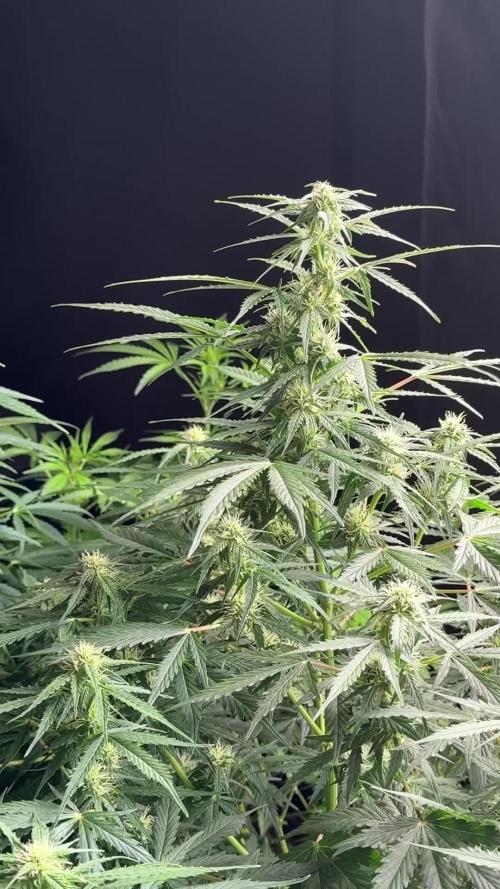
This week the girls are looking absolutely incredible.
Structure is strong.
Color is perfect.
Leaf health is excellent.
And the most exciting part:
trichomes are already everywhere.
Even at this stage the plants are starting to sparkle. Resin production is clearly ramping up and the flowers are stacking beautifully.
Height is now roughly around one meter to a little over one meter, creating a very healthy canopy without stretching out of control.
Honestly, these are beautiful specimens and a joy to watch develop.
⸻
Defoliation — Why We Did It Now
This week we performed a targeted defoliation.
This was not done because the plants were struggling or because something was wrong.
We did it by choice and by timing.
The reasoning is simple:
It is often easier and less stressful to remove certain leaves earlier in flower rather than waiting until the canopy becomes dense and airflow becomes restricted.
So we removed only what was necessary to:
• improve light penetration
• increase air movement inside the canopy
• reduce future humidity pockets
• allow the flowers to develop in a more open environment
Nothing aggressive.
Nothing excessive.
Just removing leaves that were clearly blocking key flower sites.
This kind of intervention is always a balance. Different growers prefer different approaches, but in this case it felt like the right moment to open the canopy a bit.
Now we observe how the plants respond.
⸻
First Structural Training
This week also marks the first time we applied some stronger structural training to these girls.
Until now the plants were mostly guided and allowed to develop naturally.
At this stage we introduced a bit more direction to the structure so the canopy develops evenly and future flower sites receive better light exposure.
Again, nothing extreme.
The idea is simply to help the plant organize itself for the next weeks of flowering.
The real feedback from this will come in the next report, where we will see how they react.
⸻
Environmental Conditions
The room is currently running around:
Temperature: ~28°C
Relative Humidity: ~68%
Outside conditions at the moment are:
~10°C with about 87% humidity
Considering the outside environment, we are actually very happy with how stable the room is staying.
But one thing worth mentioning:
We don’t chase room VPD numbers too aggressively.
What really matters is leaf VPD and plant response.
Plants tell the truth much better than charts do.
Right now the plants look extremely happy:
• strong leaves
• no stress signals
• steady growth
• excellent resin development
So the environment is clearly working for them.
⸻
Nutrients
Feeding remains exactly the same for now.
No changes this week.
The current nutrient schedule continues to support healthy growth and there is no reason to modify something that is clearly working.
Sometimes the best move in the garden is simply:
don’t change what isn’t broken.
⸻
Introducing a New Team Member
This week we also officially welcomed a new member to the team:
Mr. Baggy.
He has already been making appearances around the garden and many of you may have spotted him in some of the photos.
He’s now officially part of the crew and helping around the studio and garden.
Please give him a warm welcome when you see him around the diary.
He’s a cool guy and we’re happy to have him with us.
⸻
Gratitude
As always, huge appreciation to everyone who takes time to visit this diary.
To the:
• longtime followers
• new visitors
• curious growers
• supporters
• skeptics
• lovers
• haters
Everyone has a space here.
If energy crosses paths here, something is being exchanged and that always has value.
Special thanks as well to:
• the breeders behind these genetics
• the GrowDiaries platform
• the entire GD community
And of course to the sponsors supporting the project.
⸻
What To Expect Next
Over the next weeks we will mainly observe how the plants respond to the structural adjustments made this week.
Things we’ll be watching closely:
• flower stacking
• resin development
• canopy response after defoliation
• structural balance of the plants
If everything continues like this, the next weeks should be very exciting.
The girls are clearly entering the phase where the flowers start building real weight and character.
And we’ll be here documenting every step.
🙏 Thank you for your patience and continued support.
FOR DISCOUNT CODES AND MORE JUST FOLLOW THE LINK https://website.beacons.ai/dogdoctorofficial
📲 Don’t forget to Subscribe and follow me on Instagram and YouTube @DogDoctorOfficial for exclusive content, real-time updates, and behind-the-scenes magic. We’ve got so much more coming, including transplanting and all the amazing techniques that go along with it. You won’t want to miss it.
GrowDiaries Journal: https://growdiaries.com/grower/dogdoctorofficial
Instagram: https://www.instagram.com/dogdoctorofficial/
YouTube: https://www.youtube.com/@dogdoctorofficial Deleted by Youtube
Vimeo : https://vimeo.com/dogdoctorofficial Under construction stay tuned ⸻
Explore the Gear that Powers My Grow
If you’re curious about the tech I’m using, check out these links:
🔆 Lighting & Environmental Control
• Future of Grow — Advanced LED lighting technology
https://www.futureofgrow.com/
DISCOUNT CODE: DOG20
• Lumiflora — Under-canopy LED lighting
https://lumiflorade.com/
• TrollMaster — Environmental controllers and automation gear (past collaboration)
⸻
Genetics
• Zamnesia Seeds — Genetics used in this project
https://www.zamnesia.com/
⸻
🌱 Soil, Substrates, Boosters & Root Support
• Plagron — Substrates, bio mixes, and supportive products
https://plagron.com/en/
⸻
🎒 Storage, Curing & Preservation
• Grove Bags — Curing and storage solutions
https://grovebags.com/
⸻
Straw Baggy Links
🌍 Website
https://www.strawbaggy.com/?ref=339 10% discount code for our Community - Dogdoctor10
📸 Instagram
https://www.instagram.com/straw_baggy/
⸻
📸 Photography Equipment & Tools
(Not sponsors, but part of my creative toolkit)
• Sony A6700
• Sony full-frame macro lens + few more
• Stacking photography workflow - learning
• iPhone (for behind-the-scenes shots)
We’ve got much more coming as we move through the grow cycles. Trust me, you won’t want to miss the next steps, let’s push the boundaries of indoor horticulture together!
As always, this is shared for educational purposes, aiming to spread understanding and appreciation for this plant. Let’s celebrate it responsibly and continue to learn and grow together.
With true love comes happiness. Always believe in yourself, and always do things expecting nothing and with an open heart. Be a giver, and the universe will give back in ways you could never imagine.
💚 Growers love to all 💚
📸 P.S. – The Eye Behind the Lens
All photos in this diary (for now — except for the ones showing the camera, which I took with an iPhone) are taken with a Sony A6700 paired with a Sony full-frame macro lens and a few more.
Photography is part of the story — it’s how we share the fine textures, the glow, and the quiet details that words can’t always capture.
I’ve also started experimenting with photo stacking — a technique where multiple images, each taken at a slightly different focus point, are layered together to create one perfectly sharp image from front to back.
It’s not digital enhancement or AI; it’s pure photography — a way to reveal the plant’s beauty in microscopic depth, from trichome to petal.
You’ll even see a few shots of "ghost me" capturing the shots — camera, lens, setup — because every grow deserves not just to be cultivated, but documented like art.
FOR DISCOUNT CODES AND MORE JUST FOLLOW THE LINK https://website.beacons.ai/dogdoctorofficial
NEW DISCORD - Official Server Invite Link : https://discord.gg/ksjAkA5T74
Likes
15
Share


@Insaniac_0
Follow
Flower Week 5 Day 35 to 41 - 3/19 to 3/25
Got behind on my attention to these this week. That combined with their age in maturity, they really show stress this week.
Feed this week was 1.25 gallons 1 time this week and they suffered because of it. 700ppm total before add-ins. I used 700ppm Bloom concentrate mix (recipe week 5). Then I added 1ml/gal of CaliMagic (General Hydroponics 1-0-0) PH balance this week was 6.5 again.
I plan to feed 1.25gal next week with 6.6ph. However starting this week I will be starting a flush cycle of half ppms at about 400 and also decided that I will not be using HP2 - final defoliation will happen as well
Likes
5
Share


@Jays_Not_Here_Man
Follow
Girls have exploded into flower! They had a big stretch and have started stacking very nicely. Flower came so fast, they are showing a slight phosphorus need, and perhaps a bit more cal/Mag to help with uptake and such. I’ve been introducing the Clyde nutrients slowly to try and avoid burn, but I clearly need a bit more. I am liking the results overall though. Happy Gardening 🇨🇦❤️🌱😎💨


Likes
5
Share


@84ruk
Follow
The strain is really good. I harvested it when the trichomes were milky and it had a very energizing and uplifting effect. I'll definitely grow it again now with better care and the knowledge I've gained. I harvested around 20 grams dry.


Likes
229
Share


@Crashoverite
Follow
Hi everyone 😁
Welcome back in another week update!
Have to say girls are looking stunning 😍 frost it's almost everywhere. Trichomes on some buds up to 30% amber and progressing by hour. They are gaming weight on buds nicely as well. Aroma OMG I am sensing ripe sweet fruits, a bit woody and gasy. Planning to turn the lights off on Thursday at midnight and harvest by Sunday 😅
Wishing everyone a great week
Stay tuned for daily updates
Peace and love brothers and sisters ✌️💚
02/10 Day 71
Watered again approx. 2.5l of water and fish shit at 0.4 ml per 1 ltr. Runoff approx. 50-100ml.
04/10 Day 73
Everything going great. More amber trichomes, almost all pistils hairs are brown. These girls are almost ready. The Day it's just around the corner.
05/10 Day 74
Last watering, in the morning approx. 1.5l per pot. At midnight lights out for good.
06/10 Day 75
Uploaded 2 clips from last night.
Trichomes are on point. Some buds 50-70% amber and they did gained some weight overnight. Just one more night of darkness and will harvest! 😎
07/10 Day 76
It's done!!! Harvested and trimmed.
Soon will return with final update - Harvest 😁
Thank you all for such a great support, likes comments and pm's
Peace and love brothers and sisters ✌️💚

Likes
43
Share


@Jack_Greenstalk
Follow
week 3, at day 21 I started to defoliate. needs more airflow around colas. This is the start of defol, will clean and prune as needed next week. Stretching has slowed and colas are starting to stack. Ran a sort of modified manafold into the scrog. "V" on the left has 15 tops from 4 main stalks, she was topped to 4th node early on. "Blue nemo" was topped to the 3rd node early, she has 18 tops after the week 3 prune of the week lowers who couldnt make it up to the canopy. I left some popcorn buds down low that have began to develop, will throw these in the ice water hash after harvest.


Likes
5
Share

@Bncgrower
Follow
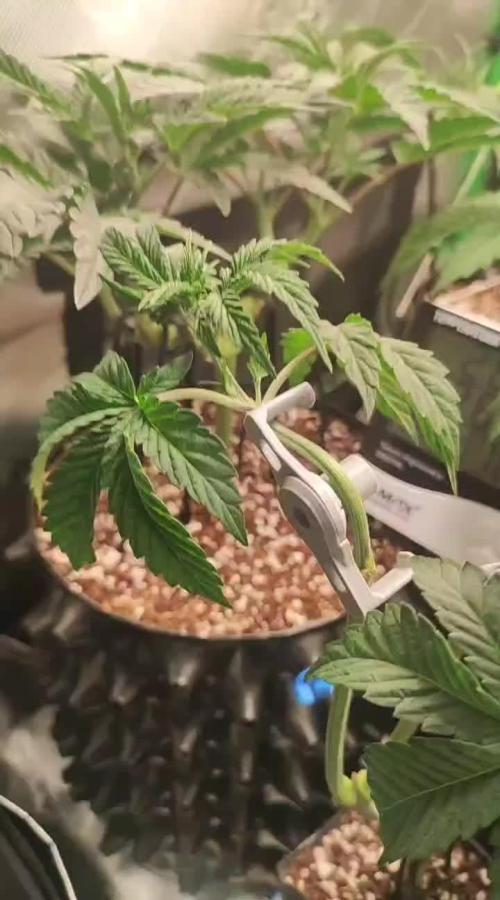
Sorry, I'm a bit behind on my updates... Everything is going according to plan 💪🌿
Likes
14
Share


@Belverde
Follow
Hi mates😊.. Final week also for this beautiful PEYOTE CRITICAL, grow in Super Soil (almost "vegetarian" ) for try to increase in special case the taste😋... Awesome strain, for what I can see during this three months..
Super strong ..and of course super resin production.. The smell is intense...kushy definitely..but with some other notes..sweet notes..
More delicate then two others Peyote Critical, in another diary... Trichomes was super milky and, 10/15% ambra..
The leafs are a little bit light green, compare always with other two babies, and it's good..but, you know, sometimes this happens with some genetics, leafs still dark green, specially in pre-mixed organic soil..but the final product always beeing clean and super tasty...
We will to see
it.. Next time..
Harwest day..
See you in about 5 days..I think she's ready😉👌..
Thank you very much for reading 🙏 bye ✌️

Likes
7
Share


@LittleBigTrees
Follow
Feeding still as they look like they need another week or two to finish.
The trichomes are all still clear.

Likes
23
Share


@adam_pawloski87
Follow
This week went real great , one has been getting flushed and the rest we will start flush Tomorrow! These ladies are doin so amazing! Hope you all enjoy !! Stay tuned for next week! Cheers an happy holidays!
Likes
6
Share


@WoodyDGrow
Follow
Its a little bit hotter now , all plants have nice flowers an i hope they grow nice buds
Likes
Comments
Share

@smoking_hills9
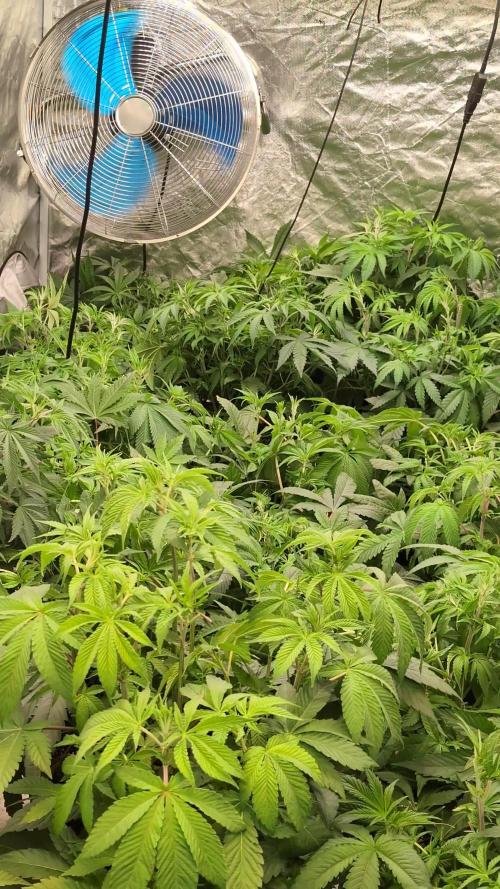
Follow
Plants are huge( most of them anyway) and I forget about 2 weeks preflower stretch , so I am switching to bloom mode from today. Defoliated again.