Likes
Comments
Share
@MassEric
Follow
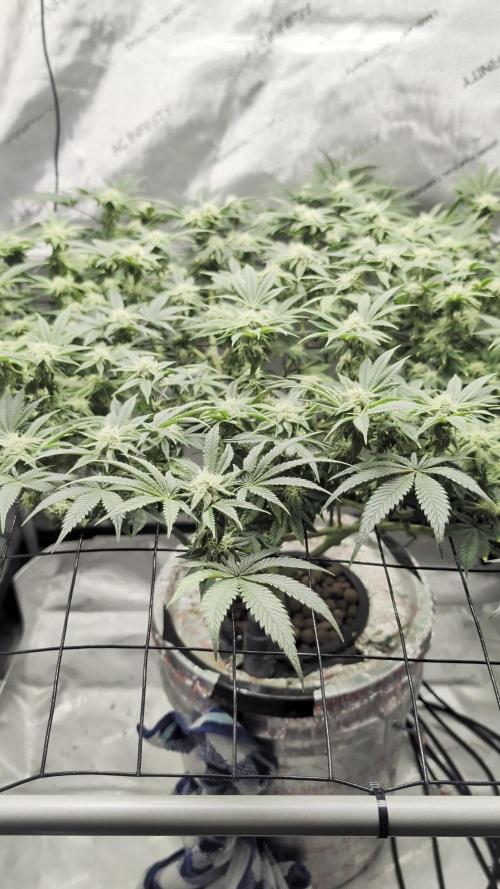
Another week down and it appears that the upward stretching has finally slowed down to a crawl at this point. I probably could have done a far better job managing these plants for maximum yields given I was doing some quick and dirty pheno hunting it really wasn't needed. I am glad to see the buds are beginning to swell nicely now. The time lapse really shows it off well, even if it is a bit over-exposed. I *really* need to get some better glass in there.... This old Brino 720p camera isn't cutting it when I want nice close shots. The buds are showing some nice trichome development as well. I'm more than a little curious to see how they after another month of filling out.
Likes
5
Share
@skaf420
Follow
The trichome formation is going fast now. The plants are becoming more and more forsty. Lets see where its ends :D
Likes
52
Share
Flowering day 11 since time change to 12/12 h. Hey guys :-) The first days of this week it looked really terrible for me because it was much too cold because of the unusual temperature. The heating mat has now also arrived for the big tent and lo and behold the plants have been developing really well since that day ☺️👍. The temperature doesn't keep quite as well as in the small box, but at least I don't get below 18 degrees in the pots at night anymore, even though it's only 16 at the top 😅👍. Since I switched to flowering, it was time to rinse off a bit with Clean Fruits :-) . Did them a lot of good. You have already received the first watering with Grow Liquid and the next in a mix with Bloom Liquid 😀👍. Otherwise everything was cleaned and checked. Stay healthy 🙏🏻 👇🏼👇🏼👇🏼👇🏼👇🏼👇🏼👇🏼👇🏼👇🏼👇🏼👇🏼👇🏼 You can buy this Nutrients at : https://greenbuzzliquids.com/en/shop/ With the discount code: Made_in_Germany you get a discount of 15% on all products from an order value of 100 euros. 👇🏼👇🏼👇🏼👇🏼👇🏼👇🏼👇🏼👇🏼👇🏼👇🏼👇🏼👇🏼 You can buy this strain at : https://www.ripperseeds.com/en/feminized/kmintz-feminized-cannabis-seeds Water 💧 💧💧 Osmosis water mixed with normal water (24 hours stale that the chlorine evaporates) to 0.2 EC. Add Cal / Mag to 0.4 Ec Ph with Organic Ph - to 5.8 - 6.5 MadeInGermany
Likes
28
Share
@Sators
Follow
Hi good fellows!💚 🌱Day 50. Watering with 3L 6.8ph 150ppm clear tap water. Run off water get 115ml and measures is 6.7ph 650ppm. MP4 included.💚 🌱Day 52. Watering with 2.7L 7ph 150ppm clear tap water. Run off water get 115ml and measures is 6.7ph 550ppm. Worry about ppm level. Keep watering with clear tap water!💚 🌱Day 54. Watering with 2.5L 7ph 150ppm clear tap water. Run off water get 35ml and measures is 6.7ph 400ppm.💚 🌱Day 56. Watering with 2.7L 6.8ph 150ppm clear tap water. Run off water get 55ml and measures is 6.7ph 400ppm. Amazing!💚
Likes
96
Share
Week 4 Report: Big Cheese Auto Flourishing in Autopilot Mode! Hey there, fellow cultivators! It's that time again – Week 4, and our Big Cheese Auto is stepping into a new phase of autonomy. This week, I introduced the Autopot system, letting our green friend decide when and how much to drink. It's like giving her the keys to the watering kingdom, and she's embracing the freedom beautifully. First and foremost, a hearty shoutout to Seeds Mafia for gifting us with genetics that keep on giving. The resilience and vigor displayed by our Big Cheese Auto are a testament to the quality seeds we started with. Now, let's dissect the nutrient symphony that's been playing in the background: Regulator (0.15ml/L): Our humidity maestro continues to dance with the elements, ensuring a stress-free environment for our plant. The monoclinic acid is working its magic, and our Big Cheese Auto is sipping contentedly in her newfound freedom. Calmag (0.25ml/L): Calmag, our nutrient bodyguard, remains on duty. This week, it's all about maintaining that structural integrity as our plant starts gearing up for more vigorous growth. Strong stems, sturdy leaves – the foundations of greatness. All-in-One Liquid (1ml/L): The NPK trio in the All-in-One Liquidstoped as the pellets on the soil s are now available and are the backbone of our nutrient regimen. Nitrogen, phosphorus, potassium – it's a growth party, and our Big Cheese Auto is the VIP. This all-in-one soil simplifies our feeding routine, letting us focus on the art of cultivation. Start Boost (0.25ml/L): Start Boost, the architect behind our root cathedral, is still in play. Those micronutrients are like construction workers building a solid foundation for our plant's future. The roots are thriving, and our Big Cheese Auto is standing tall. Aptus Mycor Mix: The underground alliance of mycorrhizal fungi and roots is establishing a symbiotic relationship that's pure magic. It's like having a secret society beneath the soil, enhancing nutrient uptake and fortifying our plant's foundation. NutriSpray by Aptus Holland: Introducing a new player to the nutrient team – NutriSpray. Packed with organic surfactants and a microelement cocktail (Mn, S, Zn, Fe), this foliar spray is like a spa treatment for our leaves. The horse chestnut extract binds with microelements, creating a protective shield that stays on leaves for up to two weeks. It's like a force field against nutrient deficiencies. How NutriSpray Works: The horse chestnut extract binds to microelements, creating a protective shield. This shield ensures the nutrients stay on leaves, allowing for a slow release over two weeks. Additionally, it thins vascular fluid, facilitating faster nutrient transport within the plant. How to Use NutriSpray: Dilute with water (2ml per 1L), and spray the entire leaf surface. For our indoor oasis, I sprayed during weeks 1, 3, and 5 of bloom for general nutrition. Our training efforts continue to pay off. Low Stress Training (LST) by bending leaves is shaping our plant into a work of art. The canopy is becoming more even, optimizing light exposure for future buds. The transplant into the spacious 15 L pot is proving to be a smart move. The roots are spreading their wings, exploring the nutrient-rich soil, and our Big Cheese Auto is reaping the benefits with each passing day. As we move into the next week, the excitement is palpable. The Autopot system is in full swing, and I can't wait to see how our Big Cheese Auto takes the reins of her own hydration destiny. Once again, a huge thanks to Seeds Mafia, Aptus Holland, Grow Diaries, and our amazing community. This journey is a collective effort, and your support is the fuel that keeps us growing. Let's continue to cultivate greatness together! Genetics -Seeds Mafia Big Cheese Automatic Light - LUMATEK ZEUS 465 COMPACT PRO 
Food - APTUS HOLLAND 
 
All info and full product details can be find in can find @ https://seedsmafia.com 

https://aptus-holland.com/
 

https://lumatek-lighting.com/ As always, thank you all for joining me on this journey, for your love, and for it all. My horticultural odyssey would never be the same without you. Your love and support are cherished, and I feel both honored and blessed to have you in my life <3 <3 <3 With true love comes happiness. Always believe in yourself and always do things expecting nothing in return, with an open heart. Be a giver, and the universe will respond in ways you can't even dream off. Friendly reminder: all you see here is pure research and for educational purposes only <3 <3 <3 Growers love to you all <3 <3 <3 P.S- I must extend my sincerest apologies for the missing video reports. Regrettably, Grow Diaries is still facing some technical issues that are preventing me from uploading them. Rest assured, as soon as the situation is resolved, I'll share those videos to give you an even closer look at this fascinating journey.
Likes
6
Share
All good so far
Processing
Likes
14
Share
Plants leaves are out of control. Had to do an early pruning to open up plant a bit. Probably could’ve done more but dont wanna stress them out too much. Raised light a bit to encourage a bit of stretching. Irrigation working great but overwatered plants again testing it. Did some lst to open up plants and get branches above those giant leaves.
Likes
Comments
Share
@Archentar
Follow
Separating the Heat from the Garbage ✂️🗑️ Week 9, and it's time for some honest talk. This week was all about damage control and heavy pruning. To be completely blunt, these FastBuds RF3 genetics are a massive mixed bag. The Strawberry is looking absolutely terrible, and it’s clear the Guava is going to be a total disappointment too. Just zero potential on those two. The only saving grace in the tent right now is the Banana Purple Punch she is actually holding it down, stacking nicely, and showing some real quality. At this stage, I'm just cleaning up the trash phenos, focusing on the Banana, and pushing through to the finish line. Not every run can be a winner, but we ride it out until the end! 🤷‍♂️💨
Likes
8
Share
@Naujas
Follow
28 dienos!!! Megaitų nemačiau kelias dienas, tad prieš išeidamas šiek tiek palaistiau, bet manau, kad tai bus sutvarkyta, 28 dieną pašalinau lapus ir šakas, taip pat pradėjau ją dresuoti LST, bet mano palapinė tikra netvarka, nežinau, kur ji yra ir kaip :D Vos telpa dvi damos:) sėkmės visiems :).
Processing
Likes
26
Share
Thanks Short Stuff Super Cali Haze will be a nice one, I hear she gets big . This strain is the holy grail of auto flowering growers, a true and pure auto-Sativa and one which has been described as a SUPER AUTO by its breeder stitch. Stitch has been working for many years on refining an autoflowering haze strain but as many other breeders know this a very difficult and some say an impossible task. Stitch finally managed to do this when he created his ‘Nirvana sky’ strain and this has been used as the basis of super cali-haze. First a ruderalis was crossed with haze special and bred until it was 100% autoflowering. This was then crossed back with a resinuous colombian mother from Cali state and the super auto was then stabilised. Super cali haze is our first SUPER AUTO and she is a big tall strain which can grow over 2 metres outdoors and produce upwards of 4 ounces. This is perfect for someone wanting to fit 2 harvests into one summer season and still be cropping out before everyone using traditional photo-period strains. Super cali haze also works perfectly indoors although some training and tying down may be required to help control her unbelievable growth. Unlike most autoflowering strains which are indica dominant Super cali-haze is a pure Sativa strain so will give you that soaring cerebral hit you expect from a good old fashioned haze. The aroma of the plant is not too potent but when you take your first hit you will truly experience its wonderful earthy and spicy flavour. The high comes on fast and is uplifting, energetic and incredibly potent keeping you on another level for a good few hours. When you come down its without a big bump and super cali haze will not leave you feeling groggy and lethargic. This really is a very different auto and one which you will surely want in your collection. The super auto is here and its here to stay, this is going be Big!!!
Processing
Likes
15
Share
Start of week 7 for the OG Kush and blueberry. Second repeat of week 5 feeding for the super lemon haze as she's on a 10 week schedule. OG's are super sticky, smelly and packing on thick dense buds, blueberry is bulking up, but not nearly as much as the oG. The SLH is also pumping out nice buds, that are very sticky. Very happy with this grow so far.
Processing
Likes
23
Share
Another week down few more to go can't wait!! First ever attempt of growing my own so really impatient to see the final results now and get to the finish line, that said all has went well upto now other than the size they reached haha, really started putting on weight now it seems and they smell lovely, excited to see the buds fatten and progress over these last few weeks up until harvest now, started 5 liberty haze also they are just coming upto 3 weeks now so check that diary out to, any comments info tips for the final stages appreciated
Likes
18
Share
Green light is radiation with wavelengths between 520 and 560 nm and it affects photosynthesis, plant height, and flowering. Plants reflect green light and this is why they appear green to our eyes. As a result, some growers think that plants don’t use green wavelengths, but they actually do! In fact, only around 5 – 10% of green light is reflected from leaves and the rest (90 – 95 %) is absorbed or transmitted to lower leaves [1]. Green wavelengths get used in photosynthesis. Chlorophyll pigments absorb small amounts of green wavelengths. Light that doesn’t get absorbed is transmitted to leaves that are shaded out from direct light. This means that leaves at the bottom of the canopy get more green light than leaves at the top. A high proportion of green wavelengths compared to other colors tells lower leaves that they are being shaded out, so they are able to react accordingly. Lower leaves may react by opening or closing their stomata or growing longer stems that help the leaves reach brighter light [1, 2, 3]. When it comes to growing cannabis, many cultivators are interested in the quality of light used for the flowering stage. In many plants, flowering is regulated by two main photoreceptors: cryptochrome and phytochrome. Both photoreceptors primarily respond to blue light but can also respond to green, although to a lesser extent. Green can accelerate the start of flowering in several species (although cannabis has yet to be tested) [1, 4, 5]. However, once flowering has begun, it’s important to provide plants with a “full spectrum” light that has high amounts of blue and red light, and moderate amounts of green, in order for photosynthesis to be optimized. Green light mediates seed germination in some species. Seeds use green wavelengths to decide whether the environment is good for germination. Shade environments are enriched in green relative to red and blue light, so a plant can tell if it is shady or sunny. A seed that senses a shaded environment may stay dormant to avoid poor growing conditions [1]. Some examples of plant species where researchers have documented this response are: ryegrass (a grass that grows in tufts) and Chondrilla (a plant related to dandelion) [1, 6]. Although green wavelengths generally tell plants NOT to germinate, there are some exceptions! Surprisingly, green wavelengths can stimulate seed germination in some species like Aeschynomene, Tephrosia, Solidago, Cyrtopodium, and Atriplex [1, 6, 7]. Of course, light is not the only factor affecting seed germination – it’s a combination of many factors, such as soil moisture, soil type, temperature, photoperiod, and light quality. When combined with red and blue light, green can really enhance plant growth [1, 8]. However, too much green light (more than 50% of the total light) can actually reduce plant growth [8]. Based on the most current research, the ideal ratio of green, red, and blue light is thought to be around 1:2:1 for green:blue:red [9]. When choosing a horticultural light, choose one that has high amounts of blue and red light and moderate amounts of green and other colors of light. Not many studies can be found about the effect of green light on cannabis growth or metabolism. However, if one reads carefully, there are clues and data available even from the very early papers. Mahlberg and Hemphill (1983) used colored filters in their study to alter the sunlight spectrum and study green light among others. They concluded that the green filter, which makes the environment green by cutting other wavelengths out, reduced the THC concentration significantly compared to the daylight control treatment. It has been demonstrated that green color can reduce secondary metabolite activity with other species as well. For example, the addition of green to a light spectrum decreases anthocyanin concentration in lettuce (Zhang and Folta 2012). If green light only reverses the biosynthesis of some secondary metabolites, then why put green light into a growth spectrum at all? Well, there are a couple of good reasons. One is that green penetrates leaf layers effectively. Conversely red and blue light is almost completely absorbed by the first leaf layer. Green travels through the first, second, and even third layers effectively (Figure 2). Lower leaf layers can utilize green light in photosynthesis and therefore produce yields as well. Even though a green light-specific photoreceptor has not yet been found, it is known that green light has effects independent from the cryptochrome but then again, also cryptochrome-dependent ones, just like blue light. It is known that green light in low light intensity conditions can enhance far red stimulating secondary metabolite production in microgreens and then again, counteracts the production of these compounds in high-intensity light conditions (Kim et al. 2004). In many cases, green light promoted physiological changes in plants that are opposite to the actions of blue light. In the study by Kim et al. blue light-induced anthocyanin accumulation was inhibited by green light. In another study it has been found that blue light promotes stomatal opening whereas green light promotes stomatal closure (Frechilla et al. 2000). Blue light inhibits the early stem elongation in the seedling stage whereas green light promotes it (Folta 2004). Also, blue light results in flowering induction, and green light inhibits it (Banerjee et al., 2007). As you can see, green light works very closely with blue light, and therefore not only the amount of these two wavelengths separately is important but also the ratio (Blue: Green) between these two in the designed spectrum. Furthermore, green light has been found to affect the elongation of petioles and upward leaf reorientation with the model plant Arabidopsis thaliana both of which are a sign of shade avoidance symptoms (Zhang et al. 2011) and also gene expression in the same plant (Dhingra et al. 2006). As mentioned before, green light produces shade avoidance symptoms which are quite intuitive if you consider the natural conditions where the plants grow. Not all the green light is reflected from the highest canopy leaves in nature but a lot of it (50-90%) has been estimated to penetrate the upper leaves at the plant level ((Terashima et al., 2009; Nishio, 2000). For the plant growing in the understory of the forest green light is a signal for the plant of being in the shade of a bigger plant. Then again, the plants growing under unobstructed sunlight can take advantage of the green photons that can more easily penetrate the upper leaves than the red and blue photons. From the photosynthetic pigments in higher plants, chlorophyll is crucial for plant growth. Dissolved chlorophyll and absorb maximally in the red (λ600–700 nm) and blue (λ400–500 nm) regions of the spectrum and not as easily in the green (λ500–600 nm) regions. Up to 80% of all green light is thought to be transmitted through the chloroplast (Terashima et al., 2009) and this allows more green photons to pass deeper into the leaf mesophyll layer than red and blue photons. When the green light is scattered in the vertical leaf profile its journey is lengthened and therefore photons have a higher chance of hitting and being absorbed by chloroplasts on their passage through the leaf to the lower leaves of the plant. Photons of PPFD (photosynthetic photon flux density) are captured by chlorophyll causing an excitation of an electron to enter a higher energy state in which the energy is immediately passed on to the neighboring chlorophyll molecule by resonance transfer or released to the electron transport chain (PSII and PSI). Despite the low extinction coefficient of chlorophyll in the green 500–600 nm region it needs to be noted that the absorbance can be significant if the pigment (chlorophyll) concentration in the leaf is high enough. The research available clearly shows that plants use green wavelengths to promote higher biomass and yield (photosynthetic activity), and that it is a crucial signal for long-term developmental and short-term dynamic acclimation (Blue:Green ratio) to the environment. It should not be dismissed but studied more because it brings more opportunities to control plant gene expression and physiology in plant production. REFERENCES Banerjee R., Schleicher E., Meier S. Viana R. M., Pokorny R., Ahmad M., Bittl R., Batschauer. 2007. The signaling state of Arabidopsis cryptochrome 2 contains flavin semiquinone. The Journal of Biological Chemistry 282, 14916–14922. Dhingra, A., Bies, D. H., Lehner, K. R., and Folta, K. M. 2006. Green light adjusts the plastic transcriptome during early photomorphogenic development. Plant Physiol. 142, 1256-1266. Folta, K. M. 2004. Green light stimulates early stem elongation, antagonizing light-mediated growth inhibition. Plant Physiol. 135, 1407-1416. Frechilla, S., Talbott, L. D., Bogomolmi, R. A., and Zeiger, E. 2000. Reversal of blue light -stimulated stomatal opening by green light. Plant Cell Physiol. 41, 171-176. Kim, H.H., Goins, G. D., Wheeler, R. M., and Sager, J. C. 2004.Green-light supplementation for enhanced lettuce growth under red- and blue-light emitting diodes. HortScience 39, 1617-1622. Nishio, J.N. 2000. Why are higher plants green? Evolution of the higher plant photosynthetic pigment complement. Plant Cell and Environment 23, 539–548. Terashima I., Fujita T., Inoue T., Chow W.S., Oguchi R. 2009. Green light drives leaf photosynthesis more efficiently than red light in strong white light: revisiting the enigmatic question of why leaves are green. Plant & Cell Physiology 50, 684–697. Zhang, T., Maruhnich, S. A., and Folta, K. M. 2011. Green light induces shade avoidance symptoms. Plant Physiol. 157, 1528-156. Wang, Y. & Folta, K. M. Contributions of green light to plant growth and development. Am. J. Bot. 100, 70–78 (2013). Zhang, T. & Folta, K. M. Green light signaling and adaptive response. Plant Signal. Behav. 7, 75–78 (2012). Johkan, M. et al. Blue light-emitting diode light irradiation of seedlings improves seedling quality and growth after transplanting in red leaf lettuce. HortScience 45, 1809–1814 (2010). Kasajima, S., et al. Effect of Light Quality on Developmental Rate of Wheat under Continuous Light at a Constant Temperature. Plant Prod. Sci. 10, 286–291 (2007). Banerjee, R. et al. The signaling state of Arabidopsis cryptochrome 2 contains flavin semiquinone. J. Biol. Chem. 282, 14916–14922 (2007). Goggin, D. E. & Steadman, K. J. Blue and green are frequently seen: responses of seeds to short- and mid-wavelength light. Seed Sci. Res. 22, 27–35 (2012). Mandák, B. & Pyšek, P. The effects of light quality, nitrate concentration and presence of bracteoles on germination of different fruit types in the heterocarpous Atriplex sagittata. J. Ecol. 89, 149–158 (2001). Darko, E. et al. Photosynthesis under artificial light: the shift in primary and secondary metabolism. Philos. Trans. R. Soc. B Biol. Sci. 369 (2014). Lu, N. et al. Effects of Supplemental Lighting with Light-Emitting Diodes (LEDs) on Tomato Yield and Quality of Single-Truss Tomato Plants Grown at High Planting Density. Environ. Control Biol. 50, 63–74 (2012).
Likes
11
Share
@RoyColt
Follow
Day45 continue main lining,lst and def. Day46 2,5lt ro water 2,5ml sensi cal mag extra Total 200 ppm pH6.2 Drain 150 ml 880 ppm. Day49 18.01 3lt ro water 4ml growA 4ml growB total 1050 ppm ph 6,1 Drain 200ml 1080ppm.
Likes
44
Share
@Haoss
Follow
Active flowering began 😈, I gave fertilizers from the second week of flowering
Likes
16
Share
@Naujas
Follow
girl, from the beginning she was watered with water from the tap, the value of which is almost 350ppm. and a lot of lime, which prevents me from growing it bigger, but I'm happy with the result :) it's a small pot and only 50 w :) the flowers look very beautiful and sticky :) super ​
Likes
6
Share
@Sup3rNov4
Follow
She is beautiful. Slowed down on water intake but thats fine as I believe the roots are spreading before the fruits fatten
Likes
50
Share
INFO: __________________________________________ LIGHT: * 400 PPFD, 12/12 + Keep raising the PPFD with a (100) each week until we reach +800 PPFD. __________________________________________ NPK: * MAIN: PLAGRON // Coco A // 3,0ml / Liter * MAIN: PLAGRON // Coco B // 3,0ml / Liter * Stimulator: PLAGRON // Power Roots // 1,0ml / Liter * Stimulator: PLAGRON // Pure Zym // 1,0ml / Liter * Stimulator: Blackstrap Molasses // 5,0ml / Liter * Foliar Feeding: BIONOVA // Silution // 2,0ml / Liter __________________________________________ ENVIROMENT: * Humid: 60-65% * Temp: 22-25C * CO2: 600-900 __________________________________________ HAPPENINGS: + Flipped over to flower 12/12 light schedule + Increased the main nutrients - Can see some spots on the leafs, so im adding BIONOVA Silution in foliar feeding __________________________________________ STRAIN INFO: Gender: Feminised Genes: 80% INDICA - 20% SATIVA Genetics: Californian Sunset Sherbet and the autoflowering strain Strawberry Cola Auto. Harvest: 450-600 g/m² Flowering: 7 weeks THC: 18-22% CBD: 0,1% Taste: Earthy, Citrus, Cool EFFECTS Stimulating, Happiness, Relaxing Release Year202? WEBPAGE: https://sweetseeds.es/en/f1-fast-version-seeds/3237-strawberry-cola-sherbet-f1-fast-version.html