


Likes
Comments
Share


@Ju_Bps
Follow
Hello my friends 👩🌾👨🌾,
This little 9th flowering week was good 👊, we're now on the final Lap 🏁🏁.
Trichromes are now milky and few amber,
Ready to harvest! 🌲✂️✂️.
I've continued flush with flash cleaner
💦 1 Watering this week 1.8l/plant .
Water + flash cleaner
PH@6
Lamp @100%
After almost 5 months growing, Plants have been harvested, I'll publish harvest in few days.
Thanks community for follow, likes, comments, always a pleasure 👩🌾👨🌾❤️🌲
See you next week 👊👊
Mars Hydro - TS 1000
https://www.mars-hydro.com/ts-1000-led-grow-light
Mars Hydro - FC3000
https://www.mars-hydro.com/fc-3000-samsung-lm301b-led-grow-light
Mars Hydro - SP3000
https://www.mars-hydro.com/sp-3000-samsung-lm301b-greenhouse-led-grow-light
The High Chameleon - Vannila T
https://www.thehighchameleon.com/shop/vanilla-t-5


Likes
10
Share

@Crazy_Doofus
Follow
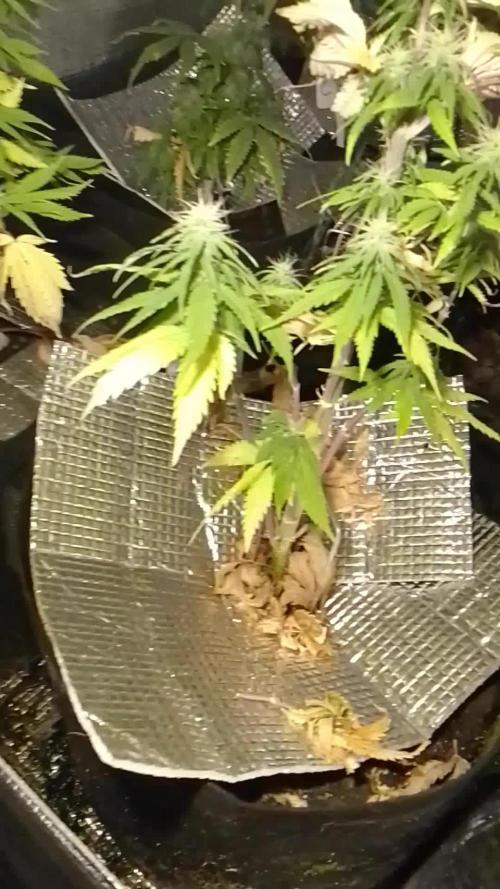
Growing a bit more, hope these feminised grow big flowers! Bit of LST on the top, peaking too close to the lamp
Flowers growing fast!! 😍😍😍 Looking great!!
Clones survived, still very small 🤞🤞
This plant looks great, ma best plant. At least 40gr + the clones ♥️♥️♥️♥️


Likes
58
Share


@MadeInGermany
Follow
Flowering day 18
since time change
to 12 / 12 h
Hey guys :-)
The ladies have recovered well from the cold thanks to the heating mat and have developed beautifully 👍.
During the check today I saw that despite spraying neem oil 3 times, there are still a few trips :-( .
Now I've ordered nematodes again specifically against trips for leaf and substrate.
I will use that immediately 👍.
Watering was done twice this week, each time with 1.3 l (nutrients see table above)
Next week I will remove the lowermost shoots so that the energy goes into the upper buds.
Fresh osmosis water was mixed with tap water and put into the 100 liter tank so that the water can stand and I'll have enough next week :-)
Otherwise everything was cleaned.
Have fun and stay healthy 💚🙏🏻
👇🏼👇🏼👇🏼👇🏼👇🏼👇🏼👇🏼👇🏼👇🏼👇🏼👇🏼👇🏼
You can buy this Nutrients at :
https://greenbuzzliquids.com/en/shop/
With the discount code: Made_in_Germany you get a discount of 15% on all products from an order value of 100 euros.
👇🏼👇🏼👇🏼👇🏼👇🏼👇🏼👇🏼👇🏼👇🏼👇🏼👇🏼👇🏼
You can buy this strain at :
https://www.thegratefulseeds.com/shop/feminized-seeds/limited-edition/blue-javaz/
Water 💧 💧💧
Osmosis water mixed with normal water (24 hours stale that the chlorine evaporates) to 0.2 EC. Add Cal / Mag to 0.4 Ec Ph with Organic Ph - to 5.8 - 6.5
MadeInGermany


Likes
13
Share


@Antonycultivatattoo
Follow
Es impresionante como han crecido tan robustas son tremendas cepas 🏵️💐 las más grandes son las de @sweetseeds que bellas crystal caldy


Likes
18
Share


@DogDoctorOfficial
Follow
Week 7 VEG – The White OG (Seedsman Seeds)
This week was all about shaping, training, and refining. We stepped into the art of mainlining, guiding her structure into perfection while giving her the space to shine. A little seduction, a little discipline, and a whole lot of plant love. 😏✨
🌿 Mainlining: The Art of Balance
Mainlining isn’t just training—it’s sculpting. By evenly distributing energy and growth, we create a strong, symmetrical plant that’s ready to thrive.
🔹 Topped and trained – Ensuring equal energy flow and balanced growth.
🔹 Leaving two nodes per branch – Structuring her for a powerful, even canopy.
🔹 Guiding her gently – With the right support, she bends but never breaks.
🍃 Defoliation: Light, Air, and Growth
Less is more when it comes to defoliation! The goal? More light penetration, better airflow, and a happier plant.
💡 Removing lower leaves – Redirecting energy to the most important growth points.
💨 Improving airflow – Keeping her environment fresh and reducing moisture buildup.
🌞 Allowing deeper light penetration – No more shadows, just pure, even growth.
🔥 The Studio Treatment
This week, she got the VIP studio treatment—out of the tent, under the lens, and shining against that sleek black background. Sometimes, you just have to appreciate the beauty of the work in progress.
Tent Conditions & Feedings
🔸 Temps: Around 18°C – a little chilly, but she’s handling it like a champ.
🔸 RH: 60% – Keeping that balance for steady veg growth.
🔸 Feed: Still running Aptus Holland’s organic-mineral lineup—strong, steady, and full of potential.
🔸 Lights: Future of Grow LED, 200 PPFD—keeping her compact and thriving.
💚 Shoutouts & Love
Huge thank you to the amazing sponsors and supporters!
🌱 @Seedsman @AptusHolland @FutureofGrow @TrolMaster @ProMixSoil @Cannakan
🌍 Special shoutout to the entire Grow Diaries family, the followers, the lovers, the haters—this one’s for you all!
👀 New episodes dropping weekly on YouTube! Come check it out! SeedsmanSeeds - DOGDOCTOR 10% off discount code is live!
🔥 Mainlining, training, defoliating—it’s all part of the dance. Let’s keep this beauty thriving!
Bonus Content: New Episodes Weekly on YouTube! 🎥
Don’t forget to check out my YouTube channel for weekly episodes with tips, tricks, and behind-the-scenes action. Links are in the profile—come join the fun!
Growers Love! 💚
DISCOUNT CODE - SeedsmanSeeds - DOGDOCTOR 10% off
As always thank you all for stopping by, for the love and for it all , this journey of mine wold just not be the same without you guys, the love and support is very much appreciated and i fell honored and so joyful with you all in my life 🙏
With true love comes happiness 💚🙏 Always believe in your self and always do things expecting nothing and with an open heart , be a giver and the universe will give back to you in ways you could not even imagine so 💚
Friendly reminder all you see here is pure research and for educational purposes only
💚Growers Love To you All and remember to keep that smile big and alive 💚
Likes
23
Share


@Jackweed77
Follow
Passata anche la seconda settimana di fioritura🌻 le ragazze 🌱stanno bene💪 e sembrano gradire la loro dieta Plagron🍨...nel prossimi giorni quando inizieranno a nascere i primi boccioli ⚘️ vedremo se la mia impressione è esatta....🧐👍

Likes
75
Share


@Jef79
Follow
EXOTIC SEEDS
STRAWBERRY COLA
Effect - Relaxed
Genetics - ((Strawberry Banana X Mango Cream Auto)F4 X Monster Mash) F3
Yield - 550 - 600 G/M2
Potency - High
Flowering Time - 8 Weeks
Great auto strain for beginners to veteran growers.. No problems with her throughout grow.. She's extremely short, stocky and produced very tight resinous flowers with beautiful colours all over her!.. Initial smoke after dry and simple curing was very pleasant fruity cola with a skunky after taste.. Nice and relaxing buzz from her also.. Definitely worth growing again..
www.exoticseed.eu
https://www.viparspectra.com/?aff=454&utm_source=affiliate
https://partners.viparspectra.com/create-account?ref=454
Coupons -
code: Itxsgdvip
code: JEF
https://www.amazon.com/dp/B08CHCFCG1?ref_=ast_sto_dp


Likes
16
Share


@BLAZED
Follow
Week 16 (30-9 to 6-10)
30-9
Temps: 18.2 to 24.8 degrees
Humidity: 55% to 73%
Watering: 2000 ml.
1-10
Temps: 19.1 to 24.1 degrees
Humidity: 64% to 77%
2-10
Temps: 18.6 to 23.5 degrees
Humidity: 59% to 77%
Watering: 2000 ml.
3-10
Temps: 17.8 to 22.9 degrees
Humidity: 57% to 74%
4-10
Temps: 17.7 to 26.8 degrees
Humidity: 54% to 68%
5-10
Temps: 17.6 to 22.8 degrees
Humidity: 54% to 75%
Watering: 2000 ml.
6-10
Temps: 17.6 to 22.5 degrees
Humidity: 55% to 72%

Likes
12
Share


@Roberts
Follow
FBA2505 is doing okay. She has had a good growth spurt after beating the root rot she has started to show pistils. Everything is looking a lot better then it was. Thank you Medic Grow, Athena, Xpert Nutrients, and Fast Buds. 🤜🏻🤛🏻🌱🌱🌱
Thank you grow diaries community for the 👇likes👇, follows, comments, and subscriptions on my YouTube channel👇.
❄️🌱🍻 Happy Growing 🌱🌱🌱
https://youtube.com/channel/UCAhN7yRzWLpcaRHhMIQ7X4g.
Likes
37
Share


@GreenHouseLab
Follow
Week 8 in the books, cruising to the finish line two more hard watering each and 48 hrs of darkness starting Friday.
Genetics: Natty Roots Seed Co
Instagram: @green_house_lab
Likes
3
Share

@ChubbyBudBros
Follow
-
Day 43
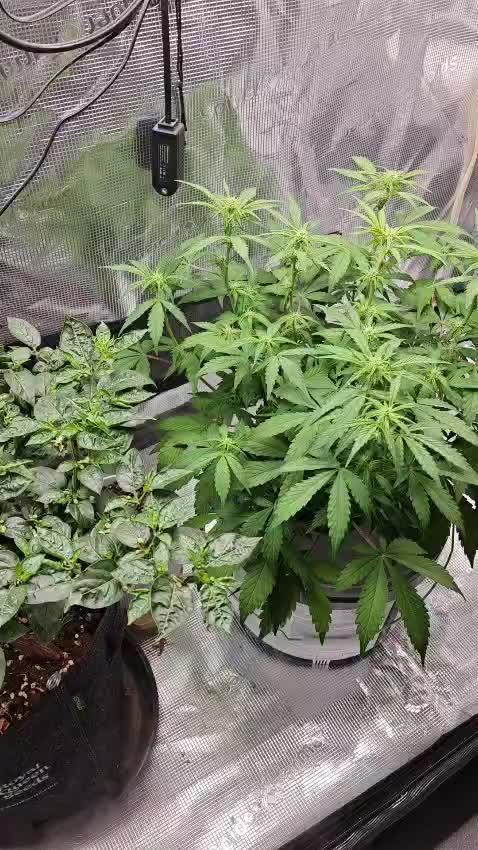
Refreshed the tank today. pH was reading at 5.5 so seems like she is mostly drinking the water and not really the nutrients..I think. she's drinking a lot so the nutrients get a lot more concentrated. Gonna have to keep an eye on that. Think it's good that I switch to a schedule now of replacing the water reservoir twice a week now. Also checked PPFD, the top canopy is getting about 620 PPFD.
Day 44
Flowers are starting to set in nicely. She is drinking a lot right now, have to top up the 4 liter reservoir every day now it seems. pH went up to 6.4, so brought it back down to 6.0 now.
Day 45
She had another big stretch over night. I've raised the light a bit as she was getting close to it now and I don't wanna overstress her. She is still drinking a lot, topped up the reservoir with another 1.3 liters of ph 6.0 water. Will be doing a full water change tomorrow.
Day 46
Fully renewed the water today with new nutrients, I did put in a bit less of each nutrient this time, I'm seeing some minor leaf tip burn starting to happen. Seems to correlate with the higher bloom nutrient dose, so I will dial that a bit down from now on. Removed some fan leaves on the fastest growing stems also to slow them down a bit, a lot of the smaller stems are starting to catch up nicely now.
Day 47
Had to top up with 1.5 liters of water, she is definitely drinking even more now...after adding the water (6.0 pH) the pH was 6.1. She is still growing a lot as well, especially those side stems are catching up to the top of the canopy. I should probably do some lollipopping soon.
Day 48
Ph was down to 5.8 today, had to top up the water again with 1.5 liter of 6.0 pH water, which brought the pH up to 5.9. She is still stretching quite a bit right now. Also did my first defoliation today, I removed a ton of leaves but it looks like barely anything was removed because there so much foliage 😅.
Day 49
pH got down to 5.7 today. It keeps surprising me to see how much she drinks in one day. Was able to top up the bucket with almost 2 liters again. Made the water 6.1 pH which brought the pH in the bucket back up to 5.9.
Processing
Likes
13
Share


@Trailblazers_Farm
Follow
Week Two:
The seedlings received their first and second feedings of Innovating Plant Products. Along with one just a plain watering. (Feed / Feed / Water).
The first feeding was on 5/21 of 900 ppm of the veg nutrient line. The pH was 6.3
The second feeding was on 5/24 of 700 ppm of the veg nutrient line. The was 6.4 After assessing the first feeding it was felt the PPM was a bit high for their first feeding. We could have easily done this in reverse order.
On 5/26 the plants were given just plain water to finish out their week.
One of the seedlings appeared to be a bit deformed and has since been tossed. This one seed didn't germinate well, but we thought we would give it go. Assessing the seedling we simply opted to pull it.

Likes
30
Share


@Ganjagrandaddy
Follow
Hi all
A great week for flower production this week.
Temps have been on the high side but within a copable range for growing these ladies.
Bruce Banner continues to show the many bud sites getting fatter and her mains are forming together well too. She is a smaller overall height to the other strains so I have boosted her a little higher to get the best light positioning for her. She has a lot of secondary growth that looks promising too. No issues with any deficiencies or leaf colours
Candy rain is still catching up with her node distancing but with at least 4 weeks left , there is time.
Jealousy #1 and #2 are fattening up nicely on their long thick stems and look amazing already. They have not skipped a beat the entire grow so far.
I am more than happy with progress so far and can see a potentially beautiful harvest of summer fruit strains to sit amd ponder in the sunshine with. There are signs on a couple of buds that they are starting to mature the initial pistil sets with a nice golden appearance. Not to a point of being close at all bit will lead to a pistil flush which should help them to start packing weight on for the final leg. So there it is for this week's update. all good and smelling so sweet in the room now. Until.next time. Be healthy and well


Processing
Likes
6
Share


@Mr_nugs_lover_David
Follow
Hello everybody!! I topped my princess on day 29 since she was born,she's in a 30l tex pro pot,I'm using dry amendments by guanokalong, veg pearls,sea weed powder and bat guano.she looks very very healthy looks like she's enjoying it right now let's see how she develops

Likes
Comments
Share

@destroytek
Follow
Flowering Week 6 – Fading Leaves, Persistent Flies
The sixth week of flowering brought a mix of progress and persistent problems.
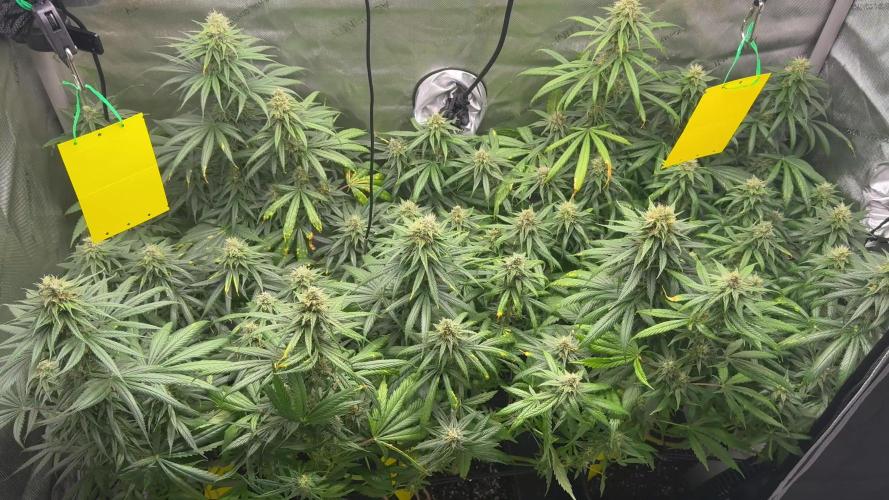
The whitefly issue unfortunately hasn’t gone away. I replaced both yellow sticky traps at the end of the week, and within minutes, two new whiteflies were already spotted on the fresh left trap. The old one had four additional flies on the back. This pest pressure remains a concern, but I’ve decided to hold off on further neem oil sprays for now, given how far along we are in flowering. I’ll keep monitoring closely.
Nutrient-wise, I stayed cautious this week due to ongoing signs of overfeeding. Leaf tips are still showing yellowing and some burn, especially on the lower leaves. Many leaves have pronounced yellow spots and curled tips — a clear sign of excess nutrients earlier on. To reduce stress, I watered with plain pH-adjusted water (5.5–6.0). Total watering volume was approximately 29 liters
This week I also did a second round of lollipopping, focusing on removing all small popcorn buds and lower growth under the net that wouldn’t develop well.
Despite the nutrient stress and the ongoing whitefly presence, the plants are still developing well. Buds are getting chunkier, trichome production is visibly increasing, and the overall structure is solid. Still, I’ll be keeping a close eye on both leaf health and pest activity in the coming days.
⸻
TL;DR – Week 6:
• New whiteflies still showing up – 7 total seen this week. Both sticky traps replaced.
• Additional lollipopping done: removed popcorn buds and shaded growth under SCROG.
• Leaf symptoms (tip burn, spotting) persist – watered with plain pH water, once with half HESI dose.
• Watered 3x this week: 9.5 L (pH only)
• Light stayed at intensity level 7

Likes
13
Share

@CheeRz
Follow
WEEK 13 - FLOWERING: Late Flowering Phase / Flush Start
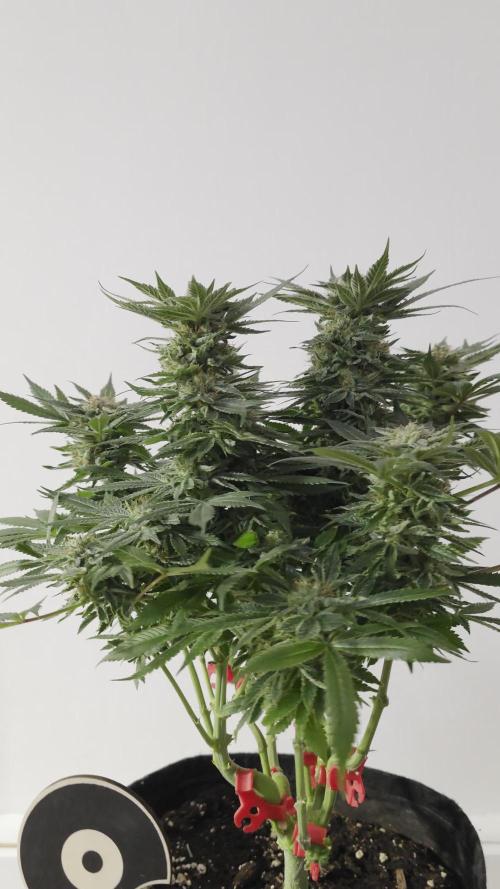
🌼 FLOWERING PROGRESS We are officially entering Week 13 (Week 9 of flowering). Environmental conditions are dialed in with a stable VPD of 1.69 kPa. The plant is responding perfectly, showing extreme resin production and dense flower development. The trichomes are looking mostly cloudy with some beautiful amber heads starting to appear. The plant’s structure remains extremely compact and sturdy under the LED.
👃 TERPENES & AROMA The aroma has evolved beautifully this week. The heavy fuel-like "Gas" scent has faded into the background, leaving a dominant profile of sweet berries with a distinct sour finish. It’s a very complex and refined smell that really highlights the Sour Bluez heritage.
💧 NUTRIENT FEEDING & WATERING
I watered the plant yesterday (2nd April) with 1.7L of pure water, adjusted to a pH of 6.8 using citric acid. Last Monday (30th March) was the very last nutrient feeding (where I already cut out Bio-Grow). From now on, the plant will only receive pure, pH-regulated water to flush out any remaining salts and prepare it for a clean, smooth smoke. The focus is now entirely on a clean burn and white ash.
Current Feeding Schedule:
~~Citric acid: 1.2 ml/l~~
Parameters:
pH: 6.5
Humidity (RH): 46%
Day Temp: 25°C
Pure Water Only!
💭 GROWER'S NOTE Week 13 and the flush has officially begun! Maintaining a consistent VPD of 1.69 kPa to ensure maximum resin output while keeping the dense buds safe and healthy. The resin coating is so thick it covers even the larger sugar leaves, which are now showing a lovely dark purple/anthracite "fade". The plant is extremely compact and I'm very happy with how it’s ripening. Keep it IZI 💚

Likes
5
Share


@Budhunter
Follow
Gorilla punch is getting frosty, nice colas, many branches and I am excited for what is turning. Come on 🥊 gorilla