Check the winners The Grow Awards 2026 🏆
Likes
Comments
Share
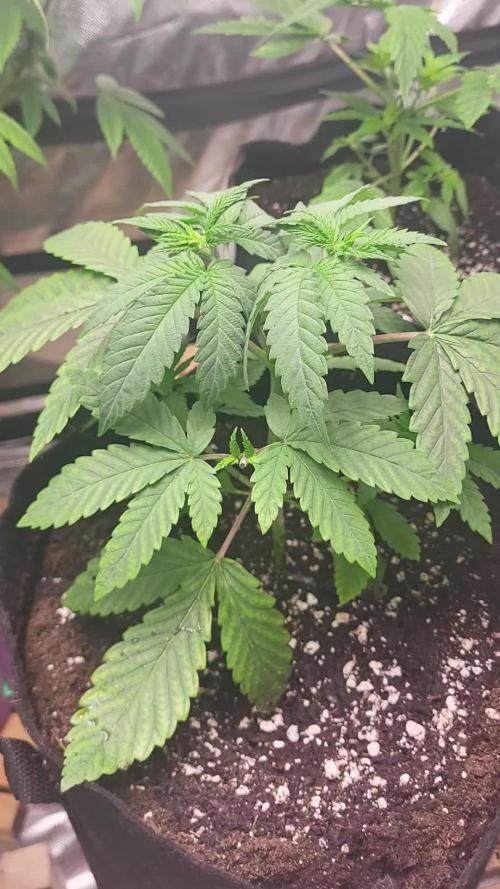
Afgoo is an indica and candyland is as a sativa heard that talking to plant will increase nodes and increase overall yield first experience 3 days after topping these pictures are taken
Likes
9
Share
- Plants are all looking very nice at this stage. - Flowering is well under way and the buds are developing nicely throughout this week. - Have not started LSTing 5th seed and it is growing very well - Last week of the MH Light. Switch to HPS for flowering stage
Likes
68
Share
Removed autoflower and put her in her own pot outside the tent. Foliars applied in strong blue 430nm with 4000Hz tone. 20-minute dose prior to application. In essence, you're seeing a combination of the infrared light reflected by the plant, which the camera perceives as red, and any residual visible blue light the plant reflects, which results in a purple hue. I was doing more stretching of the stems, adjusting weights, just a little too much, and it snapped almost clean. I got a little lucky in that it was still connected, wrapped her almost instantly while holding her in place with yoyo's. The core framework is now in place. If your soil has a high pH, it's not ideal; you want a pH of 6.4, 6.5, or 6.6, which is ideal. If you are over a pH of 7, you have no hydrogen on the clay colloid. If you want your pH down, add Carbon. If you keep the pH below 7, you will unlock hydrogen, a whole host of new microbes become active and begin working, the plant will now be able to make more sugar because she has microbes giving off carbon dioxide, and the carbon you added hangs onto water. Everything has electricity in it. When you get the microbes eating carbon, breathing oxygen, giving off CO2, those aerobic soil microbes will carry about 0.5V of electricity that makes up the EC. The microorganisms will take a metal-based mineral and a non-metal-based mineral with about 1000 different combinations, and they will create an organic salt! That doesn't kill them, that the plant loves, that the plant enjoys. This creates an environment that is conducive to growing its own food. Metal-based: Could include elements like iron, manganese, copper, or zinc, which are essential nutrients for plants but can exist in forms not readily accessible. Non-metal-based: Examples like calcium carbonate, phosphate, or sulfur are also important for plant growth and potentially serve as building blocks for the organic salt. Chelation in a plant medium is a chemical process where a chelating agent, a negatively charged organic compound, binds to positively charged metal ions, like iron, zinc, and manganese. This forms a stable, soluble complex that protects the micronutrient from becoming unavailable to the plant in the soil or solution. The chelate complex is then more easily absorbed by the plant's roots, preventing nutrient deficiency, improving nutrient uptake, and enhancing plant growth. Chelation is similar to how microorganisms create organic salts, as both involve using organic molecules to bind with metal ions, but chelation specifically forms ring-like structures, or chelates, while the "organic salts" of microorganisms primarily refer to metal-complexed low molecular weight organic acids like gluconic acid. Microorganisms use this process to solubilize soil phosphates by chelating cations such as iron (Fe) and calcium (Ca), increasing their availability. Added sugars stimulate soil microbial activity, but directly applying sugar, especially in viscous form, can be tricky to dilute. Adding to the soil is generally not a beneficial practice for the plant itself and is not a substitute for fertilizer. While beneficial microbes can be encouraged by the sugar, harmful ones may also be stimulated, and the added sugar is a poor source of essential plant nutrients. Sugar in soil acts as a food source for microbes, but its effects on plants vary significantly with the sugar's form and concentration: simple sugars like glucose can quickly boost microbial activity and nutrient release. But scavenge A LOT of oxygen in the process, precious oxygen. Overly high concentrations of any sugar can attract pests, cause root rot by disrupting osmotic balance, and lead to detrimental fungal growth. If you are one who likes warm tropical high rh, dead already. Beneficial, absolutely, but only to those who don't run out of oxygen. Blackstrap is mostly glucose, iirc regular molasses is mostly sucrose. Sugars, especially sucrose, act as signaling molecules that interact with plant hormones and regulate gene expression, which are critical for triggering the floral transition. When sucrose is added to the growth medium significantly influences its effect on floral transition. Probably wouldn't bother with blackstrap given its higher glucose content. Microbes in the soil consume the sugar and, in the process, draw nitrogen from the soil, which is the same nutrient the plant needs. Glucose is not an oxygen scavenger itself, but it acts as a substrate for the glucose oxidase (GOx) enzyme, effectively removing oxygen from a system. Regular molasses (powdered if you can), as soon as she flips to flower or a week before, the wrong form of sugar can delay flower, or worse. Wrong quantity, not great either. The timing of sucrose application is crucial. It was more complicated than I gave it credit for, that's for sure. When a medium's carbon-to-nitrogen (C:N) ratio reaches 24:1, it signifies an optimal balance for soil microbes to thrive, leading to efficient decomposition and nutrient cycling. At this ratio, soil microorganisms have enough nitrogen for their metabolic needs, allowing them to break down organic matter and release vital nutrients like phosphorus and zinc for plants. Exceeding this ratio results in slower decomposition and nitrogen immobilization, while a ratio below 24:1 leads to faster breakdown and excess nitrogen availability. Carbon and nitrogen are two elements in soils and are required by most biology for energy. Carbon and nitrogen occur in the soil as both organic and inorganic forms. The inorganic carbon in the soil has minimal effect on soil biochemical activity, whereas the organic forms of carbon are essential for biological activity. Inorganic carbon in the soil is primarily present as carbonates, whereas organic carbon is present in many forms, including live and dead plant materials and microorganisms; some are more labile and therefore can be easily decomposed, such as sugars, amino acids, and root exudates, while others are more recalcitrant, such as lignin, humin, and humic acids. Soil nitrogen is mostly present in organic forms (usually more than 95 % of the total soil nitrogen), but also in inorganic forms, such as nitrate and ammonium. Soil biology prefers a certain ratio of carbon to nitrogen (C:N). Amino acids make up proteins and are one of the nitrogen-containing compounds in the soil that are essential for biological energy. The C:N ratio of soil microbes is about 10:1, whereas the preferred C:N ratio of their food is 24:1 (USDA Natural Resource Conservation Service 2011). Soil bacteria (3-10:1 C:N ratio) generally have a lower C:N ratio than soil fungi (4-18:1 C:N ratio) (Hoorman & Islam 2010; Zhang and Elser 2017). It is also important to mention that the ratio of carbon to other nutrients, such as sulfur (S) and phosphorous (P) also are relevant to determine net mineralization/immobilization. For example, plant material with C:S ratio smaller than 200:1 will promote mineralization of sulfate, while C:S ratio higher than 400:1 will promote immobilization (Scherer 2001). In soil science and microbiology, the C:S ratio helps determine whether sulfur will be released (mineralized) or tied up (immobilized) by microorganisms. A carbon-to-sulfur (C:S) ratio smaller than 200:1 promotes the mineralization of sulfate, when the C:S ratio is low, it indicates that the organic matter decomposing in the soil is rich in sulfur relative to carbon. Microorganisms require both carbon and sulfur for their metabolic processes. With an excess of sulfur, microbes take what they need and release the surplus sulfur into the soil as plant-available sulfate A carbon-to-sulfur (C:S) ratio higher than 400:1 will promote the immobilization of sulfur from the soil. This occurs because when high-carbon, low-sulfur materials (like sawdust) are added to soil, microbes consume the carbon and pull sulfur from the soil to meet their nutritional needs, temporarily making it unavailable to plants. 200:1 C:S 400:1: In this range, both mineralization and immobilization can occur simultaneously, making the net availability of sulfur less predictable. This dynamic is similar to how the carbon-to-nitrogen (C:N) ratio regulates the availability of nitrogen in soil. Just as microbes need a certain amount of nitrogen to process carbon, they also require a balanced amount of sulfur. Both mineralization and immobilization are driven by the metabolic needs of the soil's microbial population. Sulfur is crucial for protein synthesis. A balanced ratio is particularly important in relation to nitrogen (N), as plants need adequate sulfur to efficiently use nitrogen. A severely imbalanced C:S ratio can hinder the efficient use of nitrogen, as seen in trials where adding nitrogen without balancing sulfur levels actually lowered crop yields. Maintaining a balanced carbon-to-sulfur (C:S) ratio is highly beneficial for plant growth, but this happens indirectly by regulating soil microbial activity. Unlike the C:N ratio, which is widely discussed for its direct effect on nutrient availability, the C:S ratio determines whether sulfur in the soil's organic matter is released (mineralized) or temporarily locked up (immobilized). Applied 3-day drought stress. Glucose will hinder oxygenation more than sucrose in a solution because glucose is consumed faster and has a higher oxygen demand, leading to a more rapid decrease in oxygen levels. When cells respire, they use oxygen to break down glucose, and this process requires more oxygen for glucose than for sucrose because sucrose must first be broken down into glucose and fructose before it can be metabolized. In a growth medium, glucose is a more immediate and universal signaling molecule for unicellular and multicellular organisms because it is directly used for energy and triggers a rapid gene expression response. In contrast, sucrose primarily acts as a signaling molecule in plants to regulate specific developmental processes by being transported or broken down, which can be a more complex and slower signaling process. Critical stuff. During wakefulness (DC electric current) life can not entangle electrons and protons. During the daytime, the light is sensed as multiple color frequencies in sunlight. Coherence requires monochromatic light. Therefore, at night, IR light dominates cell biology. This is another reason why the DC electric current disappears during the night. The coherence of water is maintained by using its density changes imparted by infrared light released from mitochondria in the absence of light. This density change can be examined by NMR analysis, and water is found to be in its icosahedral molecular form. This is the state that water should be in at night. This is when a light frequency is lowest and when the wave part of the photoelectric effect is in maximum use. 3600
Likes
20
Share
Im really pleased with how these girls are turning out, i was worried at 1st as the propagation tent they were in wasnt big enough to get good air flow so they were very small but as soon as i got them into the Homebox triangle tent that all changed and they are looking great. Fantastic strains and genetics by Anesia Seeds.
Likes
11
Share
Likes
44
Share
With no doubt these plants have not produced much more quantity and density of buds due to the 2 serious mistakes I've made (those who have read the weeks will know what I mean). However, I can say that I am happy with the production obtained given the mistakes made. Between the 2 plants, the one that has produced more and generated the most dense buds has been the Gorilla with the Man-lining technique applied, it has also loosed a bit less weight drying than the non man-lining one. In comparison with the Money Makers with which they have grown the result is the same. Both Gorillas have each produced more than any of the Moneys comparing them 1 to 1. Also buds are a bit dense than the moneys, but none of them is really desde at all. *****ESPAÑOL***** Sin duda estas plantas no han producido mucha mas cantidad y densidad de cogollos debido a los 2 graves errores que he cometido (quien se haya leído las semanas sabrá a que me refiero). No obstante, puedo decir que estoy contento con la producción obtenida dados los errores cometidos. Entre las 2 plantas, la que más a producido y ha generado cogollos más densos ha sido la Gorilla con la técnica de Man-lining aplicada, y también ha perdido un poquito menos de peso en el secado que la otra. En comparación con las Money Maker junto a las que han crecido el resultado es el mismo. Las Gorillas han producido cada una más que cualquiera de las Moneys comparándolas 1 a 1. Así mismo, los cogollos de las Gorillas presentan un pelín más densidad que el de las Moneys, aunque realmente ninguna de las 4 plantas ha generado cogollos densos del todo.
Likes
14
Share
2ª Settimana di Fioritura 💐 Eccoli arrivati i fiori spumosi della RUNTZ 💓 di Zamni💙🗿 La giovane cresce bene, regolare e senza carenze! Avanti tutta🔝💪🏻 Abbiamo fatto un po' di training alla pianta in modo da avere Bud di qualità 👍🏻🚜
Likes
37
Share
@siLva_77
Follow
Its time to Chop! The Trichomes a few days before chop were like 90% milky, few clean, and the Rest beginning to amber. The Driyng Conditions are around 17 C* and 60/61% Humidity. Approx. ~ 12 days Drying days from now on. Fingers crossed that they dont get mold, even tho i got 2 Vents (Lvl= 1) and the exhaust (Lvl=5) running
Likes
33
Share
***** Week 6 December 23 to 29, 2020 - Days 36 to 42 from germination ***** Week 5 was certainly a stretch week and she grew tall baby👊👍 She has been doing well with her crack on the main stem from early on and when I pulled her out you could hardly tell where it was. Perfect......because she has been growing hard she is getting a little uneven in her canopy but I have been watching how hard I pull on her main stem. Correcting the situation as best I can now but with only in 3 gal pots its tough to get out further on her long branches and tie them down. Could get creative with Bamboo and creating ties but those suckers are eye pokers and I don't use them too often. Will just deal with the potential difference in height and keep pulling her harder now that I can. Silica increasing this week as well now that we close to the end of being able to shape her lower branches. She needs the strength now to defend any potential pests and to growth thick stocks so she can support the bud weight. Since she has been going hard it was time to pull her out and start trimming some lower branches now. Yes she is an auto and many say to never remove leaves, never mind branches, but I do and want to allow her to focus on top buds. I will accept a potential decrease in yield but since I am already performing LST and working with more than one top.....a gain in one area can be offset in another without too much pain😜👍 Stripped quite a few leaves from this girl. She is thick at the bottom and in the last week her node spacing has gone crazy on the 8 main branches😲 I will trim the bottom as it just doesn't get the light intensity down below......even with opening the canopy up lots those sites are still 12" to 18" lower than the tops at this point. Her side branching is really thick and looking awesome. She is showing signs of wanting to grow some big buds😀 She will be able to support the weight at least.........really nice selection Fast Buds!!!!!!! Little more detail........ Dec 23/20, Day 36 - Feeding day today. Continuing with first weeks flower feed of 2ml/L. - 2L feed with Micro, Bloom, Magnifical, AstroFlower, VeloKelp, Natures Candy @ 2ml = 800ppm and 5.8pH. - add microbes again on the next feeding!!!! Dec 24/20, Day 37 - She was given 1L of feed left from yesterday (both her and Orange Sherbet.......J47 is on a two day dry.) - Her color is good but still quite yellow in the new growth points. - pull out tomorrow and clean up lower growth and check runoff numbers. Dec 25/20, Day 38 - 2L full feed again with the same 2ml/L feed as earlier in the week for all the autos. Added AN Rhinoskin as well for silica. - 1150ppm and 5.9pH going in.........pots were really dry and perfect pretty well. - Runoff was 925ppm and 6.1pH.........I can live with that at week 2 flower😁😁 Dec 26/20, Day 39 - 2L full feed again. Had mixed up 12L yesterday. - Added 2ml/L of Microbial Mass and Piranha = 1200ppm and 5.9pH. - The girls needed their microbe allotment as we get closer to the end. - Bacteria added to help keep some of the nutrients in the media as she finishes. - next watering is more of plain water and add Terpinator. Dec 27/20, Day 40 - pots are light again in the afternoon. - 2L watering with Magnifical, Rezin, and Microbes @ 2ml. Terpinator @ 3ml = 400ppm and 5.8pH - She taking the nutrients but backing off the ppm on this watering a bit. - noticing some clawing in the girl.....start of some excess nitrogen or environmental??? Keeping an eye on it👌 Dec 28/20, Day 41 - the girl is hungry so feeding again today with full nutrients. - 2.5L watering today, stepping up from 2L volume. - Full line of Remo, all 6 parts plus silica again @ 2ml = 1150ppm and 5.9pH Dec 29/20, Day 42 - another feeding in the morning today. Pot was really light. - 2L in the morning giving with same feed of 1150ppm and 5.9pH. - her colour change in the leaves is really popping out now. Bud is all purple but the leaves are turning purple as well. - noticing leaf colour is getting even to the other girls for green. No need to compensate any deficiency anymore......in fact watch over feeding now😀 - in the evening, 12 hours later, pots were pretty light so gave another 1.25L of feed that was left over for 16L mixture yesterday. - she had a total of 3.5L feed today......water tomorrow and not feed. She is doing very well at the start of the week. Canopy height is good but her node spacing has me concerned a bit. Looks like we are going to get some beautiful colours from this girl as her buds are purple already. Leaf colour already has a yellow huge to her........Purple Lemonade baby......on point!!!!.......nice work Fast Buds.......this strain is making a lot of growers go, DAMN she's freaking awesome😁😁😁
Likes
Comments
Share
@deseed_uy
Follow
Ya recuperadas de todos los bloqueos volvimos al ferti y se lo tomaron muy bien, volvieron al color verde lindo y estan felices asiq mañana martes pasamos a flora al finnn veranito del terror jaja
Likes
5
Share
@Skipi007
Follow
Hi, here is another week, nothing major happened, Plants 1 and 2 are growing nicely, Plants 1 and 3 are getting watered like last week, only Big Bud will be removed. Plant 2 is very advanced so from today I started giving only SHOGUN Dragon Force 4ml/L and Calmag. Plant 1 - gets 2.1 L and leaks 0.4 L Plant 2 - gets 1.4 L leaks 0.3 L Plant 3 - 0.5 L leaks 0.3 L Plant 3 will probably be removed from the tent in a few days, I don't know what I'll do with it yet, if there's any point in inventing something and not just destroying it. Hi, so plant 3 was removed from the tent, plant 1 was trimmed, and plant 2 is slowly starting to ripen, it smells nice, I smell mango or citrus. At the beginning of the week I did a flush, it seemed to raise the ppm quite a bit.
Likes
15
Share
@moritz
Follow
Week 6 is a short one. Humidity is high as shit but I've just ordered a dehumidifier. VPD sadly is only at about 0.8 mPa during the Day and wayy lower at night.
Likes
64
Share
Super easy growing, almost no maintenance, she just needs love and attention, and she will shine for you
Likes
7
Share
@skitz
Follow
Switched from acti-vera to bio-grow to trigger flowering. The autoflower is already showing pistils.
Likes
69
Share
Eternity Grow Cup - Week 11 VEG Report This is a pivotal week in our Eternity Grow Cup journey as we wrap up VEG and prepare to transition into FLOWER. Our goal has been to ensure that the plants are thriving and optimized for the next phase. This report will detail everything that took place during this crucial week. Mass Defoliation & Structural Training We began the week with an extensive defoliation session. Every leaf with a stem was removed to clear space for optimal light penetration and airflow. This process was done mostly by hand, clicking them off in the opposite direction of growth, while some stubborn ones were snipped with scissors. By the end, it felt like we had taken out nearly half a kilo of leaves! The room now looks clean, structured, and ready to fill out the ScroggNet. To further enhance the plant structure, branches were attached to the pots, allowing for better horizontal growth. This technique helps maximize canopy exposure and prepares the plants for even light distribution once flowering begins. Defoliation before flowering is a key step as it reduces overcrowding, improves airflow, and sets the plants up for efficient energy use in the next phase. Light Schedule & Adjustments This week, we introduced a subtle but effective light adjustment. While still maintaining an 18-hour light cycle, we initiated a 15-minute delay with the whites, allowing the reds to start first. This gradual shift signals the plants that a change is coming. Similarly, at the end of the light cycle, the whites turn off 15 minutes earlier, leaving the reds on for an extended period. This strategy mimics natural sunrise and sunset, helping the plants transition more smoothly into flowering. Additionally, at the end of the week, we will be implementing 48 hours of darkness before the official flip to flower. This method has worked exceptionally well in past grows, helping plants recognize the transition and encouraging a strong start to flowering. However, it's important to emphasize that this is a personal technique and not a universal rule. Every grower should experiment with different methods to find what works best for their specific environment. Environmental Conditions & Challenges Currently, our temperature is at 27°C with 60% humidity, resulting in a VPD of 1.50. While slightly higher than the ideal for VEG, our CO2 levels are over 1000 ppm, and the light intensity is at 570 PPFD, making it a manageable balance. The solution pH is 5.79 (essentially 5.8), EC is 1.38, and water temperature is 17.7°C. One challenge we are facing is maintaining optimal reservoir temperatures. Currently, it's a bit low at 17.7°C, and we are exploring solutions to raise it slightly. However, the medium temperature sits at 22.2°C, which is a good range. The humidifier is still in use, though it struggles to increase humidity further, so we are working with what we have to keep the VPD in check. ICL-300s Integration The ICL-300 lights are now fully active. Unlike the last grow, where we introduced them later, this time they are on from the start of flowering prep. This adjustment is an experiment to see if the plants respond better to an early introduction. Learning is at the core of this journey, and each grow offers new insights. Whether this proves to be the optimal strategy or not, it will be a valuable lesson for future grows. TrolMaster Hub & Data Monitoring Throughout the week, we have been closely monitoring our grow using the TrolMaster App TM+. We are displaying some of the collected data for everyone to see the details. Stay tuned as we explore this further in the next report! As always, we want to extend a huge thank you to our sponsors and the amazing community. Special thanks to Aptus, Groovebags, Cannakan, Promix, Ziggy Papers, TrolMaster,and Plagron, Zamnesia and Grow Diaries for making the Eternity Cup possible. I apprecilove the support from all sides—lovers, haters, competitors, and fellow growers. The competition continues to push us to improve, and i am thrilled to see the incredible reports from others. This is a challenging yet rewarding experience, and i couldn’t be happier to be part of it. For those following along, we invite you to check out our YouTube channel, where we upload full 4K episodes showcasing the entire journey. Some episodes are too large to be uploaded directly to Grow Diaries, so YouTube is the best place to catch everything in high definition. This marks the end of VEG, and we are officially ready to flip to FLOWER. Next week, we will dive into the TrolMaster System in action, check the data insights, and monitor how the garden adapts to the shift. Stay tuned! Growers Love to all, happy growing, and best of luck to all competitors! See you all in the next update! Genetics - Runtz https://www.zamnesia.com/6000-zamnesia-seeds-runtz-feminized.html Nutrients - Plagron https://plagron.com/en/hobby - Aptus Holland https://aptus-holland.com/ Controls - Trol Master https://www.trolmaster.eu/ LED - https://www.futureofgrow.com/en LED - https://www.thinkgrowled.com Soil - https://www.promixgardening.com/en Germination - Cannakan https://cannakan.com/?srsltid=AfmBOopXr-inLXajXu3QFgKXCXXos4F1oEvScjMKIB5MR5dk8-GJ-F49 DOGDOCTOR 15% off Smoking Papers - https://ziggioriginal.com/ Terpene saver - https://grovebags.com/ As always thank you all for stopping by, for the love and for it all , this journey of mine wold just not be the same without you guys, the love and support is very much appreciloved and i fell honored with you all in my life With true love comes happiness Always believe in your self and always do things expecting nothing and with an open heart , be a giver and the universe will give back to you in ways you could not even imagine so As always, this is shared for educational purposes, aiming to spread understanding and appreciation for this plant. The journey with nature is one of discovery, creativity, and respect. Let’s celebrate it responsibly and continue to learn and grow together! Growers Love To you All 💚 #EternityGrowCup #RuntzHunt #GrowersLove #CannabisCommunity #AptusHolland #ProMixSoil #TrolMaster #Zamnesia #Plagron #ZiggiPapers #Grovebags
Processing
Likes
Comments
Share
estoy usando agua de osmosis para limpiar raices.