


Likes
Comments
Share


@Colo420
Follow
Todo en orden, un poco descuidados y entrando poco a la página debido a las fiestas de fin de año



Likes
17
Share

@38PLAN
Follow
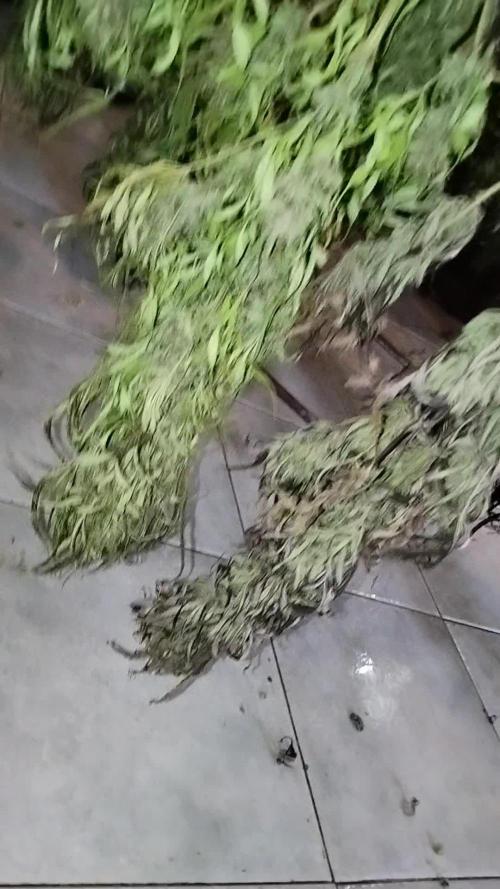
Quella che vedete nel video è una parte della zillion pesata,quella che rimane attaccata e che è diventata nera viola è l'altra metà della pianta che è rimasta attaccata,veramente longeva e produttiva,gli odori non sono il suo forte ma compensa con una potenza fuori dagli schemi,è stata la più resistente e quella che è fiorita prima,contando la pianta che è rimasta attaccata e quella che ho pesato supererà sicuramente i 1500g ma mi sono tenuto basso,vigorosa,dai colori sgargianti,menefreghista ed indistruttibile,se volete un erba che vi tocchi il cervello e basta con i suoi 32% di THC ragazzi miei questa è un ottima scelta


Likes
10
Share


@hexhex
Follow
Love seeing them grow! Tried giving them a little more EC, I've been precision stressing via a low nutrient environment the whole grow. It's going to be interesting to see how distance to lamp will affect bud growth. I keep DLI @ 50 at the highest top.
Likes
9
Share


@Jbuttch
Follow
Ya viendo el resultado del último LST, desde aquí ya veo cómo van las cosas!
Processing
Likes
17
Share


@GardnerXXI
Follow
Day 25 . This bitch hermied. Gonna keep her few more days to see the progress

Likes
17
Share


@ScouseCityLX
Follow
Seen some good growth. Lots of leafs to dispose of with defoliating 5 plants.


Likes
8
Share


@AustinRon
Follow
Week 6 - Bolt 3 (Flower Week 3)
Sangria - by Twenty20 Mendocino
4Q 2022
Veg Week 4: Wednesday 01 February - Tuesday 07 February 2023
Start of Veg - 1 Node
Start of Week: [ 2022-02-08, SA20 43:B3:6:1]
End of Week:
[ 2023-02-14, SA20 49:B3:6:7]
HeightWeekStart: [ 10.5, in]
HeightWeekEnd: [ TBD, in]
Start Date: 28.12.2022 # Seeds Wet
Harvest Window: 17 - 27 March 2023, 79 - 89 Days
EnvironmentGermination
- LightDistance: [ 14.5, in]
- LightStrength: [934, 505, µmol/m2/s]
- Temp: [ 79, 85, °F]
- RH: [ 73, pct]
- HumidifierTrigger: [ 66, %]
Fertigation
(BioAg, Mammoth-P)
- [x] R&R/Recalibrate BluMat’s at next IDEAL pot moisture
Wednesday 08 February 2023
SA20 43:B3:6:1
- Added 1 Pt surface watering. Pot significantly lighter. No bottom heft.
- High Humidity and low temps have been a challenge this week, trying to keep VPD above 0.80 kPa
- Looking less droopy, but not uproariously happy, yet.
__________________________
Wednesday 08 February 2023
SA20 43:B3:6:1

1056 02.08.2023
- Added 1 Pt surface watering. Pot significantly lighter. No bottom heft.
- High Humidity and low temps have been a challenge this week, trying to keep VPD above 0.80 kPa
- Looking less droopy, but not uproariously happy, yet.
- Foliar: [ CalMag Fuel, 20, ml, gal], [ Lush Green, 5 ml, gal], [ Photosynthesis Plus, 6, ml, gal]
- What a Day! Humidity over the charts.
- Looking REAL Droopy. Mixed up 1 Pt w/ Ful-Power, SLF-100, PhotoSynthesis Plus. Top sprayed in pot.
- Pot has weight but no unbalanced heft.
- Calibrated BluMat, Drip/Stop, + 2pts on Carrot
And 5 hours later

1554 02.08.2023
__________________________
Thursday 09 February 2023
SA20 44:B3:6:2
- Plants aren’t praying, SLOWLY coming out of Droop.Look A little more lift than yesterday.
- 0928 Raised humidifier 1 F to 63%
- 1407
“
“
64%
- VPD 1.1+, want to be in the 1.0 range
Friday 10 February 2023
SA30 45:B3:
Saturday 11 February 2023
SA20 46:B3:6:4
- HumidifierTrigger: 66%, up
Sunday 12 February 2023
SA20 47:B3:6:5
- HumidifierTrigger: 71.5%, up
- Temp < 85 F
Monday 13 February 2023
SA20 48:B3:6:6
Tuesday 14 February 2023
SA20 49:B3:6:7


_____________________
Next week (Nominal Flower 4)
Wednesday 15 February 2023
SA20 50:F:7:1

Likes
37
Share


@DaddyPrime2
Follow
6/3/24
These genetics really chunk up.
I may have to harvest everything early. Luckily the autos in my tent are close to being done. They could be chopped now without much issue.
My whole tent system went out for about 8 hours and My humidity was 75 and my Temps were 73. I really hope everything is ok but that is a possible
6/5/24 she's still plumping up alot. She's going through water almost too fast now. Not giving anything but water and slf100 for a week or
Likes
8
Share


@skaterblasted
Follow
Days 74 - 80 (from seed)
4/15/24 - 4/21/24
Lamp distance: 13" @ 50% power (estimate PAR?)
VPD: not checking - humidity set to 40%
Feed schedule: feed schedule once a week, 1/4 gallon water per plant daily - FPE added at 2oz per gallon every third day
IPM: visual inspection only
Notes:
Final push, fading occurring on all plants now and some amber starting to show during trichome inspection. Cookies & Berries taking the most time of the group to finish while Mango Sky crossed the finish line first. All four plants will be chopped next week on the morning after the full moon, April 24th - according to the moon gardening calendar it is "best time to pick medicinal herbs and plants, while flowers if cut during this time have an intense scent and endure longer." They're close to finished in my book so it can't hurt to follow the lunar suggestion.

Likes
23
Share


@RadDad
Follow
I've let our girl blue grow for an extra week and I think our base is looking really strong. It's time for topping to creat the base of our manifold.
To do this were going to use he Nebula's Manifold technique by Nubula Haze from GrowWeedEasy.com. I'm in no way affiliated with the site or Mrs. Haze but I have found her website to be a great place to start my cannabis growing journey. I've done so much more research now but it did start for me back in 2020 at GrowWeedEasy.com
Anyway I've got some video that will explain the method as I top the plant but basically what we're going to top down to the 3rd node and then clean all the extra growth off. This should leave only two growth tips and their fan leaves. Check out the photos and videos for more details.
Feeding and light schedules continue as normal.


Likes
207
Share


@PEAKYPLANTERS
Follow
Hello weed brothers! How's it going?
We should soon notify the lady upstairs that there will soon be a tree in the house growing out of the floor. 😄😄😄😄
Likes
Comments
Share

@bigsmoke42069
Follow
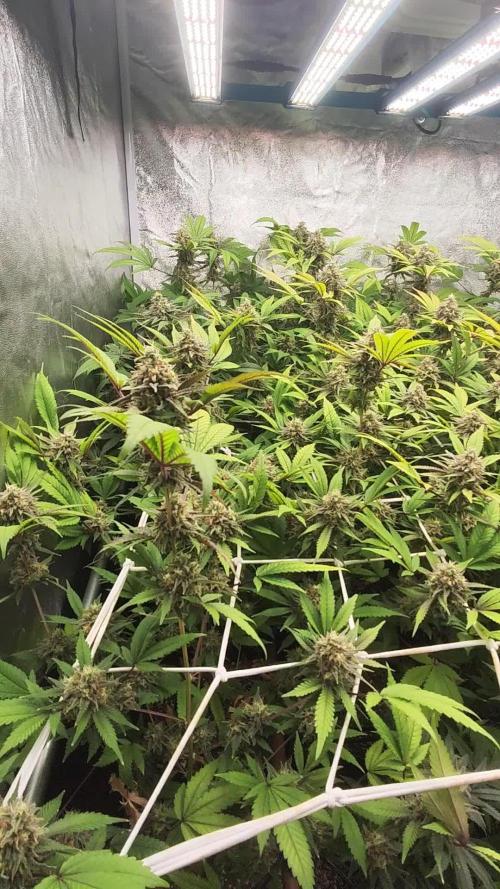
Week 7 (1.29.26 --2.5.26)
took photos on 2.5.26
2.1.26
Transitioned to ripen nutes
2.3.26
Transitioned to T.A. FinalPar
Likes
15
Share

@Naujas
Follow
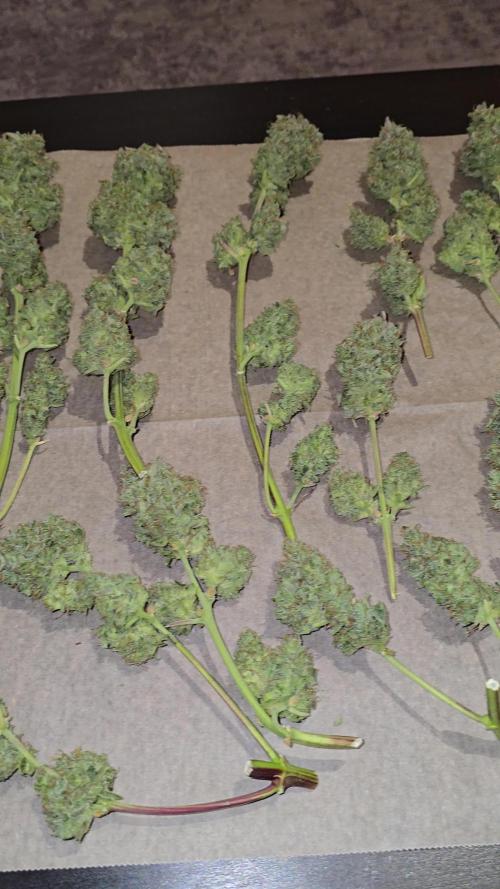
Harvest day has finally arrived for my Frostbanger Auto, and I’m very happy with how this run turned out.
She finished at 69 days from seed and impressed me from start to finish. Throughout flowering she developed a strong, sweet aroma that became richer and more noticeable every week. By harvest time, opening the tent released an amazing smell that filled the entire room.
The buds developed beautifully, with excellent frost coverage and plenty of sparkling trichomes covering the flowers and sugar leaves. Visually, she became one of the prettiest plants I’ve grown, showing great structure and dense, resin-coated buds.
Final wet weight came in at 230g, which I’m very pleased with. The plant stayed healthy, responded well throughout the grow, and rewarded me with a solid harvest and outstanding bag appeal.
Overall, Frostbanger Auto was a pleasure to grow. Great aroma, heavy trichome production, beautiful buds, and a satisfying yield. Now it's time for drying and curing, and I can't wait to see how the final quality develops over the next few weeks.
Final stats:
🌱 Strain: Frostbanger Auto
📅 Harvested: Day 69
⚖️ Wet Weight: 230g
❄️ Trichome Production: Excellent
👃 Aroma: Sweet, strong, and very pleasant
🌿 Overall Impression: Beautiful plant with great resin production and a rewarding harvest
⭐⭐⭐⭐⭐ Very enjoyable grow from start to finish
Likes
10
Share


@3lementa1
Follow
The colas keep filling out and getting longer and smell amazing. It's been warmer and more humid outside so RH in the tent has gone up. I added a mini air purifier I wasn't using (no ozone) as an extra precaution against mildew.
I woke up in the middle of the night on Monday and realized that the air purifier has a light on it so I got up and turned it off. I was worried that I'd messed with the dark cycle so I left them in darkness for an extra 2.5 hours.
My cool tube fan fell off the next day, onto my plants. They look undamaged. I taped it up again and set up a safety wire like the filter and fan have. I need a better solution for next cycle.
The buds are beautiful and having an even canopy is great. It's hard not thinking about the end result. The buds still look small compared to the big colas of a traditional grow shape but there's still a couple weeks left. There is some bud formation under the canopy but it's a little light. The tops of the colas are fat but short on the 7 gallon plants and taller and thinner on the 5 gallon plants.
I did leave a couple offshoots on that developed in late veg/early flower. By the time I caught them, I felt they were too mature to chop and I thought they helped fill out certain areas. But those ones have fewer bud sites and tend to be just a cola on a branch that shoots straight up which is still good. I do wonder if less crowding would have given me bigger buds, but I think it has more to do with pot size.
This is week 7 of flower. I switched to half strength nutes and started adding fancy molasses (18ml/gallon). I broke my pH tester and didn't replace my SCROG net until after I finally watered the next day so the canopy changed a bit. I took the opportunity to rearrange the plants a bit.
Crystal formation increased a crazy amount the day after I started adding molasses. I think I'll keep adding molasses even during flush.
The CBD Blue Shark has this really beautiful white glow. The pistils are very strong and white and the trichromes reflect back this silver light. The leaves are a nice semi-glossy dark green which gives great contrast. It's just a beautiful plant.
The Wedding Cake has a lot more colour with lots of red hairs and some yellow tones in the pistils. The fan leaves are more prone to yellowing and death than the leaves on the CBD BS. The buds seem more structurally dense and are really working on these pyramid shapes that look like delicious orange and green snacks. The buds on the CBD Blue Shark are more symmetrical and kind of otherworldly like some kind of sea creature.
Likes
9
Share

@Oldwied
Follow
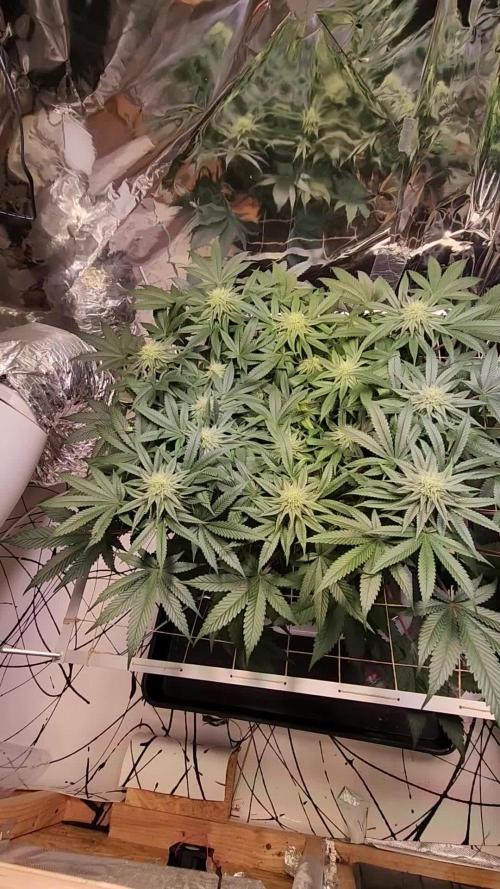
She looks very healthy and buds are forming well. However, I'm a bit skeptical as to whether a 7-week flowering period will be enough.
Over the week I increased the light power to 100%.
I added 10mL LAB (lacto acid bacteria, diy with rice water and milk) and 1 mL CalMg per liter of irrigation water.
Light Power: 100%
Day 79
Flower #28
Photoshooting
Likes
31
Share


@Fruitgrower
Follow
17.12
F47
I am definitely thinking I mixed up the seeds now.
The 2 in the airpots are now likely to be the same strain and I'm guessing royal gorilla because of the purpleing.
The 2 in the fabric pots must be cookies gelato. They are taller, greener and way thicker stems.
If anyone could chime in and help me out identifying the two strains that would be appreciated 🤦♂️
Still no nutes given.
Under 12 hours of spiderfarmer light
19.12
Day 49
Noticed some odd (or not) deformeties on the 2 (what I believe to be after the potential mixup) cookies gelato....
Likes
3
Share


@GodlyGas7
Follow
Topped At The Beginning Of Week 4. Little Bit Of A Magnesium Deficiency (Lockout) From Soil PH Being Too Acidic. (Raising PH To 6.3)Transplanting Into 5 Gals, LST, And Moving Outdoors At The End Of Next Week.


