


Likes
Comments
Share


@NordicCropz
Follow
Day 111, 9 weeks flowering is passed. Currently a nice fade going on. Pistils and trichomes are not really close to ripe, but I'm gonna cut her within the next week anyway because I need the tent.
Lighting hasn't been perfect, since this girl stretched like a weed, while my Harlequin didn't. Gonna be smarter on the next try :) nevertheless, she oozes of brilliant smell and taste.

Likes
226
Share


@HighTV
Follow
| 📅 Week 10 | Days 64 - 70
| 💡 750w 📏25' |
| ☔ 38%-50% |
| 🌡️️🌞 72 - 74 |
| 🌡️️🌑 68 - 71 |
1/11 The reservoirs were swapped out with fresh nutrients and topped off at 5.8PH. I will give them another day or two before flushing I think. The smell is currently fantastic
1/12 There really isn't much to do with these girls anymore other than PH every day and make sure their water levels are consistent to maintain their nutrient levels. Tomorrow I will begin the Flushing
1/13 I decided on one more day of nutrients. I Topped off the Reservoirs and adjusted their PH's to 5.8 as usual. I cleaned out the tent today as well. I can't wait to harvest these buds they are looking great.
1/14 Today is Flushing Day! I will flush them for about 6 days which is very fairly long for a typical DWC grow. I will only PH the water from here on out.
1/15-19 I Flushed these plants while maintaining a stable PH and humidity the best I could. The water level is not important during this because without nutrients you don't need to worry about ratios as long as you just keep the PH stable you will be fine. With a longer flush like this one, you should expect to see death in leaves its ok. I only did this for life reasons, I suggest a 3-5 day flush in DWC.
These plant's Trichomes matured fast and harvest time approached quickly. The smell in the tent is very potent and gloves are going to be an absolute must on this chop! I will be hang drying the plants inside the dark grow tent with ventilation to maintain humidity levels. I don't personally have a preference between a slow or fast drying process. This time I will be looking at 3-5 days of hang drying before chopping them into jars for a few weeks of cure using Boveda packs. I'm very pleased with the bud color and smell even though the overall weight will be less than desired I will be growing this strain again immediately. There isn't too much more to add to this week other than the grow is complete and the Dry/Cure process is all that is left. Be sure to look out for the harvest update with the final weight and smoke test!
_______________________________________________________________________
Feel free to leave comments/questions below or give me any feedback to improve my diaries. If you like this Diary follow along and check out my others as well 😎

Processing
Likes
13
Share


@Silverback_Guerilla
Follow
SUNDAY 4/21:
I fed her about 1/2 gallon today.
Will take some photos tomorrow-
MONDAY:
Busy with life today, so they only got ogled for a few minutes..
TUESDAY:
I rearranged and took some photos today.
WEDNESDAY:
I tool some more photos and a video today. Will water her tomorrow-
THURSDAY:
I watered with about 1/3 gallon and included some terpinator, calimagic, and beastie bloomz.
She's looking kinda haggard since the high-temp issues from last week....losing much foliage..I hope she has the energy to finish strong.🙏
FRIDAY:
I made some improvements to my fresh air a/c intake in the tent that dropped the temp a couple of degrees, and the new dehumidifier is keeping the RH right where I want it..45-50%.👌 This allows the evap cooler to be more effective at cooling as well...above 50% RH and it's basically just a fan..

Likes
14
Share


@Shellshocked
Follow
Skipped a week so that the weeks in the diary were the same age as the new plants also took over my wife's aquaponics ak auto flower that is 4 weeks old so ill add that into the grow. The aquaponics plant was in rough shape it was showing huge signs of cal mag def. So I went to the local fish store and bought a cal mag substitute that's safe for fish also dropped the ph to 6.1 she had it at 7+ (not her fault ph metre broke )now plant looks great 1 week later after pulling off all affected leaves. Nothing new with the girl sco8t cookies except I fed today 1 gsc starting to lighting up
Likes
Comments
Share


@UrbanBoer
Follow
Another Day another Dollar, a week later and I am starting to like being attentive when it comes to my babies, reminds me of the lock down days… dark times, but cultivation kept the days ticking and the mind clear.
This Lady over has truly made a leap from her miniature pot to a whole 20lt highly rich compost mix, posted a video showing my mixing skills… it is getting warmer as the days progress, I am nervously awaiting the first Thunder storms, my makeshift greenhouse will be put to the sword, would be a sad day if that sword prove mighty, this structure has saved my babies through cold fronts, negative temperatures, speaking of weather the picture of the thermometer and my catalogued weather don’t correspond due to, The thermometer is showing my greenhouse’s room temperature, and I am cataloguing atmospheric temperature and humidity, I will get better in logging other such as water ph, for now all I know is I use rain water, and when I water I use 250ml of water per 24hrs, each plant to keep soil moist, I will increase the volume as soon as the morning temperature are at double digits. I cannot be disappointed with how this grow is proceeding. When Summer Shines it burns.
Likes
7
Share


@HoffmanShulgin
Follow
¡Hola a todos! Han pasado 3 semanas de floración y ya se pueden ver pequeños brotes. He estirado aún más las ramas que han crecido. También he recortado las hojas enormes para que la luz pueda penetrar en el interior de la planta. He agregado más fósforo al fertilizante para estimular la floración. Ahora solo queda la etapa final de la floración. ¡Estoy esperando con ansias!
Likes
23
Share


@elementhc
Follow
The Ethos photos have been flipped to flower a week or so ago. Took 12 clones.
Gsc Auto will be ready to harvest this week. Others still have a few weeks.


Likes
12
Share


@KitaKush
Follow
Week 6 and we are reaching for the skies! LOL...it's a good thing but also bad...as she is starting to get light burn on the top main cola...my light is the highest it can be so I'm hoping that the Fox Farms Nutrient, Open Sesame, stops the stretch and focuses more on bud development. She will get fed on Friday!
I absolutely love watching my Runtz grow, I want massive trees in my tent now...I used to go crazy with the LST during veg weeks 4-5 and introduced open sesame earlier because I never wanted tall plants before...my first grow had tons of light burn and my tent is tiny!!! Just a little 2 x 4......but now I am steering that way...I just think the tent looks more beautiful....tall lengthy trees as opposed to short stumpers which is what I have been growing from the start :P
Went in with some more LST...at week 6 is usually when I try to go minimal on the manipulation but with how lanky she is...I think there's more room for some surprise colas to make an appearance!
Also, I took the SCROG netting out...I want more experience with growing before I start messing with new growing techniques..if you made it this far into reading wow congrats! LOL and Happy Valentine's Day....it's a day about love...loving yourself, your family, your pets, and of course your PLANTS!


Likes
Comments
Share

@Northern_Ent
Follow
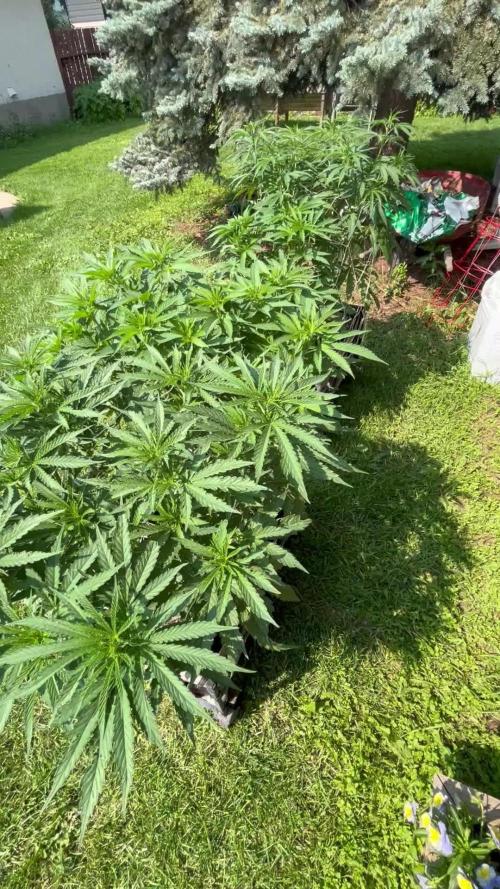
July 18: still recovering from the hail storm 7 days ago, but looking good.
Start force flowering tonight. That means in the dark garage at 9 pm, a few seconds of 730 nm far red light to initiate ‘dark mode’ 2 h faster, and then out of garage at 7 am. So I get 10 +2 or 12 h of darkness in a ‘26 h’ day. Great trick if you have daily access to your flowering plants.
July 19: added second layer of scrog net. Watered with a compost tea this morning.
July 22: added Plagron Power Buds for first use. Despite the hail damage from 11 days ago, she seems to be doing fine. Need to get malted barley for use as a top dressing.
Godfather OG is in the G-Wagon with Gorilla Cookies Fast.

Likes
4
Share

@DogDoctorOfficial
Follow
🥒 Project Blue Tent – Week 5
Pickle Lemon Haze F1 – Pheno B (Folder 14B)
Hello everyone, and welcome back to another chapter of Project Blue Tent! 💙🌱
For anyone discovering this diary for the first time, Project Blue Tent follows four individual Pickle Lemon Haze F1 plants, each grown under exactly the same environmental conditions while being documented separately from seed to harvest.
Although every plant shares the same genetics, each one develops its own personality, growth habits and structure. By giving every phenotype its own diary, we get to appreciate those subtle differences while learning how each plant responds throughout the entire grow.
Today we're checking in on Pickle Lemon Haze F1 – Plant B.
──────────────────────────────
🌱 Week Five – Filling Every Corner
This week has been all about controlled expansion.
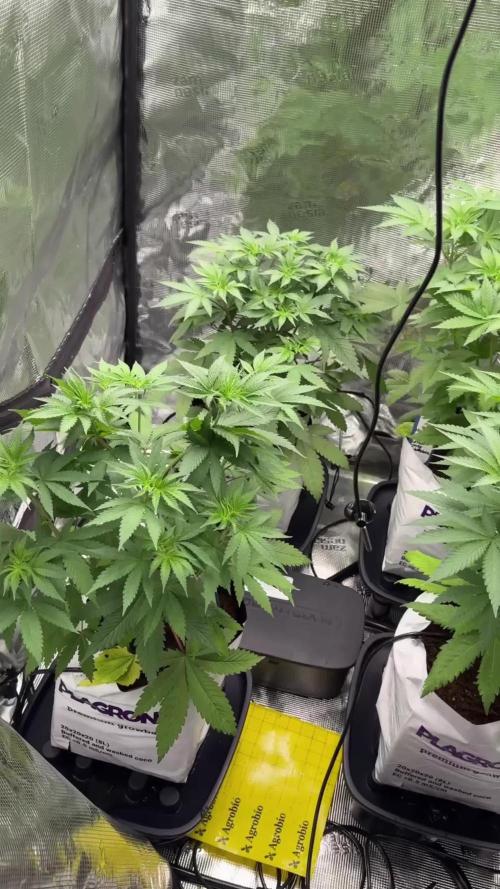
After recovering beautifully from last week's topping, Plant B has exploded with vigorous new growth. Rather than stretching excessively, she's focused her energy on producing an incredible number of side branches, creating one of the bushiest structures inside the tent.
With so many healthy shoots developing, it was the perfect moment to begin introducing the SCROG net.
For anyone unfamiliar with the technique, SCROG stands for Screen of Green. Instead of allowing the plant to grow vertically, each branch is gently guided underneath a horizontal net, encouraging it to spread across the available space.
The objective isn't simply to make the plant wider.
By opening the canopy, every future flowering site receives better light penetration and improved airflow, while creating a much more even surface for flowering later on. Rather than producing one dominant cola, the plant is encouraged to develop many equally productive tops.
This week we spent some time gently bending and positioning branches beneath the screen, allowing Plant B to begin claiming her share of the canopy.
She handled it like an absolute champion.
──────────────────────────────
🌡️ Environmental Conditions
Maintaining consistency continues to be one of the main goals inside Project Blue Tent.
Stable environmental conditions allow the plants to recover quickly from training while maintaining uninterrupted vegetative growth.
This week's average conditions were:
• 🌡️ Day temperature: 30°C
• 🌙 Night temperature: 25°C
• 💧 Relative humidity: 58%
• 🥥 Root zone temperature: 24°C
• 💦 Nutrient solution: 18°C
• ⚗️ pH: 5.8
• ⚡ EC: 1.92 mS/cm
• 💨 CO₂: approximately 450 ppm
• 💡 Light schedule: 18/6
Despite the slightly warmer daytime temperatures this week, the plants have continued growing vigorously, showing excellent transpiration and healthy development throughout the room.
──────────────────────────────
🥥 Feeding Strategy
As the plants continue increasing their growth rate, their nutritional demands naturally increase alongside them.
A couple of weeks ago all four phenotypes began displaying a slightly lighter shade of green. Since every plant responded the same way while maintaining vigorous growth, it was clear they simply wanted a little more food rather than showing signs of stress.
The feeding schedule was adjusted accordingly and continues producing exactly the response I was hoping for.
Current feeding consists of:
• Plagron Hydro A — 1.9 ml/L
• Plagron Hydro B — 1.9 ml/L
• Plagron Hydro Roots — 1 ml/L
The newest growth is gradually deepening back into a richer green while maintaining excellent growth speed and healthy leaf development.
Sometimes the smallest adjustments make the biggest difference.
──────────────────────────────
🌿 Pickle Lemon Haze F1 – Plant B
Every week this phenotype becomes more interesting.
While her sister shows slightly more vertical ambition, Plant B has decided to become an absolute bush.
The recovery after topping has been outstanding. Both new main leaders have established themselves perfectly while countless secondary branches continue racing upward, creating an incredibly dense canopy filled with future flowering sites.
After introducing the SCROG net this week, it quickly became obvious just how much lateral growth she's capable of producing. Every branch seemed eager to occupy its own space, making the training process surprisingly enjoyable.
One characteristic that really stands out is her natural symmetry. Even after being bent in multiple directions, she continues producing an impressively balanced framework with very even spacing between developing tops.
Her stems continue thickening nicely, internodal spacing remains compact, and leaf posture stays upright throughout the day, clear signs that she's handling every bit of training without complaint.
She's lush, healthy, vigorous, and showing exactly the kind of structure I love seeing before flowering.
Looking at her now, it's hard to believe she was topped only a short time ago.
──────────────────────────────
🌿 Looking Ahead
As both Pickle Lemon Haze sisters continue filling the tent, canopy management is becoming increasingly important.
These two ladies are definitely going to compete for space over the coming weeks, and that's exactly the kind of problem every grower enjoys having.
The next step will simply be continuing to weave branches through the SCROG net while allowing every future top to find its own place in the canopy.
A light selective defoliation may also become necessary soon. Not because the plant needs correcting, but simply to improve airflow and allow more light to reach the rapidly developing interior branches hidden beneath this beautiful sea of leaves.
For now, though, she's doing exactly what I hoped she would.
Growing wider.
Growing stronger.
And becoming one impressive little bush.
──────────────────────────────
💙 Thank You
A huge thank you goes to Zamnesia for the incredible Pickle Lemon Haze F1 genetics and for providing the complete ecosystem that makes Project Blue Tent possible.
Another heartfelt thank you goes to Plagron for supplying the Premium Growbags together with the Hydro nutrient line, helping these ladies build strong root systems and maintain vigorous growth week after week.
I'd also like to thank GrowDiaries for providing a platform where growers from around the world can document their journeys, exchange knowledge, and continue inspiring one another every single day.
And finally, thank you to everyone following Project Blue Tent.
Whether you've been here since germination, recently discovered these diaries, actively leave comments every week, or simply enjoy watching these beautiful plants evolve, your support truly means a lot.
Every phenotype tells its own story.
This one is quickly becoming one of my favourites.
I hope you're all having an amazing week.
Until next time...
Growers Love, happy growing, and take care everyone! 💚🌱
Processing
Likes
9
Share


@APmonsta
Follow
End of week 10 looks like 3 of the ladies will start getting flush next week the others look like they will go until week 13 or 14 definitely wasn't my plans I was hoping around week 11 everything would be done. But even tho they are all the same strain and dropped the same day they finishing at different times wired but ok. I'M READY TO CUT but I have to let them run they course
Ps: the tricone production and smell is amazing on these plants once I pull them out of the net I will get sum awesome pics for your growers
Likes
4
Share


@Diy_autoflowers
Follow
This week I discovered my ppms were over 2000!! Starting a flush and starting over with RO water. I learned,
Froot by the foot looks almost ready to harvest and she's only 54 days. I don't want to harvest her that early. Gonna try and wait day 70 out.
The second granite runtz is a completely different plant. Will go far past day 70. I hope.


Likes
16
Share


Likes
22
Share


@dillande3
Follow
Hello, Day 77, Flower Phase , PGK, Final weeks of flower phase ongoing, Plant starting change color some leaves I can see some purple colors and mostly yellowish color. Trichomes still slightly cloudy and buds looks grate, smells also like tropical Mango ))) Temp is ok and TH also good at 65% these days. Thanks.
Week 11 - Flower Phase
Day 76 - 18/01/23
Day 77 - 19/01/23
Day 78 - 20/01/23


Likes
8
Share

@Nillenium
Follow
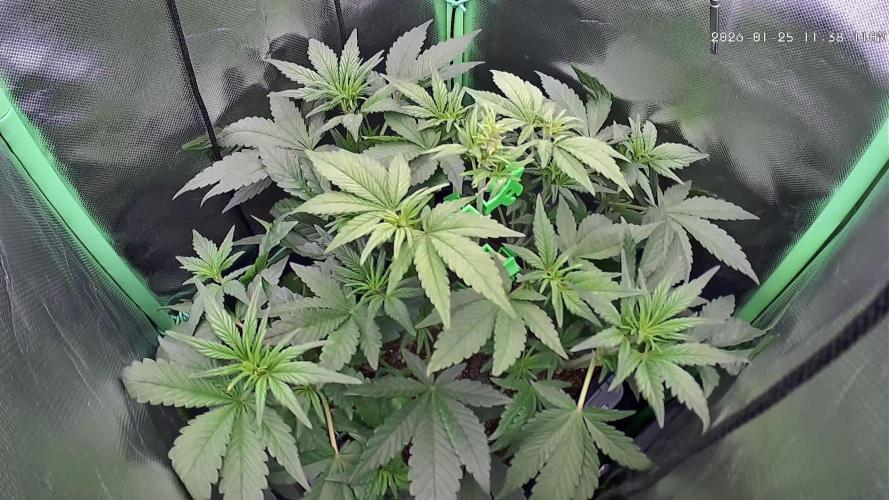
Woche 5, alles läuft nach Plan. Sie hat sich bis auf 53cm gestreckt und will auch noch ein paar cm machen. Die Lampe + Cam mussten täglich angepasst werden. Die Timelapse ist diese Woche nicht ganz so schön geworden.
Sobald der Stretch in den kommenden Tagen durch ist, gibt es eine großzügige Entlaubung und die erste Runde Blütedünger.
Likes
82
Share


@BigBadLion
Follow
Hey guys! Here's the 3rd week of flower! 😻
This week I trimmed my babies (just a little, about 8 leaves or less each plant). Some leaves were healthy but were blocking a lot of light from the flowers and tucking them wasn't doing the job anymore. Besides that Boomer stretched out a lot (which also worried me as I didn't want my babies to go wild on me. I LSTed some of them hoping that would fix the issue). Where I live has been getting somewhat cold at night and I fear that might be doing something to my babies (I hope to be wrong).
Besides that the flowers are getting bigger everyday and some are even starting to show some trichomes (I think looks cute!). The pistils are also getting bigger and the smell is stronger now (it was already strong).
Near the end of the week I saw Falco's leaves were getting yellow and I suspect it is nitrogen deficiency... and what's causing it is probably some residues at the end of the pot (so I might need to flush her) or maybe I just need to feed her more nutes). Keep in mind she used to be quite small during veg and only in the end she grew enough to be transplanted to a bigger pot. Maybe she's just special?
This week you'll see less timelapses compared to last week... I forgot to take photos for about 3 days 😅 but at least there are some!
I hope you'll enjoy what I'm sharing!
Thanks for reading! 👋

Likes
47
Share


@Ultraviolet
Follow
The cannabis strain Grape Guava can be a purple strain, depending on its specific phenotype and genetic makeup. While not all phenotypes of Grape Guava are purple, some variations, such as the Zatix Grape Guava, are noted for their striking purple appearance due to the genetic expression of anthocyanin pigments.
https://www.youtube.com/watch?v=cKdVmdoKJ5k
In a garden of green, Grape Guava gleams,
With its fruity aroma, enchanting dreams.
Clusters of grapes, guava's sweetness ignite,
A strain so divine, in purple and white.
Euphoria whispers, a lush fruity haze,
Grape Guava's embrace, a tranquil daze.
Off and away.@1400ppm. The increased CO2 allows plants to thrive at higher temperatures, which in turn necessitates higher humidity to maintain the ideal VPD for healthy growth and transpiration. 80F -5F = 75F LST with 70% RH = 0.72 kPa. Higher temperatures and humidity promote rapid growth, nutrient uptake, and photosynthesis while maintaining a lower stress level. Temperature influences the rate of enzymatic reactions involved in aerobic respiration. Enzymes, such as those involved in glycolysis, the Krebs cycle, and the electron transport chain, work most efficiently at an optimal temperature range. In low temperatures, enzymatic activity will slow down, thus reducing the rate of aerobic respiration. In high temperatures, enzymes can become denatured, thus impairing their function and stopping the process of aerobic respiration. Glucose is the primary fuel for aerobic respiration. The rate of aerobic respiration increases with the availability of glucose, as it is the starting point for glycolysis. If glucose levels are low, cells may rely on alternative energy sources such as fatty acids or amino acids , but these processes may yield less ATP or be less efficient. To determine this effect, carbon dioxide volume was measured (as carbon dioxide is an output of aerobic respiration)
18/6 with the 6 being IR. The near infrared (IR-a) borders around 700nm up to 1400nm @ photon par flux density of 1.8 instead of darkness, keeping temps overnight a neat 77F-80F.
Think of my tent as a lung. What goes in must come out. When the rate of air going out exceeds the amount of air coming in, it creates a negative pressure. Tent concaves (bends in). If set up correctly, your RH will begin to drop slowly to the desired level you set, and the extraction turns off when it reaches desired% RH. The plant, as it performs cellular respiration, will always be releasing more water into the air, so the RH% of the tent overnight will always increase, so long as oxidative phosphorylation is occurring. As soon as the RH% creeps back up to 55%, the extraction turns back on, over and over. This creates a strong pressure differential which will work wonders on your grow. Replicating high and low-pressure fronts in nature. Critical for oxygen diffusion at the critical time of peak cellular respiratory function..
Moisture will not transfer from a saturated atmosphere to another if that air is already at or above its saturation point, meaning the air can't hold any more water vapor. Once I understood that water is produced as a by product during cellular respiration, specifically at the very end of the electron transport chain (ETC) where electrons are finally transferred to molecular oxygen, the higher the RH of the air, the more resistance there is for more moisture to be added to that environment, and effects the ease with which it does so. But none of that water comes from the pot; it's pulled from the air. If you run high daytime RH, your medium/pot is 100% reliant on transpirational root pull to move water. ZERO evaporation happens across the atmosphere if the tent air has high RH%, the medium cannot release its water through evaporation. Once a canopy develops, light no longer slowly wicks and evaporates from the topsoil. The Soil-Plant-Atmosphere Continuum (SPAC) describes the continuous pathway and process of water movement, driven by a gradient in water potential, from the soil, through the plant's roots, stem, and leaves, and finally evaporating into the atmosphere through transpiration. There is evaporation, there is transpiration, and then there is evapotranspiration; Evapotranspiration (ET) is the combined total of two processes: evaporation (water lost directly from soil and surface water into the atmosphere) and transpiration (water released from plants to the atmosphere through their leaves). Evapotranspiration represents the total amount of water that moves from the medium into the air. There is no such thing as a medium with too much water, only a medium that retains too much for too long.
The water must always flow efficiently from one atmosphere(Medium) to another(Air) in a timely manner. Moisture is a critical factor for bacterial growth and decay. Dictating how long it's allowed to sit in any one location for any given period is a key preferred control. To ensure a net reduction in a bacterial population, the rate of removal (ET) must exceed the rate of bacterial growth (decay rate), which is often modeled as a growth rate for the specific bacterium under the given conditions. By optimizing daytime VPD, we also optimize conditions for bacterial growth to explode exponentially above 77°F.. If water is allowed to sit in a medium without an escape within a timeframe, nothing good will happen. IF High RH is maintained overnight as well as during the day, placing 100% of water movement at the behest of daytime transpiration, roots can only pull where they can reach, and if soil is compressed above a certain point, moisture will become trapped in a medium with no way of moving day or night. This will begin the countdown for decay to take hold. When water stagnates in a medium, it loses oxygen, creating anaerobic conditions that foster the growth of harmful microorganisms like bacteria and fungi, which can produce toxins and disease vectors.
Thigmomorphogenesis, the process by which plants respond to mechanical stimuli like touch by altering their growth and development, results in significant morphological changes to improve survival against mechanical perturbations. This complex response involves sensing touch and initiating physiological and genetic responses, leading to changes in form and structure over days or weeks. The process is triggered by physical forces such as wind, rain, or touch. Plants adapt to these stimuli by changing their shape and structure, which may include slower growth, thickened stems, or altered leaf development. Plants possess sophisticated mechanisms to detect even subtle mechanical stimuli and initiate responses. A variety of molecules, including calcium ions, jasmonates, ethylene, and nitric oxide, are involved in signaling these mechanical inputs. Touch can induce the expression of genes that encode proteins for calcium sensing, cell wall modification, and defense mechanisms. A plant exposed to constant wind may become shorter and sturdier. A plant that is touched frequently might grow more slowly to conserve energy and develop thicker cell walls. These changes increase a plant's resilience and ability to survive in harsh environments.
Let's get Thiggy with it.
Likes
39
Share


@J_diaz420
Follow
Realmente muy feliz con lo obtenido, 307g en 0.8me me parece genial, estas flores tienen un aroma genial entre el típico haze mezclado con cacao, un efecto muy agradable y confortable, rica al fumar y muy poco picante gracias al lavado de raíces con flawles finish 👌👨🌾🏻
Totalmente recomendable esta genética de royalqueenseeds muy agradecido por la oportunidad 👍👌👨🌾🏻