


Likes
Comments
Share


Likes
20
Share


@Budley
Follow
Final week of the grow! Feeding it plain water from this point on. Buds have fattened nicely and the plant smells amazing. Very happy with everything so far.

Likes
55
Share


Likes
220
Share


@CRiSPrGrow
Follow
These had a pretty good life. I actually only fed NPK the one time . Germinated them in a Zambeza propagator, i really recommend getting one of those propagators, they're reusable and really take the heat off those first days when you're sweating. Pooped them into their plugs they sprouted out strong, germinated 5 kept 3. transplanted them no problem. Veged these for 4 weeks, then they shot up. during veg they stretched out a bit early on i should have been giving some specialised micro i had on had but for some reason on the other i didnt. They needed extra support for their first three weeks, so i decided to LST them around week 2. Two camping hooks one anchor for the main stem and one to keep the plant down. Once i dialed in my lamp to plant distance they benefitted by slowing down on the stretch a bit. they all took to LST extremely well, bushing out and creating an nice even canopy. They pushedout these thick indica leaves, one of my plants was a lighter colored leaf pheno, the vertafort one. The Six Shooter genetic really stretches, if just off the top of my head it seems that the plants quadrupled in size over an 8 week period, completely eclipsing their neighbours and creating a thick dense canopy throwing shade down below. Each turned into a bush with three or more mains sticking out the top by week 6. IThe results start to look real pro around week 8. Before that though I hadn't been defoliating. This and simple lack of light means that I had loads of undevellopped colas. If I'm honest I should have tried to harvest in stages but by colas. Anyway these kind of grew like a gorilla glue but with much different and much better flower structure. The plants started pushing out flowers and pistils and preflowers etc early, but then took a while to gear up towards towards getting fat. The flower branch out in a spiral pattern up and down the main and secondary colas evenly, creating this misssile shaped colas, but they branch out once sometimes twice, which means less branch to nug ratio than a gorrilla glue by a full multiple. They started smelling like lemons around the time they were fattening up. Then they started getting buff, really little by little, what did rippen rippened evenly. Some colas was basically waste especially the colas stuck on the sides of the tent and some of the colas where for some reason or another there was no light there due to the dense canopy. Truly a BEAST OF A PLANT, HIGH POTENTIAL, great BRANCHING, if you look carefully each plant has more than a dozen colas,
Timed it so the harvest was on a day the plants were chock full for plain water after ten day's worth of additive aided flushing. hung to dry slowly in the tent, got it around 55RH inside the buds over 12 days then trimmed and jarred in miron glass with boveda 62. The trim was a great experience, took a while but not that long because the flowers were so nice in the way they are. you do have to trim every sugar leaf one by one though if you're doing it by hand, broke these sizzors that @Mrs_Larimar sent me because of the resin lol. so I pull these plants out my tent and I just kinda look at them and they're basically dark green because of all the sugar leafs, i'm thinking to myself "shit i messed up this isnt even that frosty". well, what i found out is every time i clipped one of those trademark long sugar leafs off it revealed absolutely resious white frost. That's what can keep someone motivated. ! Once jared, if there's boveda in your jar, you dont really need to burp it daily, or even weekly i just let it sit there, obviously i've been smoking it and following the cure, let me tell you this one needs longer to cure than you're used to maybe, at least two more weeks of cure after a slow dry. Four weeks after the chop , it's a strong weed !
Didn't smell all that loud, but I have a 1300M3/H exhaust so... i'm not surprised. I will say though that my neihbour said she could smell weed even when I wasnt home and she could smell weed in the corridor, from the times I was trimming and basically every time I open my jar. Gonna need a new carbon filter for the next grow. I retired my lightbulb too. Hard to put my finger on the taste because the smoke is so smooth, and when i saw GD had a tag for Woody, i knew right away this was that taste i felt. I will say this though, cure this correctly, dont rush, dry it real slow, then cure it, citrussy tastes, usually those will evaporate, leaving this distinguished terpene heavy hitter much better tasting. So what can i tell you, this weed is white weed, so frosty. Bag appeal is great too, this strain pushes out pistills like no other, maybe even more than the gorilla glue. that means this is a chill weed right? One of the phenos I grew had more pistils than the other two. Mr. B's did, but i dont know if you can really tell from the close ups, i'll try to put some more pictures up. I got two maybe three phenotypes in terms of taste. Mr. B’s is much pine-ier than the others, and when the joint goes out and you light it again, it’s even more piney … I’m actually really happy about that reminds me of white rhino from the east coast back in the day but way piney-ier than that even. When you smoke the other phenos the smell is incense and the taste is really really smooth & woody. Sometimes I find different after tastes on the exhale like coffee, pepper, and maybe sweet/fruity sometimes too depends on the pheno I'm toking on. It is LOUD THOUGH, always have a spare filter on hand IT’S NOT WORTH IT get it !
Well at the end of my first grow, i'd like to quickly review all of Bulbi's own :
Bulbi"s Own Early VegMicro: Fine green powder with calcium and all the rare metals in it. I didnt use it ! Damn, next time I'll amend my soil with it like i did this time on the FBT1
Bulbi's Own Cal Mag : Organic fine white powder with calcium and magnesium, i used it in the feed and sometimes as a spray. I didnt know how much to put in because these things dont come with instructions so i ended up putting 1/4 doses most of time. The correct amount should have been 2.5G/L.
Bulbi's Own Flower Micro : Organic fine beige powder that I used mixed in with the sulfur. I think this one's a keeper, really helped my plants make it through the stress of bottom feeding and all that heat.
Bulbi's Own Mag Sulfur : Organic fine red powder that I used mixed in with the Flower Micro I used this one in my spray too , to great effect, in my opinion
Bulbi's Own Beneficials Trio : This was the base beneficials mix I had, you need to put 7.5 to 15g/l , watch out for clumps, use at the night fall, or when still dark.
Bulbi's Own Anti Afid : I threw it in there i think just in time to protect my plants when I intentionally overwatered when I went on my trip. There were some white flies that emerged, because... well that's what they do isnt it. but there were just a few of them and they ended up flying around wierdly, and within four days, no more white flies, didnt even use yellow sticky tape ! You mix this one with the trio for even more effect. I used these in a spray I think , also.
Bulbi's own Anti-Worm : This one is more directed against larvae, and can be combined with the base trio. I was weary of using it, but I'm glad i did to give my soil matrix that full spectrum of biological protection.
Bulbi's own Humic Acid : This one i loved, looking back I'm regretful not having used it more. the dry humic acid is a great experience, the quality of it was impressive, clumps would seperated into more clumps ad infitum the feed slowly turning completely ink black. definituely using this once a week from now on
Bulbi's own Amino Acids : this one is just amino acids, maybe next time I'll use it at the same time as the humic acid, but I'm not 100% on that. What i did do was spray the top layer of the soil with amino acids when I accidently ran into some issues from spraying kelp all over the place. So in that sense it's an absolute life saver and a must to have on hand.
Bulbi's Own Kelp Extract Concentrate. Loved this one too haha, so thick, and green, check out the video of when i pour it lol. Worked great, raises the pH some so be careful, i used this one as a sprat aswell to get those plant growth hormones pumping during the seeding and veg stage.
Bulbi's Own CO2 : well part of what I set out to do was to test the CO2 theory. Like roots do absorb CO2 but at a lower efficiency than leaves say 15% vs. 85% the theory being enriching your water or feed with CO2 would ultimately benefit the plant. So i enriched water with these ceramic based co2 tablets, because CO2 is a soluble gas, it stays in water. Then i fed the plants in this manner in the feed and also as a spray. The idea behind that was that co2 enriched water would come in direct contact with the plant allowing for absorption of some quantity of CO2 through the leafs. Someone explained to me that these are actually old school techniques. Well I know i started late and didnt follow a regular schedule like i wished for but the plants didn t die, or show any immediate negative upon innoculation, so what can I say? I'm doing this again, perhaps. Only problem is that these things are really a pain to pH correctly
General Hydroponics Dry pH Down : GREAT PRODUCT, hard to find but amazing – not registed on GD for some reason
I still have to make my bubble hash so any advice welcome ! 🚀

Likes
85
Share


@Smokwiri
Follow
Buds packing, filling up a bit.
First hairs have started to turn brown.
I heard about this strain finishing early, so maybe it will finish sooner than expected.
Grown under Mars Hydro TS600

Likes
76
Share


@MagnoliaFrost
Follow
SETUP:
-MIGRO 100
-Grow space 60X60X160 (Mammoth PRO 60).
-Grow medium is Gold Label Special Mix Gold edition Premium, Airpot (10l).
_____________________________
29th August - Day 6 (Day 8 Beer Cup) - Gave them 50ml of 💧each. The Beer Cup one is looking like she needed more water.
_____________________________
1st September - Day 9 (Day 11 Beer Cup that's been transplanted) - I need to support both cause the tip over if not :(
_____________________________
6th September - Day 14 (Day 16 "Beer Cup") - Gave Final Pot 100ml of 💧. Nothing for "Beer Cup". Increased the LED from 1/5 of strength to 2/5 of strength.




Likes
Comments
Share


@zombikush81
Follow
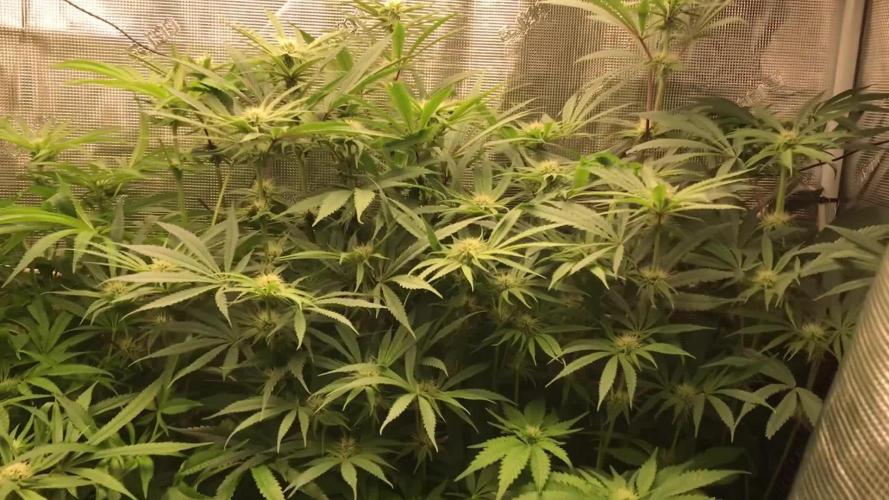
I start by saying that the genetics of this fantastic and super plant, the only exemplary because I was given after ordering, the first time I cultivated this variety .. I never had any problem from germination at the end of harvest, made grow for 6 weeks approximately with light hours 18/6, then kept in bloom for 10 weeks ...... and from about 10 days to dry with temperatures between 19/20 degrees, and humidity rate to 50% between today and tomorrow I'll make a nice manicure.





Likes
20
Share


@eldruida_lamota
Follow
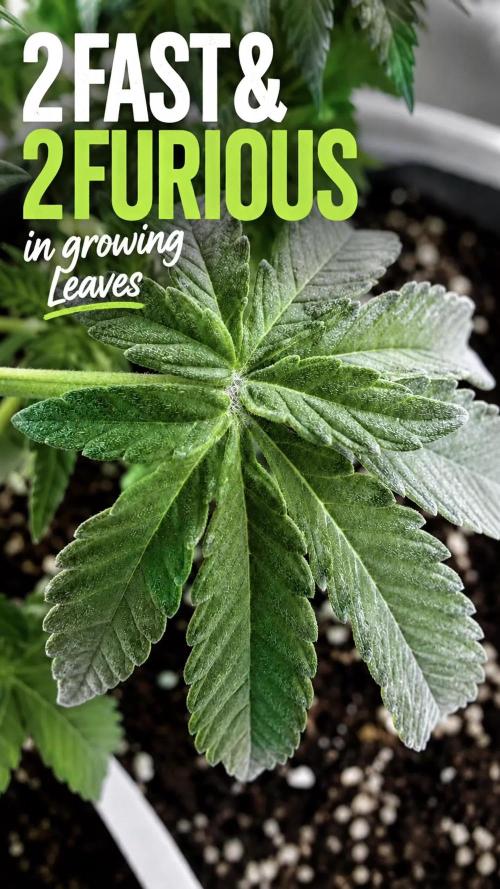
Esa familia vamos actualizar ya la tercera semana de floración de estas Lava Cake de Zamnesia.
Y es que me sorprende están increíbles tienen un color verde alien se ven bien sanas.
Temperaturas máximas en 26.5 y mínimas en 24 y una humedad estable en torno al 50/55%.
Os comento que tengo un descuento y para que compréis en la web de Zamnesia de un 20%, el código es ZAMMIGD2023
The discount 20% and the code is ZAMMIGD2023
https://www.zamnesia.com/
Agrobeta:
https://www.agrobeta.com/agrobetatiendaonline/36-abonos-canamo
Mars hydro:
Code discount: EL420
https://www.mars-hydro.com/
Espero que lo disfrutéis, buenos humos 💨💨.
Likes
6
Share


@Jungle_James_Grows
Follow
She's starting to fade out now, and budding up nicely. Not seeing much purple coming through yet. She's getting nice and fat and smelly now.
Trying out a macro lens thingy.

Likes
5
Share


@Tried_and_Tested
Follow
This was another very good week for the plants, with the flowers beginning to swell up and take shape. Some of the lower leaves are starting to yellow, but this is expected. As the light doesn't penetrate as far, the plant will begin to 'consume' those leaves and drop them to redirect energy to the tops.
The canopy is fairly even apart from 1 small spot, which does not have any colas at all. This is due to me bending away the GSC that was topped, with the intention of the lower branches stretching up. This happened with all the other plants I did it to, but not this one for some reason. I think it was due to airflow around the budsites so I added an extra fan last week to hopefully improve this.
The strongest looking plants by far are still the ones that were Topped with LST, followed by the mainlined, with only LST in last place. I have found that the LST only ones do not have stems as thick as the others, so this may impact yield later.
Not much done in the way of training apart from the odd leaf bending or stem tying. The next few weeks will most likely be fairly uneventful, as now we just need to wait for them to flower fully :D
Likes
45
Share


@AsNoriu
Follow
Day 151. Girl is harvested, sticky, stinky, oily, a bit too leafy and kind of light, cant see even 100 of her .. ( 8.5 is already choped, the brushed by wall branch ).
She stinks like skunk with some aftertaste ( tried scissors hash already).
Now it looks like she had to go couple weeks more, trich mostly milky and leaves after darkness are green, looks like she was beging me to leave her and put makeup to look younger ;)))))
We shall see ..
Day 157. Boy oh boy ... how i love to be wrong ...;))))
Girl is a record braker. 141 from one plant, my new pure indoors record.
Long journey , desent result, she could make in 6 weeks earlier, but she had a crazy life, lets hope it will be crazy smoke ;)))
Report to come ....


Likes
19
Share


@4Haut
Follow
Hi@all, it is the end of the fifth week, I started some low-stress training to bend the lower branches towards the light. It worked really well. Three days ago, I topped the "head". I hope she's recovering from it in the next days/week. So far, everything seems to be going well and it’s really enjoyable. 😎🌿
My only concern is the 40x40 cm tent – I think it might be a bit tight in there...
Greetings ✌️

Likes
13
Share


@Fatnastyz
Follow
10-14
Buildabloom 1/2 tap
10-16
Water
Water between 500-700 ml a day.
10-18
Fed 450 ppm build a bloom
10-19
Water few leaves removed.
Love her smell. Lemon, lime, sourish!
I definitely over filled my tent and this one felt it the most. But mainly because I didn't know what to expect. Somehow she has not been over fed, yet! I still got time!
Im excited for her and to grow her again! Oh and to learn to not over feed more than anything. Think imma try just drit, till shes hungry, then do water feeds! When hungry 🤣🤞
.
Likes
14
Share

@FlonGrow
Follow
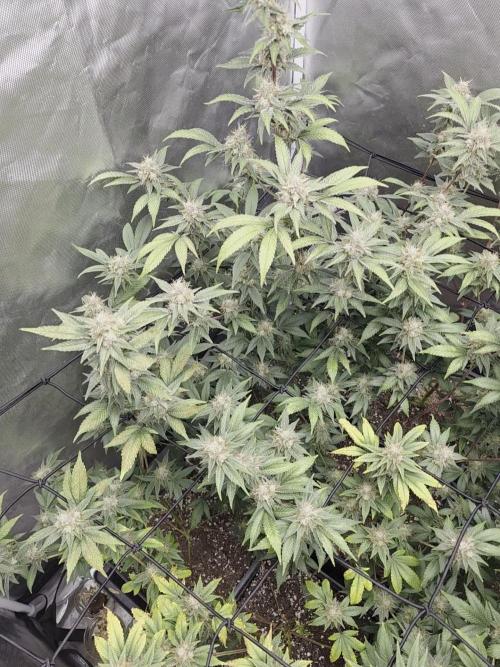
Pflanzen bekommen wieder gegen Ende calmag mangel . Bekomme das irgendwie net in griff
Likes
9
Share


@SmokinTees420
Follow
Week 4 of flower started on 4/25. Did another moderate defoliation on the larger dark green fan leaves to open the canopy up for more light. Hoping to get bigger buds this go round.
Processing
Likes
27
Share


@Fibro_Witch
Follow
Everyone got transplanted yesterday! They've been hardening off outside for almost a week. The got some Fish Emulsion a couple days ago. One night it got down to 38F, even though the weather said it would only get down to 50F! So I'm very grateful that they're so resilient.
They're not showing much transplant stress so that's good. I watered in some lime when i transplanted. I put them in with my tomatoes that I need to stake. I started putting down seaweed mulch which hopefully I will finish tomorrow.
Overall a good week and it feels good to have them in the ground!
Likes
8
Share


@420DeepGrow
Follow
Gracias al equipo de Fast Buds, XpertNutrients y Marshydro sin ellos esto no seria posible.
💐🍁 Lemonpaya:
Lemonpaya es una fusión perfecta de nuestro corte Keeper Lemonade y la reconocida variedad Papaya (Oni Selection). Fast Buds Lemonade Keeper, apreciada por su suave fragancia a limón, sirve como padre fundamental en muchos de nuestros proyectos de cría. La papaya, a su vez, aporta su característico aroma y sabor intensamente dulce y tropical, junto con una reputación por su gran producción de resina. Lemonpaya hereda los mejores atributos de ambos linajes, con abundantes cosechas de flores densas y grandes infundidas con la tentadora dulzura de la papaya y un toque de limón picante. La planta se presenta como un arbusto alto y robusto, adornado con colas largas y rectas cargadas de densos cogollos. Su resistencia al estrés la convierte en una variedad versátil adecuada para espacios de cultivo tanto de interior como de exterior. En interiores perdona multitud de errores, mientras que en exteriores muestra una resistencia incomparable a los desafíos y elementos ambientales. La Lemonpaya prospera tanto en climas cálidos como fríos y ofrece constantemente una cosecha excepcional acompañada de su suave perfil de terpenos con infusión de limón.
🚀 Consigue aqui tus semillas:
https://2fast4buds.com/th/seeds/lemonpaya
💡FC6500: Eficiencia líder en el mercado: la lámpara de cultivo LED FC-E6500, que ostenta un estatus líder en el mercado, es una solución rentable con un PPE de 2,8 µmol/J y un rendimiento máximo de 2,5 g/vatio. Ofrece un PPF alto de 2026 umol/S y es adecuada para una cobertura de vegetación de 1,50 m x 1,50 m y una cobertura de flores de 1,20 m x 1,20 m.
Iluminación versátil y uniforme.
https://marshydro.eu/products/mars-hydro-fc-e-6500-730w-commercial-led-grow-light/?gad_source=1&gclid=Cj0KCQjw1qO0BhDwARIsANfnkv9IIrYSbmJqz8PqpJOIyWwJfp5bc3SGJgUV68USLQ4tjmXDYwoBuAsaAue3EALw_wcB
🚥 MarsHydro ADLITE UV/IR/RED:
Para lograr un crecimiento óptimo de las plantas y maximizar los rendimientos es un arte simple que depende en gran medida de las condiciones ambientales adecuadas. Reconociendo las limitaciones de la iluminación natural y las soluciones de iluminación tradicionales para satisfacer estas necesidades únicas, lanzamos ADLITE. Estas luces especiales UV, IR y roja están diseñadas para llenar áreas del espectro, proporcionando las altas longitudes de onda que las plantas necesitan para un crecimiento y desarrollo óptimos.
🚀 Consigue aqui tu Adlite:
https://marshydro.eu/collections/adlite-supplemental-lights/
🏠 : Marshydro 1.50 x 1.50 x 1.80, carpa 100% estanca con ventanas laterales para llegar a todos los lugares durante el grow
https://marshydro.eu/products/diy-150x150x200cm-grow-tent-kit
🌬️💨 Marshydro 6inch + filtro carbon para evitar olores indeseables.
https://marshydro.eu/products/ifresh-smart-6inch-filter-kits/
🍣🍦🌴 Xpert Nutrients es una empresa especializada en la producción y comercialización de fertilizantes líquidos y tierras, que garantizan excelentes cosechas y un crecimiento activo para sus plantas durante todas las fases de cultivo.
Consigue aqui tus Nutrientes:
https://xpertnutrients.com/es/shop
📆 Semana 13:
Última semana antes de cosechar esta maravilla, hay 2 fenotipos diferentes uno de ellos con unos tonos purpura que resulta una belleza visual