





@Drgreenthumb627
Volgen
Day 26, what can i say this plant is a beast, been a dream to grow and the structure on the plant is very desirable for my style of training. the terps on this one overpower all other smells when i open the tent.


@Silverlok
Volgen
Hey guys,
Nothing special happened.
They are still looking fine and doing a good job!
As you can see, i lollipopped them yesterday. Maybe a little bit too much! :D But i think its okay
Greetz


@JBoBz
Volgen
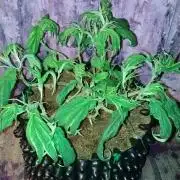
I'm really happy about the quality of this strain, but I'm unhappy about the final results.. I think it was a setup mistake in the room, it probably took lots of heat but I got other seeds of it I'll probably will do another diary with her!
Okay guys, thanks for the support and we will se in the next room, happy growing to everyone 💚🍀💯




@MADMANk
Volgen
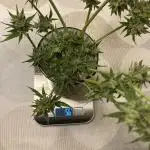
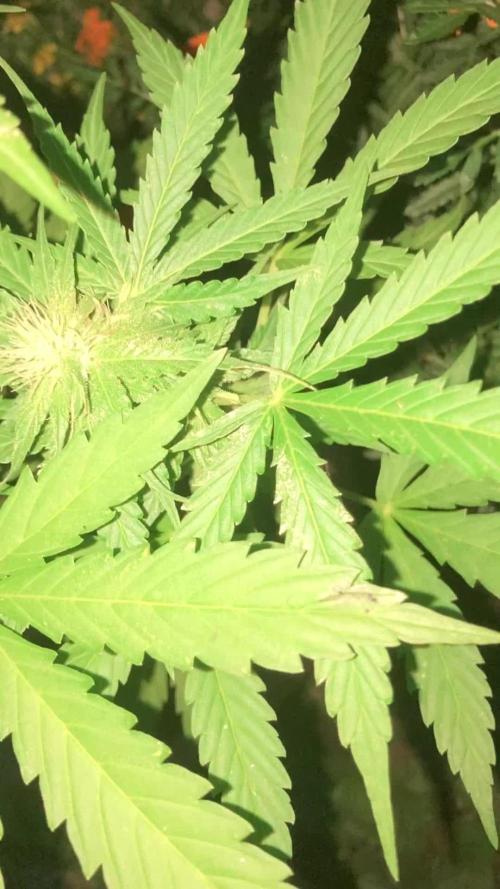
If i said i wasnt getting a bit intimidated by the amount of nodes this girl is shooting id, id be lying...
Big defoliation, as she needs constantly almost!
The nodal spacing is so cool, rather than 2 nodes a time the nodes spawn in a more "zig zag" pattern up the stems
Super healthy and happy


@India_Calcoen
Volgen
09-09-2025
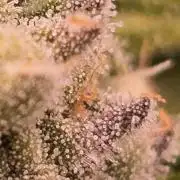
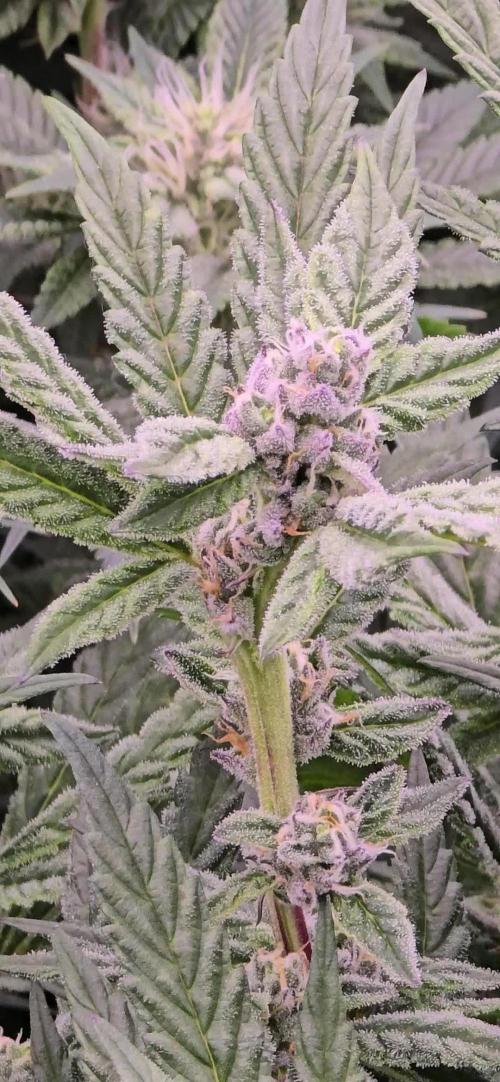
Yesterday evening I noticed some bright yellow spots on the leaves of my White Widow. I didn’t know what it was. Today I saw that the spots turned brown. I tried to wipe it off, but I couldn’t. I think this is downy mildew. I moved the plant to the garage. The garage is quite dry and has a better humidity level than the greenhouse. I hope this will not spread. I don’t know what to do about it…




@BioBuds
Volgen
Great to see you and I missed you, I had some time so I created a video to thank our lovely foster company, who were so kind to let us try their light in return for a review. Now, most of you don't know I'm also into making music, mostly Techno but I also love HipHop and Gangster rap, mainly 90's Westcoast, although I'm fond of East Coast and a little dirty South, so this was an excellent time to showcase one of my tracks.
So please check my Autumn-themed, not commissioned, or approved by Mars Hydro, visualization video in thanks for @MarsHydroLED.
The grow has been going great! If you don't count the about a thousand fungus gnats I have been fighting. I'm manually manifolding and training the girls, into the desired shape, which is a bit hands-on but I see it as a collaboration more than a 50 shades approach to training. You can't just bust out a rope and domination on girls like that. We ease it in there, going to the limit every time, making them stretch and curl underneath the touch of our tender but firm hands. And when they are used to a little groping and fixation, we might bring out a few ropes here and there to spice it up a little. Anywaaaays.... I'm getting carried away here, back to the grow.
I had bought some coco-peat, after leaving none for the top layer as I suggested to all of you in the previous weeks of my grow (if you missed it, click one week back for a full recipe (the yellow image) for everyone in Europe) left me with enormous amounts of fungus gnats.
Its seems to alleviate the problem already. As it did with my previous grow the Gelato 33 Golden Canopy from Heaven.
In the meantime I notice my temperatures going down so Im trying to fix that too. All in all it had been a good week and this Orange Hill Special is promising to become something special!
Thanks for visiting again, see you soon!


@MrPipi
Volgen
Mr. Pipi defoliated a bit after the topdress last week. just some old leafs here and there, not much. And Frost is building up, terps are coming. Mr.Pipi is happy :)
AND the colors BOI oh BOI. thats what Mr.Pipi dreamt of.
Day 46: Heights : Frank 47cm , Pedro 44cm and Lance 34cm.



@DogDoctorOfficial
Volgen
💙 Project Blue Tent – Week 13
🌿 Blue Waffle F1 – Pheno B
🌱 Same Genetics, Different Expression – A Beautiful Fade into Lighter Greens
Hello everyone, and welcome back to another chapter of Project Blue Tent! 💙🌱
My friends, we're back with another individual report, and this time it's all about our beautiful Blue Waffle F1 Pheno B!
And honestly, what can I say?
These girls are amazing! 😂💙
We've reached another interesting stage of flowering, and while all four plants are sharing the same environment, the same reservoir, the same irrigation system, and the same general cultivation approach, each one continues to show us her own individual characteristics.
Last week, we talked about the beautiful development of our Blue Waffle F1 girls and the incredible details we've been capturing through photography and focus stacking.
This week, we're continuing that journey.
The room is moving towards the final stage of flowering. We're gradually reducing temperatures, lowering the nutrient concentrations, and beginning to decrease the output of the overhead LEDs.
The two LumiFlora under-canopy fixtures remain part of the experiment, and the irrigation system continues supporting all four plants.
But today, we're not simply repeating the room update.
We're looking at what makes this particular girl different.
Because even when plants share the same genetics, that doesn't mean they will express themselves in exactly the same way.
And Pheno B is giving us a beautiful example of that.
Her structure is a little different from her sister's. Her flower development has its own character, and her colours are moving more towards lighter shades of green rather than the more pronounced blues, purples, and reddish tones we've been admiring on Pheno A.
She's still compact. She's still beautiful. And the aroma?
Absolutely incredible!
Let's take a closer look. 💙🌿
🌸 WEEK 13 – MOVING TOWARDS THE FINISH
We're now in Week 13 of flowering, and the entire room is gradually moving towards the final stage of the journey.
The major structural work has already been completed.
The plants have been trained, topped, managed through the stretch, and supported with the SCROG system. The second layer of support remains in place, and the under-canopy lighting experiment continues.
At this stage, we're concentrating on maintaining a stable environment and observing how each plant develops.
We're not looking to make unnecessary structural changes just because another week has passed.
Instead, we're watching the flowers, the changing foliage, the overall structure, and the characteristics each phenotype is expressing.
And this is where things become particularly interesting.
Pheno A and Pheno B share the same cultivar, but they aren't identical copies of one another.
They have their own morphology, their own individual appearance, and their own way of progressing through flowering.
Pheno B is now showing us a different side of Blue Waffle F1.
And I'm really enjoying seeing those differences develop!
🌿 SAME GENETICS, DIFFERENT MORPHOLOGY
One of the most interesting things about documenting individual plants is that it gives us the opportunity to observe differences that might otherwise be overlooked.
Our two Blue Waffle F1 plants share the same cultivar, but each comes from a different seed.
And although they share the same growing environment, their physical expression isn't identical.
Pheno B has a different overall structure from her sister.
The way her flowers are developing, the way the plant presents itself, and the colours she's expressing are all slightly different.
We're still seeing that compact appearance, but the overall morphology isn't exactly the same.
It's a reminder that a cultivar name doesn't guarantee that every individual plant will look identical throughout its life cycle.
Genetics provide the potential for particular characteristics, but individual plants can express that potential differently.
Environmental conditions can also influence how plants develop, so we shouldn't automatically attribute every difference to genetics alone.
And that's precisely why we document these plants separately.
We're not trying to force them into the same description.
We're observing what each one actually shows us.
Pheno A has her own personality.
Pheno B has hers.
And both deserve their own spotlight! 💙🌱
🌱 A DIFFERENT STRUCTURE, BUT STILL BEAUTIFULLY COMPACT
Let's talk about the structure of this girl.
Pheno B remains compact and beautifully developed, but when I compare her with Pheno A, I can see differences in the way the plants have expressed themselves.
The overall morphology is slightly different, and the flower formation isn't quite the same.
It's difficult to say exactly why those differences have developed.
It could be down to individual genetic expression, environmental influences, or a combination of factors.
Even though the plants share the same tent, they don't necessarily experience every condition in precisely the same way at every point across the canopy.
Light distribution, local airflow, and individual plant characteristics can all contribute to differences in development.
However, we don't have enough evidence to identify one specific cause here.
And that's perfectly fine.
We're documenting the observations rather than inventing an explanation.
What matters is that Pheno B has developed her own structure, and we're now able to appreciate that individual expression as flowering progresses.
She's looking beautiful, and I'm happy with what we're seeing.
🌸 FLOWER FORMATION – HER OWN WAY OF DOING THINGS
The flower formation is another area where I notice differences between the sisters.
Although both plants remain compact and are progressing through the same general flowering stage, their flowers don't present themselves in exactly the same way.
Pheno B has her own pattern of development, and this is something I'm particularly interested in following as we move closer to the finish.
Was it something about the environment?
Was it simply the individual expression of this plant?
Could it be a combination of factors?
At this point, I can't give you a definitive answer.
And I don't want to pretend otherwise.
Sometimes, when we're growing several plants together, we see differences that are easy to observe but much harder to explain with certainty.
That's part of the learning process.
We record what we see, compare the plants, and continue observing as they mature.
The important thing is that Pheno B is developing beautifully, and her individual characteristics are becoming increasingly clear.
Her sister might be showing a more colourful expression, but Pheno B has her own charm.
And that's exactly why I love keeping separate phenotype diaries.
🌿🌈 THE COLOURS – A DIFFERENT KIND OF BEAUTY
Now, this is where Pheno B really separates herself from her sister.
While Pheno A has been showing us a more pronounced mixture of blues, purples, reddish tones, and greens, Pheno B is moving towards lighter shades of green.
Her fade is different.
It's less about those strong contrasting colours and more about the changing green tones we're seeing throughout the plant.
And honestly, my friends, there's absolutely nothing wrong with that!
😂💚
Not every plant needs to develop the same colours to be beautiful.
Different phenotypes can express different pigmentation patterns, even when they share the same cultivar.
Genetics can influence those characteristics, while environmental conditions and the stage of maturity can also play a role.
We're seeing Pheno B move towards a lighter, greener appearance as she progresses through flowering.
That's what the plant is showing us, and that's what we're documenting.
I'm not going to claim that the cooler temperatures alone caused this particular fade, because we can't establish that from our observations.
Instead, we'll continue watching her colours develop alongside the other signs of maturity.
And I have to say, I really like seeing the contrast between the two sisters.
One is showing a more colourful palette.
The other is expressing herself through lighter greens.
Same cultivar. Same room. Different individual expression.
That's what makes this comparison so interesting! 💙🌿
❄️ COMPACT FLOWERS AND PLENTY OF DETAILS TO OBSERVE
Despite the differences in colour and structure, Pheno B remains compact and attractive.
The photographs give us a closer look at her flowering sites and the details developing across the plant.
And this is another reason I enjoy documenting each phenotype individually.
When we look at the whole tent, it's easy to concentrate on the general appearance of the canopy.
But once we start looking at individual plants, we can appreciate their particular characteristics much more clearly.
The flower structure.
The arrangement of the flowering sites.
The way the plant presents its foliage.
The changing colours.
And the small differences that make one phenotype distinct from another.
We're continuing to observe the flowers and the developing trichomes as the plant progresses.
The pistils are also changing as flowering advances, but their appearance alone doesn't tell us everything about maturity.
We'll keep looking at the overall development rather than relying on a single visual indicator.
For now, Pheno B is looking beautiful, and I'm excited to continue documenting her progress.
📸 PHOTO STACKING – LOOKING CLOSER AT THE DETAILS
Photography remains an important part of Project Blue Tent.
This week, we've continued capturing photographs of the plants and documenting the flowering sites through close-ups and focus stacking.
As many of you already know, focus stacking combines multiple images captured at different focus distances to create a final photograph with greater depth of field.
It's a fantastic technique for showing intricate details that can be difficult to capture in a single frame.
The process also takes time.
We need to set up the camera, choose the composition, capture the individual frames, and then process the stack.
And when we're working inside the grow room rather than in a dedicated studio, we have to work with the conditions available to us.
But that's part of the process, too.
The aim is to document the plants as accurately and clearly as possible, while giving everyone following the diary a closer look at what we're seeing.
For Pheno B, these photographs help us appreciate her individual flower formation and the differences between her and her sister.
They're not just pictures for the sake of taking pictures.
They're part of the record of this grow.
And I genuinely enjoy sharing that process with the community. 📸💙
🌡️ THE SHARED ROOM – LOWER TEMPERATURES FOR THE FINAL STAGE
Now let's return to the wider environment, because everything we've been doing in the room applies to Pheno B as well.
We're gradually lowering both daytime and nighttime temperatures as we move towards the final stage of flowering.
The current daytime air temperature is approximately 25°C.
During the night, when the plants are resting, the temperature drops to around 19–20°C.
We've also brought the solution temperature and substrate temperature down to approximately 21°C.
These adjustments are part of our approach to the finishing stage.
We're interested in observing how the plants respond as the environment changes and how their natural characteristics develop over time.
Cooler conditions can influence colour expression in some cultivars, but the response depends on the genetics and the overall environment.
We're not assuming that every plant will respond in the same way.
And Pheno B is a perfect example of why individual observation matters.
Despite sharing the same room with Pheno A, she's expressing a different colour pattern.
We'll continue watching both plants and documenting what happens as they approach the finish.
💧 HUMIDITY – UNDERSTANDING THE READINGS
Our normal relative humidity is approximately 55%.
You may notice that some photographs show higher readings, particularly when I'm working inside the tent.
When I'm moving around, taking photographs, checking equipment, and breathing inside the room, the humidity can rise temporarily.
Even with the air conditioning running, the readings can change while I'm working.
That's why it's important to distinguish between a temporary measurement during maintenance and the normal operating conditions we're aiming to maintain.
For this report, we're recording approximately 55% relative humidity under normal room conditions.
The aim is to keep the environment stable while monitoring the plants throughout this stage.
🌱 NUTRITION – LOWERING HYDRO A AND B
We've also started reducing the nutritional concentration as the plants move towards the final stage.
The new recorded recipe is:
PLAGRON Hydro A – 1.8 ml/L
PLAGRON Hydro B – 1.8 ml/L
PLAGRON Power Buds – 1 ml/L
PLAGRON pH Plus – as required
PLAGRON pH Minus – as required
The recorded pH is approximately 5.96, while the EC is around 1.86 mS/cm.
By reducing Hydro A and Hydro B, we've also reduced the overall nutrient concentration, which is reflected in the lower EC and TDS readings.
The pH can also shift as the composition of the solution changes, although its response isn't always predictable.
Our target is to keep the pH close to 6, allowing for small variations above or below that point.
As long as the reading remains within our intended range, we avoid unnecessary adjustments.
We're not chasing a perfectly fixed number every minute.
We're observing the solution, keeping the system stable, and making changes when there's a reason to do so.
The same nutritional program is being used across the shared reservoir, so Pheno B is receiving the same general solution as her sister and the two Pickle Lemon Haze F1 plants.
Keeping this consistent also helps us compare the plants without introducing unnecessary differences in the feeding program.
💡 LIGHTING – REDUCING THE OVERHEAD POWER GRADUALLY
The overhead LED output is now approximately 90%.
From here, we're planning to reduce the output gradually, by around one or two percentage points per day, as we move closer to the end.
We're not switching everything off or making a sudden change.
We're taking a gradual approach while observing the plants and maintaining the overall environmental balance.
The goal is to keep the lighting appropriate for this stage rather than simply running the equipment at maximum power.
Light intensity, temperature, humidity, and plant response all need to be considered together.
And that brings us to another interesting part of the project.
💡 TWO LUMIFLORA FIXTURES – LIGHT FROM BELOW
The two LumiFlora 150W full-spectrum under-canopy fixtures remain in place beneath the canopy, arranged in an X-cross configuration.
We're keeping their output around 90–95% for now, with the possibility of reducing it closer to the finish.
The overhead LEDs provide the main lighting, while the under-canopy fixtures supplement the lower portions of the plants.
We're interested in observing how the lower flowering sites develop under this arrangement.
One of our goals is to see whether this lighting balance helps the flowers across different parts of the plant progress more uniformly.
However, we won't assume that the additional lighting automatically produces that result.
We'll continue monitoring the plants and documenting what we see.
The lighting arrangement is part of the experiment, and the individual phenotype reports allow us to keep track of the differences between the plants as they develop.
💧 IRRIGATION AND DRAINAGE – THE SYSTEM CONTINUES WORKING
The automatic irrigation and drainage system remains an important part of the Project Blue Tent ecosystem.
All four plants share the same reservoir, and the system helps us maintain consistency throughout the room.
The recorded watering volume is approximately 1.6 litres per plant per 24 hours.
As always, the actual water requirements of an individual plant can depend on its development and the conditions around it, so we continue observing the system rather than assuming that every plant necessarily uses water at exactly the same rate.
The aim is to keep everything working smoothly while we concentrate on the plants themselves.
And that's one of the advantages of having an established system.
When the equipment is operating as expected, we can focus on observing, photographing, and documenting the plants without making unnecessary changes.
🌿 FOUR PLANTS, TWO CULTIVARS, ONE SHARED ENVIRONMENT
This is one of the most interesting parts of Project Blue Tent.
We have four plants sharing the same room, representing two cultivars: Blue Waffle F1 and Pickle Lemon Haze F1.
They share the same general environment, the same reservoir, and the same lighting setup.
Yet each plant has her own characteristics.
And when we compare Blue Waffle F1 Pheno A with Pheno B, those differences become particularly interesting.
Pheno A is showing more pronounced blues, purples, reddish tones, and contrasting colours.
Pheno B is moving towards lighter greens.
Their structures are also slightly different, and the flower formation isn't identical.
At the same time, both remain compact, both are progressing through flowering, and both are producing an aroma that I absolutely love.
The similarities are just as interesting as the differences.
Their shared genetics provide a starting point for comparison, but they don't mean that every characteristic will be expressed identically.
That's why these individual diaries are so valuable.
We're not trying to make the plants look the same on paper.
We're recording what makes each one unique.
And I'm really enjoying seeing these differences emerge as the girls approach the finish.
👃 THE AROMA – INCREDIBLE, AND VERY SIMILAR TO HER SISTER
Now, one thing that seems remarkably similar between the two Blue Waffle F1 girls is the aroma.
The whole room smells amazing!
😂🌸
Despite their differences in structure and colour, the aroma coming from these plants is very similar, and it's becoming increasingly noticeable as flowering progresses.
It's another interesting point of comparison.
Their visual expression differs, but the overall aromatic impression is remarkably alike.
I'm not going to assign a detailed terpene profile or invent specific aroma notes that we haven't documented.
For now, what I can say is that the smell is strong, beautiful, and very similar between the sisters.
And honestly, it's one of those things that makes spending time in the room such an enjoyable experience.
The photographs can show us their colours and structure.
The video can give you a closer look at the garden.
But the aroma?
You'll have to take my word for it!
😂💙🌿
🔭 WHAT I'M WATCHING NEXT
As we continue towards the end of flowering, I'll be paying particular attention to Pheno B's changing colours and overall development.
I'm interested in seeing how her lighter green fade progresses.
I'll continue observing the flower structure and the developing trichomes, alongside the overall condition of the plant.
I'll also keep comparing her with Pheno A, because their differences are becoming an increasingly interesting part of this project.
We're maintaining the same general environmental approach across the room, gradually reducing the overhead LED output, keeping the under-canopy fixtures in place, and lowering the nutrient concentrations.
Now we give the plants time to respond.
There's no need to rush to a conclusion or assume that the sisters will finish in exactly the same way.
We'll keep observing, photographing, and documenting their individual journeys.
And that's what this project has always been about.
💙 FINAL THOUGHTS – DIFFERENT EXPRESSION, EQUALLY BEAUTIFUL
My friends, Blue Waffle F1 Pheno B is looking beautiful.
She's compact, she's developing her own flower structure, and she's moving towards a lighter green expression as flowering progresses.
Her sister has been showing us more pronounced blues, purples, and reddish tones, while Pheno B is taking a different visual path.
And I love that.
We have the same cultivar, the same shared environment, and the same general cultivation approach, yet the individual plants aren't expressing themselves identically.
It's a great reminder that growing is about observing what actually happens rather than expecting every plant to follow exactly the same pattern.
We can make comparisons.
We can record measurements.
We can photograph the differences.
But we should also be honest when we don't know exactly why a particular characteristic has developed.
That's part of learning.
And it's one of the reasons I enjoy documenting the entire journey, including the weeks when the changes are subtle rather than dramatic.
The room is gradually getting cooler.
The solution and substrate temperatures are around 21°C.
The nutrient concentrations have been reduced.
The overhead LED output is now around 90%, with gradual reductions planned.
The under-canopy lights remain part of the experiment.
And the irrigation system continues supporting all four plants.
Meanwhile, Pheno B is showing us her own beautiful expression of Blue Waffle F1.
Different structure.
Different colours.
Very similar aroma.
And a beautiful plant continuing towards the finish.
I'm genuinely happy with what we're seeing.
Let's keep observing, keep learning, and see what the next chapter brings!
🌿💙🌈
💬 COME JOIN THE DOGDOCTOROFFICIAL DISCORD COMMUNITY!
Before we wrap things up, I want to invite everyone to join our Discord community.
If you're already a member, you know how much fun we have together.
And if you're new, you're more than welcome!
We have a fantastic community where growers can share experiences, exchange ideas, show their gardens, ask questions, and enjoy the hobby together.
No level required.
You don't need to be an expert.
You don't need the biggest setup.
Everyone is welcome.
We also organize giveaways and photo championships, with prizes for the winners.
It's a wonderful place to meet other growers, learn from one another, share photographs, and become part of a community that feels like family.
So come and join us!
💙 DogDoctorOfficial Discord:
https://discord.gg/dogdoctorofficial
Introduce yourself, share your garden, and say hello.
We'd love to see you there!
🙏 A HUGE THANK YOU
A huge thank you to Zamnesia for making Project Blue Tent possible and giving us the opportunity to document these beautiful Blue Waffle F1 and Pickle Lemon Haze F1 plants.
Thank you to PLAGRON for the Hydro nutrient line supporting the girls throughout this journey.
A massive thank you to Zamnesia for the Phytonaut LED lighting, curved scissors, and clip fans that have become important parts of this ecosystem.
Thank you to Mars Hydro for the irrigation and drainage equipment helping us maintain consistency throughout the room.
And a special thank you to LumiFlora for the 150W full-spectrum under-canopy fixtures that we're using to explore supplemental lighting beneath the canopy.
Thank you to GrowDiaries for giving us the platform to document the journey, share the photographs, compare the plants, and record what we learn along the way.
And, of course, thank you to everyone following Project Blue Tent!
Your support and your comments make these diaries even more enjoyable to put together.
We're continuing to observe, experiment, photograph, and learn, one week at a time.
Until next week, my friends...
More flowers.
More observations.
More photographs.
More learning.
And hopefully, even more beautiful details to share with you.
Growers Love, happy growing, and take care everyone! 🌱💙🌸



shorts_status_processing


@ThatoneAKguy
Volgen
Originally I didn’t think I had much to update until I compared the plants photos at 7 days. The ff3’s have definitely responded better to their new home than the neighboring ff2. They are definitely getting a thicker stalk and adding more foliage. I started the week with a light dose of flora flex nutrients which is by weight rather than tea or tablespoon. They call for 1 gram of the v1 & v2 per gallon of water and I opted for 1 for the entire 6 gallons. But with no response I adjusted the ph and added a small amount of Cali magic and flora grow. On my previous rockwool multi time per day feeding I would have expected these to be twice the size at two weeks. Hopefully we get some explosive growth soon.


@HomeGrowHeaven
Volgen
The plant has recovered well from the last capping and defoliation🏻♀️
A few leaves have yellowed a little, but that's not so bad🏻♂️
It will get a compost tea🍵 in a few days when it is sent into flower and then everything will be fine again😊💪🏻🏻
The compost tea is brewed and was given to the Watermelon Runtz at day 49 of Veg🍉🏃♂️

shorts_status_processing


@greengrassiIreland
Volgen
This is the first time I have experienced such a bad run of germination. I have contacted the vendor and I am still awaiting a response.
I have been very loyal to these guys and I'm now 3 weeks behind on stocking up for our winter meds!


@Afterglow
Volgen
Цветет необычайно быстро. Все 8 шишек примерно одинакового размера и это мой рекорд, так как в прошлый гров такие шишки были на 8-ой неделе цветения, а не на 4-ой как сейчас.
Ветка к концу цветения будет в виде колбасы. Также никогда еще такого не было в моем опыте мини гровинга.
Воду пьет по 2 литра в сутки. PPM и PH стоят как вкопанные и не двигаются, что на влив, что в дренаже.
Кажется что имеется переизбыток азота, но склоняюсь к генетике, так как к концу цветения листья должны почернеть.
В середине недели пришлось оторвать несколько листов, так как закрывали центральную часть, где тоже растет 4 низкие ветки, но также с большими бутонами.


@Santi_nf
Volgen
Las mejores de donde sacaré esquejes son por orden cachalote 3,8,7,1,6
Y de las ak 9,8,1,5
Son las mejores de momento .
entra en flora las siguientes variedades en el armario 2skywalker og runtzxl ,1 razubery,1 black toffee ,1panty punch todas autos.
1Scrambler haze,2 critical Windows ,1 hard diesel,1 fast skunk,1tutty Candy todas feminizadas.

Tutti Candy · Zmoothiez

Critical Widow · Pev Seeds

Sweet Skunk Fast Version® · Sweet Seeds
Skywalker OG Runtz XL Auto · Sweet Seeds

Cheese Berry · 00seeds

Hard Diesel · Gea Seeds

Scrambler Haze · Blimburn Seeds
AK · Gea Seeds
Cachalote · Gea Seeds
Gealato Kush · Gea Seeds
Gorilla Glue #4 · Gea Seeds
Somango · Gea Seeds


@Whitebelt
Volgen
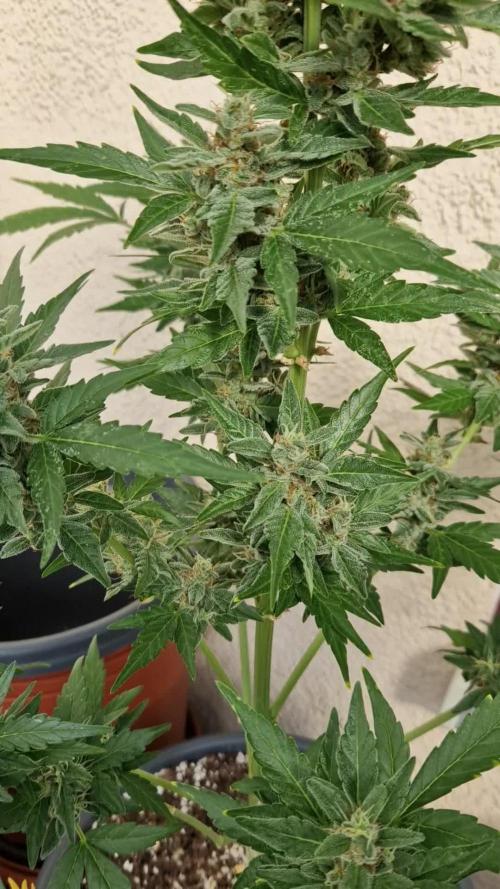
Week 8 - second week of flower
One plant is much smaller - still not confident on sex of any of them ... maybe that small one is a male - I’m guessing they’re all female tho. Either way i may need to slaughter that little guy - the other plants are just overtaking the tent - might not be worth keeping that little one in there.
Update 6/5/19 - I’ll take some updated pics tomorrow - I’m 95% sure I have FOUR out of four female plants.
Just picked up some yucca to try - and I got some more led hangers so maybe I’ll upgrade the lights today - the rapidLED far red flower initiator isn’t coming until Wednesday unfortunately but I have two more SolStix I could add.
Update 6/5/19 - far red flower initiator and the two (now 4) solstix are installed - I need to make a simple aluminum frame - maybe this weekend
Picked up some 29% H202 to clean the rez tank and pumps and filter etc (not to put in the nutes for the plants tho!)
Got a better air pump and airstone for the rez.
New Vivosun oscillating fan - wtf!? Made for grow tents but can’t turn without stopping on the sides of the tent!? - I emailed them maybe it’s defective.


@TrickzGrowz
Volgen
Servus Moin!
Die Super Lemon Haze Auto sieht eigentlich schon so gut wie fertig aus. Ich werde sie aber ein wenig länger stehen lassen, um zu schauen, ob die Buds noch ein wenig anschwellen.


