Check the winners The Grow Awards 2026 🏆
Likes
Comments
Share
Likes
2
Share
@Trinidad
Follow
15.11.25 Day 37 Blue Cheese which was initially the biggest has recovered. I left her without water for to long. She is now the smallest. The Big Buddha Cheese is looking good, now is good time for training and moving into individual buckets. The badazz OG Cheese is starting to sprint ahead.
Likes
14
Share
@Kakui
Follow
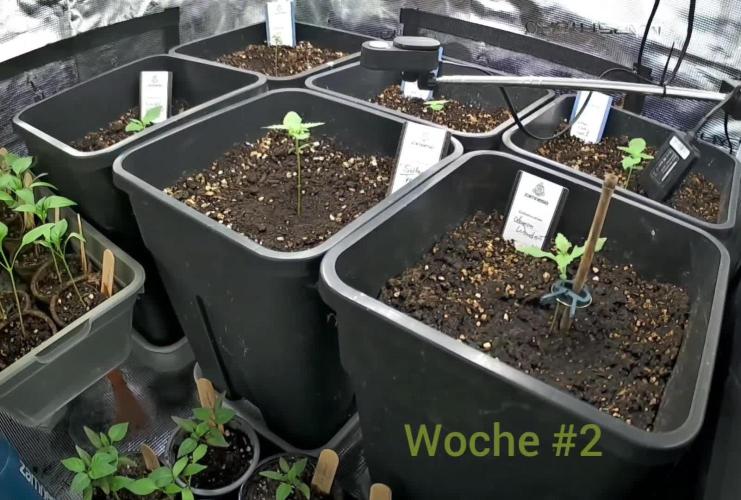
Exotic Genetix: Event Horizon (x3) y Toasted Toffee(x3). Thug pug Genetics: Peanut Butter sunset(x3). Una ves sean transplantadas a su macetero definitivo(5 litros) se comenzará con riego automático, drip to waste, y protocolo Crop Steering. 20 Octubre(15:30): 9 semillas en remojo, solución de 2 partes de agua de ósmosis + 1 parte de peróxido de hidrógeno 3%, 5.8pH, 0.6EC, 28°C~30°C. Antes ser puestas a remojar se lijaron las semillas para favorecer la absorción del agua. 21:30: puestas en toalla de papel con la misma agua de remojo, dentro de un contenedor de vidrio hermético y sobre una alfombra de calor a 28°C~30°C, para aumentar la actividad metabólica. 21 Octubre: Pre carga del coco, con solución de nutrientes Athena en 2.0EC y 5.7pH, saturación hasta lograr drenaje, el drenaje fue de 1.5EC y 5.6pH. 21:50: Todas las semillas presentan radicula de distintos tamaños(1cm aprox) son inmediatamente pasadas al sustrato. 22 Octubre: 21:10, se aprecian todas ya brotando, se mantiene el ambiente en 26°C~28°C y 70%+ de humedad. 23 Octubre: 9/9 semillas brotadas, se ven algunos Cotiledones. 24 Octubre: (9:30)8/9 cotiledones abiertos, altura entre 3cm~5cm, etapa de plantula iniciada. Toffee n3 se atrofió por mala manipulación, espero que crezca aunque sea lento, si no, tendré que seguir solo con 8 plantas. 25 Octubre: Toffee n3 está viva!!! Estuve a punto de quitarla, y está mañana apareció sin su capucha, cotiledones afuera. Yujuuuu!! 26 Octubre: hoy tuvieron su primer riego con nutrientes Athena, 2.0EC y 5.8pH. Se regó hasta alcanzar drenaje, el drenaje fue de 1.9EC y 5.7pH. 27 Octubre: Se desarrollan a buen ritmo, algunas han estirado más que otras, alturas entre 4cm~7cm. 31 Octubre: Segundo riego, 120ml casa una, 2.0EC y 5.8pH, runoff de 2.3EC y 5.7pH. 2 Noviembre: Creciendo a buen ritmo, alturas entre 5cm y 9cm. 4 Noviembre: Riego 180ml cada una, 2.0EC y 5.8pH, runoff 2.8EC y 5.8pH, desde ahora se regarán más seguido, removí las primeras hojas, solo por comodidad para regar, de igual manera los primeros nodos y esas hojas se terminan podando pronto. 8 Noviembre: Riego 2.0EC, 5.8pH, 240ml cada una para aumentar el runoff, valores de runoff de 3.0EC y 6.0pH. Alturas entre 9cm y 14cm.
Likes
9
Share
Was away so missed a feeding but overall still doing well
Likes
59
Share
Supereasy Plant She was Germinating extremly fast, growing vigor without any Problems After Seedlingsstage, they moved into 30l Soilmix, amended with 5g/l BioGrow from Greenhousefeeding She had alittle training like 2 times Topping and minimal LST Plant itself showed great Structure, and fantastic Ratio from Buds to leaves No Popcorn Buds. Only Massive Topcolas, with konic formed dense Buds She smells very various and complex, like Fruits, Herbs, Perfum, Diesel. Depends how near you are, or if you cut her,If you break the flower she turns out the more Diesel part I am very courious to her Taste and effects I had very much fun with this Grow. I harvested her after fullfilled 8 Weeks of Flower ( 56 days) Here is the other Diary of the DEEP Candy CBD , grown as Microgrow https://growdiaries.com/diaries/112859-grow-journal-by-mrs-larimar#
Likes
18
Share
@Nurse
Follow
There is a lot of smell this week. I plucked one of the buds and quickly dried it and smoked it. I couldn't stand it anymore, you can see his picture too. ====My QUESTION==== My plants had a lot of stress from the beginning because it was my first cultivation. The most important I think was for fertilizer. Instead of fertilizing them, I gave them empty water, which in week 8 I saw all the leaves turn yellow. And that's where I started fertilizing. Now in week 10 the plants have green leaves. But they do not grow tall and do not drink much water. It takes 4 to 5 days to dry. The buds no longer grow. Little by little, some of the pistils are turning orange. I also took pictures of trichometers with my phone, I don't know if they are transparent or milky. Now is the first day of the 11th week. Do you think I should fertilize them again and they will continue to grow? Or should I give them water and flush them? Someone can explain to me what he thinks. I do not know how long they will grow and ... Thank you very much.
Likes
13
Share
@zehfred
Follow
Last week I started applying Flowermind Brazilian organic fertilizer. The girls have had good growth in the last few days. With the exception of the youngest plant, I think it could be an effect of the soil having less aeration. When I started this cultivation, the amount of material for the soil was not enough for the 4 pots so the fifth pot had slightly different components in terms of proportion, having less peat and perlite than the first ones.
Likes
4
Share
I'm having a hard time judging an approximate finish time with this plant. Its definitely in its final push though. Starting to yellow off quite a bit. I've never grown a plant that has stayed this small. Makes me wonder if I did something wrong along the way. I'll honestly be very happy once this thing is out of my tent. No issues to report this week. Happy growing everyone!!
Likes
21
Share
@Bncgrower
Follow
We've reached the end of this journey, the result was good, a very good strain to cultivate, a little sensitive at first, but then it reacted very well. The buds had a very good aroma, dense and resinous, now just wait for the drying and curing process to complete the cycle.. ✌️✌️✌️
Likes
12
Share
small timelapse more comments and good pictures follow up, slowly my eyes are going better and better and I can come back to fully commitment again. Plant 1: Topping and LST done by scrogging Plant 2: Heavy LST on Mainstem and LST done by scrogging Plant 3: smallest plant, done nothing stunted early by a bit to much nutients + water (seed poped 3 days later treated the same because no time). Loads of fun right now with those plants and just for refence guys its JUST a 5Liter pot!!!!
Likes
24
Share
@EBPbyEVD
Follow
Hi guys,i have some news for you and of course we are celebrating 👻🎃 1)Now the lamp works at 50% plus we are testing the sunset/dawn function. In fact, it simply reduces the power by 25% two hours before turning off and the same with turning on. I don’t know what this will give us, but the understanding that we are closer to nature warms the soul☺️. 2) It turned out that all the time I pour increased psh 6.4-6.8. The point here is that I prepare the compote in advance, respectively, I also lower the psh in advance, and for some reason in my sick head I was completely confident that Plagron ph down would keep the psh at the value I needed, but I was wrong. (Now it’s worth thinking about which of us is still down). Because of this jamb, we have a couple of unpleasant things, the first and most unpleasant thing is a delay in development, as well as all sorts of dirty tricks on the sheets, which they kindly told me that I was doing something wrong. Photos are attached. 3) Changed the composition of the compote. StartUp was removed. It was replaced by the Plagron Coco a+b and Fish Force base.
Likes
7
Share
After 12 weeks of flowering and an incredible fragrance, I cut off the larger top blooms. The smaller ones that were covered will be given another 1-2 weeks to ripen. Incredibly beautiful colors, pink-purple-green colored flowers The larger fan leaves were quickly cut off. The scissors were covered in purple resin. The wet flowers were carefully sorted into the drying net. Now they can be dried in the dark at 19°C and a humidity of 50-55%
Likes
17
Share
@akroaster
Follow
Day 14 flowering Single plant now 36” x 30” Found one male pollen sack so far, no intention of stopping grow as this was known to have hermi potential. Started addition of “High Tide”, by Todal Vision. The owners of this company are from my town, and they are using processed crab shells. I have heard amazing results from everyone i know using this product, and it’s making waves in production facilities.
Likes
24
Share
Likes
4
Share
@Rko41
Follow
Après l’invasion de chenille verte elle repart mais je reste à l’affût tous les jours
Likes
16
Share
27/04/22 CONTEST TIME! 😍 I'm very happy to announce that I've been selected for "Best Diary of the Year - Edition 2022" 😍😍😍🎉 Third year as grower and first time with this strain. 🙋‍♂️For those that don't know me, I'm a 100% OUTDOOR grower from Italy, great supporter of efficient and simple things; I love experimenting and always learning for my errors and this what I do also when growing 💪 🌱 The candidate for this new diary is a "White Widow Auto" by Ganja Farmer Seeds. I would like to thank @GanjaFarmerSeeds for sending me these seeds and allowing me to take part to their contest. I will update the diary once a week and in particular the first day of each week. "Day 0" will be assigned when the first leaves will come out from the soil. #OUTDOORGANG #PRAISE_THE_SUN - DD
Likes
52
Share
You don't become confident by shouting affirmations in the mirror, but by having a stack of undeniable proof that you are who you say you are, outwork your self-doubt. Nitrogen fixation is a chemical process by which molecular nitrogen (N2), which has a strong triple covalent bond, is converted into ammonia (NH3) or related nitrogenous compounds, typically in soil or aquatic systems but also in industry. The nitrogen in air is molecular dinitrogen, a relatively nonreactive molecule that is metabolically useless to all but a few microorganisms. Biological nitrogen fixation or diazotrophy is an important microbe-mediated process that converts dinitrogen (N2) gas to ammonia (NH3) using the nitrogenase protein complex (Nif).[2][3] Nitrogen fixation is essential to life because fixed inorganic nitrogen compounds are required for the biosynthesis of all nitrogen-containing organic compounds, such as amino acids and proteins, nucleoside triphosphates and nucleic acids. As part of the nitrogen cycle, it is essential for agriculture and the manufacture of fertilizer. It is also, indirectly, relevant to the manufacture of all nitrogen chemical compounds, which include some explosives, pharmaceuticals, and dyes. Nitrogen fixation is carried out naturally in soil by microorganisms termed diazotrophs that include bacteria, such as Azotobacter, and archaea. Some nitrogen-fixing bacteria have symbiotic relationships with plant groups, especially legumes.[4] Looser non-symbiotic relationships between diazotrophs and plants are often referred to as associative, as seen in nitrogen fixation on rice roots. Nitrogen fixation occurs between some termites and fungi.[5] It occurs naturally in the air by means of NOx production by lightning.[6][7] All biological reactions involving the process of nitrogen fixation are catalyzed by enzymes called nitrogenases.[8] These enzymes contain iron, often with a second metal, usually molybdenum but sometimes vanadium. Green clover (Fixation) White clover (Fixation) Red Clover. (Fixation) Yellow Clover. (Fixation, deeper roots) Sweet Thai Basil. (Terpenes) Italian Basil. (Terpenes) Chamomile.(Oil production) Borage.(Pest attraction taste) Lavender.(Pest attraction smell) Marigold(Pest attraction visual) Mycorrhizae are beneficial associations between mycorrhizal fungi and a plant’s root system. Mycorrhizal fungi spores germinate in the soil, creating filaments (hyphae) that penetrate the root cells, thus establishing a symbiotic relationship. This collaboration leads to the development of both intra-radical and extra-radical networks of filaments, enabling efficient exploration of the soil for enhanced access to nutrients and water. Consequently, these vital resources are transferred to the plant, resulting in numerous benefits for crop cultivation. Various mycorrhizal products are available in diverse formulations (powder, granular, and liquid), concentrations, and qualities. Ongoing advancements in products, technologies, and research are reshaping our understanding of mycorrhizae. Despite these positive developments, certain misconceptions persist. In the following discussion, we aim to clarify the truths and dispel the myths surrounding mycorrhizae products. MYTH #1 A HIGHER NUMBER OF MYCORRHIZAE SPECIES MEANS BETTER RESULTS. Contrary to common belief, having a higher number of mycorrhizae species in a product does not translate to better results; in fact, it often yields the opposite outcome. A plant can sustain only one association with a particular mycorrhizal fungi species. Introducing multiple species creates competition among them, which is not advantageous for the plant. The initial colonizer does not ensure the highest success; instead, it gains precedence. It is recommended to select a product with a concentrated presence of a single mycorrhizae species known for its effective performance, rather than opting for a product with multiple species at lower concentrations. MYTH #2 ECTOMYCORRHIZAE ARE EFFECTIVE FOR CANNABIS PLANTS. Although ectomycorrhizae can colonize five to ten percent of plant species, cannabis is not among them. Ectomycorrhizae do not penetrate the root cells; instead, they develop around the roots and on the exterior. For cannabis plants, it is essential to seek out endomycorrhizae. Endomycorrhizae are capable of colonizing 70% to 90% of plant species, including cannabis. Unlike ectomycorrhizae, endomycorrhizae penetrate the root cells, forming structures like arbuscules for the exchange of nutrients and water with the plant. MYTH #3 WHOLE INOCULANT (PROPAGULES) PERFORM BETTER THAN ONLY VIABLE SPORES. The propagule count specified on most mycorrhizae products indicates the presence of spores (viable and unviable), hyphae, and root fragments. However, it is crucial to note that only viable spores, those with the capacity to germinate, can successfully colonize a plant’s root system. Spores are to mycorrhizal fungi what seeds are to cannabis plants—a fundamental component enabling fungi reproduction. Consequently, even if a mycorrhizal product boasts millions of propagules, its effectiveness hinges on the presence of viable spores. Without viable spores, the product will not contribute to plant development. Therefore, the genuine value of a mycorrhizal inoculant lies in the quantity of viable spores it contains, as only viable spores can efficiently initiate symbiosis. MYTH #4 ALL METHODS OF APPLICATION YIELD IDENTICAL RESULTS. To establish the symbiosis, mycorrhizal fungi spores must be close to the plant roots. The optimal recommendation is to directly apply mycorrhizal inoculant to the roots, either in powder, granular or slurry form. This method ensures maximum proximity between the spores and the roots, facilitating a rapid establishment of symbiosis. Particularly with crops like cannabis, which have a short growing cycle, employing this technique is the most effective way to obtain optimal benefits. Alternatively, techniques such as blending the inoculant with the soil are effective, but there may be a delay in the establishment of symbiosis. This is because the roots need to grow and come into contact with the dispersed spores throughout the growing media. MYTH #5 MYCORRHIZAE CAN ONLY BE GROWN ON LIVING PLANTS. While the predominant method for commercially producing mycorrhizae involves growing them on the root systems of living plants (in vivo production), it is not the exclusive nor the optimal technique. In fact, this production approach has notable drawbacks that the “root organ culture” method just does not have (in vitro production). In vitro production occurs in meticulously controlled, aseptic laboratory conditions, allowing for the consistent generation of products that are viable, highly concentrated, species-specific, and free from pathogens. Achieving such precision and quality is impossible when relying on the cultivation of mycorrhizal fungi on plants exposed to external conditions. In conclusion, it is crucial to take all these factors into consideration when choosing the appropriate product for your crop to fully harness the wide array of benefits provided by a high-quality mycorrhizal product. STRONGER PLANT – Stress resistance. FASTER GROWTH – Improve plant structure and shorter veg time. INCREASE YIELD – Overall more biomass. IMPROVED QUALITY – Increase cannabinoids and terpenes content.
Likes
2
Share
Day 21. Plan to hit em with a good defol and one more top dress. I can push them a little more as I have no burning what so ever. As of now, no issues, just a few gnats. Day 22- thinned them out just a little, no major defol as of now. Mbrxgp so far smells lemon/citrus on the leaf rub. Nothing from the PR