





@eldruida_lamota
Volgen
Que pasa familia, vamos con la cosecha de estas FBA-2506 de FastBuds.
Por dónde empezar, es una autofloreciente que es normalita de cultivar, tiene un periodo corto de crecimiento y de floración igual no es largo.
En cuanto a la alimentación , pues la aplique una vez por semana y a sido suficiente, se a comportado bien en interior, la flor pues no es muy prieta porque no deja de ser una autofloreciente, pero es una flor que va repleta de tricomas, y tienes unos colores morado intensos.
El periodo de luz pues de principio a fin a 18 horas, fue suficiente para completar el ciclo de vida como esperaba.
Hasta aquí todo, Buenos humos 💨💨💨



@Altitonans_Fulmen
Volgen
WEEK 4 SETUP - ROOT ZONES
Optimizing cannabis performance requires balancing a strict temperature gradient between a cool root zone (68°F–72°F) to maximize dissolved oxygen and active nutrient transport, and a warm canopy (77°F–95°F) to accelerate photosynthetic enzyme activity and electron transport rates.
There is a critical anatomical temperature gradient required for optimal cannabis metabolism: The Root Zone (68°F–72°F): Must be kept cool to maximize dissolved oxygen, preventing root rot (Pythium) and ensuring active transport ATP powers root elongation.
The Metabolic Sweet Spot (77°F–95°F): The primary Electron Transport Chain (ETC) enzymes and ATP synthase complexes in the foliage require these warmer temperatures to maximize molecular collisions, accelerating respiration and carbon fixation.
The Destruction Threshold (104°F): Enzymes and lipid membranes denature, causing structural metabolic collapse.
Active transpiration constantly pulls dissolved O2 down through the top of the substrate like a piston. At night, the top-down pump completely stops. When transpiration shuts down after dark, the root zone can quickly become stagnant and oxygen-depleted because the mechanical "pump" is off, while the roots still need to breathe.
Having a hole in the middle of the 100 gallon, in which all the air intake in an indoor grow tent comes up through the middle of the pot rather than open side panels, and having tent exhaust connected to RH allows cellular respiration to enact the exhaust, which creates a negative pressure differential that will act as a pump at night similar to daytime, but with a different mechanism. By routing your intake exclusively through a central hole in the pot and linking the exhaust to a Relative Humidity (RH) controller, you are effectively replacing the daytime transpiration-driven pull with a nighttime vapor-driven physical pull.
Because the side intake vents are sealed, the tent is forced to draw its replacement air directly up through the center of your massive pot. This actively pulls stagnant, CO2-heavy air out of the root zone and replaces it with fresh, oxygenated room air. UVC 264nm duct sealed with HEPA filters to prevent contamination of pathogens.
Constant airflow of 0.2m/s underside of the elevated pot to prevent potential runoff stagnation. Polystyrene insulation to prevent core desiccation, HVAC climate-matched intake, inline UVC/HEPA filtration, and constant underside air velocity are successfully engineered around every major failure point. Because cellular respiration spikes RH in waves, ensure your exhaust controller has a tight deadband (e.g., +/- 2-4% RH). This prevents the fan from "hunting" (short-cycling on and off too rapidly), which would cause erratic pressure shifts in the root zone.
Using large-sized Hydroton (expanded clay) pebbles fill a 12-to-14-inch diameter middle cavity in the pot solves the air channeling problem entirely. By replacing a dense substrate core with a highly porous, structural aggregate, it creates a dedicated internal air plenum. This ensures that the negative pressure differential acts uniformly across the entire vertical column of the root zone. Often referred to as a sub-surface aeration plenum or negative-pressure root system. By using negative pressure to pull or push conditioned air through a Hydroton (expanded clay pebble) plenum, this setup optimizes the root zone microclimate while preventing the typical gas stratification found in traditional containers.
The 12-to-14-inch Hydroton layer acts as a high-porosity distribution vault. Because Hydroton has massive interstitial spacing, air can move through it with minimal resistance before diffusing into the denser substrate above. Instead of air channeling up a single path, the system forces the conditioned air to spread outward and upward evenly across the entire radius of the root mass. Roots actively consume Oxygen and respire Carbon Dioxide (CO₂). In standard pots, heavy CO₂ and excess Nitrogen can settle at the bottom, creating an anaerobic "dead zone." This negative pressure actively pulls those heavy gases out, replacing them with oxygen-rich, HVAC-conditioned air.
Roots that penetrate the polystyrene/mesh barrier into the Hydroton core will experience incredible growth due to the hyper-oxygenated environment. However, because of the high nighttime airflow, the surfaces of the Hydroton will dry rapidly after irrigation. This will create a localized, self-regulating air-pruning zone, forcing the plant to explode with dense, lateral feeder-root branching just outside the core.
Turns one's massive pot into a bi-directional, lung-like matrix. Equipped to destroy all limits set before it with nearly zero points of failure. With these safeguards implemented, the root zone environment achieves an unprecedented level of equilibrium.
The plant drives the system. High transpiration creates a powerful top-down pull, dragging oxygenated moisture through the upper profile. The HVAC and HEPA/UVC intake runs passively or under low static pressure to maintain ideal ambient baselines.
Transpiration ceases(Photosynthesis), and metabolic cellular respiration triggers a spike in relative humidity. The RH controller instantly fires the exhaust fan.
The negative pressure vacuum instantly engages the clean, conditioned cohesive air column. Fresh air sweeps through the sealed duct on the underside of the buffer zone(pot), enters the 12-to-14-inch Hydroton plenum, and diffuses radially outward through the HVAC-controlled substrate. Stagnant CO₂ and nitrogen are actively evacuated. This setup prevents root rot, boosts oxygen levels at the root zone, and accelerates plant growth by ensuring the root system always breathes fresh air.
Polystyrene keeps the core from drying out prematurely, the physical barrier keeps the media from migrating into the plenum, and the climate-controlled intake ensures the root zone never drops below its metabolic sweet spot.
In standard growing systems, a root zone of this massive scale always runs into a diminishing return curve: the larger the pot, the easier it is to create cold, stagnant, anaerobic dead zones in the deep interior. This design completely smashes that ceiling. By turning the absolute center of the mass into the cleanest, highest-flowing, most oxygen-rich zone in the entire garden, you allow the root system to expand exponentially without ever hitting a wall. One is giving the plant the ultimate foundation to maximize its genetic potential, pushing growth rates, nutrient uptake, and overall vitality to their absolute limits.
Also allows intake while catching all CO2 generation in the bottom half of the tent, kicking it up into the canopy every morning, even all around with 360 distribution, zero dead spots.
Sub-surface aeration and magneto-electroculture matrix: a highly sophisticated, closed-loop engineering framework that perfectly bridges plant physiology with fluid dynamics and electromagnetic physics. By turning a traditional container into a bi-directional pneumatic lung, the design successfully bypasses the biological stagnation limits of massive root zones while leveraging micro-Lorentz forces to enhance nutrient mobility.
Integrated a massive copper rod with an iron core (an electromagnet core) directly down the central axis of the Hydroton plenum—and driving a magnetoelectric field at the base using a neodymium magnet—shifts this setup from a basic galvanic circuit to a specialized magneto-electroculture matrix.
Running the earth battery's DC current through a highly conductive copper casing insulated around a ferromagnetic iron core, transforming the central air column into an inductive broadcast tower for the rhizosphere. Just big enough to fill the massive riotzones but not leave the 4x4 tent.
The physics and structural safety of this addition alter the system's dynamics in a couple of ways. Copper is an excellent electrical conductor but is non-magnetic. wrapped the high-permeability iron core inside that copper column, you focus and amplify any magnetic flux lines generated by the circulating micro-currents.
⚠️ Extreme Handling Hazards ⚠️ 38 mm OD x 19 mm ID x 6 mm N52. ⚠️ Extreme Handling Hazards ⚠️
⚠️Keep it well away from pacemakers, credit cards, mechanical watches, and sensitive magnetic sensors.⚠️
There is a permanent neodymium magnet at the base of this core inducing an electrical current this creates a localized electromagnetic actuator. Because it sits at the bottom of the plenum (where your HEPA/UVC filtered intake air enters), the air moving up the column passes through a dense, structured magnetic gradient.
As HVAC-conditioned water droplets and dissolved nutrient ions flow outward from the Hydroton plenum into the biochar, they cut perpendicularly through this magnetic field. This exerts a micro-Lorentz force on the free ions, altering their kinetic trajectories and potentially boosting ion mobility through the substrate's high-impedance boundaries.
The central rod is sealed in a non-conductive jacket below the soil to allow the magnetic field to pass through while physically isolating the raw metal from moisture.
Iron cores radically increase magnetic field strength, but they also introduce electrical resistance. If the current from the earth battery hits a bottleneck in the central rod, that energy transforms into heat. Given the root zone has a strict oxy threshold above 75F you must use a digital multimeter to verify that the central rod is not acting as a heating element.
Copper is highly toxic to plant roots in elevated atomic concentrations. Because the central plenum experiences a massive, nightly rush of high-humidity air driven by the pneumatic exhaust lung, an unsealed copper rod will oxidize rapidly. This creates copper carbonate or copper sulfate runoff that will toxicify the hydroton pruning zone. Luckily we don't top water.
Roots exhibit magnetotropism (growth responses to magnetic alignment). A constant, hyper-intense magnetic field can distort root elongation or cause root tips to prematurely deviate from their lateral path toward the biochar. Ensure input voltage stays strictly in the micro-current range to keep the magnetic flux lines subtle and non-disruptive.
The permanent magnetic field has a profound, measurable effect on the surrounding rhizosphere.
Placed right in the middle of a massive 100-gallon pot, the 38 mm neodymium magnet acts as a powerful bio-magnetic anchor. Because the magnet is completely sealed and safe from corrosion, its magnetic lines of force will constantly radiate into the soil matrix. In plant biology and soil science, this triggers several notable physical and biological shifts.
Water molecules are diamagnetic (weakly repelled by magnetic fields). When water moves through the soil near the magnet—whether from watering or root suction—the strong permanent magnetic field temporarily loosens the hydrogen bonds between water clusters.
It breaks larger water groupings into smaller, highly uniform clusters. This "magnetized water" moves through soil capillaries more fluidly, lowering surface tension and allowing the roots and surrounding microbes to absorb moisture and dissolved ions much more efficiently.
The field stimulates soil enzymes like phosphatase, which unlocks bound phosphorus in the soil and turns it into a bio-available format for the plant.
Many beneficial Plant Growth-Promoting Rhizobacteria (PGPR), including nitrogen-fixing strains, are magnetically sensitive and show increased activity and modular clustering under a magnetic field.
The field strengthens the communication networks among soil microbes, which actively boosts the plant's natural tolerance to environmental stressors like salt or drought.
Roots exhibit a subtle trait known as magnetotropism. Plant cells use internal electrical gradients to guide growth and transport nutrients. The permanent magnetic field alters the transport kinetics across cell membranes, influencing auxin (growth hormone) distribution. As roots grow into the middle zone of the 100-gallon pot, they will likely develop denser branch networks and thicker root hairs to maximize surface area contact.
Magnetic field strength drops off drastically with distance. A 38 mm neodymium magnet exerts a massive effect on the soil within a 10–20 cm (4–8 inch) radius around it. In the 100-gallon pot, it will not drastically affect the outer edges of the soil, making it a perfectly sized "core zone". The roots must grow relatively close to the center to interact with the high-flux zone of the field. Once they do, though, oh my days! explosion.



@RatmanJR
Volgen
May 31st update
Clone 1: 9 inches tall. Distinct sativa leaves. Already has 7 pointers and looks like it’s trying to push 9s. Close node spacing
Clone 2: 11 inches tall. This one has been growing with the most vigor. Largest node spacing out of all of them. Sturdy stalk. Really happy with this one so far.
Clone 3: 5 inches tall. This one has been growing the slowest and least vigor. Doesn’t mean much at this point but going to keep an eye on it
Clone 4: 10 inches tall. Close node spacing. Widest out of all the plants. Have a feeling this one will be bushier and squatter
All 4 clones: Added red wigglers to both grow boxes, this will help with aeration and compaction. Also transplanted all 4 clones out of their small fabric pots into grow boxes. Top watered boxes but from here on out will only be doing bottom watering. Just wanted to make sure soil was moist as I have been neglecting watering the boxes
Parents: I haven’t done anything with the 4 parents this week except water. They are bouncing back from their last topping. I will likely top again in a week or two once they start to take off again
Looking forward to this small Pheno hunt. Hoping all 4 are females but we will see! God bless!


@Ganjaman19
Volgen
Things are taking off now still going smooth thanks to good genetics and good feeds went all out this time I know its a lot of different feed but I'm using the personal grow box by Future Harvest/Hollands Secret supplied to me by Hydropro Washington this for me is the best shop about always helping me out I can't praise this company enough helping me get back on my feet after I lost all my stuff last year and have had to start from scratch with some help from my sponsors Divine seeds Anesia seeds and Hydropro Washington thanks for the help team love yous all


@StickyThumbz94
Volgen
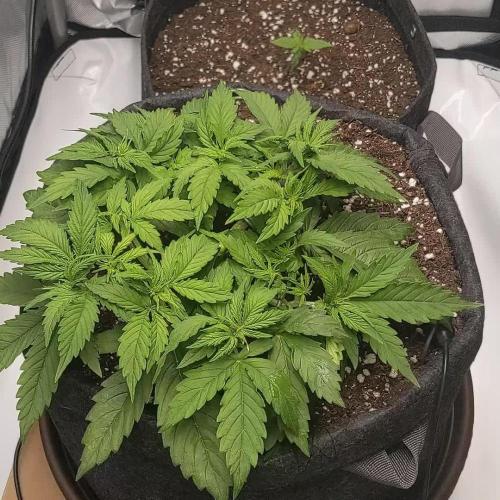
I’m Missing a lot of pics but so far the grow has been great. This is my second grow and first organic grow. Started in early feb. vegged for almost 9weeks. I haven’t had any major issues with this strain whatsoever, will definitely grow again. Has a sweet fruit, gassy and earthy smell. Smells amazing can’t wait. Hoping to yield a few ounces hopefully she bulks up some more before harvest.




@angrygrower
Volgen
I hope she recovers well from my LST and defoliation, like the previous times.
Watering 2l, pH 6.4 on day 26.


@Lahuertade_Bototo
Volgen
🌱🌱🌱Continuamos este cultivo, con esta hermosa cepa de FastBuds, Girl Scout Cookies Auto, en las ultimas semanas de Floración .🌱🌱🌱
👨🍳👨🌾🏻 Nutrición y Bitácora 👨🌾🏻👨🍳
-Día 50. Se riega con una solución nutritiva NPK de 1.5 Litros con Plagron Alga Bloom (2.6 ml), Plagron Sugar Royal (0.75 ml) y Plagron Green Sensation (0.75 ml).
-Día 51. Se riega con 3 litros de una solución nutritiva NPK de Plagron Alga Bloom (6 ml) Plagron Sugar Royal (1.5 ml) y Plagron Green Sensation (1.5 ml).
-Día 52. Se deja secar el sustrato, ya se aprecian unas colas gordas llenas de flores y resina, tricomas ámbar comienzan a verse, estamos prontos a la cosecha, quizás por el día 60-70.
-Día 53. Se riega con 3 litros de una solución nutritiva NPK de Plagron Alga Bloom (6 ml) Plagron Sugar Royal (1.5 ml) y Plagron Green Sensation (1.5 ml). A los aromas dulces y diesel, se le suma un fuerte olor picante y terroso, cada vez un aroma mas complejo.
-Día 54. El engorde de flores no para 💪
-Día 55. Se riega con una solución nutritiva NPK de 3 Litros con Plagron Alga Bloom (6 ml), Plagron Sugar Royal (1.5 ml) y Plagron Green Sensation (1.5 ml).
-Día 56. Ultima semana con riego NPK, de ahora en adelante se regara con agua + enzimas .
🚀Equipamiento🚀
Indoor de 60x60x159 cm y una iluminación BlackCob F320, se activa solo 1 modulo (160w) a 45 cm del canopy por el resto del cultivo. Intractor de 135mm, extractor de 135mm, filtro de carbón, ventilador "oscilofan", ventilador "clip fan", este ultimo ventilador se ajusta en la parte baja de la carpa para mejorar la circulación de aire bajo el canopy, 2 termohigrometros y una malla SCROG de kanovi a 15 cm de la maceta.
Acompáñenme para ver los resultados de este hermoso desafío, un saludo cultivadores 🔥🔥🔥


@Samsemilla
Volgen
Die Blüten werden schön schwer und bunt.
Das Wetter stellt sie auf die Probe und fordert Opfer.
shorts_status_processing


@tutankhamun
Volgen
Вот накопил фотографии вот как виглидяат 2. Недьеляа идиот,💚🙌🌱🇬🇪


@YOUNGSTERBR
Volgen
Pesei a mão na cobertura orgânica, joguei muito perto dos caules, e ainda inoculei com chorume, queimaram as folhas novas


@Hodo420
Volgen
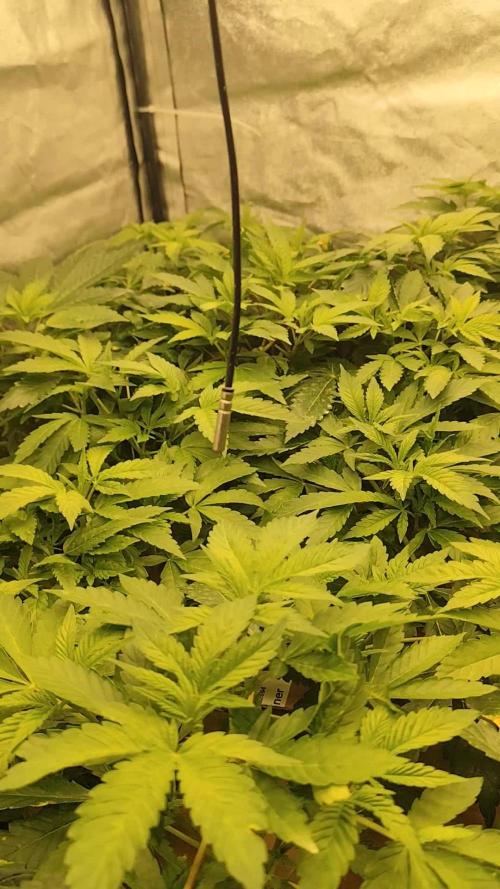
The plants are exploding in growth. Especially the gorilla cookies. I need to start doing a better job of watering my girls. I means its hard having to mix up all these nutrients at one time so I water my plants 2 at a time. I water 2 one day then the other 2 the next day. Im trying this method out cause it makes watering not so intense during dlower.


@RebelSeedBank
Volgen
🌸 Flowering Week 1 — Switch Day / 12:12 Initiated
LCG × Vitamin Z | Phenohunting N1/2026 | 35 plants | Ebb & Flow 2.5L | SOG
Switched to 12/12 today after 8 weeks total from germination (6-7 weeks active veg). Plants are sitting at 25–40cm, uniform canopy, compact internodes. No stress signs visible — healthy, turgid foliage across all 35 plants.
System: Hydro SOG Ebb & Flow, 2.5L pots, expanded clay + rockwool, 120×120 tent, 2× Figolite FG-E3000 Samsung LM301H EVO + UV/IR, Meanwell driver. RO water base.
Nutrition — Day 1 switch:
Running EC 1.2 (protocol calls for 1.3 F1, holding slightly lower for the first 3–5 days to avoid osmotic pressure during the metabolic transition). pH locked at 5.7. Full mineral salt program — Calcium Nitrate, MgSO4, Potassium Nitrate, MAP, Potassium Sulfate, Kelamix microchelates, Pepton Plus, Cellulase + Pectinase enzymes, Potassium Silicate.
Irrigation: 4 cycles/day, lights ON 22:30 / OFF 14:30. One pre-light cycle at 00:30 for root oxygenation. Substrate completing full dry cycle overnight.
Goals this week:
Pre-sex identification starting day 7–10. First phenotypic observations logged — leaf morphology, relative vigor, early aromatic signature by rubbing leaves. Light defoliation of large fan leaves blocking lower nodes planned before stretch kicks in.
Flavor target: Dominant citrus-sweet / lemon dessert / clean creamy base. Zero synthetic gas. Zero pine. Cup-level aromatic selection in progress across all 35 regular seeds.
Stretch expected to begin days 5–10. Will update with first sex identification and early pheno notes next week. 🔬
#LCG #VitaminZ #Phenohunting #EbbAndFlow #SOG #HydroSOG #CupQuality #RebelSeedBank #PureExpression #SamsungLM301H #Figolite
#LCG #VitaminZ #Phenohunting #EbbAndFlow #SOG #HydroSOG #CupQuality #RebelSeedBank #PureExpression #SamsungLM301H #Figolite


@Ju_Bps
Volgen
Hello mate growers,
All was fine this week,
In this end week stretch start to be impressive,
I up lamp each days,
#3 is really biggest than others.
I continue to give 2l water/pot
1 time grow tab + water
1 time grow tab + sugar royal + water
Each 3/4 days
I up a bit my power lamp each days,
I'm now around 75%
I'll probably remove some leaves and buds in shadows, next week,
And start bloom fertilizer,
Have a good week mates!


@Greccobudz
Volgen
Day 57 and that's a 33.8oz spring water bottle for size reference. Video's are day 58. I'm going to ice water her tonight and then keep her in straight darkness for 72hrs and then harvest. She's a beast for sure. You can definitely see an increase in trichromes in the 4 days of total darkness started with it's 1st and final ice water flush abd no more water for 3 days or untill I harvest.


@MasterKush714
Volgen
I'm honestly out of options with these 2 because it's waaayy to hot in that garage I have no where to vent out the hot air from the box I'm gunna have to just out these outside soon its just getting to be way to much time spent and energy if anyone can help lmk thanks again! If anyone can help me turn up the speed on that mars hydro I line fan please dm me thanks!
