




Likes
12
Share


@HAN_GROWER17
Follow
#PSICODELICIA®️ 12/12 DESDE SEMILLA
Ha sido una excelente planta, se ve una excelente producción a pesar de las condiciones a las que sea enfrentado la planta.
Parece que ya no seguirá engordando, ya que si lo hace lo mas probable es que se rompan sus ramas por el alto peso que tienen las flores.
Hoy vi sus tricomas y se ven ya en su punto.

Likes
6
Share


@Daniel_Tri95
Follow
this wedding cheesecake ff is the healthiest plant i have grown with massive fan leaves these two girls have been in bloom for 1 week can’t wait for the buds to start forming


Likes
12
Share


@Jays_Not_Here_Man
Follow
This was an easy grow, and had some amazing results. This is some of my best homegrown to date ❤️ the ladies were easy to manage, no PM, pests or disease. The root balls were enormous, wasn’t much soil to recover. They got heavy in the end from the weight but managed to stay upright for the most part. They were big stretchers , prepare for that, scrog was a good way to go but some of the eager beavers got away from me, which ended in some massive colas. Overall easy to grow, no surprises and you won’t regret the results! 10/10 ❤️👊🤤

Likes
18
Share


@EaRtH
Follow
Plants have developed the first pair of leaves and second one is already developing. I am waiting for true leaves or at least 10cm height, so I can start with nutrients.
One of my plants is recovering from overwatering. She's about 2 days behind others.
3.10.2023 - 9.10.2023
Likes
Comments
Share


@Organic473
Follow
The struggle is real for her but she is pressing on. Not much growth this week but I look forward with a positive mind.

Likes
9
Share


@CalGonJim
Follow
4/27 11:35PM just happend to pause Joy of Painting when the harvest is too small...i did a meme.
4/30 EVERYONE IS DONE ALREADY!!! ICE-T AND MONETL ARE DONE, LIKE FAST I CANT BELIVE...I WANTED TO KEEP THEM BU THEY ARE AWESOME AND FAST JUST LOVE BROTHERS GRIMM ALL OF THEM ARE JUST MAGIC ... All of them work great in 1 gallon, you can get perfect and a nice amount at lower watts. They are all good for speed, and bud density...just great!
5/2 1:59 PM Ice-T BodyCount combination of Rosetta Stone and purple Urkel my brothers Grimm seeds. She has been a very compact plant and grew very well in a tiny 1 gallon pot. I’ll probably get a couple ounces dry very little effort. I think next time I’ll top keep it in the small container. In a larger container I can’t imagine you know it’s different brothers. Grim seeds are always kind of a very special brand all of them. This one will ruin ice tease your reputation because this is a soft and floral elegant very upscale smell to it and then right after that it smells like grape so it kind of smells very Complicated. Very worth it really holds up well very fast flowering time I mean really these things are as fast as autos. I was kind of surprised so if you need a stealthy home grow and it’s very inexpensive to run 1212 hours so overall I’m gonna give her a 10 out of 10 all grand brother seeds are 10 out of 10. It’s just nice where they are their flowers really kind of have a signature to them. I really like all of them. I’m glad I discovered the brand with trailer Park boys and Montel as well.
5/2 2:03 PM Montels dream widow by Brothers Grimm seeds. She grew some of the most unique flowers I’ve ever seen. She’s 10 out of 10, but I’m gonna give her 11 out of 10 because of the way that she grow so much about 3 1/2 feet tall, maybe 4 feet tall, a little taller than the others but in a 1 gallon I probably got 2 1/2 or 3 ounces dry at least two and they are the most resin covered buds I’ve seen they look like little white tarantulas when they’re reforming the smell is overpowering just the best overpowering smell you could ever imagine. I’m so glad I picked up these seats. I really like this strain. In particular there’s another Montel coming out and this strain is very strong. I didn’t have any problems growing her drying and caring. That’ll be a few days away I don’t really need to cure the stuff. I don’t know what it is with me but once it’s dry, I put it in a Turlock bag and it’s good enough about the Montel’s definitely a winner. I mean absolutely a winner.
5/2 Julian is so skinny!!! Looks like Turbo 80's AIDS set in!😂
5/3 11am Video of Ice-T BodyCount by Grimm Brothers Seeds.
5/24 10:39 AM I just got my seeds. They were in the mailbox for almost a month again before I was able to go outside.I haven’t been able to do any updates. I have a pencil eraser size hole in the back of my neck and I ripped it open again getting the mail. I’m in a lot of pain and I’m bleeding and I it’s an open cyst and I can’t believe I’m not dead yet but it’ll be a while before I can update again.


Likes
120
Share


@CBD_Sweden
Follow
Hi all the happy people here in GrowDiaries.
This is my second cultivation ever and it will be fun to try a bigger space than my closet grows
First, I'm just going to say I'm done with the construction of my new growroom.
I put some pictures on the construction here in week one.
The room is 2.14 meters by 1.7 meters and has a ceiling height of 2 meters.
It provides a floor area of 3.6 square meters.
I use a 54 Watt Lightwawe T5 for germination and 2 Pcs 400 Watt HPS lamps.
I have a channel fan that replaces the room air about 40 times an hour to get a comfortable theme in the room, the air enters a fresh air intake from the outside.
The air is purified through a carbon filter to then leave the room to the rest of the basement.
Then I use that heat to heat the rest of the basement.
I will use 8 pcs 15 liter Autopots to grow with and a 100 liter water tank that supplies the pots of water and nutrition.
I will grow completely organically in soil and will watercure my buds to get the best possible medicine for me.
But there are no cultivation rooms to be displayed here, so I continue with what is most important.
I am very excited to see how the new growroom will work and how this CBD Fast Eddy plant from Royal queen seeds will turn out.
CBD Fast Eddy Automatic is combining Cheese x Juanita la Lagrimosa x Ruderalis, Fast Eddy is a rapid growing, flavourful, and CBD-rich auto strain that goes from seed to harvest in 8-9 weeks, produce generous yields, and induce a clear, mellow, and most importantly, functional high.
THC: 9%
CBD: High
Yield Indoor : 400 - 450 gr/m2
Yield Outdoor: 80 - 130 gr/plant
Height Indoor: 60 - 100 cm
Height Outdoor: 80 - 120 cm
Flowering: 6 - 7 weeks
Harvest month: 8-9 weeks after sprouting
Genetic Background: Cheese x Juanita la Lagrimosa x Ruderalis
Type: Sa 50% In 40% Ru 10%
Effect: Clear, Painrelief
Climate: Mild
-----------------------------------------------------------------------------------
2017-09-18. Week 4 starts and she is in flower. She is 36 cm high and looking really healthy.
---------------------------------------------------------------------------------------------------------------------------------------------------------
2017-09-19. 2 new fans is installed in the grow room. Added pic and video.
---------------------------------------------------------------------------------------------
2017-09-20. Kl 10.00. New video. The girl is 38 cm high and doing great.
Kl 23.00. Did some massive defoliation, added video and pics
------------------------------------------------------------------------------------------------
2017-09-22. The girl have recovered well after my massive defoliation. She is 39 cm high now and have received 2 liters of water and nutrition today.
Likes
3
Share

@psychonaut420
Follow
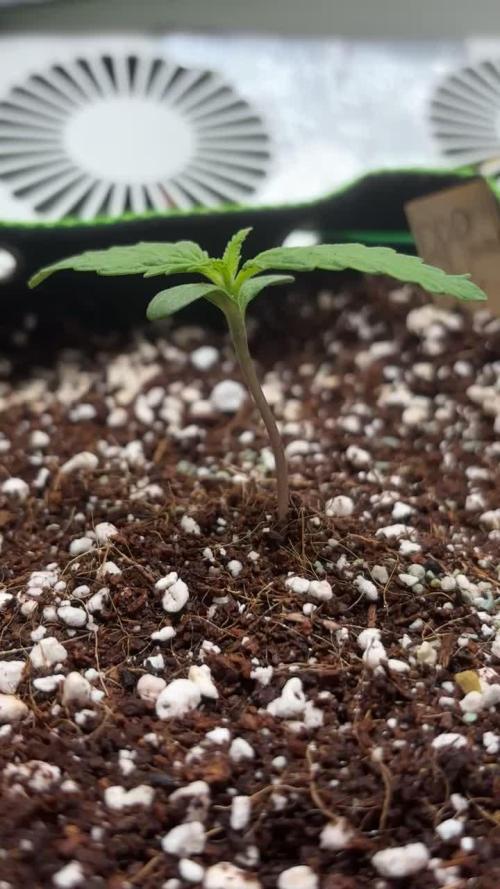
Banana purple punch RF3 auto has been developing at a steady rate the 2nd node is more developed with a tiny 3rd set of leaves can been seen for the next node have begun light bending of the stem to thicken it up and get ready for LST
Likes
14
Share

@RakonGrow
Follow
+
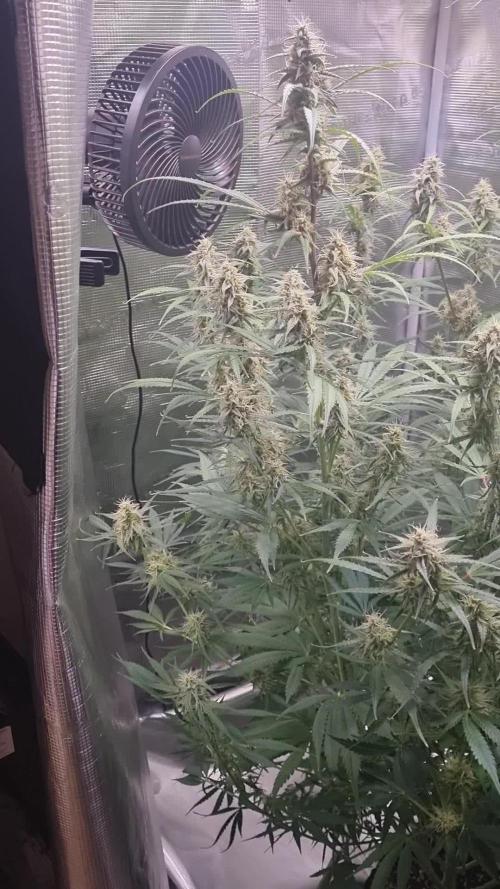
Tag 72:
starting 30-70% watering rule
1.75L bottle water EC 0.35 + 0.3ml/L CalMag + Terra Flores 4.5ml/L Final PH 6.23
Tag 71:
starting 30-70% watering rule
1.75L bottle water EC 0.35 + 0.4ml/L CalMag + Terra Flores 5.25ml/L Final PH 6.17
Tag 70:
starting 30-70% watering rule
1.75L bottle water EC 0.35 + 0.4ml/L CalMag + Terra Flores 5.25ml/L Final PH 6.20
Tag 69:
starting 30-70% watering rule
1.75L bottle water EC 0.35 + 0.4ml/L CalMag + Terra Flores 5.25ml/L Final PH 6.17
Tag 68:
starting 30-70% watering rule
1.75L bottle water EC 0.35 + 0.4ml/L CalMag + Terra Flores 5.25ml/L Final PH 6.20
Tag 67:
starting 30-70% watering rule
1.75L bottle water EC 0.35 + 0.4ml/L CalMag + Terra Flores 5.25ml/L Final PH 6.20
Tag 66:
starting 30-70% watering rule
1.75L bottle water EC 0.35 + 0.4ml/L CalMag + Terra Flores 5.25ml/L Final PH 6.20
---------------------- all values are weight in grams ( assumption : 1000g = 1000ml.) -------------
Day......State...Date Time..................Seed......messure..change...watering.....surplus.....DayLight.....Night.....within 24h
...66...bloom...22.11.2025 06:00.....Wurlz...........6029.......-283.......................................................................-283.............-1689
...66...bloom...22.11.2025 07:00.....Wurlz...........7653.......1624...........1624.............-65
...66...bloom...22.11.2025 23:45.....Wurlz...........6365.....-1288.................................................-1288
...67...bloom...23.11.2025 06:00.....Wurlz...........6035.......-310.......................................................................-310.............-1598
...67...bloom...23.11.2025 07:00.....Wurlz...........7639.......1584...........1584.............-14
...67...bloom...23.11.2025 23:45.....Wurlz...........6232.....-1407.................................................-1407
...68...bloom...24.11.2025 06:00.....Wurlz...........5994.......-288.......................................................................-288.............-1695
...68...bloom...24.11.2025 07:00.....Wurlz...........7642.......1698...........1698.................3
...68...bloom...24.11.2025 23:45.....Wurlz...........6276.....-1366.................................................-1366
...69...bloom...25.11.2025 06:00.....Wurlz...........5985.......-291.......................................................................-291.............-1657
...69...bloom...25.11.2025 07:00.....Wurlz...........7651.......1666...........1666.................9
...69...bloom...25.11.2025 23:45.....Wurlz...........6240.....-1411.................................................-1411
...70...bloom...26.11.2025 06:00.....Wurlz...........5996.......-244.......................................................................-244.............-1655
...70...bloom...26.11.2025 07:00.....Wurlz...........7622.......1626...........1626.............-29
...70...bloom...26.11.2025 23:45.....Wurlz...........6199.....-1423.................................................-1423
...71...bloom...27.11.2025 06:00.....Wurlz...........5942.......-257.......................................................................-257.............-1680
...71...bloom...27.11.2025 07:00.....Wurlz...........7728.......1786...........1786............106
...71...bloom...27.11.2025 23:45.....Wurlz...........6286.....-1442.................................................-1442
...72...bloom...28.11.2025 06:00.....Wurlz...........6015.......-271.......................................................................-271.............-1713
...72...bloom...28.11.2025 07:00.....Wurlz...........7764.......1749...........1749..............36
...72...bloom...28.11.2025 23:45.....Wurlz...........6294.....-1470.................................................-1470
+

Likes
3
Share


@FireAntTheGrower
Follow
Lava Cake , I had to grow it because from what I hear people say Lava Cake isn’t all that. I actually like it. We did my girl and I smoke test it . lol said make her horny smh 🤦🏾♂️ not only that I got female growmies saying Lava Cake her favorite strain. Sweet and earthy .

Likes
9
Share

@Mrs_Larimar
Follow
2025-11-30
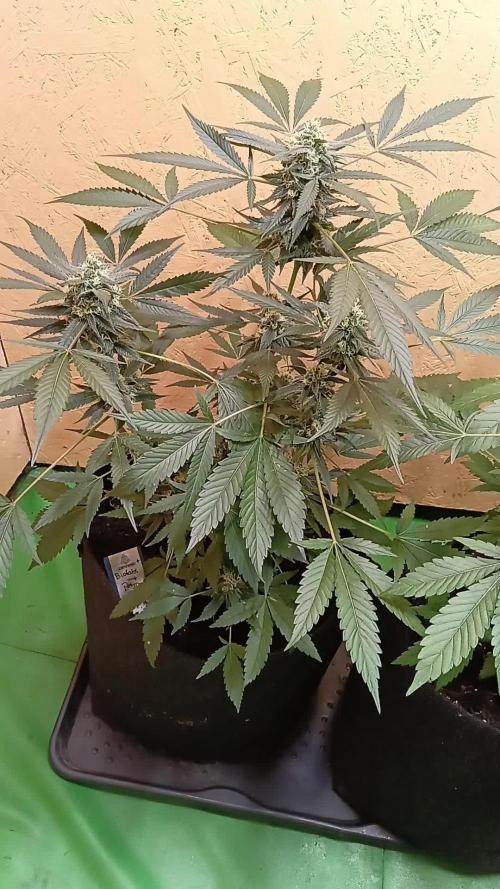
shes doing well, pistils start to change- so i think 10 more days for her.
🌿 Soil Preparation
Base Medium: 35L Terrapreta soil
Nutrient Integration: Mixed according to Aptus Living Soil Schedule
Method: Nutrients pre-mixed into soil for optimal distribution
📋 Growing Schedule
Phase 3:Flowering
Final Home: 35L Smart Pots
Location: Main grow room alongside comparison studies (documented in separate diary)
xxxxxxxxxxxxxxxxxxxxxxxxxxxxxxxxxxxxxxxxxxxxxxxxxxxxxxxxxxxxxxxxxxxxxxxxxxxxxxxxxx
BREEDERS INFO
🌟 Strain Profile: Permanent Marker
🏆 Award Excellence
Recognition: Leafly's Strain of the Year 2023
Genetics: Premium award-winning lineage
⚡ Potency Profile
THC Content: Up to 31% - Extreme potency levels
Effect: High-impact experience for seasoned consumers
Breeder Heritage
Master Breeder: JBeezy @ Seed Junky Genetics
Reputation: Industry-leading genetic specialist
🌸 Aromatic Signature
Base Notes: Lingering floral foundation
Unique Accents: Distinctive soap & gas undertones
Profile: Complex, memorable terpene expression
Likes
28
Share


@eldruida_lamota
Follow
Que hay familia, vamos con la octava semana de floración de estas Apple Fritter de Zamnesia.
La temperatura está entre los 21/24 grados, la humedad está entorno al 55%, y el ph lo mantengo ahora al principio en 6.2, el foco por supuesto está enchufado 12 horas , estan creciendo bien fuertes.
Y aparte añadimos nutrientes de Agrobeta, que no puede faltar semejante gama.
Todo correcto hasta ahora, ya van madurando las flores y ya están bien resinosas, estas próximas semanas veremos cómo avanzan.
Os comento que tengo un descuento y para que compréis en la web de Zamnesia de un 20%, el código es ZAMMIGD2023
The discount 20% and the code is ZAMMIGD2023
https://www.zamnesia.com/
agrobeta: https://www.agrobeta.com/agrobetatiendaonline/36-abonos-canamo
Mars hydro:
Code discount: EL420
https://www.mars-hydro.com/
Hasta aquí es todo, buenos humos 💨💨💨.


Likes
5
Share


@Bear_Grows_Green
Follow
02/19 start of new week.
02/20 got 7 gallons of water
02/21 harvested a branch off each at 45 days flower
01/23 watered with 10.5 gallons 3.5 gallons of goodies
Likes
23
Share


@Firepharmer
Follow
Week 5
Everything looks good and frosty .. I’ll add the futur vert uv LED’s in a few days


Likes
22
Share


@coriander
Follow
Day 74 -
Cheese - Been watering with only clean ph every 3-4 days and watching the trichomes. They're mostly cloudy with no amber. Just gonna keep watching and letting it swell.
Super Lemon Haze - Buds are coming in nicely. Purple leaves coming in near the top. Gets cold in the basement at night, so I'm not surprised with a bit of colour change. The tip burn doesn't seem to be moving too fast on the leaves it effected and the rest of the growth is coming in nicely. I Think there should be only a few weeks left now, so probably one more nutrient feed and onto flush as well.
End of week 11 -
For my first grow, I've already made it far past my expectations. Love growing and love these plants. Stay tuned for cheese harvest!

Likes
9
Share


@Green4H
Follow
Hello growers, I haven't shown you my plants for three weeks, I'm ashamed, I don't know what they are like, I let one dry and it weighs 5.68g, which is ridiculous... The second is still blooming and I have the impression that nothing will happen to it. .
Likes
38
Share


@Crownlaura
Follow
8 weeks / 56 days today.
Growth has slowed down a lot this week luckily. Smell is getting really hard to contain now.
Sticky orange buds still nowhere near as big as purple skunk but definitely a bit fatter than last week. Purple skunk buds are getting a lot fatter. Both are really sticky to the touch, looking a bit frosty close up and can see plenty of trichomes.
Little bit of leaf burn but not a lot I can do because of the space issue so just tucking the branches and leaves as best I can and moving the lights around a bit to minimise it.
Watering between 1 and 1.5 litres every other day and they are soaking it all up. Increased to 3ml per litre of nutrients too.
Humidity has been a lot easier to keep under control this week and hasn’t risen above 60 all week so I am happy with that. it’s been a worry for a few weeks.
I had a real panic this week when I thought I saw seed sacks forming at the base of each branch. But after hours and hours of reading, I am pretty sure they’re calyxes.
No intentional defoliation this week but I’ve accidentally snapped a couple of fan leaves whilst watering. I really need a bigger tent!
Would love opinions on when you all think they might be ready for the chop. Comparing to other diaries I still think I’ve probably got another 6+ weeks but I’m daring to think about how/where I’m going to dry them out. I’m pretty sure purple skunk will be ready first so drying in the tent will be a no go.

Likes
15
Share


@Witchcannabis
Follow
Sweet afgani #1 64gr
Sweet afgani #2 58gr
Admittedly, I was expecting more dry weight, but the bud quality is ideal.