The Best Cannabis Nutrients for Master Growers: What Experienced Cultivators Actually Run

The best cannabis nutrients for master growers are not simply the strongest feeds. They are cannabis-specific, stage-adjustable systems that let experienced home growers control base nutrition, root-zone performance, bloom support, late-flower finishing, and electrical conductivity (EC), a measure of feed concentration, while accounting for light, irrigation, and cultivar response.
What Makes a Home Grower a Master?
A master grower is defined by repeatable control, not by years logged or by the size of the tent. The clearest way to see the difference is to look at what a grower is actually solving for.
A first-year grower spends most of the cycle managing survival: correcting pH drift, clearing lockout, backing off after tip burn, recovering from a week of overwatering. The work is reactive, and the target is a healthy plant that makes it to harvest.
Master-level growers have moved past treating basic survival as the benchmark. What they pursue instead is the ceiling: how much of a cultivar’s genetic potential they can express in a given room, and how reliably they can repeat that result next cycle.
According to the 2026 Grower Intelligence Report, compiled by Advanced Nutrients from more than 300 home, craft, and commercial growers surveyed in February 2026, that progression follows a consistent shape.
The survey included 323 respondents, including 284 home growers. 143 home growers stated they have more than five years of experience.
The report calls it the Sophistication Curve. Some 68.18% of first-year growers lean heavily on soil, while coco adoption climbs from 18.18% in year one to roughly 27% and holds steady among veterans. Canopy size tracks the same arc: 40.91% of brand-new growers run one to three plants, while 32.87% of growers past the five-year mark manage a six to ten-plant canopy.
The medium changes because the objective changes. Coco and hydro trade forgiveness for control, and control is the currency of master-level cultivation.
In 2027, these priorities will increasingly shape master-level cultivation:
Consistency and control. Delivering the same quality across successive runs through structured comparisons rather than unmeasured intervention.
Tailored cultivation. Feeding for cultivar-specific expression instead of maximum strength.
Root-zone precision. Tracking input EC against root-zone and runoff EC to avoid nutrient antagonism and unnecessary salt accumulation.
Dynamic watering. Treating irrigation frequency, substrate moisture content, and targeted drybacks as levers that work alongside nutrient strength.
Holistic quality. Maximizing total cannabinoid, terpene, and flower production while prioritizing aroma, resin, density, and postharvest preservation, rather than chasing a single potency number.
That last priority is where the standard has shifted hardest. Yield determines how much flower a grower ends up with. Flavor and aroma determine whether that flower is memorable.
Among experienced cultivators, a loud, true-to-strain terpene profile has become one of the clearest signs that a crop expressed its genetics well, and it cannot be recreated simply by extending flower time or increasing feed strength.
What Master Growers Expect From a Nutrient System
Experienced growers judge a nutrient line on six practical criteria, and marketing claims are not among them.
Medium compatibility. The program has to behave predictably in soil, coco, rockwool, and recirculating water without a separate rulebook for each.
Complete nutrition. Macros, secondary elements, and chelated micros in ratios built for cannabis rather than adapted from other crops.
Solubility. Full dissolution, no sediment in the reservoir, no emitter clogging in a drip line.
Stage control. The ability to shift the ratio between vegetative and generative demands rather than running one profile from start to finish.
Predictable mixing. With source water, temperature, and measurement conditions controlled, the same inputs at the same rates produce a reliably comparable EC.
Measurable response. Changes to the feed show up in plant response, runoff readings, and the finished crop in ways the grower can actually track.
For growers who already manage light, irrigation, and environment carefully, a cannabis-specific system will become increasingly essential in 2027 for maximizing yield without compromising resin, aroma, or bag appeal.
Why Master Growers Never Evaluate Nutrients in Isolation
No feeding program corrects a weak environment. A stronger feed cannot compensate for insufficient light intensity, inconsistent irrigation, excessive dryback, low transpiration or careless postharvest handling. Push EC in a room with poor VPD (vapor pressure deficit) control and the usual result is antagonism and salt accumulation, not bigger flowers.
Experienced growers will not accept the claim that nutrients alone unlock genetic potential, and they are right to reject it. Light intensity, canopy management, VPD, irrigation strategy, and temperature can each have an equal or greater effect on the finished crop.
Nutrition is one variable inside a system. The value of a well-designed program is that it removes a source of noise so the other variables become readable.
The products below earn attention because they give a grower more precise control over that one variable, not because they substitute for the rest.
The Foundation: Maximizing Genetic Potential With the Right Base
What base nutrient do master growers use? The best base for pushing cannabis toward its genetic ceiling is a cannabis-specific system that changes its ratios as the plant changes its demands.
For cultivators comparing the best cannabis nutrients for master growers, Cultivator Series® is Advanced Nutrients’ 7th-generation, tunable, and cost-efficient three-part powder option, developed with experienced home growers and commercial cultivation experts in mind.

The problem with generic agricultural fertilizer is structural. Many formulas used in cannabis were developed for other crops and do not track cannabis’s specific phase shifts in nitrogen, potassium, phosphorus, calcium, and key micronutrients as the plant moves from structural development into flower initiation, generative production, and finishing. A fixed nutrient ratio gives the grower less control over that curve, and the missed opportunity can show up in yield, aroma, resin and finished-flower quality.
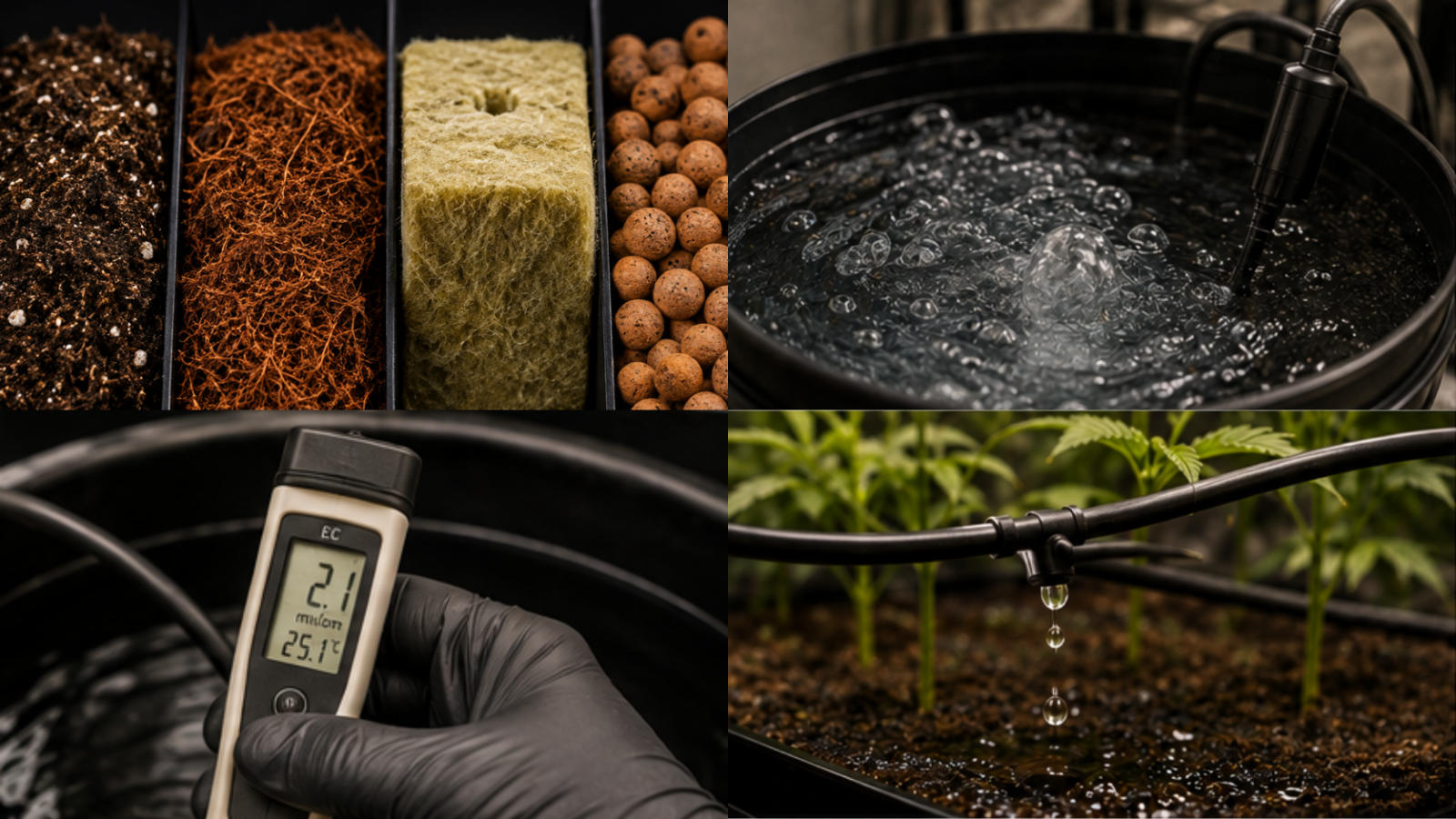
Medium changes the execution more than the principle. Soil offers more buffering and a slower feedback loop, so adjustments are generally made in smaller increments and read over longer intervals. Coco is largely inert but carries meaningful cation exchange behavior, which tends to raise calcium and magnesium demand and makes runoff EC a central daily reference. Hydroponics and rockwool give faster feedback, so reservoir stability and root-zone monitoring become the primary discipline.
Master growers may be fully capable of managing pH manually. After all, correcting a reservoir is routine work. Even so, plenty of experienced European cultivators still run pH Perfect® Connoisseur® Grow & Bloom, and the reason is practical rather than remedial: removing one source of daily variation frees attention for the variables that actually differentiate a crop. According to the 2026 Grower Intelligence Report, it is the third most-used base among surveyed growers at 21.05%, behind pH Perfect® Sensi Grow & Bloom at 28.48% and pH Perfect® Grow, Micro, Bloom at 28.17%.
The Cultivator Series takes a different route. It is a three-part water-soluble powder system - Grow (2-9-24), Base (14-0-0) and Bloom (3-13-26) - and the three-part architecture is the whole point.
It lets a grower move the ratio deliberately: Grow and Base through vegetative development, Base and Bloom through early flower, a heavier Bloom contribution through peak floral development, then a taper of Base as the crop approaches its finish.
Three formulation details matter to growers working at this level:
Cascading nitrogen delivery. Nitrogen is supplied in ammoniacal, nitrate, and urea forms rather than a single form, producing a phased supply across the cycle instead of a spike and a fade.
A multi-form iron chelate blend. Iron is delivered through EDTA, DTPA, and ortho-ortho EDDHA chelates, each with a different pH stability range. Because iron availability becomes harder to maintain as root-zone pH rises, combining the three broadens the range over which iron stays available.
Phase-specific micronutrient placement. Boron, copper, iron, manganese, molybdenum, and zinc sit in the Grow and Bloom components rather than the Base. That means calcium and nitrogen can be tapered independently in late bloom while the micronutrient levels critical to flower quality and terpene synthesis stay intact. Programs that tie micros to the calcium or nitrogen component cannot separate those two decisions.
For exact week-by-week rates, master growers can reference the Official Feeding Guides on the Advanced Nutrients website. Any published rate is a starting point rather than a prescription: the value of the Cultivator Series is that Grow, Base and Bloom can be adjusted independently, so the program can be tuned against root-zone response instead of followed on faith.
The practical advantages in a small European garden are straightforward. Powder is measured by weight, which gives experienced growers a repeatable gravimetric dosing method rather than relying on liquid-volume measurement. It occupies a fraction of the storage space of an equivalent liquid program and reduces shipping weight and storage burden because no liquid carrier is being transported.
It dissolves cleanly, which matters in drip and recirculating systems. And it swaps into an existing three-part protocol without rebuilding the routine. In Europe, it is listed in 1 kg and 10 kg bags, so the 1 kg option puts the system within reach without commercial-sized quantities.
Strengthen the Plant From the Ground Up: Root-Zone Activation
What activates the root zone in a master-level program? Voodoo Juice® Plus is the consolidated microbial option for that job. Even the best nutrients for cannabis plants underperform when the rhizosphere is thin: root surface area sets how much of the solution the plant can reach, and biological activity determines how much of the bound mineral content becomes available at all.
It is a quick-dissolving tablet that brings together the microbial spectrums previously delivered by three separate liquids - Voodoo Juice®, Piranha® and Tarantula® - in a single format. Each 1 g tablet carries 10 billion CFUs across 16 hand-selected strains of beneficial bacteria and fungi, including endomycorrhizae, ectomycorrhizae and plant growth-promoting rhizobacteria, and treats up to 380 L (100 US gallons) per tablet.
The functional claims are specific: expanded root mass and absorptive surface, mycelial networks that extend the root system’s effective reach, solubilization of bound nutrients into forms the plant can take up, and improved water and nutrient absorption. The guaranteed analysis is 0-0-0, so the tablet adds microbial biology without adding declared NPK to a mineral program the grower has already dialed in.
For an experienced grower, the operational case is just as relevant. One tablet replaces three bottles, shelf life is 18 months, and storage drops to a blister pack. In Europe, the tablets are sold in 10 x 1 g and 10 x 0.125 g packs, with the smaller format better matched to compact reservoirs and tents and reducing the need to divide a 1 g tablet built for 380 L.
They are compatible with hydroponic media and continuous liquid-feed systems, including aeroponics, drip irrigation, NFT, flood and drain, and deep water culture. The 2026 Grower Intelligence Report recorded 41.49% adoption for Voodoo Juice®, one of the established microbial lines consolidated into the Plus tablet.

Trigger Natural Defenses Early: Building Resin and Terpenes From Veg Onward
Master growers do not wait until late flower to push a crop. They start working on plant biology in vegetative growth, and Bud Factor X® is the tool built for that job.
The published feed chart runs it from veg week 1 through bloom week 7 - across vegetative growth and most of bloom, not as a transition-only or late-flower product. Waiting until week five of bloom to start leaves most of that window unused.
Bud Factor X is a 0-0-0 biostimulant, so it runs alongside the veg and bloom feed without changing the program’s declared NPK balance.
Its role is to trigger the plant’s natural defense response. When cannabis perceives pressure, it produces more resin and more of the volatile compounds that protect it, and those are the same compounds responsible for aroma and flavor.
Eliciting that response on purpose is why growers associate Bud Factor X with crystal-packed, resin-heavy flower and stronger terpene expression. The same response also supports growth, yield and potency. It is one of the more direct levers a grower has for maximizing trichomes and terpenes.
Applied at 2 mL/L once weekly from veg week 1 through bloom week 7, it is compatible with a wide range of programs, including pH Perfect and non-pH Perfect bases, hydroponic media, coco, drip, NFT, flood and drain, deep water culture and foliar application. It contains no paclobutrazol, daminozide, or other banned plant growth regulators.
Starting in veg puts that response to work from the beginning, instead of leaving the lever until the final fortnight.

How to Bring Out the Flavor: Pushing Ultimate Bag Appeal
Growers looking for how to improve cannabis taste and aroma while still building weight have a straightforward answer: feed the flower-expansion window with a product formulated to support terpene expression rather than simply forcing bulk. Aggressive feeding and high-intensity LEDs can flatten a cultivar’s natural character, and a heavy harvest that finishes flat is a harvest that misses the point of the genetics.
This will matter even more in 2027 than it did five years ago. The 2026 Grower Intelligence Report puts the Fruity family at 39.38% of grow plans for the coming season, well clear of Cookies at 14.75% and Kush at 8.12%. Fruity genetics get chosen for aroma and taste. Producing dense, heavy flower from a fruity cultivar and losing the profile is the definition of a run that worked technically and failed where it counted.
Big Bud® is built for that window. It is a 0-1-3 liquid bloom booster, and the ratio is deliberate: a 3:1 potassium-to-phosphorus relationship that reflects the plant’s actual potassium demand during flower rather than the phosphorus-heavy balance common to conventional bloom boosters. Its 0-1-3 profile is built around monopotassium phosphate and potassium sulfate.
Big Bud also supplies pre-formed L-amino acids, and that is the part that connects the product to flavor. Supplying them ready-made lets the plant direct metabolic energy into floral development and secondary metabolite production instead of spending it synthesizing those amino acids itself.
For a serious home grower, boosting terpene production is about expressing the cultivar clearly and producing flower worth remembering. And worth growing again.
The published rate is 2 mL/L across bloom weeks 2 to 5, the principal expansion window, after which the program hands off to Overdrive. Big Bud is also the most widely used additive in the surveyed base by a clear margin: 64.09% overall adoption according to the 2026 Grower Intelligence Report, rising to 80% among soilless growers and 75% among hydro growers.

Finish Strong, Then Flush Clean: Breaking the Late-Stage Yield Plateau
Plants slow in late flower. Overdrive® is formulated to keep them productive through the closing weeks before the flush.
In the later weeks of a typical bloom, metabolism tapers as the crop moves toward maturity, and many feeding programs taper with it. That can leave the closing stretch underused, even though those final weeks are when density finalizes, resin coverage matures and the terpene profile locks in.
Overdrive is a 1-5-4 formula built around phosphorus and magnesium to support late-stage energy transfer. Applied at 2 mL/L during the final two to three weeks before flushing - weeks 6 and 7 on the published seven-week bloom chart - it supports continued flower weight, calyx density, resin, and aromatics at the point where the plant would otherwise coast. It runs 48.92% adoption in the surveyed base, and like Bud Factor X it carries no banned plant growth regulators.
Then the flush. Flushing is a required finishing step, not an optional one, and it is where a considerable amount of flavor is protected or lost. Residual fertilizer salts and mineral ions can compromise burn quality and smoothness when a crop is fed hard to the final day. Advanced Nutrients positions Flawless Finish® as a flushing agent designed to help purge those residual salts and mineral ions, supporting a clean, deliberately managed finish.

What master growers do differently is refuse to run the flush on a calendar. Timing and execution get adapted to medium, root-zone EC, runoff or reservoir readings, feeding intensity, irrigation frequency, cultivar maturity, and flowering duration. A high-EC coco crop on a fast-finishing cultivar may call for a different approach than a lower-EC soil run. The point is not a fixed number of days. The point is that the finish is planned, measured, and executed deliberately rather than treated as an afterthought.
The Master-Grower Feedback Loop
Mastery comes from making increasingly precise, evidence-based decisions. It does not come from feeding more, and it does not come automatically with years accumulated. Master-level growers treat every crop as a controlled learning cycle rather than a feeding chart to be executed.
Input EC → root-zone response → plant response → harvest assessment → documented adjustment
In practice, that means:
Compare input EC against root-zone, runoff or reservoir conditions rather than trusting the input number on its own. The gap between the two is the actual information.
Read plant response alongside irrigation and environmental data. A leaf symptom during a week of high VPD is a different data point than the same symptom under stable conditions.
Evaluate the finished crop on dry yield, flower density, resin coverage, aroma, flavor, and cultivar expression. All of them, recorded rather than remembered.
Change one major variable at a time. Two changes in a single run produce a result with no attribution.
Write it down. A diary that captures feed rates, EC readings, environmental conditions, and finished-crop assessments is what turns twelve runs into twelve lessons instead of twelve repetitions.
That last point is also the argument for logging publicly. In the GrowDiaries dataset used for this article, Advanced Nutrients ranks first by recorded harvest volume, with 10,057 harvests and 16,398 diaries logged, which makes it the most widely used and documented nutrient systems among experienced GrowDiaries cultivators.
For a grower running structured comparisons, that documented base is a working resource: it is possible to find diaries at a comparable scale, in a comparable medium, on comparable genetics, and read what actually happened.
The Upcoming 8th-Generation Elite Series in Europe
The 8th-Generation Elite Series is Advanced Nutrients’ newest platform, launched first in the USA and now part of an ongoing global rollout. The European release will include smaller-sized formats, giving serious small-scale cultivators access to the same generation of stage-specific nutrient technology without having to buy commercial quantities.
For a home grower, the relevant question is not facility economics. It is whether this generation of technology supports the things that actually decide a small-garden crop: stage-specific control, run-to-run repeatability, resin, aroma, flower quality and cultivar expression. That is the case the platform is built on.
What the series adds sits on top of mineral nutrition rather than replacing it:
Aminome™ - a complete complex of 20 amino acids weighted toward the pathways that produce cannabinoids and terpenes.
NanoCarb™ - nanosized carbohydrates designed for direct plant uptake without depending on microbial breakdown, supporting brix and resin density.
SAReplex™ - a proprietary plant extract blend designed to activate SAR and support resin and terpene expression.
Tetraplex Iron™ - a four-way iron chelation system built to maintain micronutrient availability across a broad pH range.
For experienced growers who already manage environment, irrigation and EC with discipline, these technologies offer another variable to refine through controlled comparisons, in formats sized for the way small gardens actually run.
In 2027, controlled comparisons will play an even greater role in master growers’ programs.
What Master Growers Actually Run: An Overview
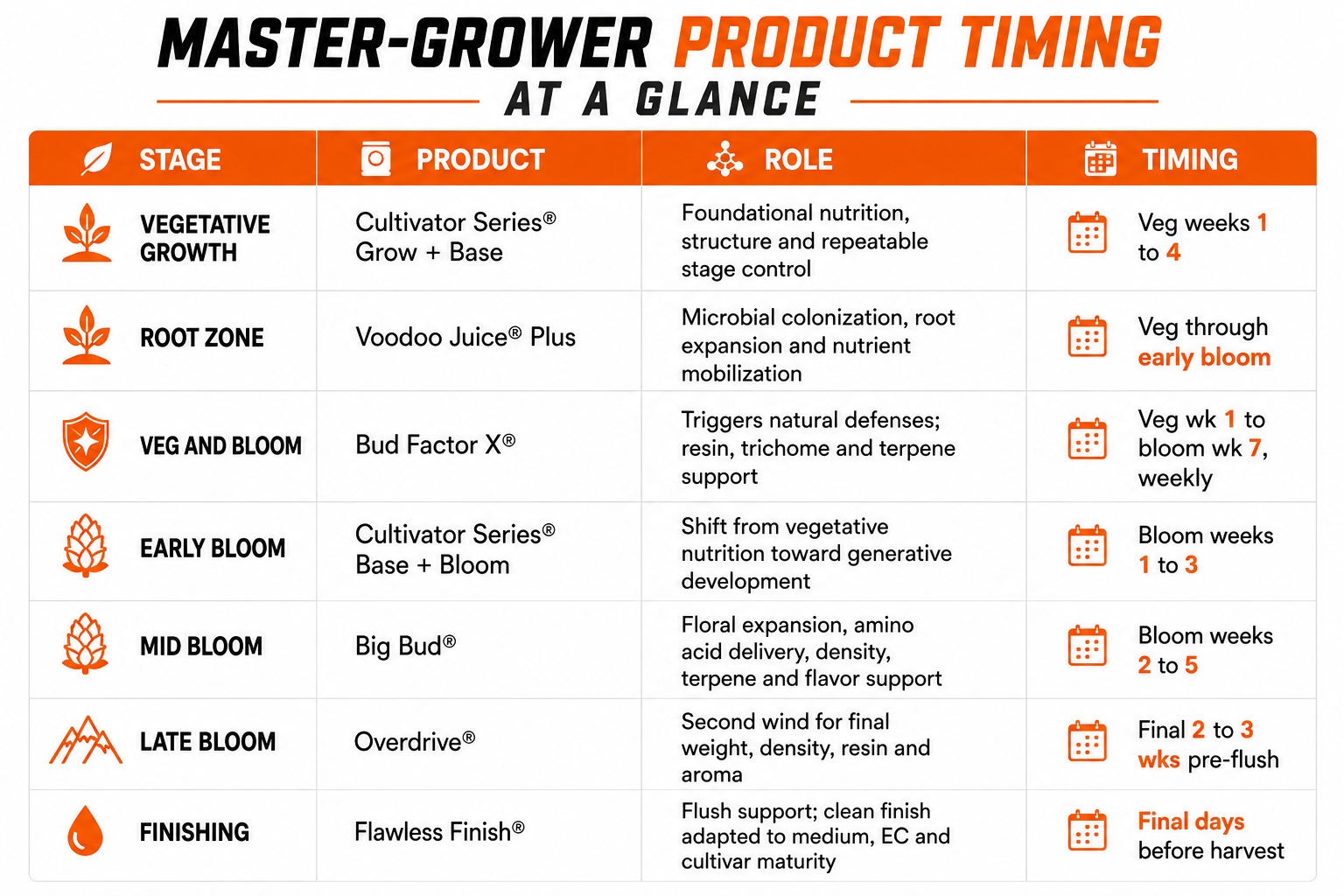
Base: Cultivator Series® for three-part powder precision, or pH Perfect® Connoisseur® Grow & Bloom for a premium liquid program with automated pH stability.
Root zone: Voodoo Juice® Plus, veg through early bloom.
Resin and terpenes: Bud Factor X®, weekly from veg week 1 through bloom week 7.
Mid bloom: Big Bud®, bloom weeks 2 to 5.
Late bloom: Overdrive®, the final two to three weeks before the flush.
Finish: Flawless Finish® and a deliberate flush adapted to medium, root-zone EC and cultivar maturity
Taken together, those products show what distinguishes the best cannabis nutrients for master growers from a generic feed program: tunable, phase-specific control over nutrition, terpenes and flavor, with room left for the environmental, irrigation and cultivar strategies that define the craft.
None of it substitutes for light, irrigation, environment or postharvest discipline. A cannabis-specific program helps remove nutrition as a source of noise, so the rest of the work becomes readable and repeatable, and the flower coming out of the tent carries the aroma and flavor the genetics promised.
Which Advanced Nutrients products are currently in your grow? If you are already running some of these additives, what are you seeing in your tents, and which one made the clearest difference to flavor and aroma in your last run? The diaries are where that gets settled.
Growers planning to add any of these to the next cycle can find retailers and distributors across Europe through the Advanced Nutrients authorized retailer map. Every purchase is backed by the 100% Money-Back Grower Guarantee.
Lees meer