




Likes
3
Share


@drewnagy0510
Follow
Very well growth and very fast very strong Indica great taste around 11 oz yield four and a half months total good cannabinoids drying was a lot longer than normal


Likes
1
Share

@Wizardgreen317
Follow
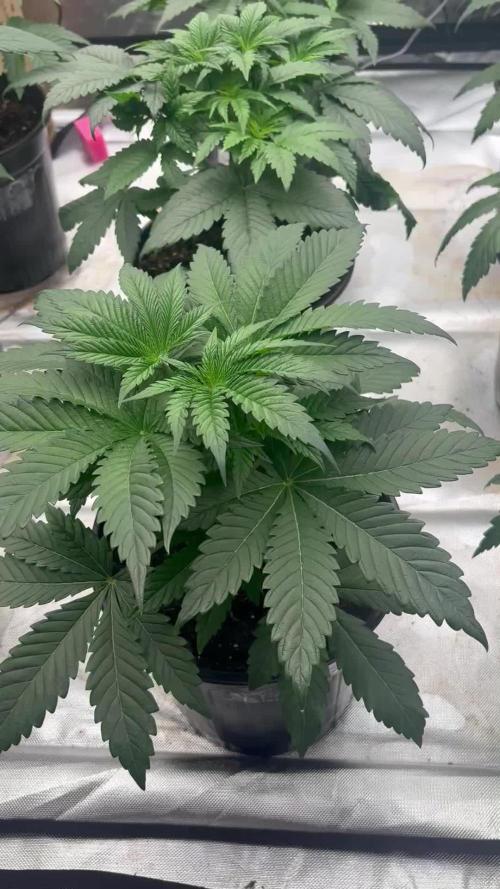
Well to my eyes growing so perfectly and they haven’t did anything specific but grow evenly, Barney’s farm never really fails these are great so yeah plants are growing fast as veg goes on leaning there side branches is coming around and growing evenly with me topping it . So yeah let go cherry poppers I hope I can get some all purple type or even a purple pinkish tips that would be dope .. but yeah hope and wishful thinking doesn’t hurt. But yeah these are doing the best as a group and one of the best in the grow also

Likes
24
Share


@OGOZHigh
Follow
So Buddy‘s
Den Ladys geht es hervorragend. Sie machen ordentlich Fortschritte.
Wetter spielt wieder Perfekt mit.
Updates folgen ✌️

Likes
3
Share


@Growing_Spartan
Follow
I’m not too sure how much EXACTLY I grew with this run but I did buy a TerpLock curing bag and it was a one pound bag with about 25% headspace for the buds and they were a bit on the fluffy side so I’d say a little over a quarter pound

Likes
19
Share


@Zonnetje
Follow
101 days after starting germination
Seems it's preparing a bit for flowering not totally sure though.
It grew a little from 150cm to 155cm.
It seems the side branches are growing the most at the moment.
Weather:
MON
8/26
33°/ 17°
actual temperatures
TUE
8/27
33°/ 19°
A thunderstorm in spots
WED
8/28
28°/ 17°
A strong thunderstorm
THU
8/29
24°/ 12°
Partly sunny; not as warm
FRI
8/30
23°/ 12°
Clouds and sun; pleasant
SAT
8/31
28°/ 14°
Clouds and sun; very warm
SUN
9/1
20°/ 10°
Clouds and sun; cooler

Likes
7
Share


@Stickygreens420
Follow
4/10/2023 - Day 43: just watered yesterday so nothing really new to report. They are really starting to smell now. Hits you right in the nose when I open the tent. Seeing more purple on the Grand Prix and some pistol browning on all the plants. Only minor problem I've had is the heat. It was almost 100° today, but my three fans and the exhaust have kept the temp under control for the most part. Had to turn on the AC for the assist, but kept temps at 80° in the tent.
4/13/2023 - Day 46 Flower: Not much has changed and I haven't had to do anything, so I haven't provided an update in a few days. Had to water again today. Added 4 gallons mixed with the same things I've been using. Jay Plantspeaker Quillaja as a wetting agent, Rootwise Bio-Phos and Bio-Catalyst, BuildASoil Big 6 Micro Nutrients and BuildABloom, Fermented Peach Extract, and Coconut Powder.
4/15/2023 - Day 48: I think the warmer weather has caused the girls to drink more. Watered another 4 gallons today, but just plane water with Jay Plantspeaker Quillaja. Seeing more purple on the two Grand Prix. Seeing a lot more orange pistols as well. The Grand Prix #2 has like a citrus gas smell, and the Frozen White Runtz is like a sweeter gas. The Ice Bath is earthy, and the Grand Prix #3 does not have a strong scent, but the bud structure is my favorite of all four.

Likes
1
Share


@SessionMeister
Follow
Overall very pleased. All the leaves are dark green and the plants are looking very happy. I’m giving them a couple more days before they are flipping into flower. All of them handle defoliation really well but Somango is a little to bushy to really do any organized Lst. I will try after Defoliation next week and give her a bit more surface area.


Likes
59
Share


@JeyGanesha
Follow
Gente,sono arrivato alla 6 settimana di fioritura,per fortuna sto riuscendo a debellare sto cazzo di ragnetto rosso...e tutti i fiorellini maschi che stavano spuntando...al momento sembra che non stiano più facendo sviluppare,ne nannars ne fiori completi di Maschio......il che è buonissimo 😋...spero riuscire a portare a termine bene la mia terapia, altrimenti mi ritroverò (ma di molto nellaCACCONA...MERDA!!!)..MA no! sono positivo e quasi sicuro che sarà buonissima 😋
Likes
11
Share


@Bread_n_Buds
Follow
This week I present the HARVEST of GODFATHER OG Autoflowering #1. The second plant is another monster, and I'll introduce it to you shortly.
The plant has a slender appearance, due, as mentioned, to a longer-than-average transition period between vegetative growth and flowering. It almost seemed like it wouldn't flower, but then, perhaps due to genetics or the addition of Power Buds to stimulate initial growth, the plant produced beautiful flowers, nice height, and a good overall result.
This plant's flower is a bit airy, but not bad at all.
Pot and Soil - This plant was grown in a 20-liter airpot with Plagron BiloLight Mix organic soil.
Lighting - A Zamnesia Phytonaut 480W LED lamp, used from mid-flowering onward, allowed fruiting. We achieved a PPFD (photosynthetically active photon flux density) between 800 and 1200 μmol/m²/s, with cycles of 24, 23, 20, and finally 18 hours.
Z https://www.zamnesia.io/it/14526-lampada-led-per-coltivazione-phytonaut-480.html (National link in case Google doesn't work)
Growing system: Zamnesia Ecosystem, fan, extractor, and grow box, all made by Zamnesia.
Trichhomes: We let the plant mature longer than usual to bring out its indica characteristics; this time, there are numerous amber trichomes and beautiful red-tipped trichomes.
Feeding: Grown with Plagron Official, a 100% organic base fertilizer, and all recommended additives.
Visit www.plagron.com for grow cycle calculations, product selection, and general information.
All nutrients are available on the Zamnesia website. Also check out the live substrate and the fantastic new Zammi product line.
You can find this excellent strain here:
https://www.zamnesia.io/en/11102-blueberry-crumble-auto-zamnesia-seeds-feminized.html
(Google it if the link doesn't work; it's a national link)
You can find this excellent strain here:
https://www.zamnesia.io/it/14330-godfather-og-auto-zamnesia-seeds-femminizzata.html
(Google it if the link doesn't work; it's a national link)
Terpene // Caryophyllene, Myrcene, Limonene
Parents // Alpha OG x XXX OG x Ruderalis
Genetics // 60% Indica / 40% Sativa
THC // 26%
CBD // 0-1%
Climate // Mediterranean
Resistance // Mold Resistant
Taste // Aroma // Sweet, Fruity, Spicy Pine Diesel
Effect // Relaxing, long-lasting, body high, calming
Zamnesia Description - Godfather OG Automatic by Zamnesia Seeds is the autoflowering version of one of the most potent OG strains on the market. With 26% THC, a rich terpene profile, and a full flowering cycle of 9-10 weeks, this indica-dominant hybrid is ideal for growers seeking fast, aromatic, and intense results without compromise.
Godfather OG Auto is the result of a cross between Alpha OG, XXX OG, and Ruderalis. This blend retains the potency of the original OG while incorporating the speed and autoflowering potential of Ruderalis. The 60/40 indica-sativa balance ensures fast and reliable yields.
Every hit delivers the classic OG bouquet: sweet fruity notes, fresh pine, wood, and a subtle diesel aftertaste. The smoke is dense, aromatic, and satisfying, perfect for lovers of bold, complex flavors.
Compact and discreet, Godfather OG Automatic is perfect for small spaces, balconies, or grow tents. Indoors, it can reach a height of 100 cm with yields of up to 450 g/m², while outdoors, it reaches 120 cm with a potential yield of 150 g/plant. All this in just 9-10 weeks from seed to harvest, with feminized seeds for maximum reliability.
"The best that nature has to offer"
www.zamnesia.com
Likes
14
Share


@Jazzvet
Follow
Hello again GD friends,
This week went very well and the girl started the vegetation phase, so summarizing:
Day 16 - I watered with 0.5l of water
Day 17 - The girl seems to have reached a height of 13 cm, so, according to biobizz, this is the perfect time to start with some fertilizers, so I'm going to use an energy booster, Bio Heaven, which improves the moisture retention . 1 ml to 0.5 l of water.
Day 18 - watered with 0.5l with 1ml of Bio Heaven
Day 19 - The first five finger leaves (Indica leaf) are about to appear, it is a sign that the vegetative phase is coming. I'm still struggling with the watering because I think I'm watering too often, so I'm going to water with 0.5 l with B Heaven and wait a while to see the reaction.
Day 21 - Finally, the Reflector that I ordered (Daisy 60cm from Secret Jardin) arrived, so now I can have the reflector closest to the plant with more confidence, because it is made of a material that does not heat the growing room as much . The first five finger leaves appeared, so tomorrow it will receive the first LST.
Day 22 - The girl is beautiful and already has 4 nods, it's the perfect time for LST and to compensate her for the stress caused, I'm adding something new to the mix, Biobizz's Active-vera, for a healthy and much stronger plant. So 1L with 2ml of Active-vera and 2ml of Bio Heaven.
Cheers guys see you next week
Processing
Likes
18
Share


@Silverback_Guerilla
Follow
I thought I just had two of this strain, but it turns out that the 134g plant was actually a C4 hybrid!
It isn't as pungent smelling as the others, but seems to have it's own unique flavor going on. I like it!
115g - C4ndycaine [Candy Cane x C4]
134g - C4ndycaine [Candy Cane x C4]
151g - C4ndycaine [Candy Cane x C4]
TOTAL: 400g 👍
Likes
14
Share


@Fre_84
Follow
It was my first cultivation. I learned a lot and will learn a lot more with the next ones. I understood that intervening on the plant requires a certain experience. In fact, of the three plants, this is the one that has grown best (and has not received any intervention). Easy cultivation ... great result!
Likes
36
Share


@MadeInGermany
Follow
Hey everyone 😃.
Another wonderful week comes to an end with two wonderful phenotypes 😊.
In the next few days both will be placed in the flowering tent 😍.
Both were watered 3 times this week with about 1 liter of water.
I will of course cut cuttings before they come into the flowering tent 👍.
I'm very excited to see how the two will develop in bloom 😊.
Until then, I wish you all the best, stay healthy 🙏🏻 and let it grow 🍀
You can buy this Strain at :
https://sweetseeds.es/de/sweet-skunk-f1-fast-version/
Type:
Sweet Skunk F1 Fast Version
☝️🏼
Genetics:
Sweet Skunk Auto (SWS34)
X
Early Skunk
👍
Vega lamp:
2 x Todogrow Led
Quantum Board 100 W
💡
Bloom Lamp :
2 x Todogrow Led
Cxb 3590 COB 3500 K 205W
💡💡☝️🏼
Soil :
Canna Coco Professional +
☝️🏼
Fertilizer:
Green House Powder Feeding
☝️🏼🌱
Water:
Osmosis water mixed with normal water (24 hours stale that the chlorine evaporates) to 0.2 EC. Add Cal / Mag to 0.4 Ec Ph with Organic Ph - to 5.5 - 5.8 .


Likes
16
Share


@Noob_quest
Follow
Another week checked off and looking pretty good.
1st nutes were are little heavy a think with a little bite burn so have dialled it right back (only fed twice) nothing since.
Overall all the girls seem healthy & happy apart from one... She seems to start drooping before the others at the end of the day and just seems less lively. She’s drinking about the same as the others so not sure. Will just keep watching not panic and see what happens.
Think the stretch has just about stopped and I’ve filled up the canopy pretty well. Hopefully just big fat stinky buds from here...
Spent quite a bit of time on YouTube etc learning this week. Feel like I’ve spotted a few places I’m still going wrong but some easy fixes so all good feel richer for the experience etc...
Thanks for reading have a great week 😊


Processing
Likes
5
Share


@TheGreenDisciple
Follow
Week 10...The plants are looking good! Took out the microscope to look at the trichomes...Starting to get milky but still another week or two before the harvest! Started flushing the plant this week!

Likes
39
Share


@LilCeeDaWeedGod
Follow
Week 10
December 13
-Had to super crop P4 again as this one is growing straight into the light
-water every other day and top dressing every two weeks
-not sure how long she’ll go but we looking decent


