




Likes
7
Share


@RFarm21
Follow
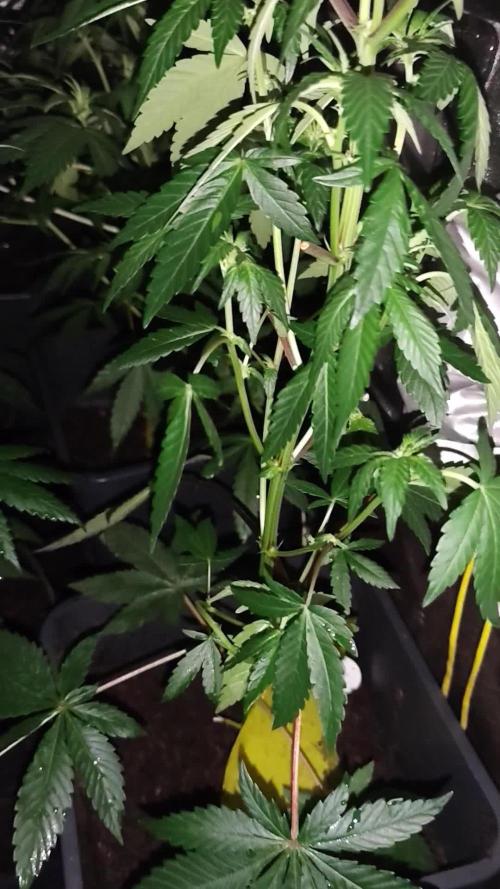
Week 5 november - 11 november
5 november - transplant in the final home, 5gallon pot
the humidity in the last few days has been very high

Likes
12
Share

@Xpie77
Follow
Kweekverslag: 4 x Spliff Seeds Gelato
Instellen
Zaden: 4 x Spliff Seeds Gelato (indica-dominante hybride, Sunset Sherbet × Thin Mint GSC-lijn)
Potten: 11 liter kunststof potten
Medium: Standaard potgrond (geen extra perliet of wijzigingen)
Tent: 120 × 120 × 200 cm (4 × 4 ft)
Verlichting: Bestva Pro 4000 LED (volledig spectrum, 3000K + 5000K + 660 nm + 730 nm IR) – hangt op ±45 cm boven de luifel
Lichtschema: Week 1-4 veg = 18/6, daarna flip naar 12/12
Temperatuur: 24-26 °C dag / 18-20 °C nacht
Vochtigheid: 55-65% veg → 50-55% bloei
Watergift: handmatig, pH 6,2-6,5, alleen water + Cal-Mag indien nodig
Week 4 Vegetatief (einde groeifase)
De 4 planten zijn supercompact en bossig – precies zoals je van Gelato had verwacht. Gemiddelde hoogte: 38-46 cm (plant 1 en 3 iets groter door betere hoek naar de LED).
Dikke, donkergroene waaiervormige bladeren met perfecte internode-afstand (±4-5 cm).
Goede vertakking vanaf de 3e knoop, al 6-8 zijtakken per plant.
Geen inspanning, geen tekortkomingen, geen gele randjes – de potgrond was perfect tot nu toe.
Luifel is mooi vlak, LED dekt de hele 120×120 perfect (geen hotspots).
Geur: nog bijna niks, alleen een heel licht aards/zoet ondertoontje als je de bladeren kneust.
Alles zag er top uit, dus ik heb op dag 28 van de groei direct geflipt naar 12/12. Geen training gedaan (geen LST/SCROG), pure bush-stijl.
Overgang & Bloei in week 1
Direct na de flip begon de typische Gelato-stretch. In de eerste 7 dagen bloei zijn de planten ±10-15 % gegroeid (eindhoogte week 1: 45-55 cm).
Eerste witte pistillen overal zichtbaar vanaf dag 4-5, vooral op de hoofdcola en de verhoogde zijtakken.
Toppen wordt al wat dikker en begint licht te “swellen”.
Bladeren blijven donkergroen en gezond, geen klauwen van branden.
Geur: vanaf dag 6-7 ruik je het al duidelijk – zoet, romig, met een hint van bessen en een heel licht gasachtig/munt-achtergrondje. Typisch gelato!
Waterbehoefte iets essentieel (nu ±1,5-1,8 liter per pot om de 2-3 dagen).
LED nog steeds op 45 cm, lichtintensiteit perfect (geen bleken).
Algemene observaties & tips voor deze opstelling
4 planten in 120×120 met 11L potten is ideaal: genoeg ruimte voor de bossige Gelato-structuur zonder dat ze elkaar verstikken.
Bestva Pro 4000 presteert uitstekend in deze tent – gelijkmatige dekking, geen dode hoeken.
Potgrond houdt het prima tot week 3-4 bloei, daarna waarschijnlijk starten met licht PK-boost (Gelato is een zware feeder in bloei).
Verwachtte bloeitijd: 8-9 weken (56-63 dagen) volgens Spliff Seeds info. De uiteindelijke hoogte wordt waarschijnlijk 80-110 cm.
Opbrengstverwachting met deze opstelling: 450-650 gram droog totaal (realistisch voor 4 gezonde meisjes onder deze LED).
Tot nu toe een gemakkelijke, stressvrije kweek. De planten zien er gelukkig uit en de geur begint al lekker te worden. Ik hou het verder in de gaten en update

Likes
12
Share


@Cannibalgardens
Follow
Well I decided to transplant this one as she was holding to much water in that smaller container and she wasn't liking the soil so much so I put her into a more balanced soil no nutrient additives . She will hopefully be doing better by the end of the week and if not I'll still keep plugging away at her and here's to the best cheers ...

Likes
8
Share
@Gorillagrower
Follow
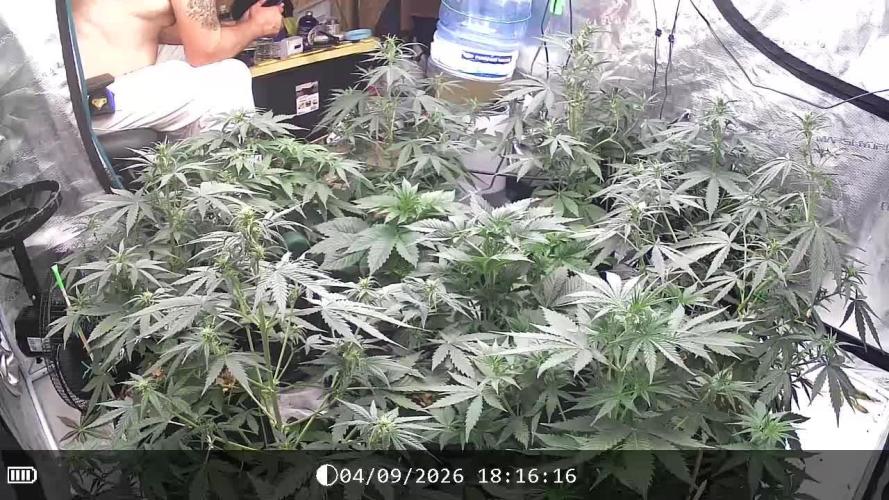
A shout out to my brother's at Spliff Seeds! Without the good genetics you don't have shit! Lol 😂 Dutch Blue Automatic is a very aggressive growing strain.
Likes
2
Share

@HOME_GROWBOOK
Follow
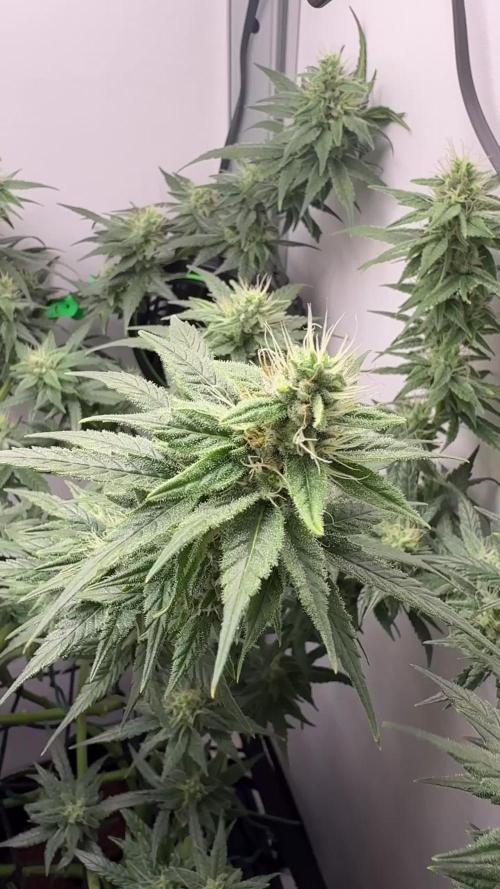
In Blütewoche 6 zeigen die Pflanzen ihr volles Potenzial. Die Buds sind deutlich angeschwollen, kompakt und komplett mit einer dichten Schicht glänzender Trichome überzogen. Viele Köpfe sind bereits milchig, einzelne beginnen sich bernsteinfarben zu verfärben – der Übergang in die Reifephase hat begonnen.
Das semi-hydroponische System läuft weiterhin absolut stabil. Die Pumpe sorgt für eine gleichmäßige Zirkulation der Nährlösung, wodurch die Wurzeln konstant mit Sauerstoff versorgt werden. Das Resultat: sichtbar vitale Pflanzen mit hoher Nährstoffaufnahme und keinerlei Anzeichen von Stress, Mangel oder Überwässerung.
Die Düngung wurde auf 8 ml/l Canna Coco A + B erhöht. Diese Konzentration wird perfekt vertragen – kein Nährstoffbrand, kein Überdruck in den Blättern. Der EC-Wert liegt im optimalen Bereich, und die Pflanzen reagieren mit kräftigem, gleichmäßigem Wachstum. Das Blattgrün beginnt langsam heller zu werden, was auf eine gute Verlagerung der Energie in die Blüten hinweist.
Die Budstruktur ist jetzt dicht und gleichmäßig, die Harzproduktion auf dem Höhepunkt. Der Duft ist intensiv und komplex, mit süß-erdigen und leicht fruchtigen Noten. Durch die offene Struktur und gute Luftzirkulation bleibt alles frei von Schimmel oder Feuchtigkeitsproblemen.
Insgesamt läuft das Setup optimal: das Semi-Hydro-System liefert konstante Feuchtigkeit, stabile Werte und beeindruckend schnelle Entwicklung. Die Pflanzen sind kräftig, die Blüten fett – alles deutet auf eine starke, aromatische Ernte in den kommenden Wochen hin.
Likes
15
Share


@MR_FLEXOPONIC
Follow
3 day into week 9 still not flowering (day 59). I don't know why this is supposed to be an autoflower that I got from homegrown cannibas Co. The white widow autoflower I got from them started to flower after about 4-5 weeks but this CRITICAL MASS AUTOFLOWER doesn't seem to want to flower and I'm doing everything the same besides the LST. I will give it a little more time and hope that it's just a late bloomer and starts to flower soon fingers crossed 🤞*UPDATE* ON DAY 61, 2DAYS BEFORE WEEK 10 CMA STARTED TO SHOW SIGNS OF FLOWERING, LST CANOPY IS PRETTY MUCH EVEN AND ABSOLUTELY NO SIGNS OF OF ROOT ROT

Likes
5
Share


@Kickdrum
Follow
She has left the Sunset Sherberts behind, and deciced to take advantage of the nice and toasty environment. Jedi (her name) has finally broken through. Steady at 21.5-24 C. RH at 65-75% with Spider Farmer Huimidifier and Dehumidifier, shooting for VPD. (day 1)
Let's quickly review the key new components I've planned to integrate or have already:
Circulation Pump - Adding this to the 14L Mars Hydro reservoir will ensure even fresh, circulated-for-a-miniute-every-hour, batch of water (and later nutes) to the auto-drip system, maintaining optimal feeding for my plants when I am away, next week.
Biobizz & BioTabs Supplements - These organic nutrient and microbial products will provide a comprehensive and balanced feeding regimen for my plants.
Auto-Drain Potted Plant Stands - The wheeled, auto-draining stands will simplify watering and prevent any spills or overflows.
Inkbird Humidity Controller - Pairing this with the Spider Farmer humidifier and dehumidifier will allow me to precisely maintain the ideal VPD (Vapor Pressure Deficit) levels.
LST Clips, Trellis Net & Shelves - These will help me maximize my grow space and optimize the plant canopy for optimal light exposure.
Pest Control Strips - An important preventative measure to stay ahead of any potential pest issues.
Smart Soil Sensors - The Zigbee-enabled sensors will provide vital data on soil moisture, temperature, and more, which I can monitor remotely.
Air Purifier/Ion Generator - Ensuring my grow environment has clean, high-quality air circulation.
With all of these elements in place, combined with my existing setup and the automated control via the iGrow app, I'm truly creating a "hands-off" grow operation. (theoretically, with a bro, coming to phiscally check too)....The ability to monitor and adjust key parameters remotely while I'm away in Italy.
Running on Sunrise/set mode(18/6) over the "seedling" scene, in iGrow app, keeping track of DLI and later on, the Adlites will come into play.
Temp at 23.5 and RH is at 60%.


Likes
10
Share


@AMNESIAHAZEPK
Follow
OKAY SO I KEPT THEM IN MY DIY SETUP FOR A WEEK AND GAVE THEM THEIR FIRST SUNSHINE TODAY 04/28 NOW THEY ARE ON A 24HR LIGHT SCHEDUELE. SUNRISE IS 5:30AM AND SUNSET IS 6:45PM.
I SHIFT THEM OUTDOOR AT 2:00AM AND THEN GET THEM INDOORS AT AROUND 6:30PM UNDER CFL LIGHTS SO NO LIGHT TIME IS FROM 2:00AM TILL SUNRISE WILL KEEP THEM LIKE THIS THROUGH OUT THEIR VEGETATION.
ATM I HAVE'NT ADDED ANY NUTRIENTS OR SOIL. BUT I WILL BE ADDING LIQUID NUTRIENTS NPK 40:20:20 FOR VEGETATION IN THE NEXT WEEK.
I NOTICED A YELLOW DECOLOURATION ON THE EDGES OF THE COTYLEDONS OF ONE PLANT BUT SINCE IT WAS THE FIRST DAY OUTDOORS I THINK IT IS HEAT STROKE PLUS I HAD TO MAKE A MAKESHIFT DOME TO KEEP THE BIRDS AWAY (OUTDOOR PICTURE ATTACHED) TOMORROW I WILLSHIFT THEM IN A GLASS MADE GREENHOUSE WITH VENTILATION SO WON'T BE NEEDING THE DOMES.
KEEP IN MIND THIS IS MY SECOND GROW IN MY REGION (PAKISTAN) AND THE FIRST ONE WAS AMNESIA HAZE AUTO FROM ROYAL QUEEN. THIS YEAR I AM PLANNING TO PLANT
SOUR DIESEL
AMNESIA HAZE
NORTHREN LIGHTS
AK 47
YOU CAN CHECK OUT MY DIY INDOOR GROW SPACE IN THE PICTURE ATATCHED IT'S MADE OUT OF SOME MATERIAL I HAD FROM MY PHOTOGRAPHY STUFF
I HAVE ALREADY STARTED WITH THE SOUR DIESEL FINGERS CROSSED AND I'LL START PLANTING THE OTHER ONES IN THE COMING WEEKS.
Add me on Snapchat! https://www.snapchat.com/add/amnesiahazepk!!


Likes
171
Share


@Roberts
Follow
Pineapple Express auto from Amsterdam marijuana seeds has germinated, and sprouted. Is looking great. I am unsure when roots will make it to the reservoir, but I would imagine it won't take long. 🤞 my mix is not too strong. First time around. Nothing new to report beyond that. She is being grow in a spider farmer 2.3x2.3x61 tent. With 4 inch inline smart controller extraction fan. Powered by a SE3000 which just got bumped to 45 percent yesterday. To purchase these items there is links below. Thank you again AMS, and Spider farmer.
Thank you grow diaries community for the likes, follows, and subscriptions on my YouTube. I greatly appreciate the support, and happy growing 🌱🌱🌱
To purchase a SE3000 please follow appropriate link
https://amzn.to/3jwCTO7
US:https://amzn.to/396hXXb
CA:https://amzn.to/3ol4oK4
DE:https://amzn.to/3q15SJT
UK:https://amzn.to/2L7NVKN
AU:https://amzn.to/3pZD6ZQ
FR:https://amzn.to/2Xkomsi
IT:https://amzn.to/3nk7A7h
Link for 3x3 tent: https://www.amazon.com/dp/B083K89FFJ
Link for 4" inline fan: https://www.amazon.com/dp/B08S7BKS3Q
Discount code on amazon: saveurcash

Likes
1
Share

@CheeRz
Follow
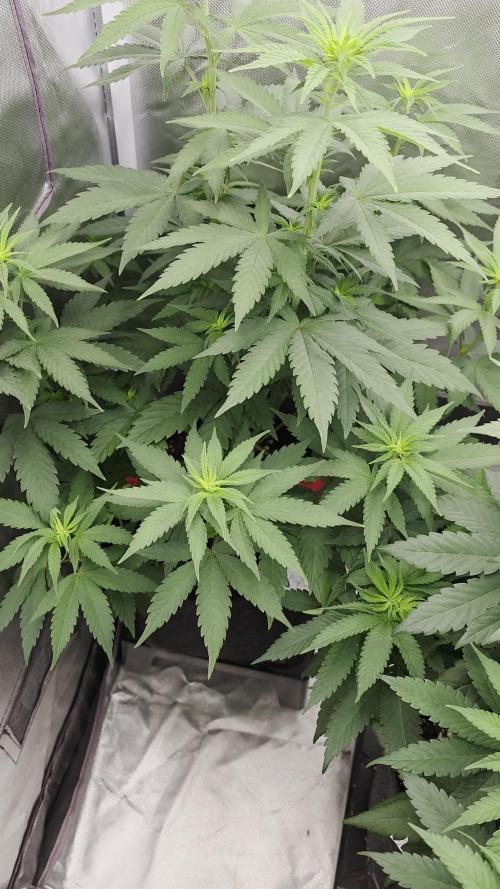
Flowering week 2 the ladies are slowly forming tips and everything is going according to plan. Purple Punch x Lemon Drizzle has slightly burnt tips from the fertilizer. I probably could have started fertilizing even later.


Likes
2
Share

@eldruida_lamota
Follow
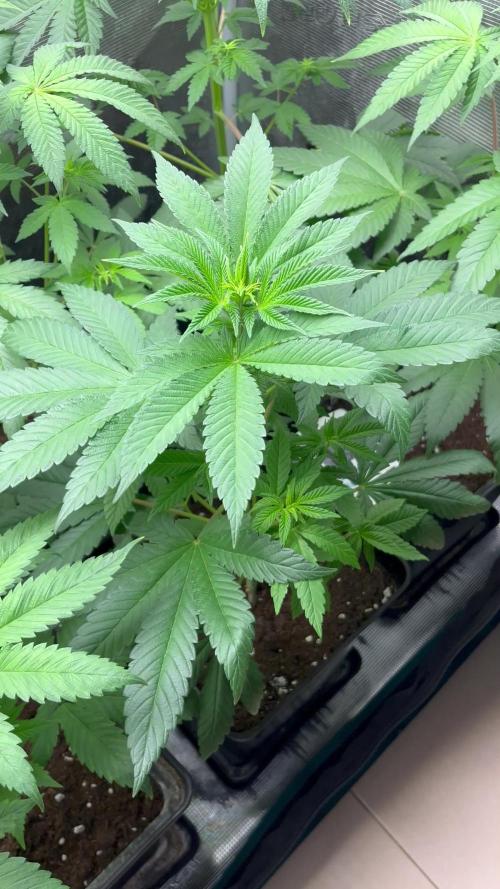
Que pasa familia, vamos con la primera semana de floración de estas Drizl Pickl feminizadas de Seedstockers.
Vamos al lío ,se trasplantaron en macetas de 7 litros definitivamente.
El ph se controla en 6.0 , la temperatura la tenemos entre 24/20 grados y la humedad ronda el 50%.
El ciclo de floración puse 12h de luz, el foco está al 50% de potencia.
De momento van creciendo a buen ritmo y tienen un buen color.
Agradecer Agrobeta por el envío del kit gold series para esta temporada, son unos jefes 🙏
- os dejo por aquí un CÓDIGO: Eldruida
Descuento para la tienda de MARS HYDRO.
https://www.mars-hydro.com
Hasta aquí todo, Buenos humos 💨💨💨
Likes
8
Share


@funderdank
Follow
10/10 great plant. Had to move three times while she was flowering and she only gave me a handful of seeds from stress. Diary is a bit short because I don’t have many pictures of her from while I was moving her. But I have more seeds and will definitely grow again.

Likes
47
Share


@Ultraviolet
Follow
2nd net is up. Early bud formations are promising. holding up to the extremes pretty well, some leaves taking minor damage, but overall, she is holding up, gave her 1 night at 50F see how she would react, stressful. Not advised as it messes with her metabolism, but I want to see if it triggers any anthocyanin response. Love to see her purp up but no signs yet. Remember, For every molecule of glucose produced during photosynthesis, a plant needs to split six molecules of water. This process provides the hydrogen needed for synthesizing glucose and other organic compounds, while oxygen is released as a byproduct.
Homework.
If Rubisco activity is impaired and it cannot properly function or regenerate its substrate, the plant's leaves are likely to turn a pale green or lime green, a condition known as chlorosis. Essentially, Rubisco activity is highly regulated and susceptible to various environmental and metabolic factors that can cause it to become inhibited, leading to an apparent failure in RuBP regeneration due to a lack of consumption.
Rubisco regeneration is intrinsically linked to nitrogen supply because Rubisco is a major sink for nitrogen in plants, typically accounting for 15% to over 25% of total leaf nitrogen. The regeneration phase itself consumes nitrogen through the synthesis of the Rubisco enzyme and associated proteins (like Rubisco activase), and overall nitrogen status heavily influences the efficiency of RuBP regeneration. RuBisCO is a very large enzyme that constitutes a significant proportion (up to 50%) of leaf soluble protein and requires large investments in nitrogen. Insufficient nitrogen supply limits the plant's ability to produce adequate amounts of RuBisCO, thereby limiting the overall capacity for photosynthesis and carbon fixation. Maintaining the optimal, slightly alkaline pH is crucial for the proper function and regeneration of Rubisco. Deviations in either direction (too high or too low) disrupt the enzyme's structure, activation state, and interaction with its substrates, leading to decreased activity and impaired RuBP regeneration. (Lime/yellowing)
Structural Component: Nitrogen is an essential building block for all proteins, and the sheer abundance of the Rubisco protein makes it the single largest storage of nitrogen in the leaf.
Synthesis and Activity: Adequate nitrogen supply is crucial for the synthesis and maintenance of sufficient Rubisco enzyme and Rubisco activase (Rca), the regulatory protein responsible for maintaining Rubisco's active state. Nitrogen deficiency leads to a decrease in the content and activity of both Rubisco and Rca, which in turn limits the maximum carboxylation rate, Vmax, and the rate of RuBP regeneration Jmax, thus reducing overall photosynthetic capacity.
Nitrogen Storage and Remobilization: Rubisco can act as a temporary nitrogen storage protein, which is degraded to remobilize nitrogen to other growing parts of the plant, especially under conditions of nitrogen deficiency or senescence.
Nitrogen Use Efficiency (NUE): The allocation of nitrogen to Rubisco is a key determinant of a plant's photosynthetic nitrogen use efficiency (PNUE). In high-nitrogen conditions, plants may accumulate a surplus of Rubisco, which may not be fully activated, leading to a lower PNUE. Optimizing the amount and activity of Rubisco relative to nitrogen availability is a target for improving crop NUE.
Photorespiration and Nitrogen Metabolism: Nitrogen metabolism is also linked to the photorespiration pathway (which competes with carboxylation at the Rubisco active site), particularly in the reassimilation of ammonia released during the process.
To increase RuBisCO regeneration, which refers to the process of forming the CO2 acceptor molecule Ribulose-1,5-bisphosphate (RuBP) during photosynthesis, the primary methods involve optimizing the levels and activity of Rubisco activase (Rca) and enhancing the performance of other Calvin-Benson-Bassham (CBB) cycle enzymes.
Biochemical and Environmental Approaches:
Optimize Rubisco Activase (Rca) activity: Rca is a crucial chaperone protein that removes inhibitory sugar phosphates, such as CA1P (2-carboxy-D-arabinitol 1-phosphate), from the Rubisco active site, thus maintaining its catalytic competence.
•Ensure optimal light conditions: Rca is light-activated via the chloroplast's redox status. Adequate light intensity ensures Rca can effectively maintain Rubisco in its active, carbamylated state.
•Maintain optimal temperature: Rca is highly temperature-sensitive and can become unstable at moderately high temperatures (e.g., above 35°C/95F° in many C3 plants), which decreases its ability to activate Rubisco. Maintaining temperatures within the optimal range for a specific plant species is important.
•Optimize Mg2+ concentration: Mg2+ is a key cofactor for both Rubisco carbamylation and Rca activity. In the light, Mg2+ concentration in the chloroplast stroma increases, promoting activation.
•Manage ATP/ADP ratio: Rca activity depends on ATP hydrolysis and is inhibited by ADP. Conditions that maintain a high ATP/ADP ratio in the chloroplast stroma favor Rca activity.
Enhance Calvin-Benson-Bassham (CBB) cycle enzyme activity: The overall rate of RuBP regeneration can be limited by other enzymes in the cycle.
•Increase SBPase activity: Sedoheptulose-1,7-bisphosphatase (SBPase) is a key regulatory enzyme in the regeneration pathway, and increasing its activity can enhance RuBP regeneration and overall photosynthesis.
•Optimize other enzymes: Overexpression of other CBB cycle enzymes such as fructose-1,6-bisphosphate aldolase (FBA) and triose phosphate isomerase (TPI) can also help to balance the metabolic flux and improve RuBP regeneration capacity.
Magnesium ions, Mg2+, are specifically required for Rubisco activation because the cation plays a critical structural and chemical role in forming the active site: A specific lysine residue in the active site must be carbamylated by a CO2 molecule to activate the enzyme. The resulting negatively charged carbamyl group then facilitates the binding of the positively charged Mg2+ion. While other divalent metal ions like Mn2+ can bind to Rubisco, they alter the enzyme's substrate specificity and lead to dramatically lower activity or a higher rate of the non-productive oxygenation reaction compared to Mg2+, making them biologically unfavorable in the context of efficient carbon fixation. The concentration of Mg2+ in the chloroplast stroma naturally increases in the light due to ion potential balancing during ATP synthesis, providing a physiological mechanism to ensure the enzyme is activated when photosynthesis is possible. At the center of the porphyrin ring, nestled within its nitrogen atoms, is a Magnesium ion (Mg2+). This magnesium ion is crucial for the function of chlorophyll, and without it, the pigment cannot effectively capture and transfer light energy.
Mg acts as a cofactor: Mg2+ binds to Rubisco after an activator CO2 molecule, forming a catalytically competent complex (Enzyme-CO2-Mg2+). High light + CO2) increases demand: Under high light (60 DLI is a very high intensity, potentially saturating) and high CO2, the plant's capacity for photosynthesis is high, and thus the demand for activated Rubisco and the necessary Mg2+ cofactor increases. Mg deficiency becomes limiting: If Mg2+ is deficient under these conditions, the higher levels of Rubisco and Rubisco activase produced cannot be fully activated, leading to lower photosynthetic rates and potential photo-oxidative damage.
Optimal range: Studies show that adequate Mg2+ application can enhance Rubisco activation and stabilize net photosynthetic rates under stress conditions, but the required concentration is specific to the experimental setup.
Monitoring is key: The most effective approach in a controlled environment is to monitor the plant's physiological responses e.g., leaf Mg2+ concentration, photosynthetic rate, Rubisco activation state, and adjust the nutrient solution/fertilizer to maintain adequate levels, rather than supplementing a fixed "extra" amount.
In practice, this means ensuring that Mg2+ is not a limiting factor in the plant's standard nutrient solution when pushing the limits with high light and CO2.
Applying Mg2+ through foliar spray is beneficial to Rubisco regeneration, particularly in alleviating the negative effects of magnesium (Mg) deficiency and high-temperature stress (HTS). While Mg can be leached from soil, within the plant it is considered a mobile nutrient, particularly in the phloem. Foliar-applied Mg is quickly absorbed by the leaves and can be translocate to other plant parts, including new growth and sink organs.
Foliar application of: NATURES VERY OWN MgSO4 @ 15.0g L-1 in a spray bottle. For those high-intensity workouts when 1 meal a day is just not enough!
Foliar sprays are often recommended as a rapid rescue measure for existing deficiencies or as a supplement during critical growth stages, when demand for Mg is high. Application in the early morning or late evening can improve absorption and prevent leaf burn. The plant was getting a little limey yellow in the centre. Shortly thereafter, she was back in business, green mostly regenerated. The starting point [of creativity] is curiosity: pondering why the default exists in the first place. We’re driven to question defaults when we experience vuja de, the opposite of déjà vu. Déjà vu occurs when we encounter something new, but it feels as if we’ve seen it before. Vuja de is the reverse—we face something familiar, but we see it with a fresh perspective that enables us to gain new insights into old problems.
Confidence is evidence... nothing more. You are confident because you have driven 10,000 times, you are confident because you have spoken 10,000 times. People think confidence is a feeling, but it's not. If you want more confidence, then you need to create evidence, take more shots, collect more data, build more experiences, take more risks; fail, confidence doesn't come first; it is the reward you get for doing the work. no one else wants to do.


Likes
5
Share


