




Likes
9
Share


@Martymar021208
Follow
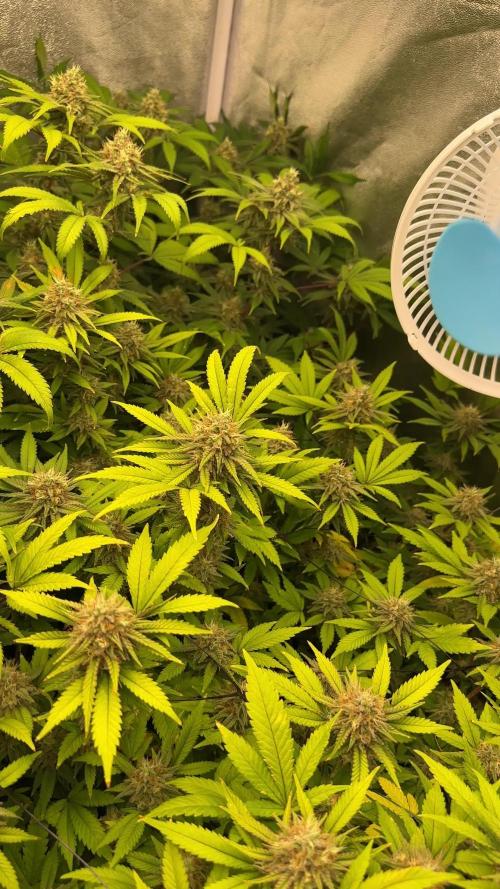
So far so good with these girls my only complaint is the fact that I wish I had a bigger light but I will make this work until I can afford another one. Overall plants are healthy and are building thick branching. Gonna take down the wall and add another small light until I can afford a big one.

Likes
105
Share


@Green_Friends_Inc
Follow
Commencing week 5/Day 29: on Nov 21st
Day 29
All is doing well now and a few more plants have roots in water but tomorrow is going to be well below freezing as well as the humidity has dipped very low
Day 32
Still growing steady the cold temps and low humidity haven't hurt or slowed them down too much
Day 34
Happy to say 6 out of 8 girls have pretty massive root masses developed in past week into bucket.
I have been very lightly foliar feeding every day a slightly acidic low ppm solution.
Lights were put back on timer since the temp and humidity are going back up I don't need the lights for heat.
pH has remained steady for past two days in low to mid 5.8s.
Is this too steady I wonder 🤔
I put on fans today today as well as under lighting LED strip.
D35
Am check-in and all is going well.
All 3 Gorilla Zkittlez are absolutely killing it, way bigger than the rest of the bunch. Although the 818 Headbands and the Raspberry Diesel are not far behind. Unfortunately both the Boss Hoggs seems to be runt-ish. One especially is really funny looking. But I always cheer for the under dog in the fight so who knows 😎
Turned off under lighting. Raised overhead LED Panels up 3-6 inches and re-oriented (angled) towards girls.
*I've decided to break off the barely mentioned personal crosses into their own journal in the next few weeks in case anyone was watching or wondering, it's coming. I'll be editing this journal accordingly when the time comes to be more accurate and useful. Lastly I am adding a new journal today for "🍋🍰" aka Lemon Cake by Moxie. It's terpalicious 👅. super sugary and lemony on the nose. Does anyone from the US or elsewhere know what's "Country-Time" lemonade mix is?? It makes your mouth water and smells almost too much like the sugary lemonade mix. Stay tuned
💚🙏


Likes
Comments
Share


@JardineiroBr
Follow
Essa planta vou tocar sem treinamento pois acho wireless o caule está frágil na base.

Likes
68
Share


@TheWeedaltor
Follow
Plant was healthy and yet enough big to switch to flowering 12/12
I am treating her good, I upgraded her in the superior double room all for her 🤪
I love how she grows 💪🏻
Good luck to all growers 💚

Likes
16
Share


@Bousmeister
Follow
All is going well I week 8! Caramelino smelling fantastic! Northern lights got harvested!
Like I said,I am disappointedin my NL clone as far as yield goes.But not disappointedin terps and thricomes. I am learning. NL started to develop nanners on the very bottom buds. I found only 3 nanners. And took them off. I also didn't really flush NL. My noob mistake but she was ready at week 7 for harvest!
Caramelinolooks fantastic,nice sized buds, super nice and strong terps and very nice looking buds!Super excited for this lady!
Started last week with her flush. Well see what happens.
Peace

Processing
Likes
13
Share


@Cheesefarmer420
Follow
Overall this plant was great to grow, she just grew and was happy doing it the entire time, pretty good yield off a plant that was only about 12inches tall. Seemed to be a lot more resistant to deficiencies then the other two strains this grow. Definitely a great mid-day Smoke!
Likes
21
Share


@Rollex420
Follow
⚠️⚠️⚠️ I apologize unfortunately I made the mistake of putting an extra week of flowering in the diary. SO THE CURRENT WEEK IS THE EIGHTH AND NOT THE NINTH ⚠️⚠️⚠️
but ignoring this problem..😅 The flush week has begun! these plants have a very clean runoff already from the first irrigations of this week, this due to the previous flushes due to an excess of fertilizers. In addition i bought a little fun and useful gadget to see the trichomes up close and their colors in the final days.. So I added some macro shots, I hope you like the update of the diary! I wish everyone an healty grow. peace and love my brothers ☮️💚
📈📈📈 UPDATE 17/04/21 📈📈📈
Week 9 -Day 63 flower- (92 total days)
I am very happy with how strong these plants remained, despite some problems that have been there..
Anyway even in this adventure i learned a lot and I hope to improve even more over time. 🤞🏻😬
Now i will leave these plants hanging down for a week at least ..once they lost most of their moisture i will do a final trim, put the clean nugs in the jars and let them dry for another three weeks or so.. opening the jars daily to allow the buds a correct final drying.


Likes
5
Share


@BettaN
Follow
The LST really opened up the girls and helped them to increase volume.
During the week PE finally got some more training, it feels like she opened up nicely.
It is not very comfortable to grow 2 plants in a 60*60cm tent.
Processing
Likes
33
Share


Likes
61
Share


@Verlido
Follow
Week 11 - Day 1 : Pinched branches from subject 1 and 2. take a good look and tell me what you think!
Week 11 - Day 2 : Restday, changed water schedule to water-water-feed, watering my plants with 4 Liters per plant every 3th day.
Week 11 - Day 3 : Pinched lower branches of subject 1, take a good look and tell me what you think!
Week 11 - Day 4 : Pinches branches of subjects 2 and 3, take a good look and tell me what you think!
Week 11 - Day 5 : Pinches branches of subject 1, take a good look and tell me what you think, had my first harvest of ladybugs in the garden and released them on my plants, noticed that I have very little spider mites on my plants. Posted week 1 to 9 on my diary.
Week 11 - Day 6 : Restday, woke up to subject 5 being damaged, What could have caused this? Too heavy branches? Maybe an animal that accidentally broke the branch and took off.
Week 11 - Day 7 : Pinches branches of subject 3, take a good look and tell me what you think!
Week 12 - Day 1 : Restday, Watered my plants 4 Liters per plant with nutrients, added Big Bud.
Week 12 - Day 2 : Pinches branches of subject 1,2 and 3.
Week 12 - Day 3 : Restday.
Week 12 - Day 4 : Restday, Watered my plants 4 Liters per plant.
Week 12 - Day 5 : Supercropped subjects 1,2 and 3. In my opinion, the canopy of 1,2, and 3 were growing vertically again so I wanted to make it more even, I tied them down to 2 nodes lower after bending the mainstem in a 90-degree angle.
Week 12 - Day 6 : Unknown information
Week 12 - Day 7 : Unknown information

Likes
38
Share


@GODSGIFT_2005_JM
Follow
For LIQUIDS & NUTES ******GREEN BUZZ NUTRIENTS***** organic.
Also i’m using their LIVING SOIL CULTURE in powder form!
MARSHYDRO ⛺️ has large openings on the sides which is useful for mid section groom room work. 🤩
☀️ MARSHYDRO FC 3000 LED 300W
💨MARSHYDRO 6” in-line EXTRACTOR with speed-variation knob, comes complete with ducting and carbon filter.

Likes
5
Share


@Ninjabuds
Follow
My gas tax plant is looking absolutely incredible right now. It's got these massive buds that are super dense and have this awesome dark color to the leaves. I'm so excited to see how it turns out when it's finally ready to be harvested. I've been checking the height, the thickness of the stem, and the density of the buds to get an idea of how much longer I have to wait. I think I might start flushing it soon.
The past few weeks have been so beautiful, watching the plants grow and change. It's amazing how something so small and fragile can turn into something so strong and vibrant. Now that they're getting ready to bloom, it feels a little bittersweet. I'm so excited to see the finished product, but I'll definitely miss having them around while they're growing.


Likes
5
Share


@alafmalaf
Follow
This week I basically gave the certs, fixed the light intensity and got my humidity control system all dialed in. The plants have seen more growth than ever! The seedlings are definitely growing way better than the older plants so I'm not sure what to do now I'm regards to flowering all of them or focusing my energy on a few
Likes
36
Share


@Ferenc
Follow
Day 80, 2nd of December 2020:
Beautiful bushy, great genetics. Well done.
Nice buds are on the way and the smell is great. I am absolutely excited :)
All good the lamp is now on 11 hours and off 13 hours. Every week 15 minutes was taken off and after 4 weeks here we go. Strated 12/12 and now 13/11 wanted try to imitate the nature as the light days are getting shorter.
Fertilization has changed no more epsom salt from this week and I will stop giving nitrogen as well from next week.
All good :)

Likes
14
Share


@Willy_Balls
Follow
I had the most brilliant moment ever. I ve been setting up the drip system for the first time with the runoff going into the ebb and flood system reservoir. I did not take into the account the syphononing effect of the pumps and that the reservoir water level has to be below the plants. I had two hours to leave for my flight, because I was going on a vacation. So I jumped online and found a way to make pressure regulator from piece of tube and t connector. It did well for the whole 10 days I was away. I'm really proud of my self :))))
Likes
19
Share


@Fire_Farmer
Follow
Seems I told a lie last week, I'm late one day and I've done videos again cos again 🤥
Its been a good week for bud production regardless of a hiccup this week which shows as cal/mag and nitrogen deficiencies throughout each plant🤒
My ph pen malfunctioned and I ended up feeding them all 4.5 and didn't notice till the leaves told me 🍂
The ph pen has been replaced, amendments made to buffer the root zone and fingers are crossed 💉🤞
Super stinky grow this, going to replace my carbon filter before starting a new one because I caught wiffs of them when I entered my home today. If the flavours match the smells in this tent I'm in for a treat come smoke time.👃⛽🍋🍇
Its that magic time in the tent now where each girls really showing their own characteristics, both the purple punches and the zkittlez are different phenos to their siblings so I'm excited to see what they finish up like🏁
So far mostly good 👍
Thanks for reading 📖
One Love💚
Fire Farmer🔥👨🌾


Likes
41
Share


@Skinnytalls420
Follow
Day 57-17/12/21 oh dear I don’t know what is going on after giving them some calmag they seem to being doing better day 61-21/12/21 some are behind others but should be taken a few down next week!!!
