


Likes
Comments
Share


@Autofemweed
Follow
Esta semana llegue y un grillo se las estaba comiendo inmediatamente al otro día fui a comprar mi indoor jajajaja

Likes
4
Share

@Dameon0803
Follow
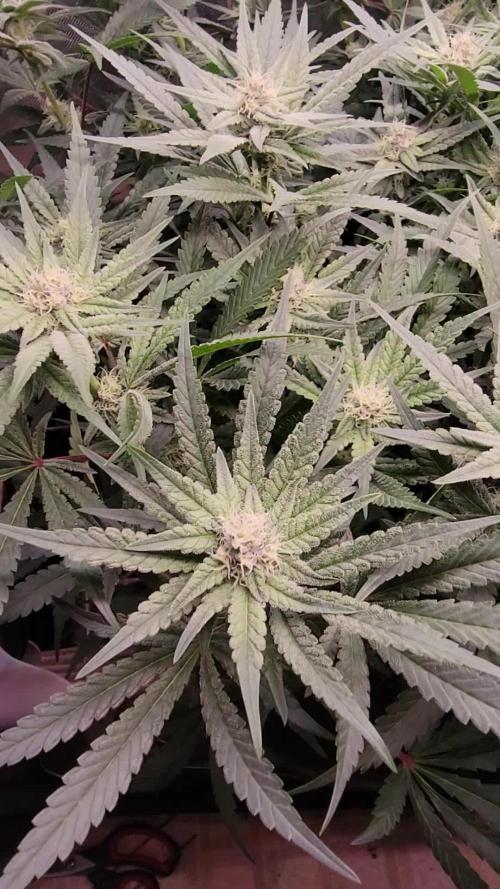
Another easy week. Bud and trichome production seem to be on point. This plant is truly maxed. She is 18 inches with about 12 inches being above the scrog screen. She stretched a little more than expected. She was supercropped in several location and didn't skip a beat. Obviously, the angle of my camera doesn't give the whole picture. But now there's some buds that can be watched in development. I'm fighting night time humidity. My little Vivosun dehumidifier can't keep up. Likely a future upgrade as I'm sure I'll struggle to get to 50% with lights on next week. Temps when my light off could ideally be lower as well. Not enough that I see the need to invest into anything like an A/C. Loving to see the little bits of purple start to come out. I'm sure lower night temps would amplify that. I did a final top dress of Build-A-Flower, an 1/8 cup of Craft Blend, and a topping of Kashi followed by a half gallon watering with the listed nutrients once at the beginning of the week.

Likes
20
Share


@dataTwiiix
Follow
08/11: La troisième semaine de floraison commence enfin on devrait les fleurs prendre forme. J'espère que le stretch est fini car elle est assez grande et doit laisser un peu de place au autres.
08/12: la troisième semaine débute sur une note un peu amer. Certaines feuilles se détériore à une vitesse folle, ainsi que des tâches brune. Premier réflexe GHE essential et cal-mag agent de Canna ce matin. Espérons que les prochains jours seront plus cool et que cela vas arranger mon problème.
08/13: après avoir fait plus de recherche je suis enfin tombé sur un article sur le blog de pevgrow et mon problème correspond en tout point à une carence en magnésium. Je devrais voir voir des améliorations dans les 4 à 7 jours. Et bien-sûr continuer à donner du calmag. Le problème viendrai du fait que je tourne en 24/7 avec les auto's enfin c'est ce que je pense après avoir croisé les conseils et avis des "growers" de GD et certains articles.
08/14: c'est dernier jours ont été intense pour moi, lors de mon premier diaries j'avais déjà eu le même problèmes avec une purplequeen auto à l'époque je n'avais pas de calmag... enfin tous ça pour dire merci à la communauté growdiaries.com qui m'a conseillé et supporter. Maintenant cela c'est stabilisé et n'atteint aucune autre feuilles, les nouvelles feuilles sont belles et viguoireuses. Me voilà rassurer et surtout j'ai encore appris de nouvelles chose sur la cannabiculture 😎😨🤓
08/15: elle a créée une belle masse de feuilles entre temps, je vais appliquer une grosse defoliation après le prochain engraissâge histoire d'être que les carences ne sont plus d'actualités. À part cela je me contente de couper deux feuilles par jours. #46
08/16: tout est rentré dans l'ordre ouF :D - la production de trichromes à bien commencé, une légère odeur typique à la weed qu'elle que soit la variété en début de flo. se dégage de la growbox. je suis enchanté! Maintenant j'epère que le switch d'engrais càd changer "BioBizz bloom/topmax" pour "Canna PK13-14/Boost Accelerator" vas lui plaire à la jolie dame #47
08/17: apres une de nuit de réflexion: arrosage/engraisser (canna calmag (.6ml/L)/BB blom-topMax (1.2ml/L chaqu'un)/ AN BigBud-BudCandy (1ml/L chaqu'un) ce matin. J'essayerai canna pk 13 14 et boost accelerator sur mon prochain plant. #48

Likes
9
Share


@DsTrees
Follow
Chopped on Day 70 (September 6th, 2020)
9/6/20: Hung her to dry after taking off most of her fan leaves. I decided to hang the whole plant this time around to see if it helps my dry quality. Will update with pictures soon.
9/12/20: Trimmed her up today after feeling that the nugs were crispy and dry. First couple days of dry we were experiencing a bit of a heat wave and high humidity levels (fluctuating from 60-75%). During the final days of drying we had rain and then it cooled off and dried out lowering my rh in the tent to around 50%. That crisped the nugs right up in 2 days and I decided it was time to pull her out and trim her up. The nugs were so incredibly sticky and smelled of chem. They are really dense despite their look especially the main cola nugs. Still smelling a bit like hay but I'm confident that the curing process will take care of that. I am curing with Boveda 58% rh packs in each jar and a hydrometer as well. Not going to test a nug until at least a week or two of curing or until I run out of Sour Crack lol. Will update with a smoke report.
9/28/20: So it's been just over 2 weeks of curing so far. When I first put the nugs in the jar, I was worried they were a bit too dry/crispy for what I was hoping for, but after 2 weeks of curing the nugs aren't as crackly sounding in my hands. I cured with Boveda 58% rh packs and mason jars as seen in the pictures.
**SMOKE REPORT**
9/28/20 - 2 weeks of curing: The smell of this strain is a really unique one, or maybe the pheno that I got is. It smells fruity for sure but it has this gas smell to it that almost smells chemical but in a good way. I marked down tropical above because the combo of pungent fruit almost brings out a sweet cocktail aroma. After really thinking about it, I've never smelled weed with a scent quite like this one! The smoke was smooth in my freshly cleaned bong and I'm decently high. I feel pretty tired but I'm ready to do something like game or make music. I don't feel hungry (yet) but my throat is begging for a drink. I'm happy that I have now smoked my own home grown weed twice!

Likes
30
Share


@ChitownCannaChica
Follow
Just up potted to a 5 gallon pot. She’s going to get one more week of veg then flipping over to flower. She is staying pretty tight…

Likes
5
Share

@PersonalSmok3s
Follow
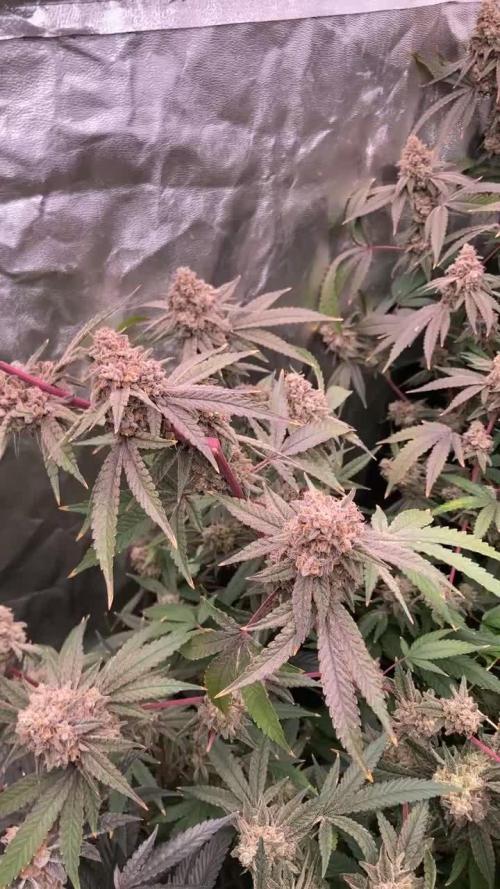
Happy with how this plants turned out 😸👏
Absolute monster! She has some of the hardest buds I’ve ever grown, it’s crazy!
Straight up orange terps. It’s very intense.
She’s been an easy plant to grow. She grew well through veg from what I can remember.
She was positioned in the hardest to reach area in my flower tent, so barely got any attention during and still turned out well.
I was anxious of potential bud rot due to lack of defoliation through flower, but she was Completely fine.
Cut her up into individual branches and filled three hangers which is great (42 pegs to a hanger). Two of the hangers are all top Bud quality, no idea what her end yield will be.
I didn’t take any clones of this plant so it’s just a ‘one and gone’, but I still have 5-6 seeds left in storage. I’ll probably have another go at this in the future.
I’d like to thank everyone who has liked or commented on this diary, I hope it’s been helpful in some way 😸
Really impressed with the quality of these new In House Genetics strains.
PersonalSmok3s 🌱💚😸

Likes
3
Share


@JeyGanesha
Follow
Quarta settimana stanno crescendo ben robuste.ancora 2/3 settimane prima di metterle in fioritura''....
Anche i piccoli peyotes stanno crescendo

Likes
25
Share


@Highone420
Follow
easy to grow and comes with n amazing nose 👃... i could not believe the candy type smell that this lady is putting out, i'm kind of in love....
smooth amazing high with a stress and pain relief you wouldn't believe!
it takes anxiety away like nothing and tastes overall amazing, big and kind of dense buds! 2nd place in bud structure ✅
Likes
5
Share


@therealgrowmie
Follow
Alrighty, the fun part’s over—now it’s time to dial things in.
The plants seem to have used up the nutrients in the soil and now require a different feeding approach for the flowering stage.
But hey, you’ve got to grow to know, and the fix is simple.
From now on, I’m fertilizing once a week with BioBizz organic nutrients, following the provided feeding schedule. I’m sticking to the basic components only.
I’ve also added some calcium and magnesium, as the lower fan leaves are showing signs of deficiency.
Since the plants have become quite bushy, I pruned the lower third over a few sessions—spreading out the stress and avoiding cutting too much at once.
Lastly, I’ve set the oscillating fan to medium intensity to prevent stagnant air. The duct fan is now tuned to maintain a VPD between 0.7 and 0.8 kPa.

Likes
5
Share


@84ruk
Follow
En la tercera semana de vegetación la planta fue trasplantada, los primeros días se vio estancado si crecimiento pero más adelante continuó su crecimiento normal.

Likes
3
Share


@SpartacaZ
Follow
Pultroppo non c'è molto sole ma fa molto freddo ...questo giro poca resa ma tanta resina


Likes
43
Share


@Jack_Greenstalk
Follow
didn't finish the whole week of veg, stopped at 53/44 before switching to 12/12 light cycle, gave RO only final day and have switched feed to bud a and B. all photos are from day 53 and earlier. since this post and switching to flower I have taken 4 clones, 2 using clonex 2 using aloe vera. i have done a ton of lollipopping and defoliation since flip and they are stretching away! stayed tuned for week 1 flower updates :)


Likes
17
Share


@GreenHouseLab
Follow
And another one from BarrieGrower that going to be absolutely fire.
Likes
11
Share


@Ninjabuds
Follow
The Blackberry Moonrocks are looking great. They're definitely the healthiest plants in the whole tent. I might have gotten a little carried away with the nutrients, so the leaves are a bit funky right now, but they're still going strong. I'm excited to see how they do in the next few weeks.
The new year is off to a frosty start! We've had snow falling for what feels like forever. My kids are loving it, of course. They're building forts, having snowball fights, and turning everything into a winter wonderland. It's been a lot of fun to watch them enjoy it.
All this snow is really making me think about how quickly time flies. It feels like just yesterday we were celebrating the holidays, and now here we are knee-deep in winter. I'm looking forward to warmer weather, but for now, I'm enjoying the quiet beauty of fresh snow.

Likes
11
Share


@GrowShock
Follow
Очень липкие цветы, при дефолиации ножницы склеиваются после 5 листика, местами начала сочится гуттация. Запах на столько сильный что весь дом пропитан уже этим ароматом терпенов. Неделя промывки и Харвест как же долго я её жду, честно говоря уже устал
Likes
22
Share


@Weedbadk
Follow
Día 1 y todas germinaron súper rápido 3 días
Día 5 desde puesta en sustrato
Ya todas están arriba
Estoy solo pulverizando el sustrato
Temperatura 23c humedad 75%
Likes
2
Share


@homegrow_pro
Follow
Growth kind of exploded in week 4. The LST and topping leads to major bush properties. I keep the plant in check by removing major leafs and metal hooks.


Likes
26
Share


@nonick123
Follow
Día 29 (10/02) Riego con 400 ml H2O RO
Detecto una ligera deficiencia de Magnesio. Aplicación foliar de sales de Epsom a 2 g/L
Día 30 (11/02) Riego con 400 ml H2O RO
Día 31 (12/02) Riego con 400 ml H2O RO
Día 32 (13/02) Riego con 500 ml H2O RO
Está teniendo un stretch espectacular!
Día 33 (14/02) Riego con 500 ml H2O RO
Día 34 (15/02) Riego con 500 ml H2O RO
Detecto unas ligeras manchas en las hojas de abanico más antiguas que parecen carencia de CalMag
Voy a regar durante unos días con mezcla de H2O RO + H2O del grifo (Tap Water) con una resultante EC 0,45
Día 35 (16/02) Riego con 500 ml H2O EC 0,45
💦 BioTabs 15% DISCOUNT code "GDBT420" biotabs.nl/en/shop/ @biotabs_official
🌱Substrate PRO-MIX HP BACILLUS + MYCORRHIZAE @promixmitch @promixgrowers_unfiltered
💡2 x Mars Hydro FC1500 EVO Led Grow Light (2024 NEW FC 1500-EVO Samsung LM301H 150W LED) - https://marshydro.eu/products/fc1500-evo-led-grow-lights/ - https://www.amazon.de/dp/B0CSSGN5D8?ref=myi_title_dp