


Likes
Comments
Share


@Roberts
Follow
Has started to fade and looking to harvest soon. Has grown great under 100 watt spiderfarmer SF-1000 light. Thank you Bomb seeds, and spiderfarmer 👍
Thank you grow diaries community for the likes, follows, and subscriptions on my YouTube channel. I greatly appreciate the support. 🌱🌱🌱
To purchase the light please visit the appropriate link below:
US:https://amzn.to/396hXXb
CA:https://amzn.to/3ol4oK4
DE:https://amzn.to/3q15SJT
UK:https://amzn.to/2L7NVKN
AU:https://amzn.to/3pZD6ZQ
FR:https://amzn.to/2Xkomsi
IT:https://amzn.to/3nk7A7h
ES:https://amzn.to/2XhtGwB
Discount code: saveurcash


Likes
11
Share


@Swanberg
Follow
Had knee surgery just trying to get the tent is rough. Gave nice strong feeding of booster concentrat lot of p-k… making a point with adjusting with potassium hydroxide. The potassium should be just the thing I need for these dense buds. Some nice growth happening and these 2 plants look to be rebounding.

Likes
15
Share


Likes
7
Share


@Adam22
Follow
The plant on the right got chopped down the hairs were 90% dark brown while left was fully white last week when it got taken down it had only one day flush. This plant I will flush for a week and see which is better. It has decent size buds all the way to the bottom but this one growing still doesn't have as many crystals as the harvested plant which was definitely cut down way to early 😕 shame it must have forced to finish early from shock when I snapped a main branch clean off. This plant I will flush with plain filtered water for 7 days and even if it doesn't have as much crystals as the other plant, the bud size is 2x-3x the size of the plant that was cut down last week so I hope they will look a lot better size wise after they shrink when they are cut down and dried. I have also noticed some medium sized fan leads turning from green into a beautiful dark purple colour over the last 2-3 days slowly and it's spreading to other leaves the buds on this plant are also purple bits it's hard to see on here but looking sweet so far I have uploaded pic of the frost one which has been drying for a week now
Likes
24
Share


@KarlOlga
Follow
Vielleicht die letzte Woche?
Gibt nur ph neutralisiertes Wasser , keine Düngung mehr!
05.02 viele bernsteinfarbene Trichome, nächste Woche wird geerntet
09.02 Die Farben werden intensiver

Processing
Likes
15
Share


@MG2009
Follow
08/26/2020
2nd week of flowering and temps are down in soil to 68° going to be 56 tonight. Put a video of her sister plant.
These girls should go another 8-9weeks but our first frost date is around the 10th of October hope for a warm and dry fall.
08/29/2020
got her tied down, snapped the center branch so I tied her stem upright. Gonna give her one last dose of blood meal (12-0-0)before week 3 starts that should be good for the next 4weeks, and 2 tbls of (4-9-3) so my last feeding will be (16-9-3) for the stretching fingers are crossed🙏
Likes
31
Share


@AbroCadabro
Follow
I have been very busy over the last week so I haven't had much time to do any documentation. There isn't much going on at the moment so you aren't missing out on much. There have been a couple of leaves on this plant showing some strange markings. Nothing that is uniform nor reoccurring. I think these defects I show in the video are localized to just two or three leaves so I am not too concerned at the moment. I will keep an eye on her for the time being. Other than that, the plant looks really happy and is growing very well. Good color all around and getting very bushy.

Likes
6
Share


@AmokNewb
Follow
So starting week 3 or week 2 of veg. I upped my feed schedule to 4 times a day as well as upped the ppm to 550.
Decided to finally named the plants. Left hand side is Amy and the right is Rose. I have been using doctor who characters for my plant names 🤓.
Well it’s day 17 and rose is looking really good and robust. Amy on the other hand is still a bit small and looking like she has some sort of deficiency. Even though both plants have been treated the same. I am going to just keep doing what I am doing and hope she will catch up in time. She is slowly looking better and better.
Other than that I am hoping to start my LST at the end of this week. I will update this week as it progresses.
This actually about day 11 after sprout and starting veg. With that being said I did start a little light LST on rose. My last grow I had a similar issue where one plant was half the size of the other of the same strain. It made flowering awkward in my setup. So I am really going to concentrate on keeping rose as close to the same height as Amy. I’ll use LST as much as I can then I will be scrogging them as best I can.

Likes
8
Share


@eldruida_lamota
Follow
Que pasa familia, estamos de nuevo con la Segunda semana de floración de estas blue spider de Zambezaseeds.
Ya están las preflores formadas y ahora seguirán formándose ya veis , estas si tienen buen color también.
Todo va sobre ruedas , añadimos esta semana el BETASHARK de Agrobeta.
Agrobeta:
https://www.agrobeta.com/agrobetatiendaonline/36-abonos-canamo
Mars hydro:
Code discount: EL420
https://www.mars-hydro.com/
Las maximas de temperatura no superan los 26 grados y las mínimas no bajan 20, así que no me puedo quejar.
Los niveles de humedad también son los correctos van entre 50%/65% de humedad relativa.
Por supuesto el Ph lo estamos dejando alrededor de 6.
Hasta aquí es todo, buenos humos 💨💨💨

Likes
59
Share


@JeyGanesha
Follow
Un altra settimana è passata e tutto procede bene.per fortuna non ho più trovato nessun nanners 🙏✌️💪..belle piantine mie, continuate così che farete delle belle pannocchie....
30/8/24 gente ho combinato una bella cazzata.pur avendo esperienza, mannaggia a me,mi sono portato a casa dentro il box, il cazzo di ragnetto rosso... fanculo...
Ho già iniziato a ripulire tutto, box e piante con Neem...li sterminerò tutti 😂..

Likes
6
Share


@CanadianFillmore
Follow
Week 9 commence flushing. This lady is looking great, super frosty, sticky and got a sweet aroma. Removed some dying leaves and now we wait for chop in about 6-7 days.


Likes
142
Share


@PapaNugs
Follow
Constantly taking leaves off all these girls. Trying to make space for those buds! These are some leafy genetics overall but some are starting to change color nicely for week six of flower! I checked some of the trichomes but they aren't close to ready so I didn't snap any pictures of those. But some good trichomes production from them.
Got the UVB 310 in full effect right now at 4 hours. Will be boosting up to six tomorrow and continue to push for the next two weeks.

Processing
Likes
5
Share


@sercultiveta
Follow
35 dias de actividad en el indoor, foto periodo de 20 horas de luz y 4 de oscuridad


Likes
3
Share


@The_Lonely_Farmer
Follow
(9th feb) So these girls are now entering week 5 and with small space comes challenges as these girls have really started too lift off growth wise as you can see 2 of the girls icc are tall and the remaining shorter girls are toronjaz all happy and healthy...
still no defoliation I have chosen not too took these girls only a topping and leaf tuck here & there and wow they are loving life under aptus nutrients 🌱
They are thriving into this week where I will be tucking a few more leaves before flip in roughly a week or so time 🙏
Finally grow diaries has let me update with images and videos and I'll be updating my fastbuds diary tomorow too
These girls are sailing through each week and I'm really happy using aptus nutrients
I have topped 1/2 and all have responded great under aptus nutrients which I'm really loving using atm.
These girls will have another 2 weeks untill flip too 12 hours light but these aptus fed girls I expect too boom in flower 😍😅
We shall deal with that issue when it arrives 🤣
Happy growing! 💚


Likes
27
Share


@LSchnabel
Follow
This plant is really starting to pack on the weight now. Buds are getting dense and absolutely covered in frost. The smell is phenomenal and very very strong now.
I had to take out a few fan leaves that started to cover up some bud. Doesn’t look like this one will be too hard to trim after the dry.
Light is sitting around 950 PPFD so she is getting absolutely blasted to the max without adding in CO2. No signs of stress ever in this plant.
I’m guessing roughly 1-2 weeks before she gets cut. Will start checking at the end of this week.
Next feed will be just CalMag and Silica.


Likes
4
Share

@sunshinegroww
Follow
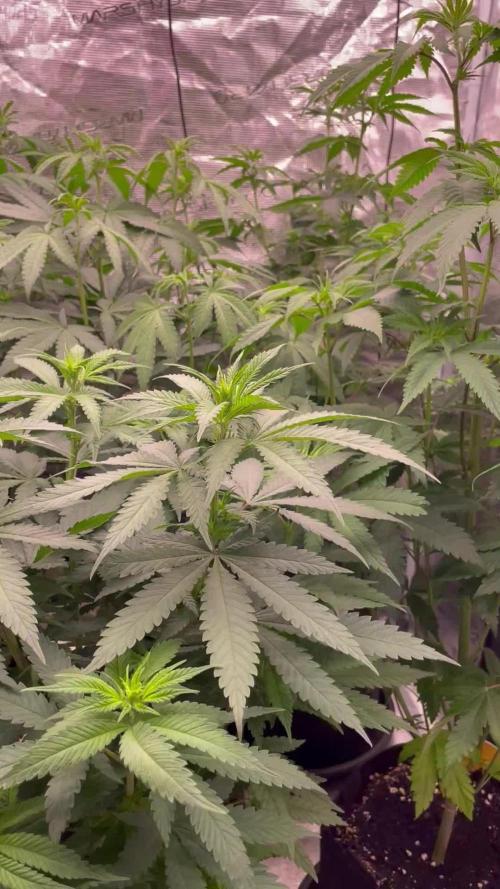
Lets go week 2 so far so good looking happy as ever kinda bushy which i like ❤️
