





@CanadianFillmore
Volgen
Week 5 starts for LSD & Green Crack. All four ladies look happy and they all grew 1-3 inches during week 4, hopefully they grow the same amount this week.
Thanks for stopping by, tune in next week! 👽🌳🔥


@Max1973
Volgen
Week 2, all 7 repotted in 4.5L and 7.5L pots.... all lights wired up properly...... holding perfectly with 24oC, 40% humidity... relying on the soil nutes, and just tap water...... the PH of the tap water is abit high- 6-7... so i'll try to get some rainwater, or 10L box of spring water....


@DogDoctorOfficial
Volgen
🌱 Divine Seeds Week Three Veg Report 🌱
Hey, fellow growers! 🌿✨
Welcome back to our weekly update on the Divine Seeds journey. We’re now into Week Three of the vegetative stage, and our plants are loving their new environment. The Moon Rock, Opium, and Big Demon are thriving after the transplant, and we’re excited to share the latest developments.
🌟 Week Three Highlights 🌟
This week, we plugged in the Autopots and turned them on, letting gravity do its magic. From now on, we’ll rely on the Regulator and CaMg-Boost in the reservoir. Our soil is rich in organic matter and nutrients, so we’re testing if just the organic inputs in the soil, plus CaMg and Regulator, can sustain the entire run. Let’s dive into the details:
1. Moon Rock 🚀
• Growth: Vigorous vertical and lateral growth, with lush, broad leaves.
• Health: The transplant has boosted its vigor, and the plant looks healthier than ever.
• Notes: Moon Rock is showing exceptional adaptability and strength.
2. Opium 🌸
• Growth: Steady and balanced growth with symmetrical leaf development.
• Health: Opium is thriving, with no signs of stress or deficiencies.
• Notes: This plant continues to flourish with grace and beauty.
3. Big Demon 💪
• Growth: Robust and vigorous, with thick stems and expansive leaf growth.
• Health: The transplant has enhanced its already impressive growth.
• Notes: Big Demon remains a powerhouse in our garden.
🌟 Nutrient Strategy 🌟
Our feeding regimen this week focuses on:
• Regulator (0.15ml/L): Helps reduce stress and improves overall plant health by regulating plant processes and enhancing nutrient uptake.
• CaMg-Boost (0.25ml/L): Provides essential calcium and magnesium, preventing deficiencies and supporting strong cell wall development and photosynthesis.
Our rich organic soil is packed with biolife and nutrients, so this experiment will test if these organic inputs, combined with CaMg and Regulator, can sustain the plants through their entire growth cycle.
🌟 LED Lighting and Control System 🌟
To support our plants’ growth, we’re using the Lumatek Zeus 465 Compact Pro LED. Here’s why it’s amazing:
• Efficiency: Provides high light output with low energy consumption, ensuring optimal growth while being energy-efficient.
• Full Spectrum: Delivers a balanced spectrum of light, mimicking natural sunlight to support all stages of plant growth.
• Coverage: The compact design ensures even light distribution across the entire canopy, promoting uniform growth.
We’re also using the TrolMaster Hydro X controller with its impressive 3-in-1 sensor for temperature, humidity, and light detection. This controller allows us to:
• Monitor and Control: Keep precise control over the grow environment, ensuring optimal conditions for our plants.
• Automation: Automate various aspects of the grow room, reducing manual work and improving efficiency.
• Data Insights: Gain valuable insights into environmental conditions, helping us make informed decisions.
🌟 Key Observations 🌟
• Plant Response: The plants have responded exceptionally well to the transplant and nutrient strategy.
• Growth Rate: Significant increase in growth rate, thanks to the balanced environment and nutrient-rich soil.
• Health and Vigor: The plants are healthy, with vibrant foliage and strong structures.
🌱 Next Steps 🌱
As we move into Week Four, our focus will be on:
• Monitoring the Autopots: Ensuring the system runs smoothly and the plants receive consistent moisture.
• Observing Plant Responses: Keeping a close eye on how the plants respond to the nutrient strategy.
• Maintaining Optimal Conditions: Using the Lumatek LED and TrolMaster controller to maintain perfect growing conditions.
Stay tuned for more updates as our Divine Seeds continue to flourish. We’re excited to see the results of this nutrient strategy and share every milestone with you on this incredible journey!
Happy growing, and may your gardens be ever green! 🌿💚
#DivineSeeds #WeekThreeVegReport #AptusHolland #MoonRock #Opium #BigDemon #GrowDiaries #PlantMagic #GreenThumb #Inspiration #LumatekZeus #TrolMasterHydroX
Germination method 🌱 @thecannakan
Genetics
@divine.seeds
Nutrition
@aptusholland 🌿
@aptus_world 🌎
@aptus_es 🌍
@aptusbrasil 🌱
@aptus_thailand 🌿
@aptus_portugal 🌳
@aptususa_officiala 🍀
@aptusplanttechnz 🌺
@aptusplanttechaus 🍃
Ambient controls🎮
@trolmaster.eu @trolmaster.eu.support @trolmaster.support @trolmaster.agro
Soil @promix_growers_eur @promix_cannabis
LED - @lumatekeu
Watering- @autopot_usa @autopot_global
Love and attention- @dogdoctorofficial
#aptus #aptusplanttech #aptusgang #aptusfamily #aptustrueplantscience #inbalancewithnature #trolmaster #trolmastereurope #trolmastersecrets #Autopots
#GreenJoy
As always thank you all for stopping by, for the love and for it all , this journey of mine wold just not be the same without you guys, the love and support is very much appreciated and i fell honored and so joyful with you all in my life 🙏
With true love comes happiness 💚🙏 Always believe in your self and always do things expecting nothing and with an open heart , be a giver and the universe will give back to you in ways you could not even imagine so 💚
More info and complete updates from all my adventures can be found ⬆️link in the profile description ⬆️
Friendly reminder all you see here is pure research and for educational purposes only
💚Growers Love To you All 💚

shorts_status_processing


@Tazard
Volgen
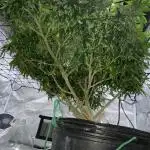
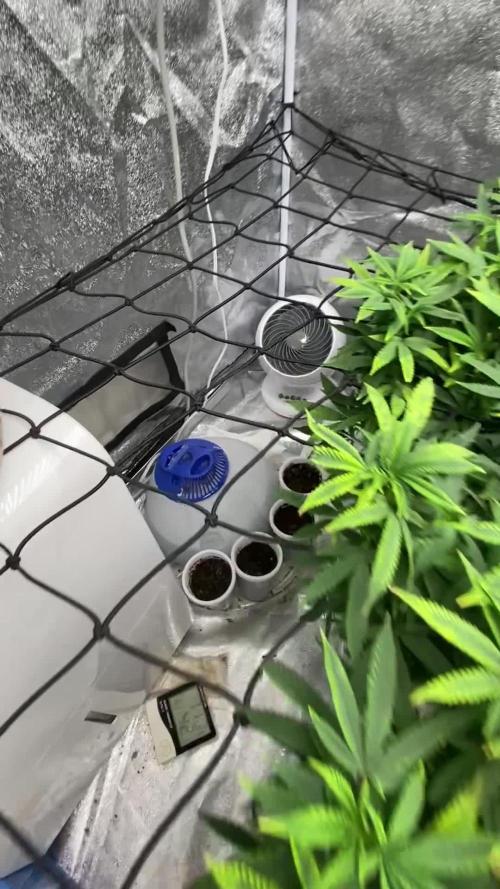
Beginning of week 3 of flower. Should be nearing the end of the stretch but if she can give just a little more we will get the screen full! Should be a great week will add more pics!



@GreeneScene
Volgen
OK, so I’ll begin dialing back in my grow focusing after I gave her a top dress feeding I watered her in well with 2 gallons of water unpHd maybe two or three days later I noticed that her topsoil was starting to dry so I gave her another gallon of water just because although I believe in allowing the plant to have the dry back. Between watering I also keep hearing you know that with organic soil, you have to keep it moist in order for you know the nutrient to break down and I definitely want those top nutrients I gave her to become readily available . Also, in terms of dialing it back in the plant has been at a very abbreviated or dimmed level like since recovering from when I basically almost killed it and with that being said with the light being out at a dim level of about 40 to 50%, it was also brought up to a very High height in order to decrease stress so that they can regrow so I lower the light from 26 inches 28“ to 14 inches above the canopy. I put back in my floor fan for the lower canopy although I found out that it no longer circulate so I’m having to replace it. Its replacement is on the way in the mail. I added it back in the humidifier for the plants mainly because I was doing the cuttings in the clones since I needed to trim the lower canopy and begin training the plant down more for the trellis. This is my first run using a trellis. This is my first time trying to make one plant so massive, but I’m just a small time grower trying to get the most bang for my book since I’m trying to grow plants to supply myself anyways rather than maintaining so many different plants, I just thought I’d give it a go at making one plant massive I’ve gotten fairly decent and establishing good structure implants as far as like the number of branches or branches so I really wanna like push the threshold of my quantity that I can that I can deliver, but this are all the while. I’m still really working hard to get the quality that I know I like to smoke. I’m happy you know I’m learning but wow I’m still very far from the goal so the light is still at 50% but it lowered to 14 inches. There’s an additional lower canopy fan that’s not currently circulating but one on the way that will circulate the air down there and the humidifier in the tent now oh I also reprogram my humid controller because ever since I’ve called the other three plants that were occupying this tent when I began this this project I tried to switch it over for new settings for this plan considering you know it was set for the flower setting for my last three ladies but when I did that I messed it up and I was just too lazy to go in there and fix it so we have been running with BPD issues this entire time you know and that’s that’s part of the stunning growth as well you know the darn near 30 inch light height, being hungry and meet me during the watering but just in discriminated amounts because I’m not TDS and or PPM any of this stuff I’m really just eyeballing it not paging this stuff circulation and low light intensity. I mean, I can see why it’s taking her a little while to start moving like got like I remember her moving but since I’m back posting I’m I’m I’m working a dollar and I was even considering buying a new light at first but then I realized one I do have a really good light too. I really haven’t got that many runs off of this light less than 10 three is because I doubt her back so much in order to like decrease the stress and I can. I can push this plant with this light. I just need to dial my equipment back in and for you know, I had him back in the extra circulation and the humidifier to get the environment dialed in. I mean, you thought you get that BPD setting right and she used to transpired but now she’s hungry and if I keep that so more so that those nuts can break down she’s gonna get to looking for those nutrients so if not now like I think it’s supposed to take a week no more than a week gonna have to before those nutrients become you know bi available tour so I’m doing I’m doing my part now to give her the attention that she needs into dollar back in so that we can we can get the show on the road. This is entirely too long, but that’s just because I haven’t. I’ve been. I’ve been hands off. I mean, I found that I like the hands off approach to growing much more than the hands-on because then I’m too impatient and I’m oh man then it becomes a chore and has to go take care of her. You know as opposed to a pleasure or like a getaway, I enjoy when I take care of my plan. I like it to be at my activity you know not something that I’m just ready to get over with. I like to spend time with my plans I like to not mind going in there and then defoliating every couple of days. Listen, I need a strain that has an excellent of matter fact a low leaf to blood ratio I need far more bud and weight less leaves. I strain that I pick out a pure interest, but at this point, I’m almost ready to pick strains based off of leaf to blood ratio. I would enjoy just a good simple girl like I just have a couple of leaf Plug every couple of weeks. Let’s see when I’m mean to her with food top dressed because she’s in a 6 gallon hot, I gave her 1 tablespoon of the guy green broke and 3 tablespoons of organic worm castings per 6 gallons so that was a total of 6 tablespoons of the guy green grow nutrient maybe even seven for good measure and then 18 tablespoons cause I don’t know how many you know a4 cups 1/3 cup for cups that is but I actually wanna find out so I can stop doing these tablespoon measurements but 18 tablespoons of worm castings and I just I did my best to work. I didn’t really well to the top so and then I watered that in really slowly to try to avoid runoff the best I could. I did end up getting about a quarter inch runoff when I usually get about an inch and a half a runoff so I did good. I just even know that stuff eventually sucks back up in the pot. I didn’t want all that stuff to like rush to the bottom and then only get sucked back up at the bottom cause I don’t know what the root looks like at the bottom. I kinda have to assume that it is nice and strong, and maybe even root bound need to be upside to a bigger pot before I flipper the flower but if it’s not like I don’t want the concentration of nutrients and salts to be at the very bottom, especially when it comes time later for flushing, like I want that stuff to be you know closer to the to the top in the middle of the other of the soul structure, where I know the majority of the roots are and eventually work as way down to the evening rate, but not have a concentration at the bottom and I’m adding stuff in at the top. I really wanna flush this plant. Well, my lash flush it was semi decent. This flush it could be between my flesh, my dry and my cure which is crippling anybody I mean the girl I got far better man you should’ve seen my first couple girls terrible but now I’m gonna achieve quality in good structure. I just need to get I mean I can see quality you know structure of plants and blood structure but I gotta get the quality smoke. The sticks the smells taste the dense buds at the right moisture level if you’re enjoying it so far, give us a like.
FINAL UPDATE OF THIS WEEK: 16DAYS SINCE DRY AMENDING SOIL . . PLANT STILL SHOWS NUTRIENT DEFICIENCY. I had hoped to be back on Water Onlu by now bc I’m afraid I’m going t burn her with these nutrient waters this long since my dry ammenduand what’s worse is that if I follow my 3 week amendment rule I’ll be adding 6 more tbl spoons of nutrient alongside worm castings ALL WHILE THE LAST NUTRIENTS I FED STILL HAVENT BECOME AVAILABLE YET. I DONT LIKE THIS


@Danger90946
Volgen
Here we are in week six of flower and not a lot has happen this week other than the usual watering and letting her do her thing. Only trouble this week was updating GoPro had to try a few times. Other than that we got some rain in my home town and collected about 60 gallons that I'm going to use to finish the rest of the grow. Also, got my new AC Infinity CLOUDLINE T4, Quiet Inline Duct Fan System with Temperature and Humidity Controller, 4-Inch. I was really hoping this two plants would finish before the year ended, however, it looks like they got others plans. See you guys next week.

shorts_status_processing


@AbroCadabro
Volgen
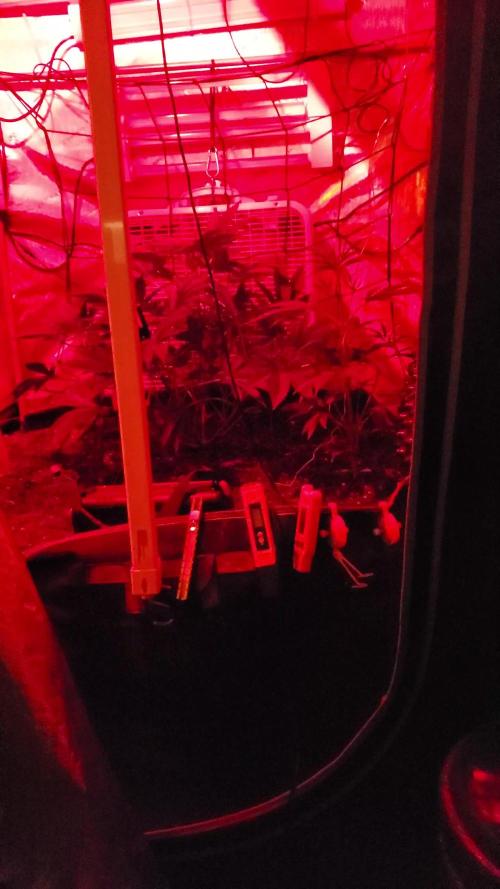
The plants have reached a stage where they have enough foliage and growth on them to begin training and defoliation. I cut most of the side growth and major fan leaves off. Using safety pins and twine, I started their LST.


@Ultraviolet
Volgen
Removed autoflower and put her in her own pot outside the tent.
Foliars applied in strong blue 430nm with 4000Hz tone. 20-minute dose prior to application.
In essence, you're seeing a combination of the infrared light reflected by the plant, which the camera perceives as red, and any residual visible blue light the plant reflects, which results in a purple hue.
I was doing more stretching of the stems, adjusting weights, just a little too much, and it snapped almost clean. I got a little lucky in that it was still connected, wrapped her almost instantly while holding her in place with yoyo's. The core framework is now in place.
If your soil has a high pH, it's not ideal; you want a pH of 6.4, 6.5, or 6.6, which is ideal. If you are over a pH of 7, you have no hydrogen on the clay colloid. If you want your pH down, add Carbon. If you keep the pH below 7, you will unlock hydrogen, a whole host of new microbes become active and begin working, the plant will now be able to make more sugar because she has microbes giving off carbon dioxide, and the carbon you added hangs onto water. Everything has electricity in it. When you get the microbes eating carbon, breathing oxygen, giving off CO2, those aerobic soil microbes will carry about 0.5V of electricity that makes up the EC. The microorganisms will take a metal-based mineral and a non-metal-based mineral with about 1000 different combinations, and they will create an organic salt! That doesn't kill them, that the plant loves, that the plant enjoys. This creates an environment that is conducive to growing its own food.
Metal-based: Could include elements like iron, manganese, copper, or zinc, which are essential nutrients for plants but can exist in forms not readily accessible.
Non-metal-based: Examples like calcium carbonate, phosphate, or sulfur are also important for plant growth and potentially serve as building blocks for the organic salt.
Chelation in a plant medium is a chemical process where a chelating agent, a negatively charged organic compound, binds to positively charged metal ions, like iron, zinc, and manganese. This forms a stable, soluble complex that protects the micronutrient from becoming unavailable to the plant in the soil or solution. The chelate complex is then more easily absorbed by the plant's roots, preventing nutrient deficiency, improving nutrient uptake, and enhancing plant growth. Chelation is similar to how microorganisms create organic salts, as both involve using organic molecules to bind with metal ions, but chelation specifically forms ring-like structures, or chelates, while the "organic salts" of microorganisms primarily refer to metal-complexed low molecular weight organic acids like gluconic acid. Microorganisms use this process to solubilize soil phosphates by chelating cations such as iron (Fe) and calcium (Ca), increasing their availability.
Added sugars stimulate soil microbial activity, but directly applying sugar, especially in viscous form, can be tricky to dilute. Adding to the soil is generally not a beneficial practice for the plant itself and is not a substitute for fertilizer. While beneficial microbes can be encouraged by the sugar, harmful ones may also be stimulated, and the added sugar is a poor source of essential plant nutrients. Sugar in soil acts as a food source for microbes, but its effects on plants vary significantly with the sugar's form and concentration: simple sugars like glucose can quickly boost microbial activity and nutrient release. But scavenge A LOT of oxygen in the process, precious oxygen. Overly high concentrations of any sugar can attract pests, cause root rot by disrupting osmotic balance, and lead to detrimental fungal growth. If you are one who likes warm tropical high rh, dead already. Beneficial, absolutely, but only to those who don't run out of oxygen. Blackstrap is mostly glucose, iirc regular molasses is mostly sucrose. Sugars, especially sucrose, act as signaling molecules that interact with plant hormones and regulate gene expression, which are critical for triggering the floral transition. When sucrose is added to the growth medium significantly influences its effect on floral transition.
Probably wouldn't bother with blackstrap given its higher glucose content. Microbes in the soil consume the sugar and, in the process, draw nitrogen from the soil, which is the same nutrient the plant needs. Glucose is not an oxygen scavenger itself, but it acts as a substrate for the glucose oxidase (GOx) enzyme, effectively removing oxygen from a system. Regular molasses (powdered if you can), as soon as she flips to flower or a week before, the wrong form of sugar can delay flower, or worse. Wrong quantity, not great either. The timing of sucrose application is crucial. It was more complicated than I gave it credit for, that's for sure. When a medium's carbon-to-nitrogen (C:N) ratio reaches 24:1, it signifies an optimal balance for soil microbes to thrive, leading to efficient decomposition and nutrient cycling. At this ratio, soil microorganisms have enough nitrogen for their metabolic needs, allowing them to break down organic matter and release vital nutrients like phosphorus and zinc for plants. Exceeding this ratio results in slower decomposition and nitrogen immobilization, while a ratio below 24:1 leads to faster breakdown and excess nitrogen availability.
Carbon and nitrogen are two elements in soils and are required by most biology for energy. Carbon and nitrogen occur in the soil as both organic and inorganic forms. The inorganic carbon in the soil has minimal effect on soil biochemical activity, whereas the organic forms of carbon are essential for biological activity. Inorganic carbon in the soil is primarily present as carbonates, whereas organic carbon is present in many forms, including live and dead plant materials and microorganisms; some are more labile and therefore can be easily decomposed, such as sugars, amino acids, and root exudates, while others are more recalcitrant, such as lignin, humin, and humic acids. Soil nitrogen is mostly present in organic forms (usually more than 95 % of the total soil nitrogen), but also in inorganic forms, such as nitrate and ammonium. Soil biology prefers a certain ratio of carbon to nitrogen (C:N). Amino acids make up proteins and are one of the nitrogen-containing compounds in the soil that are essential for biological energy. The C:N ratio of soil microbes is about 10:1, whereas the preferred C:N ratio of their food is 24:1 (USDA Natural Resource Conservation Service 2011). Soil bacteria (3-10:1 C:N ratio) generally have a lower C:N ratio than soil fungi (4-18:1 C:N ratio) (Hoorman & Islam 2010; Zhang and Elser 2017). It is also important to mention that the ratio of carbon to other nutrients, such as sulfur (S) and phosphorous (P) also are relevant to determine net mineralization/immobilization. For example, plant material with C:S ratio smaller than 200:1 will promote mineralization of sulfate, while C:S ratio higher than 400:1 will promote immobilization (Scherer 2001).
In soil science and microbiology, the C:S ratio helps determine whether sulfur will be released (mineralized) or tied up (immobilized) by microorganisms.
A carbon-to-sulfur (C:S) ratio smaller than 200:1 promotes the mineralization of sulfate, when the C:S ratio is low, it indicates that the organic matter decomposing in the soil is rich in sulfur relative to carbon. Microorganisms require both carbon and sulfur for their metabolic processes. With an excess of sulfur, microbes take what they need and release the surplus sulfur into the soil as plant-available sulfate
A carbon-to-sulfur (C:S) ratio higher than 400:1 will promote the immobilization of sulfur from the soil. This occurs because when high-carbon, low-sulfur materials (like sawdust) are added to soil, microbes consume the carbon and pull sulfur from the soil to meet their nutritional needs, temporarily making it unavailable to plants.
200:1 C:S 400:1: In this range, both mineralization and immobilization can occur simultaneously, making the net availability of sulfur less predictable.
This dynamic is similar to how the carbon-to-nitrogen (C:N) ratio regulates the availability of nitrogen in soil. Just as microbes need a certain amount of nitrogen to process carbon, they also require a balanced amount of sulfur. Both mineralization and immobilization are driven by the metabolic needs of the soil's microbial population.
Sulfur is crucial for protein synthesis. A balanced ratio is particularly important in relation to nitrogen (N), as plants need adequate sulfur to efficiently use nitrogen. A severely imbalanced C:S ratio can hinder the efficient use of nitrogen, as seen in trials where adding nitrogen without balancing sulfur levels actually lowered crop yields.
Maintaining a balanced carbon-to-sulfur (C:S) ratio is highly beneficial for plant growth, but this happens indirectly by regulating soil microbial activity. Unlike the C:N ratio, which is widely discussed for its direct effect on nutrient availability, the C:S ratio determines whether sulfur in the soil's organic matter is released (mineralized) or temporarily locked up (immobilized).
Applied 3-day drought stress.
Glucose will hinder oxygenation more than sucrose in a solution because glucose is consumed faster and has a higher oxygen demand, leading to a more rapid decrease in oxygen levels. When cells respire, they use oxygen to break down glucose, and this process requires more oxygen for glucose than for sucrose because sucrose must first be broken down into glucose and fructose before it can be metabolized.
In a growth medium, glucose is a more immediate and universal signaling molecule for unicellular and multicellular organisms because it is directly used for energy and triggers a rapid gene expression response. In contrast, sucrose primarily acts as a signaling molecule in plants to regulate specific developmental processes by being transported or broken down, which can be a more complex and slower signaling process.
Critical stuff.
During wakefulness (DC electric current) life can not entangle electrons and protons. During the daytime, the light is sensed as multiple color frequencies in sunlight. Coherence requires monochromatic light. Therefore, at night, IR light dominates cell biology. This is another reason why the DC electric current disappears during the night. The coherence of water is maintained by using its density changes imparted by infrared light released from mitochondria in the absence of light. This density change can be examined by NMR analysis, and water is found to be in its icosahedral molecular form. This is the state that water should be in at night. This is when a light frequency is lowest and when the wave part of the photoelectric effect is in maximum use.
3600



@Rko41
Volgen
A part la frosty qui a fait un debut de Flo sorti de l’interieur les autres ont pursuivibleur croissance et commence leur stretch tous doucement


@Nofeckingclue79
Volgen
These two plants are both doing fine had to go out of town for the weekend so the smaller plant has a slightly discolored leaves I'm putting this down to over watering because of not being round for four days but apart from that all good, hope everyone else's grows are going well. My plants are looking like the flower sites might all become one big cola but if they don't I can't grumble because it's my first grow, and looking at some of the other diaries with more experienced growers their plants look even worse off 🤞🙏👍


@greenthumbartisan
Volgen
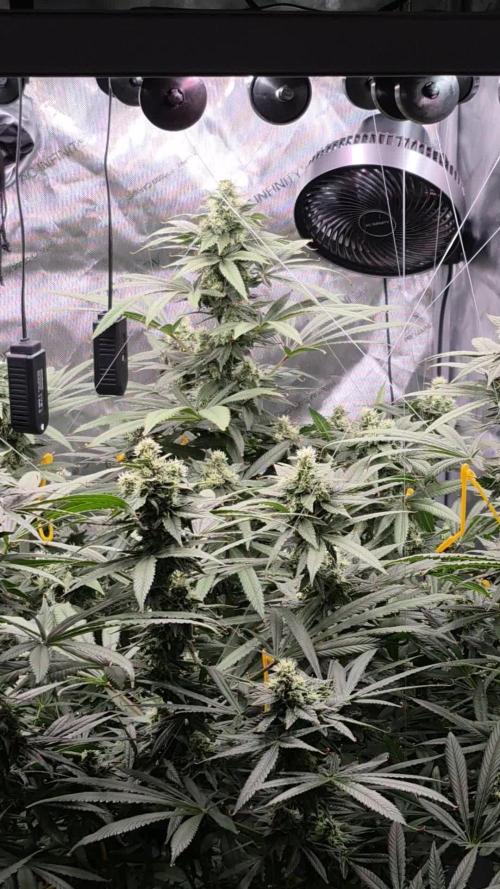
Day 37 - March 18, 2021
Ladies are looking good and healthy. Not much to report today. Just watching them grow
Planning to take clones from rest of girls this weekend / over the next week.
Watering:
02:00AM-2:30AM
~1 Gallon Water
10:00AM-1030AM
~1 gallon per pot
Gave foliar spray (9:00AM):
* 1 Gallon RO Water (EC 0.08)
* 10ML CalMag+ per Gallon
* 0.5ML Mills Nutrients Vitalize
* PH 6.0
* EC 1.19
Reservoir 1:
* tested 10:18PM
* 2.01 EC
* 5.5 PH
* 70.7F
* ~10-11 gallons
* No Topping Off
* Added 8ML PHup to raise PH from 5.5 to 5.8
Reservoir 2:
* tested 9:50PM
* 2.06 EC
* 5.5 PH
* 69.44F
* ~10-11 gallons
* No Topping Off
* Added 8ML PHup to raise PH from 5.5 to 5.8
Lights:
* Gavita LEDs On 20-hours (8:00AM - 4:00AM)
** 8:00AM Lights On (100%)
** 9:00AM (reduced intensity from 100% to 50% to give foliar spray)
** 11:00AM (Increased intensity to 65%)
** 12:00PM (Increased intensity to 80%)
** 01:00PM (Increased intensity to 100%)
* Gavita LEDs Off 4-hours (4:00AM - 8:00AM)
* UV Bars Off 24-hours
Air control:
69F-75F (70F AVG) (Lights On)
66F (Lights Off)
45%-60% (56% AVG) humidity (Lights On)
60% RH (Lights Off)
~1181PPM CO2 (Lights On)
~740PPM CO2 (Lights Off)
Day 38 - March 19, 2021
Did a little more training with tie downs today (F2,F3,F4,F6,F7,F8). Didn't have time to get to F1 and F5.
Water reservoirs drop ~0.1 PH every watering. Considering converting over DTW for quality of life change. Plants have been responding well with current setup, is just starting to require daily adjustments to PH.
Watering:
02:00AM-2:30AM
~1 Gallon Water
10:00AM-1030AM
~1 gallon per pot
Gave foliar spray (9:00AM):
* 1 Gallon RO Water (EC 0.08)
* 10ML CalMag+ per Gallon
* 0.5ML Mills Nutrients Vitalize
* PH 6.0
* EC 1.19
Reservoir 1:
* tested 11:30PM
* 2.00 EC
* 5.6 PH
* 69.44F
* ~10 gallons
* No Topping Off
* Added 6ML PHup to raise PH from 5.6 to 5.8
Reservoir 2:
* tested 9:50PM
* 2.07 EC
* 5.6 PH
* 69.44F
* ~10 gallons
* No Topping Off
* Added 6ML PHup to raise PH from 5.6 to 5.8
Lights:
* Gavita LEDs On 20-hours (8:00AM - 4:00AM)
** 8:00AM Lights On (100%)
** 9:00AM (reduced intensity from 100% to 50% to give foliar spray)
** 11:00AM (Increased intensity to 65%)
** 12:00PM (Increased intensity to 80%)
** 01:00PM (Increased intensity to 100%)
* Gavita LEDs Off 4-hours (4:00AM - 8:00AM)
* UV Bars Off 24-hours
Air control:
69F-75F (71F AVG) (Lights On)
66F (Lights Off)
45%-60% (54% AVG) humidity (Lights On)
60% RH (Lights Off)
~1287PPM CO2 (Lights On)
~780PPM CO2 (Lights Off)
Day 39 - March 20, 2021
Didn't do much with the ladies today. Spent most of the time in the room reconfiguring watering system as DTW instead of recirculating. New configuration using a single 20-gallon reservoir for watering and two separate 20-gallon reservoirs to collect runoff.
Prepared new reservoir with the following:
20-gallons RO Water (0.08 EC)
CalMag+ - 5ML per gallon
Mills Nutrients Vitalize - 0.5ML per Gallon
Mills Nutrients Basis A - 15ML per Gallon
Mills Nutrients Basis B - 15ML per Gallon
Mills Nutrients Start-R - 4ML per Gallon
H2O2 - 10ML per gallon
* Added 25ML PHup to bring PH to 5.8 from 5.1
* EC 2.51
* PH 5.8
Watering:
02:00AM-2:30AM
~1 Gallon Water
10:00AM-1030AM
~1 gallon per pot
11:00PM-11:15PM
~0.5 gallon per pot
Gave foliar spray (10:00AM):
* 1 Gallon RO Water (EC 0.08)
* 10ML CalMag+ per Gallon
* 0.5ML Mills Nutrients Vitalize
* PH 6.0
* EC 1.19
Reservoir:
* tested 10:30PM
* 2.51 EC
* 5.8 PH
* 74.48F (Had water jugs sitting outside so temp is a little high. Temps are gradually falling and expect they'll normalize by morning)
* ~20 gallons
* No Topping Off (Fresh Reservoir)
Lights:
* Gavita LEDs On 20-hours (8:00AM - 4:00AM)
** 8:00AM Lights On (100%)
** 10:00AM (reduced intensity from 100% to 50% to give foliar spray)
** 12:00PM (Increased intensity to 65%)
** 1:00PM (Increased intensity to 85%)
** 02:00PM (Increased intensity to 100%)
* Gavita LEDs Off 4-hours (4:00AM - 8:00AM)
* UV Bars Off 24-hours
Air control:
69F-75F (69F AVG) (Lights On)
66F (Lights Off)
45%-60% (55% AVG) humidity (Lights On)
60% RH (Lights Off)
~1227PPM CO2 (Lights On)
~845PPM CO2 (Lights Off)
Day 40 - March 21, 2021
Light chores in the garden today.
* Light pruning: Cleaned up small leaves at the bottom of the canopy not able to receive any light. Also removed a few large fan leaves smothering nodes at top of canopy.
* Topped off reservoir with additional 12-gallons.
** CalMag+ - 5ML per gallon
** Mills Nutrients Vitalize - 0.5ML per Gallon
** Mills Nutrients Basis A - 15ML per Gallon
** Mills Nutrients Basis B - 15ML per Gallon
** Mills Nutrients Start-R - 4ML per Gallon
** H2O2 - 10ML per gallon
** 1.25ML PHup per gallon
Watering:
03:00AM-3:10AM
~0.33 gallons per pot
11:00AM-11:10AM
~0.33 gallons per pot
7:00PM-7:10PM
~0.33 gallons per pot
Gave foliar spray (9:00AM):
* 1 Gallon RO Water (EC 0.08)
* 10ML CalMag+ per Gallon
* 0.5ML Mills Nutrients Vitalize
* PH 6.0
* EC 1.19
Reservoir:
* tested 10:00PM
* 2.46 EC
* 5.8 PH
* 69.26F
* ~20 gallons
* Topped off with 12-gallons
Lights:
* Gavita LEDs On 20-hours (8:00AM - 4:00AM)
** 8:00AM Lights On (100%)
** 9:00AM (reduced intensity from 100% to 50% to give foliar spray)
** 10:00AM (Increased intensity to 75%)
** 11:00AM (Increased intensity to 100%)
* Gavita LEDs Off 4-hours (4:00AM - 8:00AM)
* UV Bars Off 24-hours
Air control:
69F-75F (70F AVG) (Lights On)
66F (Lights Off)
45%-60% (57% AVG) humidity (Lights On)
60% RH (Lights Off)
~1293PPM CO2 (Lights On)
~800PPM CO2 (Lights Off)
Day 41 - March 22, 2021
Just another day of watching the grass grow.
Increased CO2 slightly to keep above 1200PPM. Also slightly adjusted A/C schedule to bring temps up to 78F-80F during lights on and 66F lights off. Turned humidity down slightly to keep it closer 50%.
* Topped off reservoir to ~20-gallons.
** CalMag+ - 5ML per gallon
** Mills Nutrients Vitalize - 0.5ML per Gallon
** Mills Nutrients Basis A - 15ML per Gallon
** Mills Nutrients Basis B - 15ML per Gallon
** Mills Nutrients Start-R - 4ML per Gallon
** H2O2 - 10ML per gallon
** 1.25ML PHup per gallon
Watering:
03:00AM-3:10AM
~0.33 gallons per pot
11:00AM-11:10AM
~0.33 gallons per pot
7:00PM-7:10PM
~0.33 gallons per pot
Reservoir:
* tested 9:30PM
* 2.50 EC
* 5.8 PH
* 69.26F
* ~20 gallons
* Topped off to ~20-gallons
Lights:
* Gavita LEDs On 20-hours (8:00AM - 4:00AM)
** 8:00AM Lights On (100%)
* Gavita LEDs Off 4-hours (4:00AM - 8:00AM)
* UV Bars Off 24-hours
Air control:
69F-75F (75F AVG) (Lights On)
66F (Lights Off)
45%-60% (59% AVG) humidity (Lights On)
60% RH (Lights Off)
~1274PPM CO2 (Lights On)
~680PPM CO2 (Lights Off)
Day 42 - March 23, 2021
Yesterday evening modified CO2 and Temperature settings in the room. CO2 has consistently been between 1200-1300 ppm with temps ramping up to 81F during lots on today. (Using scheduler with A/C to gradually increase temps when lights first come on and decrease them last couple hours before lights off). Girls seem to be liking it. Can see signficant difference in growth since yesterday.
Last week, before modifying resevoir to DTW config, I noticed what looked like could be Zinc / Iron deficiency mainly in F7 (maybe mag, not 100% sure). It was only impacting newest growth with yellowing in the leaves. Don't believe it has spread to new leaves, but as leaves get larger definitely looks more obvious. Continuing to monitor and watch for any further advancement of issue.
Gave foliar spray (9:30AM):
* 1 Gallon RO Water (EC 0.08)
* 10ML CalMag+ per Gallon
* 0.5ML Mills Nutrients Vitalize
* PH 6.0
* EC 1.19
Watering:
03:00AM-3:10AM
~0.33 gallons per pot
11:00AM-11:10AM
~0.33 gallons per pot
7:00PM-7:10PM
~0.33 gallons per pot
Reservoir:
* tested 9:30PM
* 2.51 EC
* 5.8 PH
* 74.1F (with ambient temps being higher, res temp is higher as well)
* ~12 gallons remaining
* No topping off today
Lights:
* Gavita LEDs On 20-hours (8:00AM - 4:00AM)
** 8:00AM Lights On (100%)
** 9:30AM (Reduced light intensity to 50% for foliar spray)
** 10:30AM (Increased light intensity to 75%)
** 11:30AM (Inceased light intensity to 100%)
* Gavita LEDs Off 4-hours (4:00AM - 8:00AM)
* UV Bars Off 24-hours
Air control:
69F-81F (75F AVG) (Lights On)
66F (Lights Off)
50%-65% (61% AVG) humidity (Lights On)
60%-70% RH (Lights Off)
~1303PPM CO2 (Lights On)
~780PPM CO2 (Lights Off)
Day 43 - March 24, 2021
Gave foliar spray (8:30AM):
* 1 Gallon RO Water (EC 0.08)
* 10ML CalMag+ per Gallon
* 0.5ML Mills Nutrients Vitalize
* PH 6.0
* EC 1.19
Watering:
03:00AM-3:10AM
~0.33 gallons per pot
11:00AM-11:10AM
~0.33 gallons per pot
7:00PM-7:10PM
~0.33 gallons per pot
Mixed of nutrient solution:
** 20-gallons RO water (0.05 EC)
** 10ML h2o2 per gallon
** 5ML Botanicare Cal-mag+ per gallon (0.54 after Cal-Mag)
** 0.5ML Mills Nutrients Vitalize
** 12ML Mills Nutrients Basis A & B per gallon
** 4ML Mills Nutrients Start-R
** 1.35 pHup (bring PH from 5.1 to 5.8)
** 2.03 EC
Reservoir:
* Added ~15-gallons of new mix to top off 20-gallons (7:30PM)
* tested 8:00PM
* 2.19 EC
* 5.8 PH
* 69.98F
Lights:
* Gavita LEDs On 20-hours (8:00AM - 4:00AM)
** 8:00AM Lights On (100%)
** 8:30AM (Reduced light intensity to 50% for foliar spray)
** 9:30AM (Increased light intensity to 75%)
** 10:30AM (Inceased light intensity to 100%)
* Gavita LEDs Off 4-hours (4:00AM - 8:00AM)
* UV Bars Off 24-hours
Air control:
69F-82F (79F AVG) (Lights On)
66F (Lights Off)
50%-65% (56% AVG) humidity (Lights On)
60%-70% RH (Lights Off)
~1217PPM CO2 (Lights On)
~810PPM CO2 (Lights Off)


@AbroCadabro
Volgen
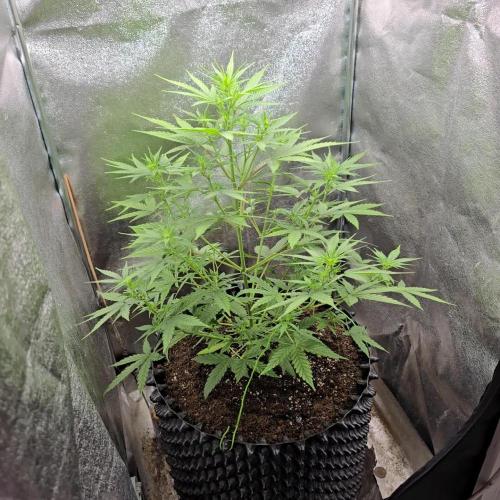
I started adding liquid KoolBloom to my reservoir at the start of week 6 after the switch to 12/12. The buds are starting to fill out. Looks like maybe another 2-3 weeks to finish.



@Mosquito_Haarlem
Volgen
Een week gemist met foto's maken, maar ze is echt prachtig zoals je kan zien.


@JUNGLE_B4RNS
Volgen
The Sensi Seeds Research breeding project has created eleven cannabis seed varieties.
How? By combining new cannabis cultivars with a selection of strains from their long-established cannabis gene bank. For the first time in thirty-six years, they are opening the doors of the Sensi Seeds Research and Development Department.
Week #5
Plants are doing well, there’s not much to do except to let them grow. Roots are filling the pots, I might transplant them in their final pots (18l) during next week.
The Mars-Hydro SP250 has done a very good job during these 5 weeks. The plants need more space to grow, I will have to switch on the HID next week to give some more light coverage.
Giving them a light feed during the week using Cellmax BIO 8-2-2 (not listed) and not Organic Grow ☝️
In my quest for plants science I have found something interesting about the Dr Cleve Backster 😊 but apparently controlled experiments that have attempted to replicate Backster's findings have failed... weird isn’t it ? 😳
(I’m looking for a job in the Cannabis industry as Master Grower, Mineralogist, Quality Control)






@ILoVeThiSpLaNt
Volgen
Giorno 100
Che pianta!!! Che odori!!!
Meno male ho ancora due semini e tutto tornerà buono tra qualche anno quando avrò spazio e magari le leggi saranno meno severe e potrò divertirmi di più facendo cloni tenendo mamme ect...
La pianta anche per le temperature molto basse purtroppo anche di giorno verrà tolta a breve.
"Spendete il vostro tempo a trovare il seme piuttosto che fare la prima cosa che vi regalano o il primo pacchettino che trovate. Le banche semi non sono tutte uguali e di conseguenza l'erba che vi fumate"
A settimana prossima 🖐️ ❤️
A settimana prossima 🖐️ ❤️


@King_Green21
Volgen
Day 47 - I topped, defoliated and flushed with plain ph’d water 10 days before switch to 12/12
These led lights keep the plants really short with a lot of middle bushy growth have already taken 2 bags full of leaves and all look healthy still🤞👍
Day 48 - Looking good day after topping and defoliation :) good sign will update end of week 8 flip to 12/12





@Kirsten
Volgen
💚 ORION LIQUID NUTRIENTS 💜
This is a clear example of me absolutely underestimating the nutrient need when using only liquid nutrients.
The plant, as a result, has really not grown as this in comparison with the 💚ORION F1 ORGANIC DRY AMENDMENTS* 💚 Which has been topped and grown 3 times the size of this one!
I topped this plant on the 20.6.25.
Here is what I fed this week:
19.6.25:
I watered with 2L of dechlorinated water PH'd to 6.1 and containing the following nutrients per 2 litres;
♡ 1/3 Cal-Mag
♡ 1/3 Mega Crop Part B
♡ 1/3 Tsp Mega Crop Part A by Greenleaf Nutrients
PH: 6.1
PPM: 891
26.6.25
I gave 2ltrs of dechlorinated water PH'd to 6.6 with the following nutrients per 2ltrs;
♡ 2 ml Ecothrive Trace
♡ 1 Tsp Ecothrive Biosys
PPM: 811
PH: 6.6
Thanks for stopping by this week 💚✌️🍃😊🌱