


Processing
Likes
Comments
Share


@CBD_Sweden
Follow
Week 19, day 6. Second week after switching to 12/12 lighting.
Nr 1 is 155 cm tall from top of soil and Nr 2 is 171 cm.
All video and pics is taken when the girls have hade 11.5 h of no lights and just got watered.
The stretch on these girls was incredible the past 2 weeks after switching to 12/12 lighting.
So fare this has gone smooth as silk and no problems at all despite temperatures over 30 degrees Celsius for the last 45 days.
I have manage the heat by having between 85-95 % of RH in the room all the time.
And this genetics from DinaFem seeds is awesome, i hope i will get a massive harvest of strong indica medicine.

Likes
80
Share


@Ganjagrandaddy
Follow
Day 35 flowering: Hi all , I hope we are all healthy , sane , and loved in our worlds. It has been another productive week for the two ladies sat basking in the Viparspectra sunshine.
The temps in the UK have been low the last few weeks so they can settle into a less hostile heat zone. They are continuing to use those reds and infrared to their advantage with building some.nice long colas among both plants. The lights penetration is really good so they are having no issues with lower bud growth at all so far.
The Northern lights has really begun to cola stack now with approx 8 mains that ade swelling by the day. She looks like she could be a very nice yield based on those alone. Fingers crossed she keeps swelling. Her buds and pistils are crystal white at the moment with no signs of ageing so she is in her freshest state of flowering right now . This is a good sign of a longer possible flowering period than the 8 weeks usual. The Grandaddys mimosa is more advanced on her ripening with quite a few orange pistils ( dying off) being replaced by fresh ,white , vibrant ones ( new pollen catchers). She has a good covering of orange hairs already for her flowering stage and could be a very early 7 week harvest possibly. She is nowhere near as big as the Northern lights and is being elevated to keep her in the canopy but she has approx 10 mains that are looking shaggy and with a high leaf ratio too. She is starting to have a nice fruity tang to her smell now when watered or handled. She could ⁹ me by swelling up huge in the next couple of weeks but I wont be too worried if not.
The light is performing really well and has done Viparspectra justice too. I am genuinely shocked at how capable it is for its size.
The other strains are doing very well too with the Gorilla cookies looking very bud productive and big. They got an amazing start into flowering from the xs1500 and I wish they were under the new offering from their range but I am hoping to twist their arms into letting me try a couple of xs 4000's from showing how well we can use this light. Lol we can but hope.....
Be safe well growmies

Likes
14
Share


@Lickey
Follow
2/3 of the plants are starting to fade. Middle pheno is showing deficiencies. It’s a toss up between pheno 1 and 3 . And a strong question about whether I want to keep this strain going. Robinhood Seeds, you have disappointed me greatly.

Likes
123
Share


@MrHightimes
Follow
Looks great. Tent is pretty maxxed out! just seeing how much these ladies stretch and seeing if they are ready for this amount of Nuets. This is pretty much the end of the amendments from Bush Doctor.
___________________________________________________________
My friend came over, I'll call him 'The Defoliator'. He bravely jumped in there and chopped through all the madness! The ladys look great with a heavy defoliation and I even jumped in to do a bit of Super Cropping just to try an even out the canopy! I think the feed is exactly where it should be and everything looks PERFECT!!!!! Flowers are popping up all over and the canopy is full and lush!
____________________________________________________________
Plants are kicking ass! Enjoying the grow! Just hoping I have all the nutrients dialed in and life should be good! Seeing some really pretty flower action and I think there should be quiet a yield off this! The PH is coming out a bit high on the drain-off, which means there is a bit of a salt build up.. I might have to use the flush sooner than later.
Likes
7
Share

@JackJolla
Follow
We’ve entered week eight, one of the final weeks, since the genetics I chose are listed as **8–9 weeks from seed to harvest**.
I hope we’re close to the end, because the plants are becoming more and more stressed and I still can’t understand what the problem is. It almost seems like some kind of nutrient uptake lockout.
For now, the maturation of the flowers doesn’t seem to be compromised, and the trichomes are starting to develop a nice color, although the buds still look a bit sparse.
As with last week, Diesel is holding up well, even though she is also starting to show some leaf issues. I just hope this is due to the flowering stage.
The others, however, seem to be getting worse, especially Sunset. Wedding Cake is maturing well, although the spots keep reappearing and some leaves are starting to yellow there too.
Sunset, on the other hand, seems to have slowed down in maturation, and the leaves are getting worse and worse. I’m limiting defoliation because I don’t want to add more stress to a plant that is already suffering quite a lot.

Likes
39
Share


@eldruidamx
Follow
Day 64. Watering with fertilizers.
Day 65. Watering with clean water.
Day 66. Watering with fertilizers.
Day 67. Watering with clean water.
Day 68. Watering with fertilizers.
Day 69. Watering with clean water.
Distinct sweet smell.
Day 70. Watering with fertilizers.

Likes
9
Share


@MrPipi
Follow
Mr Pipi loves seeing Frost. Starts to get shiny in the building. Smell was always like a fruity Whick Vaporub, but now the Menthol/Minty is not the most present and it gets more floral (kind of).

Likes
74
Share


@AsNoriu
Follow
Day 66. First girl down, found Bud Rot, so even happy to chop her !
Fastest plant ever, 66 days from seed touching soil !!!
Day 74. Second down and bud rot again !!! Lost nicest part of the plant ... In panic chopped two other girls too early and one close to good time....
But now the rest have more space ...
Day 78. First girl jared.
Day 84. Second girl is curing.
Happy Growing !


Likes
13
Share

@NuclearPyro
Follow
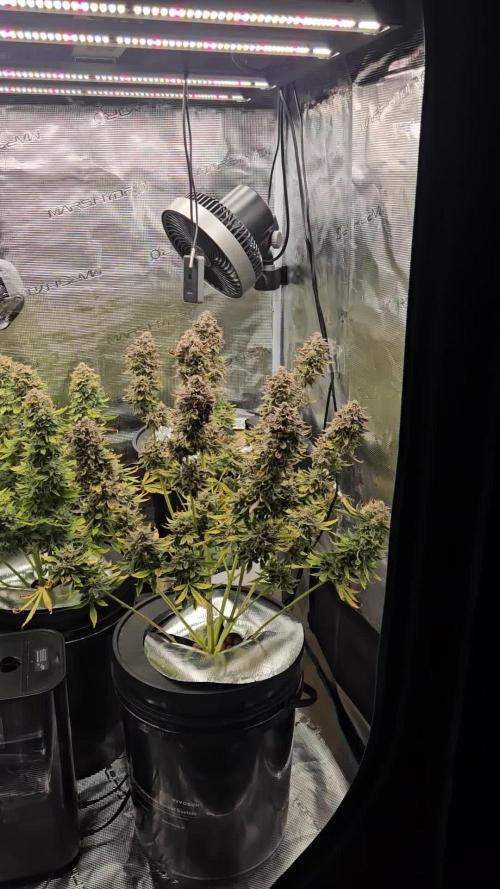
Watch the videos.... THIS WAS MY 1ST INDOOR DWC GROW!!! Personally I think I didnt do to bad for making what I thought were crucial mistakes.
2 DAY FLUSH around 10.5 weeks to get salt build up out. Than 200ppm of forabloom. Took plant 1 week to eat up 100ppm and like 1/2 Gal of H2O. They started to change. Maybe bc of the nutrient drop cause premature maturity or it was entering senescence. However did not know it was in its final swell bc i never researched such a thing. Never crossed my mind that it can bud twice. SMH!!! But it had bloom nutes at that time. Than I did a real flush around 11 wks 2 days. Than been flushing and changing res every 5 to 6 days. Lower water to a gallon and dropped to 65F⁰ and 40% RH for this past week. Temps here in mid-atlantic are fluctuating bad. Gonna be 83 for a few days then drop down to 40s again smh. Did found 2 seedling pods forming soooo yeah. All Fine and Dandy! Gonna empty reservoirs of all H2O tn and let them sit in dark for 1 or 2 days than HARVEST!
CLEAR- 20%
CLOUDY- 70%
JUST MY GUESS WITH MY LOUP
AMBER- 10%
Bc my 1st grow, did not really know gotta go 2-3wks past breeders date. With sativas, and sativa hybrid dominant strains, I will go Minimum of 13 wks and indica and their hybrid dominant strains, 11 wks. Than add or minus 1 or 2 wks depending on strain and environment conditions. I've seen 60 days flips and autos go for 100 days. I will be at DAY 90 OR 91 WHEN HARVESTED.
HAPPY 🌲💨
Likes
Comments
Share


@GanjOS_OG
Follow
First week of Veg is done after the propagator tent. Clones looking good so far - getting healthy again. Startet LST.
Likes
6
Share


@FrostyAutoflowersTV
Follow
I watered with dechlorinated ph adjusted water when the soil was dry and decided to harvest on day 80.
I harvested on day 80 and now the plants are hanging upside down in my tent.
My inline fan is running on 25% and I got a fan running on the lowest setting on the bottom of the tent, so I doesnt blow on the buds directly.
Likes
16
Share


@MarcGrows
Follow
Great week. Girls finishing up and taking longer to drink. Checked trichomes and this plant is ready with mostly cloudy and a spattering of amber. Will harvest tomorrow morning and will provide weights and measures after harvest. Will dry in tent without light and offset circulation. Will keep tent naturally at 67 degrees. I will need to assist with humidifier to get humidity to around 60 RH. Perhaps a wicking cloth in a bucket? Just thinking out options.
Update: Cut down the girls and hang them up to dry. Great thick hard buds. Can't wait to see what they smoke like, but it is going to take time to dry. Thanks to everyone that helped to make this a successful harvest. I will weigh the harvest before starting cure after a closer trim.

Likes
15
Share


@SkunkyDog420
Follow
Hallo zusammen 🤙
So das war es für Sie habe sie heute geerntet.
Wir sehen uns in 3 Wochen mit dem Erntebericht wieder.
Bis dann 🤙

Likes
6
Share


@Hoodoo
Follow
Here are the comments. Continuing on with the sexy ultra awesome General Hydroponics EXPERT LEVEL NUTRIENTS which are making the trichomes and the smell go insane! Can I prove it's the new nutrient? Not at all because this isn't a rigorously conducted scientific experiment but anecdotally, it's making a difference. I have two new white widows that are growing using the expert schedule and they are the healthiest plants I have ever grown. Too bad I didn't start this autoflower with the full nutrients from the beginning.
I've never had a prettier plant though, good genetics from Sweet Seeds.


Likes
3
Share


@Exploding_buds
Follow
Esta semana no he notado mucho cambio pero si han engordado bastante


Likes
40
Share

@wolfvb
Follow
🌿 Khalifa Kush - Sun-Kissed and Stacking! ☀️?
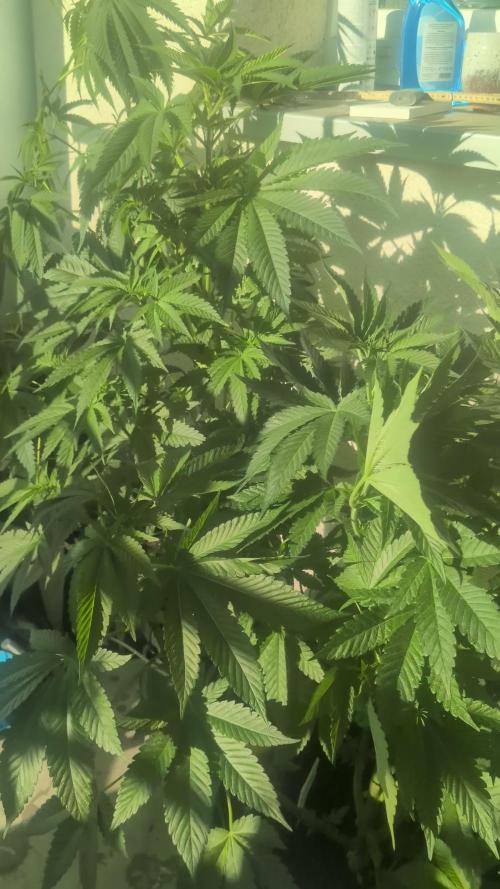
Welcome to Week 10! The Khalifa Kush is putting on a spectacular show out in the natural light. She is soaking up the sun and turning into an absolute jungle of healthy, vibrant foliage.
📈 The Details / Progress Report:
Canopy Density: Just look at how thick she is getting! The internodal spacing is tight, and she is stacking leaves on top of leaves. The structure is incredibly dense, creating a massive, bushy frame with multiple strong tops fighting for the light. 🌳
Foliage Health: The close-up shots show off exactly what we want to see. The leaves are a perfect, rich, vibrant green with deep, healthy ridges and sharp serrations. She is praying beautifully toward the sun, showing zero signs of stress or nutrient deficiencies. 🍃
Sunbathing: The way the natural sunlight catches the texture of those fan leaves highlights just how robust she is right now. She is heavily fueled up and actively converting all that outdoor energy into explosive vegetative growth. ✨
💧 Next Steps:
With a canopy this incredibly thick, the main focus moving forward is going to be keeping an eye on the airflow through the center of the plant. As she continues to bush out, I might need to consider tucking some of those massive fan leaves or doing a very light defoliation to make sure the inner growth sites are getting the light and breeze they need to thrive. For now, I'm just letting her enjoy the great outdoors!
Let's keep it growing! 🌱💨
Likes
4
Share


@Ultraviolet
Follow
0.23v tuned to 7.83Hz Plants exposed to the Schumann resonance often show greater resistance to stress factors such as drought, diseases, and pests. It is possible that these natural electromagnetic waves strengthen plants' immune systems and increase their ability to resist disease.
Pretty neat, in the afternoon when the tent hovers around 84F the plants are 🙏, can visually see in time around 10 minutes after I opened the tent the temp had dropped to 76 pressure was lost, she is still chilling but she doesn't quite have that perk anymore.
*Salinity3.5% - 100ml H2O=100g The concentration of salt in a solution 3.5%= 3.5g in 100ml.
Growing well. Not going to top or do any training, I'll let the plant do its own thing, she is constructing foundations now for what she senses ahead. Smart girl. ✨️ Let her, do her thing, let me do mine.
The voltage that is needed for electrolysis to occur is called the decomposition potential. The word "lysis" means to separate or break, so in terms, electrolysis would mean "breakdown via electricity. Green hydrogen is hydrogen produced by the electrolysis of water, using renewable electricity. The production of green hydrogen causes significantly lower greenhouse gas emissions than the production of grey hydrogen, which is derived from fossil fuels without carbon capture.
Electrolysis of pure water requires excess energy in the form of overpotential to overcome various activation barriers. Without the excess energy, electrolysis occurs slowly or not at all. This is in part due to the limited self-ionization of water. Pure water has an electrical conductivity of about one hundred thousandths that of seawater. Efficiency is increased through the addition of an electrolyte (such as a salt, acid or base).
Photoelectrolysis of water, also known as photoelectrochemical water splitting, occurs in a photoelectrochemical cell when light is used as the energy source for the electrolysis of water, producing dihydrogen . Photoelectrolysis is sometimes known colloquially as the hydrogen holy grail for its potential to yield a viable alternative to petroleum as a source of energy. The PEC cell primarily consists of three components: the photoelectrode the electrolyte and a counter electrode. The semiconductor crucial to this process, absorbs sunlight, initiating electron excitation and subsequent water molecule splitting into hydrogen and oxygen.
Water electrolysis requires a minimum potential difference of 1.23 volts, although at that voltage external heat is also required. Typically 1.5 volts is required.
Biochar, a by-product of biomass pyrolysis, is typically characterized by high carbon content, aromaticity, porosity, cation exchange capacity, stability, and reactivity. The coupling of biochar oxidation reaction (BOR) with water electrolysis constitutes biochar-assisted water electrolysis (BAWE) for hydrogen production, which has been demonstrated to reduce the electricity consumption of conventional water electrolysis from 1.23v to 0.21v.
Biochar particles added to the electrolyte form a two-phase solution, in which the biochar oxidation reaction (BOR) has a lower potential (0.21 V vs. RHE) than OER (1.23 V vs. RHE), reducing the energy consumption for hydrogen production via biochar-assisted water electrolysis (BAWE).
BAWE produces H2 under 1 V while eliminating O2 formation: key word "eliminating". Air with a normal oxygen concentration of around 21% is not considered explosive on its own; however, if a flammable gas or vapor is present, increasing the oxygen percentage above 23.5% can significantly increase the risk of ignition and explosion due to the enriched oxygen environment.
The addition of ion mediators (Fe3+/Fe2+) significantly increases BOR kinetics.
Air:
Nitrogen -- N2 -- 78.084%
Carbon Dioxide -- CO2 -- 0.04%
Hydrogen in homosphere H -- 0.00005%
Hydrogen "GAS" H2 in homosphere - 0%
"Nitrogen, oxygen, and argon are the three main components of Earth's atmosphere. Water concentration varies but averages around 0.25% of the atmosphere by mass. Carbon dioxide and all of the other elements and compounds are trace gases. Trace gases include the greenhouse gases carbon dioxide, methane, nitrous oxide, and ozone. Except for argon, other noble gases are trace elements (these include neon, helium, krypton, and xenon). Industrial pollutants include chlorine and its compounds, fluorine and its compounds, elemental mercury vapor, sulfur dioxide, and hydrogen sulfide. Other components of Earth's atmosphere include spores, pollen, volcanic ash, and salt from sea spray."
Although the CRC table does not list water vapor (H2O), air can contain as much as 5% water vapor, more commonly ranging from 1-3%. The 1-5% range places water vapor as the third most common gas (which alters the other percentages accordingly). Water content varies according to air temperature. Dry air is denser than humid air. However, sometimes humid air contains actual water droplets, which can make it more dense than humid air that only contains water vapor.
The homosphere(where you live) is the portion of the atmosphere with a fairly uniform composition due to atmospheric turbulence. In contrast, the heterosphere is the part of the atmosphere where chemical composition varies mainly according to altitude. The lower portion of the heterosphere contains oxygen and nitrogen, but these heavier elements do not occur higher up. The upper heterosphere consists almost entirely of hydrogen, cool.
78%nitrogen as N2, a far too stable bond to be used by organisms.
20%oxygen
0.04%co2
0.00005% hydrogen
When lightning strikes, it tears apart the bond in airborne nitrogen molecules. Those free nitrogen atoms N2 nitrites then have the chance to combine with oxygen molecules to form a compound called nitrates N3. Once formed, the nitrates are carried down to the ground becoming usable by organisms. Will it react with the oxygen in the air spontaneously, the answer is no. The mixture is chemically stable indefinitely. A mixture with air near the release point can be ignited, but if this does not happen then when its concentration gets below 4% it will be unable to carry a flame. Taking a small detour into chemistry here, a key concept to understanding the health impact of nitrogen-based compounds is knowing the difference between nitrates and nitrites.
What Are Nitrates and Nitrites?
A nitrite (NO2) is a nitrogen atom bonded to only two nitrogen atoms. Very strong bond
A nitrate (NO3) is a nitrogen atom bonded to three oxygen atoms. Weaker bond The optimal pH for nitrate (NO3-) depends on the process and the type of bacteria involved.
Nitrification
The optimal pH for nitrification is between 7.5 and 8.6
Nitrification is the process of oxidizing ammonia to nitrate and nitrite
Nitrosomonas has an optimal pH between 7.0 and 8.0
Nitrobacter has an optimal pH between 7.5 and 8.0
Nitrification ceases at pH

Likes
13
Share

@TheBulldozerSicily
Follow
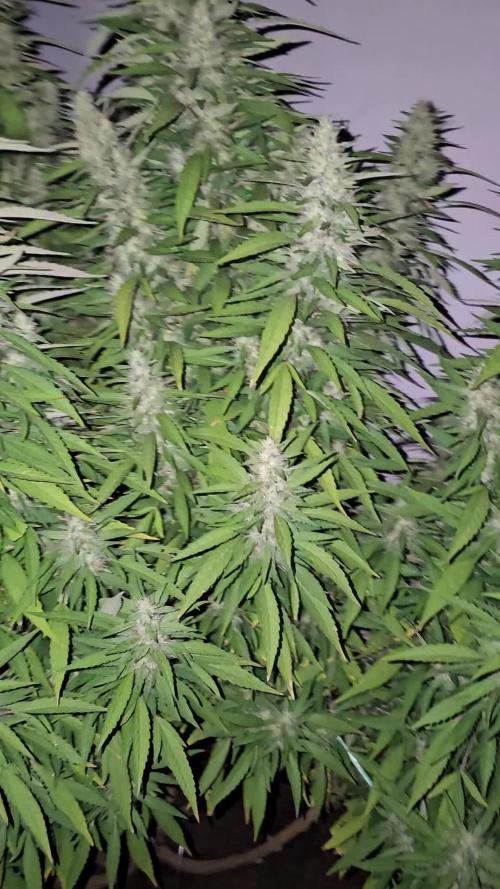
Eccoci arrivati a fine ciclo, raccoglierò dopo le ultime foto fatte la mattina


