


Likes
Comments
Share


@Homegrown93
Follow
She’s still being babysat by a friend and so far she’s growing strong. Have a good stretch so the light was moved up a bit as well, also implemented some LST. Can’t wait to see her again.

Likes
2
Share


@Ultraviolet_
Follow
The nighttime VPD does not need to mirror the daytime VPD. Daytime VPD dictates the pull of water and nutrients, while nighttime VPD acts mostly as a prevention tool. A high nighttime VPD increases the risk of the leaf temperature dropping below the dew point, which can trigger bud rot and powdery mildew.
Switched down to 12's hours of light mid-week, changed spectrum, increased light intensity from 840umol up to 1150umol at current height. Overnight from 800ppm to 1500ppm, morning compensation point (microorganisms) 46-47 days from germination, she fills the canopy herself, once the apical dominance is broken.
Measuring a plant's overnight CO2 emissions provides an accurate estimate of its dark respiration rate. Because photosynthesis stops in the dark, you are isolating the respiration process, which allows you to gauge how much stored energy (glucose) the plant has consumed and estimate the scale of oxidative phosphorylation. Oxidative phosphorylation is the final stage of respiration that generates the bulk of the plant's ATP (90%) and relies directly on the oxidation of these respiratory substrates NADH and FADH2 along with the consumption of oxygen.
From a thermodynamic standpoint. Growth is an energy-capturing process, and the rate of that growth is bound by the available free energy (Gibbs free energy) and the First Law of Thermodynamics. While the ceiling or upper limit is dictated by free energy (such as photosynthetically active radiation), the actual amount of growth relies on how the plant balances that energy with other limiting factors. These are often described as the nine cardinal parameters of plant growth. 4 Above, 5 Below. If any one of the 9 becomes bottlenecked, the entire plant's cycle is restricted.
Operating an 80F+ environment at night to force rapid carbon conversion comes with major drawbacks, as the biochemical processes work differently than the deductive logic suggests. While raising nighttime temperatures to 80F indeed accelerates respiration and speeds up the conversion of captured sugars (sink activity), doing so also radically increases the plant's overall metabolic baseline. If the plant's metabolic rate is artificially forced too high via heat, it can actually "burn" through more energy than it managed to assimilate during the day. This leads to carbohydrate starvation, stretching, and a net loss in final biomass yield.
400 ppm is near the standard ambient level; the plant's stomatal intake is the primary limiting factor, not the dark-reaction enzymes. To push 45 DLI without burning out the plant. Trying to force the conversion of a massive daylight DLI in a compressed time frame (12 hours) becomes highly inefficient because the Rubisco enzyme simply hits a saturation limit. To successfully convert a 45 DLI into dense, productive mass, the ambient CO2 generally needs to be elevated to the 1000 to 1200ppm range. This creates a steeper concentration gradient, driving the stomata to inhale CO2 fast enough to match the high photon energy.
It's not all about the amount of light, but the ratio too, as this will dictate growth through the ratio of phytohormones. In order for correct bud development, there needs to be a correct ratio of RGB. Different wavelengths have different penetration depths. When one grows using top-down lighting, only the entire canopy is limited to 2-3 layers of leaf, meaning there will only be correct bud development in those layers, regardless of getting 45DLI.
The biomass potential of a plant is linked to root mass. Generally, when a plant reaches its maximum biomass, you can help to chop off parts of the plant that are in less than efficient areas of the plant (low light) so that it can create new biomass growing towards the light.
Strength is the maximum potential, and power is the rate of conversion. You can have the biggest veg period of 18 weeks, and it means nothing, as soon as you start flowering, the chronological clock starts ticking, the only metric that matters to bud size is how much energy you convert each cycle, not by how long it took you to build the framework, it helps a lot nonetheless.
Not saying anyone should not defoliate for a reason, only that you should have one, and at the right time. Don't defoliate 30+% on autoflowers or 4 weeks into the flower period and expect an increase in yields; it doesn't work like that. There is room for dictating growth patterns and clearing out overcrowded nodes, but it needs to be done in veg because once that timer starts and buds start growing, it's all just energy conversion. One barely needs to defoliate at all in a 4x4 because with side lighting, turning a 2d canopy penetration into a 3d, even lower buds are 90% the quality and density of top ones. The rate of photosynthesis and the ultimate density of lower buds aren't just about the sheer number of photons PPFD. The specific ratio of R:G:B dictates canopy penetration and drives different photochemical reactions. The Electron Transport Rate (ETR) measures the speed at which electrons are driven through Photosystem II (PSII) during photosynthesis. The ratio of Red, Green, and Blue (RGB) light heavily dictates this rate.
Plant leaves continuously perform cellular respiration regardless of the time of day, using energy and oxygen to fuel essential metabolic maintenance. If you over-defoliate, the remaining canopy may be unable to produce enough net sugars during the day to offset the constant respiratory demands of the plant. Must balance fixation with assimilation; there's no point in capturing 45 DLI if you only convert 20% every cycle due to an extreme lack of respiratory capacity to perform cellular oxidative phosphorylation.
You can have a 4x4 canopy or a 4x4x4 canopy, yes, we know that side lights are not as effective at absorption from the sides or underneath, but it's not about DLI, it's never been just about efficiency, it's about the penetration ratios of RGB that drive ETR of/photosynthesis and trigger correct bud development. The size of each bud is its own ability to perform the ETR required for its own personal growth, and bud development is dictated by the ratio of RGB. It drives localised growth and acts as a regulatory switch for that development. Turgor pressure is another very important factor in understanding if you want big buds, for it is the "steam engine" that dictates the rate of bud expansion. Simply, a lot harder to achieve metabolically at ambient 75F than at say 86F
Because buds have less chlorophyll, they do not suffer from the same photosynthetic shutdown that over-exposed, light-stressed leaves do. They can soak up direct light energy to swell in density and size. Their tolerance to intense light is heavily limited by the temperature and humidity, but if you can control those temps and keep the rot away, buds have a much, much higher tolerance to high light than leaves. Beneficial to hammer with high light before trichomes appear. Balancing this with trichome maturity is key for rich terpene and flavonoid profiles, want it just right, somewhere in the middle, not too much, not too little. Find cannabis plants can defoliate themselves come harvest, given the right signals. Every last ounce of potential is recycled into buds by the plant itself (senseceance), given you can keep the level of conversion high enough to prompt a need to do so.
Get the canopy @ optimal PPFD range, 45-55DLI, then let the plant "stretch" the stems into a "PPFD range much higher, one that leaves don't like to grow in, but buds thrive in. What is optimal for a bud is different from what is optimal for a leaf photosynthetically. Genes provide the blueprint, but the environment dictates how, when, and if those genes are expressed. Must first signal the condition to increase the expression you want to exist through stress and response, cause and effect. A well-buffered CEC medium prevents extreme nutrient swings, allowing plants to maximise their dedicated genetic expression.
A plant is either genetically expressing "growing" or "recycling" genes based on its nutrient starvation level in the medium. Constantly toggling between "growing" and "recycling" hormonal states creates a futile cycle that wastes valuable metabolic energy. Plants rely on sophisticated biochemical switches to manage this trade-off and prevent rapid fluctuations that disrupt that balance.
This energy inefficiency is a recognised biological challenge. Plants avoid this costly "flip-flopping" by using hierarchical master regulators (like the TOR and SnRK1 protein kinases) that act as strict molecular switches. These networks enforce cellular commitment to either growth or survival, preventing mixed signals.
This is something that was missing from previous grows.
Under nutrient-rich conditions, TOR promotes protein synthesis, cell division, and structural expansion.
Under starvation, TOR is inhibited, and SnRK1 is activated. This triggers autophagy—where the plant breaks down old macromolecules and organelles to scavenge and reallocate essential nutrients to critical sinks.
"What's the point in flushing?"
The core idea behind a PK booster is to deliver a massive, concentrated surge of P&K exactly when buds are swelling in conjunction with a N starvation. Because these are short, targeted windows, the nutrients must be highly bioavailable so the plant can process them immediately. As soon as you go "organic," that's out the window. Much slower release, uncontrolled, very difficult to "spike". to cause the ratio that will initiate a response.
High-volume PK spikes rely strictly on the immediate uptake capabilities of mineral fertilisers. Making it far less efficient in organic/living soil setups.
When you use organic nutrients, it changes the dynamic with which the plant delivers and trades its nutrients; organic is always releasing new nutrients into the immediate EC. This prevents a lot of autophagic responses from occurring due to a constant stream of new nutrients into the immediate medium's EC. This can prevent nutrient starvation from being signalled.
PK boost is essentially just N starvation, triggering an autophagic response. Concentrated ratio of P&K while tapering off the Nitrogen base. To the plant, the sudden drop in Nitrogen registers as a severe environmental stressor—essentially, the beginning of starvation protocols. She aggressively strips nutrients and proteins from older leaves and vegetative structures and shuttles them directly to the developing flowers and fruit. Ta daaa. Call it a PK booster and sell it. Nothing to do with the P and K itself, it's the ratio immediately available in the medium triggering a nutrient recycling mechanism within the plant itself; all the "booster" sells is the trigger to the signal.
PK BOOST with 50% ammoniacal N signals floral maturation.
PK BOOST with N starvation signals nutrient recycling/sinking.
Very difficult to initiate a response when organic nutes are doing their thing. It takes 4x5x more water significantly to leach or wash ammonia out than it does nitrates. This can prevent triggering N starvation from having its normal impact.
Manipulating the C:N ratio in the medium. One autophagic response has multiple potential signal triggers. Nutrient starvation is not an option.
Likes
41
Share

@pandrticka
Follow
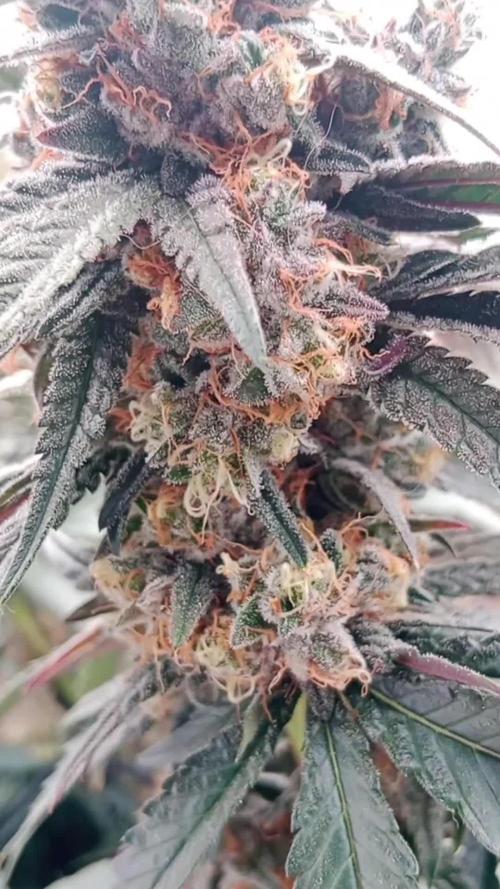
Let's go to the finale. The eighth and final week of flowering. The flowers are hard as a rock. The trichomes are milky and sometimes an amber hue appears.

Likes
4
Share


@Hommero75
Follow
This week the girls are doing really good the flowers are getting big and thicker. They just got fed with Goldleaf feterlizer. The height is the same as last week, the aroma coming out the tent is like sweet and sour.. it is a normal aroma not as strong for the 7 weeks.

Likes
4
Share


@MatthewClamfield
Follow
Moved everyone in the grow setup. Put under a MH for a couple nights before switching over the 600W HPS. Going great!
End of first week of 12/12 and already showing pre-flower.
Slowing transitioning from veg nuts to flower. Keeping a slightly higher N ratio during the stretch

Likes
5
Share


@Jubaea
Follow
Not the harvest I expect bud I had some trouble with the heat in the grow room next time better

Likes
11
Share

@GREENPHOENIX6262
Follow
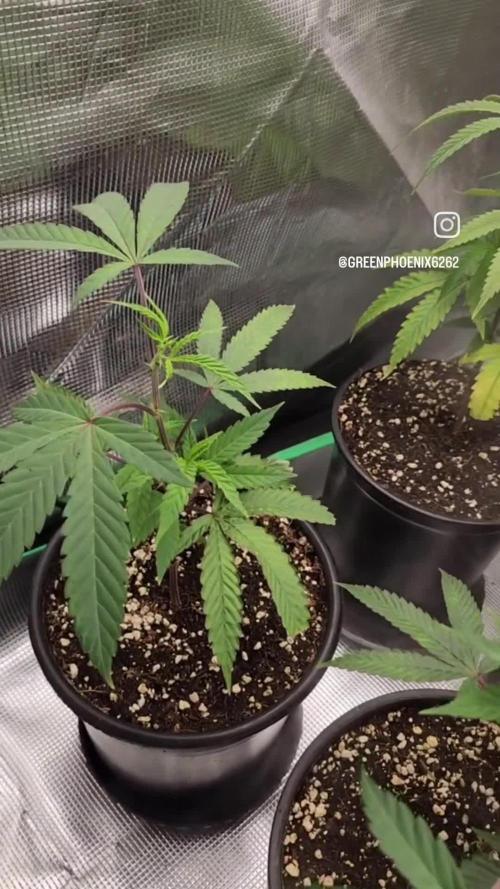
*Disclosure: The mother has was flipped into flower 3 weeks ago - Veg weeks now are only for the clones*
03/08 - (M) - Since transplant into 4x4 she has doubled in size and cleared pre-flower accordingly - Nute feeds increased from once to twice a day - One week will be only nutes the following will be clean water.
03/08 - (C ) All clones are rocking out accordingly - All 7 were topped this week - I will only top once and let them run as is - slight increased nute feed for them to provide supplement for the topping - currently still in nursery (2x2).
03/12 (M) - The mother is just coming out of pre-flower and rocking accordingly since moving into the 4x4 - offsetting feeds (3 days - 1 feed every 12 hrs for 1 minute - 3 days no feed) the offsetting feeds seems to be giving me positive results in balancing wet and dry.
03/12 (C) - The clones are coming along accordingly as well - Since topping the off shoots are coming in nicely - all 7 have been moved into the 3x3

Likes
166
Share


@iMeus
Follow
Hello my friends! I have some good news and bad news this week,
[Bad News]First I'll mention that all, yes all of my Purple Urkle's had to go 😰 I was on the phone with a good friend of mine while admiring my garden of green and I spy with my little eyes 😶 a pollen pod containing nanas. So as hard as it was to cut em down, I knew they had to go. I’m honestly relieved to have those time bombs removed from my tent, that’s all I needed was seeded product. I won’t let this discourage me, in fact I’m empowered knowing that I averted this potential crisis :) I’ll still keep me eye out just in case, you never know.
[Good News] The other remaining strains, White Widow, Super Silver Haze, CBD Blueberry, & Mazar are doing well. Since I feed them light nutes last time I’m debating if I should feed them a 2nd time, or just use some good ol ph’d tap? They look so good I don’t want to over feed em, then again I want the girls to have plenty of nutrients to avoid potential deficiencies. The CBD was the first to flower, though it’s kind of been flowering on and off for a while. If these results happen with the other CBD seeds I’d probably avoid purchasing this product again, I’m not happy with the mutations that are going on with this plant (this is technically bad news). Back to the point I see signs of flowering in all the girls now! This is where it gets exciting, so pumped for this phase, I’ve waited 78+ days for this!
I think that’s enough rambling, I’ll get right into the Individual Progress Notes, enjoy :)
~ Individual Progress Notes ~
[CBD]
Height: 24.8”
Tops: 8
Notes: This one is about 1 - 2 weeks ahead of the others, which are just showing their “hairs” now. I’m on the fence, I’m not sure how this CBD is going to be as a finished product. I hope the other seeds I have don’t have the same mutations... I haven’t had any contact from GCS since their reply. I’ll still write them a report when this girl is harvested, that would probably be better in the long run so they have more information about these mutations I’m experiencing.
[Mazar]
Height: 22.3”
Tops: 16
Notes: I’ll just say she looked like a perfect orb when I removed the trellis netting to realign the family. A very even growth rate, with a consistent distance between nodes, beautiful. The genetics for Mazar here is amazing, now I can’t say this for sure but for now her growth and shape is fantastic and beyond my expectations.
[Super Silver Haze]
Height: 22.5”
Tops: 16
Notes: Talk about sudden growth! This beastie was one of my smallest girls and just like my friend here on GD called it, she shot up! She also has the biggest fan leaves (not the most fingers). Now that she has more room to spread out and breath I’m sure she’ll grow even more.
[White Widow]
Height: 23.3”
Tops: 16
Notes: Tanya here is growing so well, very happy. Her leaves still have that blue steel, green look. I love it! Other than the mazar she has the 2nd most bud sites. Soon, very soon we’ll see flowers starting to develop. I noticed some possible nute burn/deficiencies with a couple of her fans so I’ll use ph’d water next feeding to see if the condition stabilizes, I’ll know by then.
~ Final Thoughts ~
It’s been a long run so far my friends. I can’t say everything has gone as planned, but I avoided a huge blow to my product by noticing the pollen pods developing on the Purple Urkle females. This transition has gone well so far, no shock or hardcore deficiencies. Again, thank you all for your kind words and support!
Much love, Meus

Processing
Likes
12
Share


@MisFit219
Follow
Week 7 going great. Liz is stretching a lot. She is more on the on the sativa side with her fan leaves. Both stacking well. Cut nutrients in half on the Canna A and B.


Likes
51
Share




Likes
6
Share


@D1hunned
Follow
Took advantage of their fast grow and top the 5th node and defoliated the first and all baby leaves below it. I've got very good results out of autoflower by doing this throughout my learning experience. Plant #5 wasn't ready for toppin for some reasons.

Likes
12
Share


@mucho_loko
Follow
All plants that I didn't know the sex of are female.
I have six female plants in total, I know there are too many for my grow which measures 60x60x140, but I'm sorry to discard them.
I'll keep doing SoG, to learn about it.
But i have one question about defoliation, do you think I should do it or leave it as it is? Thanks guys


Likes
48
Share


@AsNoriu
Follow
Day 36. One more heavy training session. Girls drink every day a liter at least, have to water them every 2-3 days and its good !! They got second wave of food , lost almost all oldest fan leaves and i think ill drop my plank to 80 g and will flower them next week.
Still never cracked is it better to clear bottoms before flip or with first wave of defoliation during flower. This time i'll lolipop them in flower.
In middle of last week found some mold on one leave - no waiting and hesitation - Biobizz LeafCoat applied ! Now can't find even smallest issue in them , pure perfectness !!!
Still think 10 girls is too much for my setup to bush them out, but i just can't throw away any plant ;))))
Damn - lesson for life !! Leave branches alone after watering !!! Itchy fingers and smallest plant have only 7 proper branches left, thought to move one a bit ... ;)))
Girls respond to training and food amazingly - late eves video is a proof !
Day 41. They just fly, thickness of branches is just amazing, leaves regrow faster than i pull them ;))) Today all girls will get bottoms cleaned and heavily defoliated, all tops will be HST'ed and i have power cut next tuesday, so monday - lights out for 24 hours of darkness, wednesday - flower starts !
Had to reposition them and bring in one more drain tray. Attack scheme still 2-3-3-2 ;)))
All Blue Dreams hated it, loads of supercroping, one stem split, but it looks like all is finalised for flowering !
Girls got Great White Mycorrhizae tea. Next pure water, later Molasses and only then updated feed, Root Juice out, Bloom and Heaven 2x , all plans and changes ...
Happy Growing !


Likes
11
Share


@OleGrow
Follow
Cherry A causing me all sorts of issues. She's falling on top of Cherry B. And in turn, Cherry B is hitting into my other plants (Grandpa Stash).
Also noticed what looks like pollen sacs on day 78.


Likes
23
Share


@nonick123
Follow
Día 27 (20/05) Riego con 250 ml de Té de Compost
Día 28 (21/05) Vuelven a tener sed! Las riego con 250 ml sólo H20 pH 6.2
Día 29 (22/05) Riego con 750 ml H2O+ Regulator 0,15 ml/l + CaMg-Boost 0,25 ml/l + Startbooster 0,25 ml/l + TopBooster 0,2 ml/l- pH 6.2
NYC Diesel Auto vuelve a recibir aplicación foliar de sales de Epson (4 g/L) porque presenta de nuevo ligera clorosis
Día 30 (23/05) N/A
Día 31 (24/05) N/A
Día 32 (25/05) Las plantas no paran de crecer! 😍
Día 33 (26/05) Riego con 750 ml H2O + Regulator 0,15 ml/l + CaMg-Boost 0,25 ml/l + TopBooster 0,2 ml/l- pH 6.2
💦Nutrients by Aptus Holland - www.aptus-holland.com
🌱Substrate PRO-MIX HP BACILLUS + MYCORRHIZAE - www.pthorticulture.com/en/products/pro-mix-hp-biostimulant-plus-mycorrhizae
