Processing
Likes
Comments
Share
Hello, friends, I Welcome you again from Russia. Comes week 5 photoperiod Bubblelicious. I planned to make clones of this plant, but unfortunately the whole place is occupied by other projects, and temporarily I have to give up this idea, but I will continue to grow this plant, later on, I still make clones, and while I tear off the vegetative leaves and give free growth.
Likes
64
Share
Super easy growing, almost no maintenance, she just needs love and attention, and she will shine for you
Likes
110
Share
πŸ’œ πŸ’š 😍πŸ₯€πŸ’œπŸ’œ πŸ’š 😍πŸ₯€πŸ’œπŸ’œ πŸ’š 😍πŸ₯€πŸ’œπŸ’œ πŸ’š 😍πŸ₯€πŸ’œπŸ’œ πŸ’š 😍πŸ₯€πŸ’œ Dear growmies, welcome to week 9!! ❀️ She is fantastic, if you rub her, she releases a fairly strong lemon aroma, actually she smells lile this famous lemon lemonade which has no color and comes from Santa's (or Satan's) company.. the one with the cough syrup.. πŸ’œ.. really nice! πŸ˜‹ DAY 58 Watered with 2ml bloom + 4ml growzyme + humics + big fruits πŸ’§ DAY 60 Watered with 2ml pk + bloom + 4ml growzyme + humics + big fruits πŸ’§ DAY 62 Watered with 2ml pk + bloom + 4ml growzyme + humics + big fruits πŸ’§ Thanks @Fast_Buds for your awesome genetics, growing Fastbuds is always a bit like riding a ferris wheel! Woohooo!! 😜 πŸ™ πŸ’š Thanks to my sponsors @Green_Buzz_Nutrients, their nutes never ever let me down!! Check out my diaries on how well they work! πŸ’š 😘 In case you want to give them a try, you can find a generous discount code in the setup description further down the road ⬇️ You can find more brand hot updates on my IG, where I share real time events from my growroom, don't miss this! 😝 _______________________________________________________________________ Purple Lemonade FF As refreshing as cold lemonade on a hot Summer day. 🌞 β€’ Quench your thirst. Just as good as lemonade on a hot Summer day. β€’ The gentle giant. Up to 550 g/m2 of gorgeous pinkish-purple buds. β€’ Refreshing for the mind and body. The ideal all-day strain with a perfectly balanced effect. β€’ Sweet n’ sour terps. Mouth-puckering lemon flavors that’ll hypnotize your taste buds. β€’ Properly purple. The perfect choice for purple hash and extractions. As refreshing as cold lemonade on a hot Summer day. Arising from a cross between purple and citrus Cali genetics, Purple Lemonade FF (Fast Flowering) offers a complex high made up of perfectly balanced cerebral and body effects that are ideal for daytime use. Expect an extremely enjoyable high that boosts your mood while deeply relaxing your whole body and getting rid of muscle pain. This meticulous cross produces up to 550 g/m2 of some of the most beautiful purple buds, with pinkish and reddish hues that will catch everyone’s attention. The beautiful purple buds are ready for harvest in 7-8 weeks and come hand-in-hand with unbelievably sugary citrus terps that are just as refreshing as a cold lemonade on a hot Summer day. It’s the ideal variety for the sweet-tooth stoner seeking strains that deliver both in quality and quantity of resin. Bud Description πŸ¦” Purple Lemonade FF grows chunky, spade-shaped buds that boast a whole range of pinkish-purple hues with rich, dark orange pistils shooting out of every direction. This variety stands out for the, oftentimes, lilac trichomes that give them a gorgeous pink tint and make for outstanding purple concentrates. The buds give off a delicious tart lemon aroma that reveals a sweeter, more fruity scent as you break the buds open. Definitely a must for flavor chasers and those looking for pungent terpene profiles. Smoke Reports πŸ’¨ Purple Lemonade FF offers an effect that’s just as unique as the flavor. Expect a potent uplifting high that gives you that energy boost you need to get things done while 100% happy and stress-free. The effect gradually transforms into a wave that works its way along the limbs and through the muscles, deeply relaxing your body and putting you in the right mindset to go through a busy day with a huge smile on your face. This is an excellent all-day smoke as it not only increases energy but can also help combat chronic pain, migraine and stress. Plant Appearance πŸ’„ This feminized photoperiod variety develops a thick and strong structure, growing a medium-sized main cola with multiple shorter side branches, typical of hybrid strains. Purple Lemonade FF develops fairly short internodal spacing with gorgeous purple buds growing stacked on top of each other, making it the perfect choice for growers of all levels looking to get lots and lots of top-shelf purple weed, as this variety can produce up to 550 g/m2 in a 7-8 week flower cycle. Grow Tips πŸ€“ This is a super fast feminized photoperiod version that takes approximately 7-8 weeks to flower with a 5-week vegetation cycle,, this means you can have faster harvests by shortening the veg cycle or have a longer veg cycle for bigger yields. Purple Lemonade FF (Fast Flowering) makes for a great candidate for growers of all levels as it’s a vigorous strain that will thrive with basic maintenance both indoors and outdoors. This is a resin powerhouse so make sure to have your trim bin close by as all the resinous sugar leaves will make for the most mouth- watering hash and extracts. Flavor πŸ˜‹ Expect a long-lasting citrus zest that taste just like it smells. Purple Lemonade FF reeks of a delicious blend of sweet fruits and tart citrus that’ll make your mouth water. On the inhale, expect sour flavors that taste just like lemon candy with hints of orange and a really subtle earthy background. And on the exhale, the citrus flavors open up, giving place to a more sugary berry fruitiness that leaves your whole mouth tasting like an extremely sweet weed-infused lemonade. https://2fast4buds.com/seeds/purple-lemonade-fast-flowering _______________________________________________________________ Setup: 140x70x200 cm Spiderfarmer tent 2x Monkey 16W fans (not oscillating) 1x Secret Jardin 30W 1x box fan 50W oscillating (on lowest level) LED Full Spectrum 320W AGLEX AGL-320W-MA 5,6 kg foldable, dimmable 864 pieces Samsung LH301H 864umol/s 2,7umol/J full spectrum white + RED 660nm + IR 740nm wavelength range 380-780nm covering 3x4ft Green Buzz Nutrients https://greenbuzzliquids.com/ ❗ Use code GD42025 for generous 25% discount (for orders of minimum 75€) Biobizz Lightmix + coco + wormcastings + perlite Carbon Active Granulate Filter 125/360 cmΒ³/h PrimaKlima exhaust EC 125-400/240 cmΒ³/h
Likes
6
Share
@Ribemarti
Follow
PARECE QUE VAN A CARGAR BASTANTE ESTAS PLANTAS MAS PEQUEΓ‘AS ESTOY REGANDO IGUAL QUE LAS OTRAS CADA 2 DIAS 1,5 L EC 1500 PH 6,5? EN TOTAL HAY 10 PLANTAS EN ESTA BANDEJA 5 DEL SCROG Y 5 DEL ALMARIO DE AL LADO QUE SON LAS 5 MAS ALTAS AHORA EN GANAS YA DE VER COMO AVANZAN Y SE ENGORDAN LOS COGOLLOS
Likes
7
Share
85 Days from germination to harvest! Sorry for the lack of accurate information. Just some pics from finish. Honestly- I never finished the diary so I’m leaving it as is. Was extra sweet and pungent and especially extra frosty. Not to mention fast!
Likes
47
Share
What's in the soil? What's not in the soil would be an easier question to answer. 16-18 DLI @ the minute. +++ as she grows. Probably not recommended, but to get to where it needs to be, I need to start now. Vegetative @1400ppm 0.8–1.2 kPa 80–86Β°F (26.7–30Β°C) 65–75%, LST Day 10, Fim'd Day 11 CEC (Cation Exchange Capacity): This is a measure of a soil's ability to hold and exchange positively charged nutrients, like calcium, magnesium, and potassium. Soils with high CEC (more clay and organic matter) have more negative charges that attract and hold these essential nutrients, preventing them from leaching away. Biochar is highly efficient at increasing cation exchange capacity (CEC) compared to many other amendments. Biochar's high CEC potential stems from its negatively charged functional groups, and studies show it can increase CEC by over 90%. Amendments like compost also increase CEC but are often more prone to rapid biodegradation, which can make biochar's effect more long-lasting. biochar acts as a long-lasting Cation Exchange Capacity (CEC) enhancer because its porous, carbon-rich structure provides sites for nutrients to bind to, effectively improving nutrient retention in soil without relying on the short-term benefits of fresh organic matter like compost or manure. Biochar's stability means these benefits last much longer than those from traditional organic amendments, making it a sustainable way to improve soil fertility, water retention, and structure over time. Needs to be charged first, similar to Coco, or it will immobilize cations, but at a much higher ratio. a high cation exchange capacity (CEC) results in a high buffer protection, meaning the soil can better resist changes in pH and nutrient availability. This is because a high CEC soil has more negatively charged sites to hold onto essential positively charged nutrients, like calcium and magnesium, and to buffer against acid ions, such as hydrogen. EC (Electrical Conductivity): This measures the amount of soluble salts in the soil. High EC levels indicate a high concentration of dissolved salts and can be a sign of potential salinity issues that can harm plants. The stored cations associated with a medium's cation exchange capacity (CEC) do not directly contribute to a real-time electrical conductivity (EC) reading. A real-time EC measurement reflects only the concentration of free, dissolved salt ions in the water solution within the medium. 98% of a plants nutrients comes directly from the water solution. 2% come directly from soil particles. CEC is a mediums storage capacity for cations. These stored cations do not contribute to a mediums EC directly. Electrical Conductivity (EC) does not measure salt ions adsorbed (stored) onto a Cation Exchange Capacity (CEC) site, as EC measures the conductivity of ions in solution within a soil or water sample, not those held on soil particles. A medium releases stored cations to water by ion exchange, where a new, more desirable ion from the water solution temporarily displaces the stored cation from the medium's surface, a process also seen in plants absorbing nutrients via mass flow. For example, in water softeners, sodium ions are released from resin beads to bond with the medium's surface, displacing calcium and magnesium ions which then enter the water. This same principle applies when plants take up nutrients from the soil solution: the cations are released from the soil particles into the water in response to a concentration equilibrium, and then moved to the root surface via mass flow. An example of ion exchange within the context of Cation Exchange Capacity (CEC) is a soil particle with a negative charge attracting and holding positively charged nutrient ions, like potassium (K+) or calcium (Ca2+), and then exchanging them for other positive ions present in the soil solution. For instance, a negatively charged clay particle in soil can hold a K+ ion and later release it to a plant's roots when a different cation, such as calcium (Ca2+), is abundant and replaces the potassium. This process of holding and swapping positively charged ions is fundamental to soil fertility, as it provides plants with essential nutrients. Negative charges on soil particles: Soil particles, particularly clay and organic matter, have negatively charged surfaces due to their chemical structure. Attraction of cations: These negative charges attract and hold positively charged ions, or cations, such as: Potassium (K+) Calcium (Ca2+) Magnesium (Mg2+) Sodium (Na+) Ammonium (NH4+) Plant roots excrete hydrogen ions (H+) through the action of proton pumps embedded in the root cell membranes, which use ATP (energy) to actively transport H+ ions from inside the root cell into the surrounding soil. This process lowers the pH of the soil, which helps to make certain mineral nutrients, such as iron, more available for uptake by the plant. Mechanism of H+ Excretion Proton Pumps: Root cells contain specialized proteins called proton pumps (H+-ATPases) in their cell membranes. Active Transport: These proton pumps use energy from ATP to actively move H+ ions from the cytoplasm of the root cell into the soil, against their concentration gradient. Role in pH Regulation: This active excretion of H+ is a major way plants regulate their internal cytoplasmic pH. Nutrient Availability: The resulting decrease in soil pH makes certain essential mineral nutrients, like iron, more soluble and available for the root cells to absorb. Ion Exchange: The H+ ions also displace positively charged mineral cations from the soil particles, making them available for uptake. Iron Uptake: In response to iron deficiency stress, plants enhance H+ excretion and reductant release to lower the pH and convert Fe3+ to the more available form Fe2+. The altered pH can influence the activity and composition of beneficial microbes in the soil. The H+ gradient created by the proton pumps can also be used for other vital cell functions, such as ATP synthesis and the transport of other solutes. The hydrogen ions (H+) excreted during photosynthesis come from the splitting of water molecules. This splitting, called photolysis, occurs in Photosystem II to replace the electrons used in the light-dependent reactions. The released hydrogen ions are then pumped into the thylakoid lumen, creating a proton gradient that drives ATP synthesis. Plants release hydrogen ions (H+) from their roots into the soil, a process that occurs in conjunction with nutrient uptake and photosynthesis. These H+ ions compete with mineral cations for the negatively charged sites on soil particles, a phenomenon known as cation exchange. By displacing beneficial mineral cations, the excreted H+ ions make these nutrients available for the plant to absorb, which can also lower the soil pH and indirectly affect its Cation Exchange Capacity (CEC) by altering the pool of exchangeable cations in the soil solution. Plants use proton (H+) exudation, driven by the H+-ATPase enzyme, to release H+ ions into the soil, creating a more acidic rhizosphere, which enhances nutrient availability and influences nutrient cycling processes. This acidification mobilizes insoluble nutrients like iron (Fe) by breaking them down, while also facilitating the activity of beneficial microbes involved in the nutrient cycle. Therefore, H+ exudation is a critical plant strategy for nutrient acquisition and management, allowing plants to improve their access to essential elements from the soil. A lack of water splitting during photosynthesis can affect iron uptake because the resulting energy imbalance disrupts the plant's ability to produce ATP and NADPH, which are crucial for overall photosynthetic energy conversion and can trigger a deficiency in iron homeostasis pathways. While photosynthesis uses hydrogen ions produced from water splitting for the Calvin cycle, not to create a hydrogen gas deficiency, the overall process is sensitive to nutrient availability, and iron is essential for chloroplast function. In photosynthesis, water is split to provide electrons to replace those lost in Photosystem II, which is triggered by light absorption. These electrons then travel along a transport chain to generate ATP (energy currency) and NADPH (reducing power). Carbon Fixation: The generated ATP and NADPH are then used to convert carbon dioxide into carbohydrates in the Calvin cycle. Impaired water splitting (via water in or out) breaks the chain reaction of photosynthesis. This leads to an imbalance in ATP and NADPH levels, which disrupts the Calvin cycle and overall energy production in the plant. Plants require a sufficient supply of essential mineral elements like iron for photosynthesis. Iron is vital for chlorophyll formation and plays a crucial role in electron transport within the chloroplasts. The complex relationship between nutrient status and photosynthesis is evident when iron deficiency can be reverted by depleting other micronutrients like manganese. This highlights how nutrient homeostasis influences photosynthetic function. A lack of adequate energy and reducing power from photosynthesis, which is directly linked to water splitting, can trigger complex adaptive responses in the plant's iron uptake and distribution systems. Plants possess receptors called transceptors that can directly detect specific nutrient concentrations in the soil or within the plant's tissues. These receptors trigger signaling pathways, sometimes involving calcium influx or changes in protein complex activity, that then influence nutrient uptake by the roots. Plants use this information to make long-term adjustments, such as Increasing root biomass to explore more soil for nutrients. Modifying metabolic pathways to make better use of available resources. Adjusting the rate of nutrient transport into the roots. That's why I keep a high EC. Abundance resonates Abundance.
Likes
7
Share
@Salokin
Follow
Hi Guys, I really like the structure of this plant, as it fits my little growroom prefectly. She is in preflower now, so let’s see how much she will stretch. She already smells distinctively different to the mazaars, very Afghan ;)….
Likes
2
Share
Likes
21
Share
@BLAZED
Follow
Week 15 (9-6 t/m 15-6) 9-6 Temperatuur: 30.8 graden (licht aan) 22.2 graden (licht uit) Luchtvochtigheid: 66% (hoogste) 40% (laagste) De toppen beginnen al wat dikker te worden, en de geur is nu ook erg aanwezig, het gaat de goede kant op! Watergift: 1000 ml, met 0.2 ml Silica Power per liter, 0.3 ml CalMag per liter en 1.3 gr Calcium PowderFeeding per liter. EC: 0.7 PH: 6.5 10-6 Temperatuur: 32.2 graden (licht aan) 23.2 graden (licht uit) Luchtvochtigheid: 62% (hoogste) 44% (laagste) Vandaag de lamp op 95% sterkte gezet. Watergift: 1500 ml, met 0.2 ml Silica Power per liter, 0.3 ml CalMag per liter en 1.3 gr Calcium PowderFeeding per liter. EC: 0.7 PH: 6.4 11-6 Temperatuur: 31.4 graden (licht aan) 24 graden (licht uit) Luchtvochtigheid: 70% (hoogste) 45% (laagste) Watergift: 1500 ml, met 0.2 ml Silica Power per liter, 0.3 ml CalMag per liter en 1.3 gr Calcium, 0.5 gr Hybrids en 0.5 gr PK+ PowderFeeding per liter. EC: 1.7 PH: 6.4 12-6 Temperatuur: 31.7 graden (licht aan) 24.5 graden (licht uit) Luchtvochtigheid: 62% (hoogste) 39% (laagste) Watergift: Geen. 13-6 Temperatuur: 31.7 graden (licht aan) 24.4 graden (licht uit) Luchtvochtigheid: 50% (hoogste) 35% (laagste) Watergift: 1250 ml, met 0.2 ml Silica Power per liter, 0.3 ml CalMag per liter en 1.3 gr Calcium PowderFeeding per liter. EC: 0.7 PH: 6.4 14-6 Temperatuur: 32.3 graden (licht aan) 23.7 graden (licht uit) Luchtvochtigheid: 50% (hoogste) 35% (laagste) Watergift: 1100 ml, met 0.2 ml Silica Power per liter, 0.3 ml CalMag per liter en 1.3 gr Calcium en 0.25 gr PK+ PowderFeeding per liter. EC: 1.0 PH: 6.4 15-6 Temperatuur: 31.6 graden (licht aan) 23.4 graden (licht uit) Luchtvochtigheid: 54% (hoogste) 37% (laagste) Nu nog 2 weken te gaan! 😁 Watergift: 1100 ml, met 0.2 ml Silica Power per liter, 0.3 ml CalMag per liter en 1.3 gr Calcium PowderFeeding per liter. EC: 0.8 PH: 6.4
Likes
13
Share
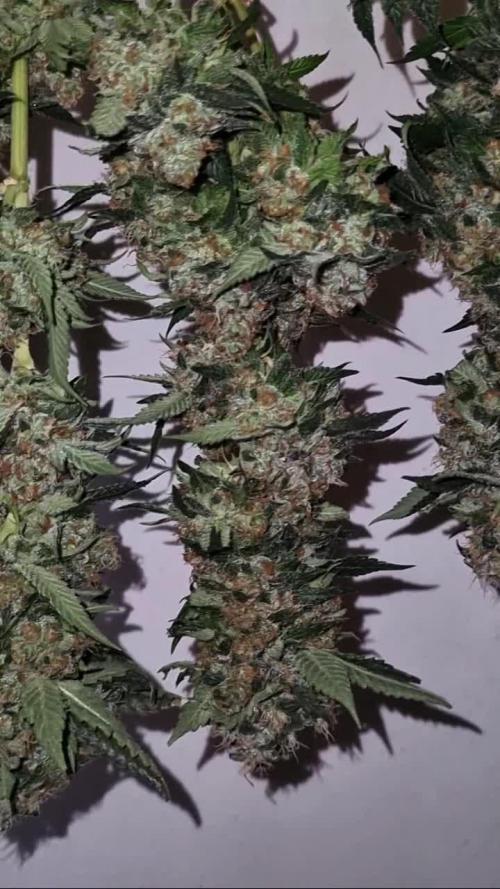
9/8 starting to look frosty, starting to ever so slightly start looking more like buds. Switched to beastie bloomz. Shes the one plant barely affected by these high winds we have. Shes a short stocky ultra durable plant producing heavy resin so far 9/10 plants filling out nicely. I lollipopped some of the lower branches that werent really producing any buds at all. Should've done it like a month ago but oh well.
Processing
Likes
6
Share
@Ashbash
Follow
Ok completely my bad with this. Haven't been feeling great the past couple weeks and have really neglected these babies, among other things. But, I had a go in there yesterday and hopefully things shouldn't keep getting so bad. The buds are fattening up on both a lot, and considering what they've been through I think they look pretty damn good. A lot of burned tops, any suggestions what o should do with them? Seems a bit harsh to smoke. I've managed to wiggle them down a bit lower, hopefully he burning shouldn't get worse, but we'll see. Smells fantastic anyway. Definitely want to run these again a. It further from the light πŸ‘πŸ‘πŸ‘
Likes
16
Share
@valiotoro
Follow
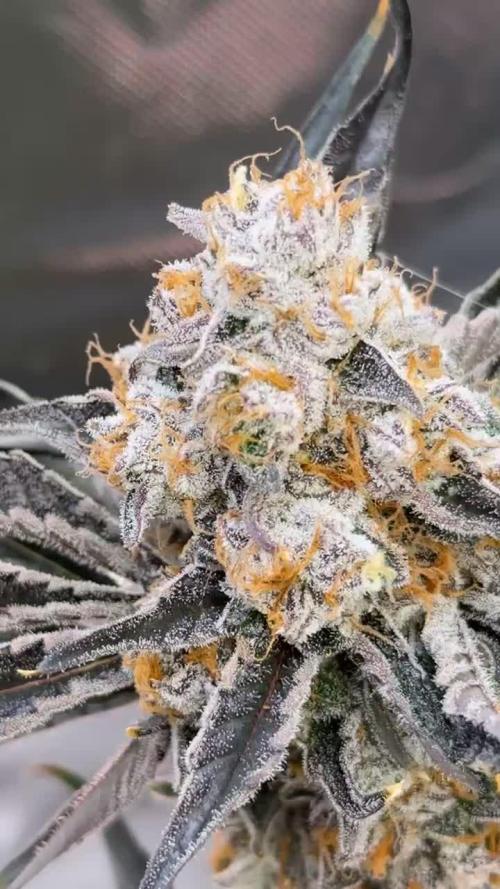
A wonderful genetic thank you Fast Buds ❀️‍πŸ”₯🀩 The trim was super easy the buds are FAT & FROSTY full of resin 🀀 I’m very happy with the harvest 142g !! For the light i’ve used the Mars Hydro SP-6500πŸ’‘
Likes
15
Share
They been doing good this past week some I cut off some water leafs and they started booming the 3 cuts are good one seems like it rooted roots caught on to the cube already hoping they get better waiting for funds to get the fish shit start using that as soon as possible
Likes
5
Share
Day 46 of Flower, 93 since germination. Starting to check the trichomes with my new wifi microscope. Looks like Lemon Extract has a scattering of amber trichome heads, but only in bud nearest the light. All other look milky and glassy. I'm thinking Lemon Extract might harvest in one week. The others, maybe two weeks. Gave the ladies their last feeding today. Just PH balanced water from here til harvest.
Likes
21
Share
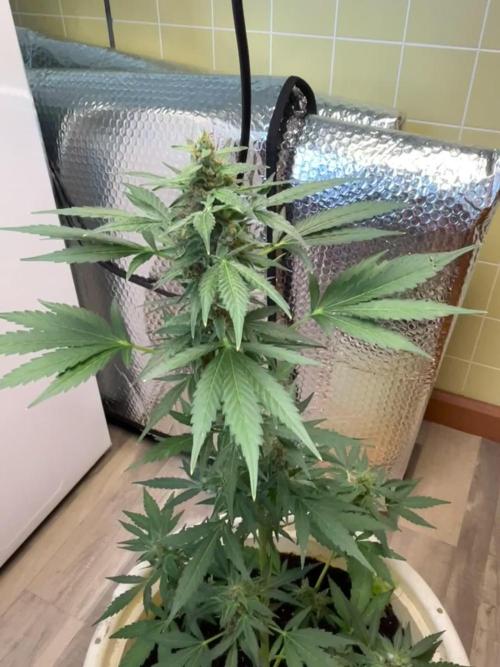
Recovered from the topping and defoliation well. Responding to bondage well. Began Biobizz nute feed at half strength. Just letting her do her thing and flower when she is ready.
Likes
1
Share
Went ahead and flipped to flower. Doing really well with the transitional nutrients. My mutiny pheno on the far right is a purple pheno, which I'm excited about.
Likes
10
Share
Likes
6
Share
@santos45
Follow
I have been given them Athena Balance and Cleanse I think this will be the last week of Veg.
Likes
5
Share
@Ryno1990
Follow
Starting out great in the begining of week 3 we had a little accident in week 2 were her pot fell over an she got a little roughed up but she came back nice an strong can deffinetly tell she stalled out for a day or 2 tho other then that she's been growing great seems to be loving this fold 6 led from medic grow Ending week 3 the Tropicana Cookies is doing pretty good now she's not doing as good as the other auto but seeing how we had a little accident with her she's doing pretty good deff loving the cronk nutrients