Likes
19
Share
@Sti_Cazz
Follow
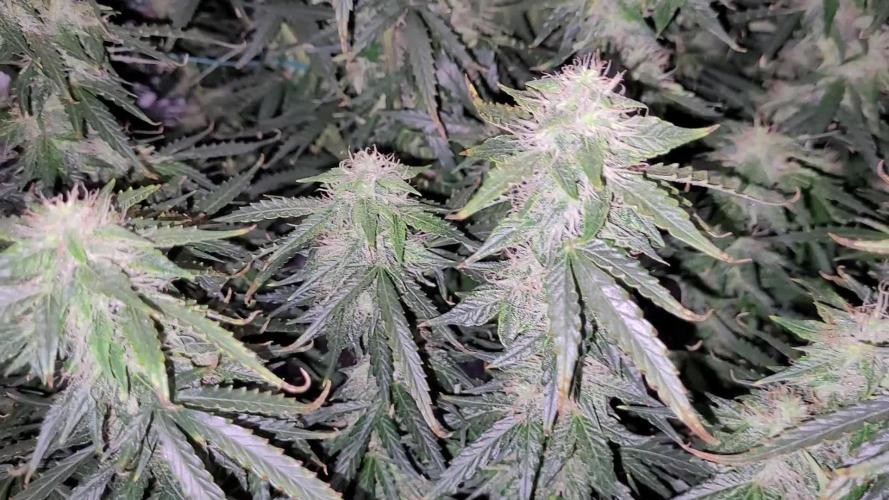
Day 70. Watered with heavy nutes last Wednesday and just water today... Just wanna give em a little break and see... The super silver haze is pretty much done. Will wait another week to get more Amber just a few seen atm. The main cola must be 10 grams alone... Bets are on! Definitely doing 100% better then last time... Guessing going to be 20/25 grams dry compared to last grow.
Likes
32
Share
Likes
158
Share
Booop Doggos Beeep Free NB & fugg GD
Likes
68
Share
@Zengrower
Follow
The Mimosa ladies are now starting to bloom 🎉 I hope they don't stretch too much though. The light is almost at the highest position because I want to prevent another light stress episode. Ofcourse there is always supercropping, but I want to prevent any stress at this point. I'm slowly switching to bloom nutrients but in small amounts. Stay tuned for more updates and pictures later this week ☘️😀 The two plants in the back are full in bloom, but the one in the front is kind of a late-bloomer. It may make a sprint to the finish, but otherwise I will harvest the two other plant and leave this one to bloom a bit longer. We still have 4 to 5 weeks ahead of us and so much can happen in a few weeks. I'm very happy about how the plants made their recovery after the light stress. They look great and seem in good condition.
Likes
82
Share
@Harukisan
Follow
Hello fellow growers👋, 5th week for the Double Grape. 🍇🍇 She is still doing great after the topping, healthily branching from all sides. I have to adjust the wires every day (sometimes twice a day). She is growing fast. Can't wait to see her develop her colas and bud sites. Otherwise, nothing much to report, I am still sticking to the HESI feeding schedule. I will probably switch to bloom nutrients next week. Thanks for stopping by and see you next week! 👍
Likes
3
Share
@Thedibber
Follow
31/10/25 - Not long now until the 2x Bubba cheesecake can move into the 3x3 and flip to flower under a scrog. 2x bubba cheesecake + 1x Badazz OG cheese going into the 3x3.
Likes
177
Share
@DreamIT
Follow
Strong genetics, resistant, fast enough, easy to grow and never pretentious. I will try further training techniques on this strain, while waiting to make more room in the box to plant the Red hot cookie as well. If you like sweet flavors and fragrant plants this is definitely for you! Soon new updates for a cycle of only plants in "monstercropping", to continue my eternal red garden 😁🦄 thanks for following me up to here and leave a comment and suggestions 🦄👍🤘
Likes
20
Share
Not particularly growing for speed or any dedicated reason this time round, just adding water and a abundande of positivity, gotta admit I do like the autoseed logo. Off we go again into the magical forest. (Arthrospira platensis) cultivated in high-alkaline, mineral-rich water in Kailua-Kona, Hawaii. It is renowned for having a higher nutrient content, including more carotenoids and essential fats, compared to other spirulina brands. It is frequently cited as a "complete food" due to its dense concentration of proteins, vitamins, minerals, and pigments. The nutritional profile of standard dried Spirulina platensis biomass. 3kg of spirulina powder has an approximate NPK ratio of 10-2-1 (or 10% Nitrogen, 2% Phosphorus, and 1% Potassium). Here is the breakdown of the nutrient content for 3kg of powder: Nitrogen (N): ~300g (10% of total mass) Phosphorus (P): ~60g (roughly 2% of total mass) Potassium (K): ~30g (roughly 1% of total mass) 3kg of spirulina powder is more than enough nitrogen for 4 cannabis plants in a 100-gallon pot—in fact, it is likely excessive and could cause severe nutrient burn or toxicity if not properly managed. Spirulina has a very high protein content (46% to 63% dry weight), which translates to a significant nitrogen source. It is often described as a 5-1-1 NPK fertilizer. 3kg (3000g) of powder in 100 gallons means 30g per gallon. General organic recommendations for potent amendments (like frass) are often around 1–3 tablespoons per gallon. 30g of powder is roughly 2-3 tablespoons, making this a very high-strength application rate if added all at once. Balance this with calcium/magnesium, and organic nutrient delivery in soil growing can lead to deficiencies in these nutrients. Not all of that 100 gallon is used, so figuring out precise measurements was ballpark, but there is about 10kg of engineered biochar in that pot. Mostly in the top half. Ideally, I'd have 25kg in a full active 100-gallon, but......... don't mess with something that is not broken. Roots do not utilize the entire 100 gallons. This has been a couple of years of trial and error, mostly error. The amount of cations you can add in grams depends entirely on the specific cation exchange capacity (CEC) of your biochar and the type of cation being added. Biochar CEC values vary widely, typically ranging from 4 to over 300cmolc/kg. Multiple Biochars in use, ranging upwards of 100cmolc/km. Different cations have different atomic weights Potassium K+ 39.1g/mol. Calcium Ca2+ 40.1g/mol. Magnesium Mg2+ 24.3g/mol. Nitrogen NH4+ 18.04g/mol. You get more nitrogen bang for your buck. It all depends on the CEC of the biochar you use, but brrrrrrrrrr roughly I'm looking at 500-600 grams worth of elemental cation exchange capacity, give or take. That's just for the biochar alone. Elemental cation exchange capacity refers to the ability of materials—such as soil, minerals, and biochar to adsorb, hold, and release positively charged ions Ca2+, Mg2+, K+, Na+, Al3+, and Zn2+. This capacity is a critical measure of nutrient availability in soil and energy density in electrochemical systems. Added calmag 2:1 to complement spirulina. Calcium (Ca): Approximately 150g - 300g of elemental calcium. Magnesium (Mg): Approximately 75g - 150g of elemental magnesium. So long as pH stays in 6.3 to 6.7 ish, the plant will unlock hydrogen. Plants will be able to cycle CEC for their own needs. Hydrogen ion pumping (proton pumping) is a fundamental mechanism used by plant roots to facilitate the cycling of nutrients within a medium's Cation Exchange Capacity (CEC), directly increasing nutrient availability. A growing medium's Cation Exchange Capacity (CEC) does not contribute directly to Electrical Conductivity (EC). CEC represents potential nutrient storage, while EC represents active nutrients in the water/soil solution. A medium with a high CEC can hold many nutrients, but if there is no water present, the EC will be low. 98% of plant nutrient uptake comes directly from the soil solution. 2% of nutrient uptake is directly from soil particles. Nutrients held on exchange sites (CEC) are not directly measured by EC until they are released into the soil solution through exchange with other ions (e.g., hydrogen ions from roots or fertilizer). Plants source the H+ ions (protons) used in cation exchange primarily by exuding carbon sugars into the rhizosphere, then microorganisms perform root respiration, which reacts with soil water to form carbonic acid H2CO3 that dissociates into H+ and bicarbonate. Roots also actively pump out H+ ions directly to acidify the rhizosphere, plants trade hydrogen produced through metabolism for essential nutrients held by the soil. In plant cells, the H+ (protons) used in proton pumping across the plasma membrane come primarily from the cytoplasm (cytosol). The protons are derived from internal cellular sources, including metabolic processes that release H+, and the regulation of intracellular pH homeostasis. Distilled water is highly useful in managing the electrical conductivity (EC) of a growing medium by allowing for precise control over nutrient concentration and assisting in the mobilization of nutrients from the cation exchange capacity (CEC) into the active, plant-available nutrient solution. Just add water & positive energy. Potential hydrogen. pH. + - , potential charge balance for hydrogen. So long as there is adequate oxygen in the soil and air and water moves at a decent interval, its practically impossible for the pH to skew in a soil that is taking in oxygen and releasing CO2 and nitrogen, I say practically, but meh, even with plenty of oxygen, the process of converting ammonium NH4+ to nitrate NO3- by bacteria releases hydrogen ions H+, which directly causes acidification (lowering pH). While water movement is necessary, consistent water moving through the soil can leach away basic cations Ca2+, Mg2+, K+, Na+, leaving behind acidic hydrogen and aluminum ions, causing pH to drop, especially in humid regions. High levels of CO2 in the soil (from intense respiration) dissolve in soil water to create carbonic acid, H2CO3, which lowers the pH. (barometric pumping removes that possibility) The pH in a cannabis cultivation environment, particularly in hydroponic or soilless setups, will often naturally drift towards acidic (lower pH) over time. Understand how to know when to lime the pH back up. Complex but critical. Once I understood this it helped ease the pain of understanding pH. Base saturation directly reflects the percentage of CEC occupied by base cations. Generally, as base saturation increases, soil pH increases because fewer acidic cations, H+ and Al3,+ are present on the soil colloid surfaces. At a pH of 7 or higher, the soil colloids are saturated with base cations, resulting in a base saturation of 90+%. While many sources include Sodium Na+ as a base cation, some calculations focused specifically on plant nutrients (like in some nutrient management contexts) may focus solely on the "Big 3": Ca2+, Mg2+, and K+. However, in soil science and CEC (Cation Exchange Capacity) measurements, sodium is usually included in the definition of total base cations, making it the "Big 4" base cations. At a pH around 5.5, soils often have a 45–55% base saturation, while a soil with a pH between 6.5 and 6.8 generally has an 80–90% base saturation. Base saturation is considered a reliable, albeit complex, indicator of soil fertility and the degree of soil weathering, acting as a crucial metric in soil classification and management. Once you take full control of the pH, so long as there is oxygen, and one keeps tabs on base saturation levels. Its near impossible for anything to go wrong. All you are essentially doing is adding water and waiting for any sign of deficiency. Not so much growing as eliminating the possibilities of things going sideways. Can't over or under water, can't skew pH, can't go anaerobic. Everything runs in optimal cycles, watering every 2 to 3 days or as required, depending on the rate of combined ET. A little warmer, a little drier, but never short on water. All the nutrients are already there in the medium, we still focus on the water, just not adding salts, but to mobilize nutrients held in the Cation Exchange Capacity (CEC) and move them into the active soil solution for plant uptake, the best supplements to add to water are fulvic acid, humic acid, or seaweed/kelp extract. Liquid solutions with high concentrations of essential trace elements. Distilled water has no alkalinity or minerals to help buffer or release nutrients. Adding these supplements turns the "empty" water into an active agent that forces nutrients off the CEC colloids into the solution for plant uptake. When to water? When Electrical Conductivity of soil gets low. No water, no conductivity.
Likes
11
Share
| Week 6 is finished and we are looking pretty good on Super Orange and Apollo Haze. Terps: ------- Orange has started to fairly loudly emit her incredible, warm, mandarine-candy (no sours, bitters) fumes. The terpinolene is playing tricks on me, never fully grasping the exact fruit or likeness in the profile. A warm, sweet & thick mandarine-syrup mixed into your local humidifier would likely emanate a similar scent. Apollo is trying to dominate the tent, but Orange has taken over with surpisingly intense trichome expression. The fact that the tent smells of her mostly means these terpenes are evaporating at present temperatures. I can either keep the temps stable (my week 6 choice), accept that many sensitive terps escape as they are built, but focus on a relaxed environment for the cultivars; or, I could just drop the temps right now and target high limonene / monoterpene retention (one of the secret sauce Haze effect ingredients). Cool distinctions we can make these days, huh? Apollo still retains a fairly 'rude' veg spice smell. It is detailed, balanced and tuned around an umami like sellerie, and most definitley not fruity. I was already afraid I would suffer another pheno or genetic expression as with 505 Headbanger (no fruit smell besides some citrus, heavy eucalyptus and mint notes, sweet after cure, some pine here and there) I did however happen to crush some trichomes on accident and to my surprise I got a heavy citrus-palette that is almost pure lemon juice. Think of all the citrus fruits you know mixed in a lemon juice cocktail, take a whiff and feel your nostrils burn! She is able to conserve the citrus contents well apparently, so I am hoping for more suprises as she ages and shifts focus and am happy with her state. Auto Cinderella Jack ------ ACJ still is a bit quieter and usually smells like fresh leaves. She unfortunately endured many invisible stress factors, like over-watering or wind & climate events (see those curled up, dry leaf tips?). Those interfered with the HST super-cropping / scrogging timing. As a result, instead of starting her flowering stretch, she turtled up. Every big leaves acts as a cup for growth underneath, she went from relaxed expansion to safety via density. In no way will she not flower happily at some point, but her situational difference decided over success of the training technique employed. Note: This cultivar often has a bushier pheno, but I have seen her do great and she would stretch nicely when -everything- was correct. Nanners: ----- The shocker this week was the discovery of undisputed nanner structures on BOTH SOH and AH. They developed exclusively on lower node branches, where you would usually see isolated bracts / calyxes covered with trichomes and 2 pistils or so. I removed what I could, but mentally, this now puts me in an awkward position. Now, the fun is out. Stress management is everything, forget about maximum plant performance. I wonder why this is. So far, I grew 9 42FB cultivars with zero nanners; and up to this point 5 Mephisto cultivars, out of which 3 produced nanners. But that is not enough data: All Mephisto cultivars displaying nanners have been leaning sharply into the landrace-sativa type. Only one cultivar was assumedly stress-pressured into hermaphroditism (OSHM / Mango, consistent light burn). Perhaps the plants felt their environment was a bit lacking in population density and sensing other females around, 2 cultivars started shedding pollen from their lower structures, leaving most flower-sites ready for actual outside pollination. Or, this is just wishful thinking. We'll see in week 7!
Likes
11
Share
Processing
Likes
2
Share
It's getting cold don't know how good she will hold up
Processing
Likes
12
Share
They are still plumping up nicely I’ve been only feeding ph water up until the end of this week. I’ve done a mix of ph’ing and not(laziness) started to notice purple leaves and buds last couple days. Just waiting for more green to disappear from the leaves.
Likes
10
Share
Defoliated on day 82. Flowers are starting to get sticky on sugar leaves & the pine smell is picking up but not as strong as expected the Gelato buds are starting to amber up. Think I'm going to up the Foliage Pro a ml as is see some yellowing since I switched up the ratio.
Likes
7
Share
@Stonytony
Follow
The second week everything is going alright
Likes
1
Share
Day 28: The Girlies are doing well. C Banana is forming some nice buds and node stacking but is still a lot less productive than her stablemate. She is getting g a tacky feel to her and has been stripped out to get some air and light to the mains forming. Monster Zkittelz is keeping her namesake at the front of her plan and is growing daily. She is a very good producer so far and her nodes are less stacked but plentiful. They are taking the feed at a very good rate now and I am having to refill the res twice a week now. Buds are stacking up on these girls nicely and forming long looking main colas all over the place. I think C Bananas poor start has certainly held her back.
Processing
Likes
5
Share
(Bloom test week) I decided to put both plants into bloom to determine the sex of each one. The Right hand plant was a Male (sad times) the left plant however is a winner and is looking super healthy , i have now switched the lights back into veg at the end of this week, aiming for another 3-4 weeks of veg.