Likes
Comments
Share
@Donbehzad
Follow
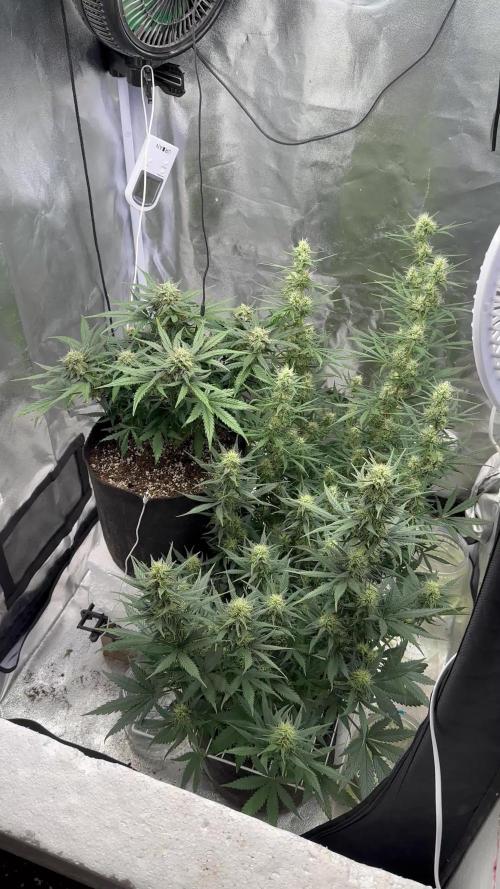
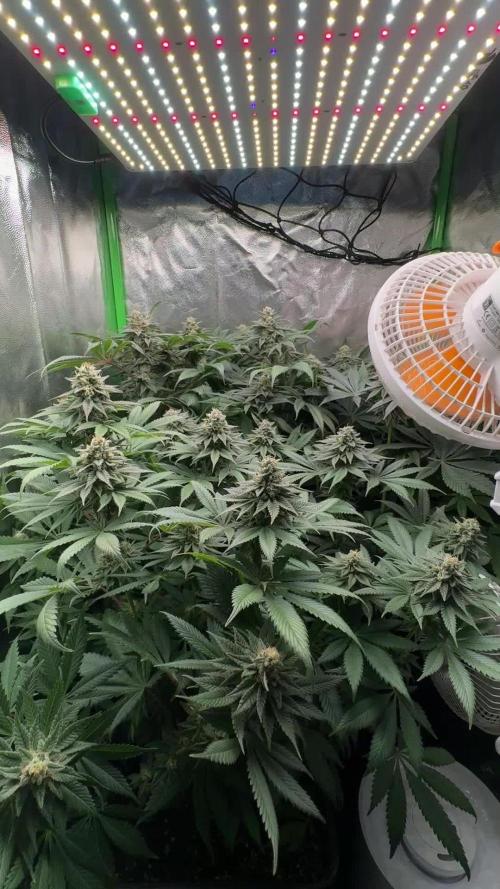
I tried defoliating two days ago but just the leaves that are underneath and started to bend toward the soil, 1-2 leaves per plant not that serious defoliating because its an autoflower and I won’t stress it to much. I did another defoliating an hour ago, 1 leaf per plant again just those trap inside the bottom part. Low stress training still on going but no new tie, i’ll try to leave it like that until the end i’ll just tuck the leaves blocking the developing pistils. I noticed that out of 3 plants, 1 is taller and bushier than the rest. Looks like the other two stunned their growth or just slow in growth. Seriously I don’t have an idea same nutrient and care are given to all plants. I feed them twice a week every 3-4 days, no negative reactions or whatnot. Nutrients adjusted in this week. Same temperature and humidity level as last week, keeping an eye daily to adjust if its not in desire level.
Likes
19
Share
@Sativeta
Follow
Esta semana seguí con los mismos abonos subí un poco las bases hasta llegar a 1,8 de EC.al final de la semana riego solo con sensisym. Tienen buen color parece estar todo bien.
Likes
7
Share
@refusing3
Follow
Day 29 of vegetation: raise the humidity to 60% trichomes on the leaves can be seen with the naked eye. I have never seen trichomes appear on vegetation before Day 31 of vegetation: remove 10 large leaves and made an LST. Now literally ALL the lower leaves receive 100% of the light After 35 days of vegetation, the plant looks like it ready to start flowering. Watering volume week 5: Day 29-35 - 400 ml per day
Likes
18
Share
Giovedi 3/11/2022 Cambio acqua, inizio controllo Ec 2200 Ph 5 60 lt demineralizzata 6 lt rubinetto Ec 289 56 Grow 112 Micro 168 Bloom 66 Enizmi 70gr mega bud Ottenendo Ec 2184 Ph 5.9
Likes
8
Share
Bis jetzt bin ich wirklich sehr über diese Sorte von Green House Seeds beeindruckt! Sehr tolle Züchtung, sie wächst schnell und und ist sehr einfach. Aktuell fängt Sie an viel Wasser zu trinken, ich denke es sind schon über 1 Liter am Tag. Dies ist auch mein erster Grow bei dem ich auf den PH Wert achte. Ich hoffe auf wirkliche Big Buds 😎 Meine Spitzenreiter waren bis jetzt LSD-25 und Purple Lemonade von Fast Buds. Tag34: Die süße fängt nun gut an zu duften und entwickelt ein Haufen Buds. Tag36: Ich habe das Gefühl, dass Sie nicht aufhört zu wachsen 😅 Sie bildet derzeit so abnormal viele Blüten, ich denke das es eine sehr gute Ernte wird. Entweder ist diese Sorte einfach nur extrem gut oder es liegt am PH Wert da ich diesen vorher nie beachtet hatte. 👉FRAGE!: sollte ich bald mit der Entlaubung anfangen oder hab ihr vielleicht ein paar andere Tipps? 👈
Processing
Likes
12
Share
Está semana as cores estão mais vivas e o cheiro está forte ualll Red Hot com cheiro floral bastante tricômas, a sweet zkitllez cheiro de frutas tropicais intenso e doce adoro sweet seeds está de parabéns lol
Likes
2
Share
Remember that, however you are played, or by whom, your soul is in your keeping alone. Even though those who presume to play you be kings or men of power, when you stand before God, you cannot say, 'But I was told by others to do thus,' or that virtue was not convenient at the time. This will not suffice. Remember that. Day:18 84°F and 65% RH (VPD) for the vegetative stage. Approximately 1.15kPa(assuming leaf temperature is about 2°F cooler than the air), which falls right into the ideal vegetative sweet spot (0.8kPa to 1.2kPa). At 1.15kPa, plants can draw water and nutrients efficiently without risking stress or wilting. It keeps the leaf pores (stomata) open, allowing for ideal carbon dioxide intake and maximizing vegetative growth. VPD is determined by the leaf's temperature, not just the ambient air. Because leaves usually run 1° to 3°F cooler than room air under bright grow lights, my actual VPD will be slightly lower, closer to the 1.0kPa mark. As she transitions from vegetative growth to flowering, one can gradually lower the humidity (to around 45–60%) and drop temperatures slightly to prevent disease from settling inside dense buds when they appear. Night:6 At 70°F and 60% relative humidity, Vapor Pressure Deficit (VPD) is 0.86 kPa. This is right on the cusp of whats optimal for the vegetative stage. During the nighttime, plants generally close their stomata and undergo cellular respiration rather than photosynthesis. Transpiration slows to a near stop, making VPD less critical at night than during the day. However, maintaining a nighttime VPD between 0.8 and 1.0 kPa is highly beneficial in that it ensures the air is dry enough to prevent powdery mildew or bud rot, but moist enough to keep the plant from undergoing unnecessary stress. This range keeps the environment comfortable for cellular processes and prevents large atmospheric swings. Keeping it all flowing. (Not pushing them yet, these are photoperiods) The optimal soil (root zone) temperature for cellular root respiration and nutrient uptake in cannabis is between 68F & 72F This narrow range balances biological energy production (cellular respiration) with the dissolved oxygen levels in the soil, maximizing plant growth and health. Warmer soils hold significantly less dissolved oxygen. When soil temperature exceeds 74F oxygen depletion occurs, inhibiting cellular respiration almost entirely, At 68-72F root cells generate optimal adenosine triphosphate (ATP) via respiration to power root-tip elongation and the active transport of water and nutrients. Too Hot (Above 78F) Root respiration increases, demanding more oxygen, while the water's oxygen-carrying capacity drops. This creates a prime environment for anaerobic pathogens and Pythium (root rot). Too Cold (Below 60F) Root metabolism and cellular respiration slow to a crawl. This severely impairs nutrient and water absorption, leading to yellowing, wilting, and phosphorus deficiencies. A lot depends on whether it's automatic or photoperiod; with photoperiod, there is not as much of a need to push "hard" as the real countdown only begins once the flower is initiated. Automatics, on the other hand, the chronological "clock" begins ticking the moment the seed germinates. It is of critical importance that the seedling growth gets off to the races, understanding that early growth is like compound interest, which will pay off come harvest. This reality is why getting autoflowers "off to the races" early on yields such exponential benefits. The "compound interest" is directly related to the surface area of the leaves. Larger, faster-growing seedlings process more light and build bigger root networks early on, which translates into an explosion of vertical and lateral growth during their short vegetative window. The margins for error are so thin with autoflowers; this early-stage momentum depends on several critical practices. Seedlings exposed to increased atmospheric CO2 levels early in life will develop at an increased rate. To effectively "extend" or optimize the capacity of Photosystem II (PSII) for increased photosynthetic efficiency. In standard oxygenic photosynthesis, Photosystem II (PSII) is naturally limited to the red-light spectrum, peaking at 680nm. Extending its light-harvesting capacity past 700nm into the far-red region requires bypassing the natural limits of standard chlorophyll a. Adding 730 nm (far-red) LEDs alongside standard red/blue lights has been shown to increase canopy photosynthesis by 20–30% in several crops by acting synergistically with shorter wavelengths. However, the limitation is that excessive, pure IR/Far-red light (without accompanying red light) can trigger the "shade avoidance response," causing plants to grow tall, weak, and spindly rather than robust. Utilizing infrared light (specifically the 700-750 nm far-red range) is a viable method to boost photosynthetic efficiency. It acts as a bridge to allow PSII to utilize a broader spectrum of light, breaking the traditional 700 nm barrier. UVR8-mediated signaling (often in conjunction with CRY proteins) triggers protective mechanisms that maintain the stability of the photosynthetic apparatus (including LHCII and reaction center proteins), thus ensuring that the efficiency of Photosystem II remains higher in UV-B-exposed plants compared to plants lacking this receptor. ΦPSII indictates the rate of electron transfer from water to plastoquinone, which drives the production of ATP and NADPH. There is a close link between ΦPSII and the true rate of CO2 fixation (Φ*co2). ETR stands for Electron Transport Rate. It measures the speed at which electrons are moved through the thylakoid membranes in a plant's chloroplasts during the light-dependent reactions of photosynthesis. Infrared light (particularly Near-Infrared or NIR) improves cellular energy by interacting directly with the electron transport chain (ETC) in mitochondria. This process boosts adenosine triphosphate production, which acts as a metabolic coefficient multiplier by accelerating enzyme activity dramatically. Extend then multiply. Far-Red photons interact with plant photoreceptors to accelerate the plant’s biological "clock" or trigger a shade-avoidance response. Autoflowers don't use the plant's biological clock, although the IR will initiate a shade avoidance and make them stretchy. You can just add equal measures of 660nm-680nm to negate the shade avoidance effect. Replacing nights' "darkness" with a combination of IR+ and 660nm. Because autoflowers don't require a dark period to flower, many growers just blast them with light. 18/6 24/0. However, this ignores the plant's metabolic rhythms, where daytime photosynthesis (light reactions) must be perfectly balanced with nighttime carbon fixation and assimilation (Calvin cycle) to avoid bottlenecking plant development. Cellular respiration is a 24/7 process, but it can only function while the plant has the free oxidative capacity to do so. A 100% photosynthetically active leaf cannot perform cellular respiration. The viral trend of defoliation of every leaf that isn't "getting enough light" is of great detriment overall, putting 100% of the cellular respiratory "workload" and responsibility on the 0/4/6 hours of darkness in sub-optimal conditions for enzymatic activity. Photosynthesis captures nearly 100% of the initial energy as carbon, while cellular respiration is the process that unlocks 90% of that captured energy into usable ATP so the plant can use it. Respiration is considered only roughly 30% to 40% efficient. It captures enough of the potential energy in glucose to synthesize around 30 to 38 ATP molecules per glucose molecule. The remaining 60% to 70% of the energy in the sugar is not captured in ATP; instead, it naturally escapes into the environment as heat, which helps regulate plant temperature. In plants, the primary enzymes of the Electron Transport Chain (ETC) and the ATP synthase complexes are typically adapted to function optimally in warmer temperatures (roughly 77°F to 95°F, depending on the specific plant strain). As temperatures rise within this physiological range, molecular collisions increase, speeding up respiration and ATP production. The cannabis plant has a branched respiratory pathway. During heat or cold stress, plants activate Alternative Oxidase (AOX). AOX burns sugars to dissipate energy as heat rather than coupling it to ATP production. This pathway actually functions optimally at elevated temperatures to help protect the cell from the damaging build-up of Reactive Oxygen Species (ROS) during heat stress. Enzyme activity generally scales with heat; there is a strict biological limit. If canopy temperatures in a grow room exceed 104°F, the enzymes and their supporting lipid membranes lose stability. Not saying you need to go crazy, just optimize nights the same as we optimize days. Phosphorus is the driving force behind early seedling development. It acts as the "energy hub" of the plant, directly driving cell division, robust root growth, and the creation of DNA. Without an adequate, easily accessible supply early on, the plant's overall growth potential and final yield can suffer permanently.
Likes
16
Share
@Diips
Follow
Both plants looking good. The cheese, is really frosting and flowering up, really crazy! shes gonna become a beast and is so early into flower 13-08-2024. both plants been given a 5 ml shot of Calmag. also the cheese got her mid bloom dose of Biopk 16-08-2024. the ladies got some water today, and the Orange Apricot Glue has overtaken the cheese in height, compared to the cheese being the bigger one for most of the “grow”.
Likes
16
Share
2022-12-16 No big Actions taken out of watering every Day with a Feedingsolution Pisitls start to change, but i think she has 10-14 more Days to go the Plant in the purple plasitc Cup is done soon. The Glass-skull takes alittle longer website for for my Fertilisers: https://greenbuzzliquids.com/en/shop/ Code: mrs_larimar Breeder Info: 👉Black Sugar is an indica dominant hybrid of Black Domina, L. A. OG and Critical. It has kept the medicinal properties of L. A OG, a good flowering rate on the Black Domina lineage, and the compact size of the classic Critical strain. With its small growth, the strain produces large yields of up to 600gr/m2 on bushy branches. The buds are very dense and stinky. Black Sugar has a high THC level. The variety has a fruity citrus aroma. Dense smoke gives the effect of relaxation and body buzz. Good for Smoking before going to bed. It can become one of your favorite Seedsman strain Genetics Black Domina x L.A OG x Critical Harvest 450 - 500 g/m² Flowering 50 - 55 days THC 20.0% CBD 1.0%
Likes
49
Share
@AsNoriu
Follow
Day 43. Girls will get heavy training later today. They grow ... and because of that i had to move 3 Kushes to other tent and i will make separate diary for theirs flowering time. 3 Auto Blue Tooth by Real Gorilla Seeds took theirs place. After todays training i will give them 4-5 days to recover and will send them to flower hopefully on sunday after 24 hours of darkness. Skunks grow bigger plants, than Cheeses, despite theirs quickest germination and obvious lead in first 3 weeks or so ... Day 46. 3 days left to flower, finally made heavy training, way too busy for LST grows... but result is good, girls hopefully will show off in bloom ! Day 47. Girls loved training, 2 more days, 24 hours darkness and tuesday latest flowering starts. Got full feed of Biobizz, feed charts updated. Next feed = water + silica. Happy Growing !!!
Likes
3
Share
The seeds germinated after 1-3 days, 1x runtz unfortunately did not germinate. 3 Days after the germination the plants were growing too quickly so I repot them them in deeper and increased the light intensity to 50% = 100 watts. When repotting in biobizz light mix, the plants were also given a load of Mykorrizah from Great white premium.
Likes
7
Share
@cwgrows
Follow
Growth is really starting to explode! Been researching all of the training methods and think some LST and eventually scrog will be the best use of this space.
Likes
14
Share
Hello my friends! Almost weekend, are you ready for it ? I can't wait, the work drained me soooo much this week! Good that this little Titan gives me so much joy and satisfaction every time im back home! Back to us! Today is friday and marks the last day of her 10th week. Today is kinda important, is exactly 77 days since the plant showed up from the soil. RQS is saying that normally this plant is ready to harvest in about 70 to 75 days. Mine is already 77 and is not ready yet. As you can see from the picutres and clips especially the last ones of this week...you can see that her trichomes are not quite ready yet. The trichomes look like they are 85%/90% ready right now, as I am writing this post. The pictures and clips are also from this morning, is all fresh material. Most of the trichomes are cloudy but you can still see that few of them are not ready yet, also there is no amber colour at all. All of this it must mean that the plant can go couple days more. This week and the previous one I was reading and checking online about this plant and her previous grows. I understood that the plant in reality takes a little longer to get FULLY ripe and ready. A little over 80 to 85 days. I will let her run for another week more or less, today is day 77. For peace of mind I am checking the trichomes every 2 days to don't miss it or be late. It would be a shame to cut it down right now. Why? I can see the buds getting bigger and bigger everyday! She's getting thicker literally in front of my eyes, especially in this late phase of flowering. I can see the buds increasing in size day by day. I am sooooo happy! Dope! So harvest probably next week! WATERING This week I've started the FLUSH cycle. The plant got 6 L of plain water adjusted to 6.3 pH and splitted in 3 watering sessions by 2L each. In all 3 waterings the drained water was around 1 liter. NUTRIENTS No nutrients this week, same story next week. Just plain water till harvest, the water will be adjusted to the correct pH. No more no less. The harvest should fall exactly on the day that marks 2 weeks of no nutrients. So actually with this we are really spot on! Perfect I would say. LIGHTNING The light is always 100%, 24/7. The only update here is that at the beginning of this week I lowered the light about 10 centimeters for this last days of flowering. Is an experiment...anyway my light is only 70 watts in the end. So I am not too worried about it, probably I should lower it couple of week ago to give that extra boost to the plant. But it is what it is, now is too late ahahahah. Anyways talking about the light...before I've got 25 centimeters between the led lamp and the plant, now is about 15 centimeters of distance. TRAININGS NO MORE training techniques were applied to the plant. At the beginning of this week I REMOVED all the LST that was trapping and keeping her strapped to the pot. I wanted the plant to BE FREE during the last two weeks of her life. Like a little treat and mercy for this beautiful prisoner ahhahaha. Removing the LST I allowed the plant to lift up a little bit more her branches. In this way the buds sites went up and closer to the led lamp, closer about 10/20%. Maybe is not much but in the end everything counts on the scale. We will see the results. The height of the plant didn't change in this last weeks, it reached 48 cm and stayed there. Actually after I released her from the LST last week, it gained 2 cm. So now at the end of her life the plant is 50 cm tall. The smell is strong and pungent, refreshing somehow. Very pleasant, I love it. OVERALL Everything is going well, just a little bit late on the schedule. The patience is the key for good and big buds! I CAN SEE THE FINISH LINE, WE ARE ALMOST THERE. See you next week for the final update! Stay safe y'all!
Likes
6
Share
💚 Amnesia Haze Auto by Zamnesia – Pheno B Week 7 | Small Pot, Big Dreams Welcome back to another chapter of the 8×8 Adventure! One of the reasons I love growing multiple phenotypes is because every now and then a plant completely rewrites the expectations we had for her. Pheno B is doing exactly that. From the beginning she has been the more compact sister. Shorter. Slightly slower to flower. More reserved in the way she expressed her genetics. But this week... She's making a statement. Looking at her today, it's becoming increasingly difficult to believe she's growing in just 11 litres of soil. Sometimes the plants teach us lessons we weren't planning to learn. And I think this lady is about to teach me one. 🌱 The 12/12 From Seed Adventure If you're joining this diary for the first time, welcome! Every plant in this room has been grown under a 12 hours on / 12 hours off light schedule from the day the seeds germinated. There is no traditional vegetative period. Instead, each phenotype is allowed to express its natural architecture almost immediately, making it much easier to compare stretch, flowering speed, branch development, internodal spacing and overall efficiency. The goal isn't simply producing flowers. It's learning how genetics behave when every environmental variable remains identical. Same room. Same lights. Same nutrients. Same watering. Same environmental conditions. Only the genetics are telling the story. And every week they continue proving just how different sisters can become. 🌿 Why Only an 11 Litre Pot? This run also includes another little experiment. Normally, I prefer giving plants considerably more root volume when growing in soil. So naturally... My curiosity got the better of me. I decided to grow this phenotype in an 11 litre pot, fully expecting the smaller root zone to become the limiting factor later in flower. Instead... She's proving me wrong. The entire plant looks vigorous. Healthy. Balanced. Strong. Which reminds us of something very important. When we're feeding with bottled nutrients, even in soil, we're essentially supplying everything the plant needs directly through the irrigation. The roots still matter enormously. But bigger roots don't automatically guarantee bigger flowers. Genetics. Nutrition. Environment. Root health. Everything works together. This little experiment is becoming a perfect reminder that sometimes there are more variables involved than simple pot size. And honestly... I couldn't be happier about being proven wrong. 🌸 Flower Development Begins Accelerating This week the transition is unmistakable. Stretch is beginning to slow while flower production accelerates across the entire plant. Every growing tip is now producing clusters of bright white pistils. The calyxes are beginning to stack. The future colas are becoming easy to identify. Instead of long empty stems, the branches are now filling with flowering sites that promise to connect beautifully over the coming weeks. One thing I particularly enjoy is how symmetrical everything feels. The branches are evenly spaced. The internodes are short without becoming overcrowded. The central cola remains dominant while every side branch receives plenty of light. It's the kind of structure growers hope for because it naturally lends itself to dense, uniform flower production. Nature really did most of the work here. 🍃 Healthy Leaves Tell Their Own Story One of the easiest ways to judge how comfortable a plant feels is simply by looking at her leaves. This week they're saying everything I hoped to see. Rich green colour. Excellent turgor. No deficiencies. No toxicity. No unnecessary curling. No signs of stress despite the warmer summer temperatures. They're acting exactly as they should: Tiny solar panels converting light into the energy that will eventually become flowers. Sometimes growers become too eager to remove healthy foliage. Personally, I prefer letting the plant decide what she still needs. A little leaf tucking whenever necessary has been more than enough to keep every developing bud site exposed while allowing the canopy to remain full of energy-producing leaves. Sometimes patience is still the best form of training. 💧 Feeding for the Bulking Phase With flowering now fully underway, nutrition continues shifting toward supporting heavy flower production while maintaining healthy metabolism throughout the canopy. This week's feeding program includes: • Plagron Terra Bloom — 2 ml/L • Plagron Power Buds — 1 ml/L • Plagron Sugar Royal — 1 ml/L • Plagron Pure Zym — 1 ml/L • Plagron Green Sensation — 1 ml/L • pH adjustment using Plagron pH Plus and Lemon Kick The EC has now increased to 1.95, providing plenty of available nutrition while still allowing the plant to feed comfortably. Green Sensation continues playing an increasingly important role. Rather than acting as a simple PK booster, it supports nutrient uptake, flower development, resin production and overall plant vitality during the weeks when the plant's energy demands increase dramatically. So far... She's absolutely loving it. 💡 Welcoming Lumiflora Under-Canopy Lighting This week also marks another exciting milestone. I've introduced Lumiflora under-canopy lighting into the room. Most growers focus almost exclusively on illuminating the top of the canopy. But once plants begin developing dense flower sites, the lower and inner branches often receive significantly less usable light. That's where under-canopy lighting becomes incredibly interesting. Rather than replacing the main fixture, it complements it. By delivering additional light underneath the canopy, the goal is to improve photosynthesis in areas that would normally spend most of the day in shadow. What am I expecting? • Better lower flower development. • More consistent bud density throughout the plant. • Improved light penetration into the middle of the canopy. • More efficient use of every flowering site. Will it perform miracles? Of course not. Good genetics, healthy roots and proper nutrition will always remain the foundation of a successful grow. But if Lumiflora helps those lower flowers mature closer to the quality of the top colas, it'll become another valuable tool in the garden. I'm genuinely excited to watch the results unfold over the coming weeks. 🌡️ Environmental Conditions Once again, consistency continues doing the heavy lifting. Current grow room conditions: • Week 7 Flower • Height: 130 cm • Light schedule: 12/12 • Day temperature: 29°C • Night temperature: 25°C • Relative humidity: 60% • pH: 5.8 • EC: 1.95 mS/cm • Root zone temperature: 21°C • Nutrient solution temperature: 21°C • CO₂ concentration: 639 ppm Stable environments allow genetics to express themselves without constantly fighting environmental stress. That's exactly the kind of consistency every grower should aim for. 📸 This Week's Gallery Looking through this week's photographs, it's hard not to smile. The full-plant portraits show a beautifully proportioned structure with impressive symmetry from top to bottom. The macro shots reveal fresh calyxes stacking around every flowering site, while countless bright white pistils continue reaching toward the light. One image that really stands out is the central cola. She's beginning to establish herself with confidence, surrounded by perfectly spaced secondary branches that already hint at a very satisfying canopy later in flower. The foliage remains vibrant and healthy, creating a beautiful contrast against the dark Zamnesia backdrop. Sometimes photographs capture more than appearance. They capture momentum. And that's exactly what these pictures show. This plant has found her rhythm. 🔮 Looking Ahead The coming weeks should become incredibly exciting. Stretch will gradually come to an end. The calyxes will begin swelling. Flower stacking should accelerate across every branch. Resin production will slowly begin increasing. And with the addition of the Lumiflora under-canopy lighting, it'll be fascinating to compare how the lower flowers develop alongside the upper canopy. The little 11 litre pot that initially felt like a questionable decision... May end up becoming one of the biggest surprises of this entire project. She's certainly giving me plenty of reasons to believe it. 💚 Thank You Thank you so much for following another chapter of this 8×8 Adventure. Projects like this remind me that growing is never just about harvesting flowers. It's about learning. Experimenting. Questioning our own assumptions. And sometimes laughing at ourselves when the plants prove us wrong. A huge thank you to: 💚 GrowDiaries for providing an incredible platform where growers from around the world can learn, share experiences, and document every step of their journey. 🌱 Zamnesia for providing the outstanding genetics making this phenotype hunt possible. 💜 Plagron for supplying the nutrition supporting these ladies from seed to harvest. 💡 Future of Grow LED for delivering the consistent light driving healthy growth every single day. 🌿 Lumiflora for joining the project with innovative under-canopy lighting that I'm excited to evaluate throughout the remainder of this grow. 🌡️ TrolMaster for helping maintain the stable environment that allows every phenotype to express its true genetic potential. And finally... A huge thank you to everyone following these diaries, leaving comments, asking questions and sharing your own experiences. This little lady may have started as the quieter sister... But week after week, she's proving that you don't need the biggest pot... ...to dream big. Growers Love. 💚🌿
Likes
6
Share
Foi uma grande experiência para mim!so.no.outdoor que tinha plantas antes !elas poderiam render mais, errei em algumas coisas !poderia ter luzes melhores e o ph!ate a 6 semana estava tudo certo com elas!dai vi um amarelo em algumas folhas logo depoia que incluir o magnifical da remo!resolvi fazer uma.lavagem das raizes mais acho que lavei demais e com um ph desregulado dai ela perdeu todos os nutri da terra ou nao conseguiu absorver o que tinha por ter ph alto!nao fiz uma poda boa e por isso rendeu muitas pipocas e os galhos ja estava ficando fragil e quebradiço bem facil!no momento da maior engorda!na minha humilde opinião!lavar as raizes somente quando ela atigir seu potencial maximo antes nunca mais!valeu a todos que acompanhou meu diário!aprendi muita coisa nesse cultivo e espero nao erra no próximo!ou errar para aprender!
Likes
7
Share
@hooolian
Follow
10/12/21: lights are at 60% and around 18 inches from the plants. disposed of the freak plant from earlier weeks and now have only 8. installed a six inch extractor and carbon filter fan on top of the grow room. also added an inlet fan to add more oxygen into the tent. Air circulation is good with 2 large fans blowing the air around. the plants themselves are thriving - 300ml of filtered water every other day. one plant is larger than the rest - affecting light spread somewhat but it looks too healthy to give up. aiming for around 6/7 weeks in veg for this set up.
Likes
Comments
Share
I can’t wait for it to start ripening — those buds are gonna be huge! 🌿🔥
Likes
34
Share
Candyman Day 22, Week 3 of veg! Will probably push 3 more weeks of veg until I flip 😬 The first plant (first pictures) seems a lot smaller then the other two 🤔 I've upped the lights to 50% intensity now. Second plant I've topped a set of lower branches aswell hopefully can start using my lst clips to train all three very soon. Last one seems a bit unhappy to me but still growing nicely. First couple branches only pushed out 3 finger leaves probably nothing just not noticed that before 🤷‍♂️🏼🤣 Update: I've just applied some LSTing so see how they look over next couple of days
Likes
1
Share
Good week we all know ;) any questions down below! Would like to know what u think!
Likes
17
Share
@EXZELENS
Follow
Bud wet weight : 168,1g of trimmed medium to big sized buds 25,4g of tiny tiny buds/larfs = 193.5 grams of trimmed wet buds. Details on genetics and smoke report above. This, as my first grow, is way more than I ever expected it to be. I haven´t had that much fun and enthusiasm in a very very long time. I can´t even explain the feeling it is to harvest your own cannabis, but I know most of you know what I´m talking about haha. It was really nice to practice LST, even tho it was SO HARD, ´cause I didn´t had barely any space to work since I used a hard pot and did not fill nearly half the size of it and the walls of the pot were really high. It was even difficult to water without dropping water on the lower buds. I haven´t learnt much about defoliation tho, I feel I need to study a little more about the phases you should or should not do it. Also, I discovered thrips are a pain in the ass. I had 2 tough weeks dealing with thrips, but in the end it was alright. I don´t have any humidity control device, which I intend to buy for the next grows. Growdiaries was really helpful for me, it kept me motivated everyday (not that I wouldn´t have had it anyways), the Grow Questions are REALLY useful and all the community is awesome. Thanks to all people that helped me here on GD during this first grow! To conclude it: I am really happy and satisfied with how the grow turned out. They look incredible, it almost feels like I can´t believe it still. Peace. UPDATES: 07/10 : The buds are now dry and already in curing jars, one of them with a Boveda 58% humidity pack. The total grams of the dry buds are: 41.4g (medium to big sized buds) 4.1g (tiny buds) = 45.5 grams! I´m really happy with the results, I thought it would be around 30g so yeah, that´s a really good surprise! In 2 weeks I´ll be back to update the smoke report. Thanks so much for reading! Peace. 09/10 : I managed to fit everything in the same container with some space between them, so now every bud is with the Boveda pack. 14/10: It´s been a week and the smell improved, it still smells a little like hay/plant ( even tho it´s not too dry neither too wet ). 21/10: Now it´s been two weeks and even tho the smell isn´t anymore hay, it´s a lot herbal. I really think the aroma can get better, but the taste is already good enough for me. The smoke report has been done and in case I have something to add, I´ll report here. Thank you so much for reading! Peace.