


Likes
Comments
Share


@coriander
Follow
Another great week!
Sweet Caroline looks to have stopped stretching and some buds are starting to form, so I'll be holding off on doing anything more than feeding her for a while. Might still trim the odd leaf, but probably only if it's dead.
Day 57 - Light's at full power now. I want to ensure that im not burning her, but I want to maximise growth potential as well, so I'll be keeping an eye to see how she handles it.
Day 60 -
Fed 6 cups clean
PH:6 T:21°C
Day 61-
Did a little bit of defoliation where some leaves had died off at the bottom. Took a bunch of the ties off from previous LST. The tent was getting full, so I repositioned some things for better light distribution. Also took a runt I had been growing out of the tent and into the backyard to give Sweet Caroline more room to breathe.
Day 63-
Fed .75 gallon of nutrient solution.
PH: 6.01 PPM: 500 T:20°C
Doubled up on the Micro and the Bloom, as my schedule for the week seemed a little lite.
Overall, I'm happy with the Sweet Tooth Auto so far. Smells great, looks like she will produce a solid amount and hasn't really given me any issues. Excited to see how she turns out.
Thanks for stopping by! 🥦

Likes
1
Share


@plmvdthjml
Follow
Among the most sought-after options are Grade A+ products, including shatter, hash, and more. Explore these premium offerings with https://t.me/cerianberigam a trusted supplier on Telegram, ensuring you have access to the best cannabis products available.


Likes
56
Share


@Ultraviolet
Follow
What's in the soil? What's not in the soil would be an easier question to answer. 16-18 DLI @ the minute. +++ as she grows.
Probably not recommended, but to get to where it needs to be, I need to start now.
Vegetative @1400ppm 0.8–1.2 kPa 80–86°F (26.7–30°C) 65–75%, LST Day 10, Fim'd Day 11
CEC (Cation Exchange Capacity):
This is a measure of a soil's ability to hold and exchange positively charged nutrients, like calcium, magnesium, and potassium. Soils with high CEC (more clay and organic matter) have more negative charges that attract and hold these essential nutrients, preventing them from leaching away.
Biochar is highly efficient at increasing cation exchange capacity (CEC) compared to many other amendments. Biochar's high CEC potential stems from its negatively charged functional groups, and studies show it can increase CEC by over 90%. Amendments like compost also increase CEC but are often more prone to rapid biodegradation, which can make biochar's effect more long-lasting. biochar acts as a long-lasting Cation Exchange Capacity (CEC) enhancer because its porous, carbon-rich structure provides sites for nutrients to bind to, effectively improving nutrient retention in soil without relying on the short-term benefits of fresh organic matter like compost or manure. Biochar's stability means these benefits last much longer than those from traditional organic amendments, making it a sustainable way to improve soil fertility, water retention, and structure over time. Needs to be charged first, similar to Coco, or it will immobilize cations, but at a much higher ratio.
a high cation exchange capacity (CEC) results in a high buffer protection, meaning the soil can better resist changes in pH and nutrient availability. This is because a high CEC soil has more negatively charged sites to hold onto essential positively charged nutrients, like calcium and magnesium, and to buffer against acid ions, such as hydrogen.
EC (Electrical Conductivity):
This measures the amount of soluble salts in the soil. High EC levels indicate a high concentration of dissolved salts and can be a sign of potential salinity issues that can harm plants.
The stored cations associated with a medium's cation exchange capacity (CEC) do not directly contribute to a real-time electrical conductivity (EC) reading. A real-time EC measurement reflects only the concentration of free, dissolved salt ions in the water solution within the medium.
98% of a plants nutrients comes directly from the water solution.
2% come directly from soil particles.
CEC is a mediums storage capacity for cations. These stored cations do not contribute to a mediums EC directly.
Electrical Conductivity (EC) does not measure salt ions adsorbed (stored) onto a Cation Exchange Capacity (CEC) site, as EC measures the conductivity of ions in solution within a soil or water sample, not those held on soil particles.
A medium releases stored cations to water by ion exchange, where a new, more desirable ion from the water solution temporarily displaces the stored cation from the medium's surface, a process also seen in plants absorbing nutrients via mass flow. For example, in water softeners, sodium ions are released from resin beads to bond with the medium's surface, displacing calcium and magnesium ions which then enter the water. This same principle applies when plants take up nutrients from the soil solution: the cations are released from the soil particles into the water in response to a concentration equilibrium, and then moved to the root surface via mass flow.
An example of ion exchange within the context of Cation Exchange Capacity (CEC) is a soil particle with a negative charge attracting and holding positively charged nutrient ions, like potassium (K+) or calcium (Ca2+), and then exchanging them for other positive ions present in the soil solution. For instance, a negatively charged clay particle in soil can hold a K+ ion and later release it to a plant's roots when a different cation, such as calcium (Ca2+), is abundant and replaces the potassium. This process of holding and swapping positively charged ions is fundamental to soil fertility, as it provides plants with essential nutrients.
Negative charges on soil particles: Soil particles, particularly clay and organic matter, have negatively charged surfaces due to their chemical structure.
Attraction of cations: These negative charges attract and hold positively charged ions, or cations, such as:
Potassium (K+)
Calcium (Ca2+)
Magnesium (Mg2+)
Sodium (Na+)
Ammonium (NH4+)
Plant roots excrete hydrogen ions (H+) through the action of proton pumps embedded in the root cell membranes, which use ATP (energy) to actively transport H+ ions from inside the root cell into the surrounding soil. This process lowers the pH of the soil, which helps to make certain mineral nutrients, such as iron, more available for uptake by the plant.
Mechanism of H+ Excretion
Proton Pumps: Root cells contain specialized proteins called proton pumps (H+-ATPases) in their cell membranes.
Active Transport: These proton pumps use energy from ATP to actively move H+ ions from the cytoplasm of the root cell into the soil, against their concentration gradient.
Role in pH Regulation: This active excretion of H+ is a major way plants regulate their internal cytoplasmic pH.
Nutrient Availability: The resulting decrease in soil pH makes certain essential mineral nutrients, like iron, more soluble and available for the root cells to absorb.
Ion Exchange: The H+ ions also displace positively charged mineral cations from the soil particles, making them available for uptake.
Iron Uptake: In response to iron deficiency stress, plants enhance H+ excretion and reductant release to lower the pH and convert Fe3+ to the more available form Fe2+. The altered pH can influence the activity and composition of beneficial microbes in the soil. The H+ gradient created by the proton pumps can also be used for other vital cell functions, such as ATP synthesis and the transport of other solutes. The hydrogen ions (H+) excreted during photosynthesis come from the splitting of water molecules. This splitting, called photolysis, occurs in Photosystem II to replace the electrons used in the light-dependent reactions. The released hydrogen ions are then pumped into the thylakoid lumen, creating a proton gradient that drives ATP synthesis.
Plants release hydrogen ions (H+) from their roots into the soil, a process that occurs in conjunction with nutrient uptake and photosynthesis. These H+ ions compete with mineral cations for the negatively charged sites on soil particles, a phenomenon known as cation exchange. By displacing beneficial mineral cations, the excreted H+ ions make these nutrients available for the plant to absorb, which can also lower the soil pH and indirectly affect its Cation Exchange Capacity (CEC) by altering the pool of exchangeable cations in the soil solution.
Plants use proton (H+) exudation, driven by the H+-ATPase enzyme, to release H+ ions into the soil, creating a more acidic rhizosphere, which enhances nutrient availability and influences nutrient cycling processes. This acidification mobilizes insoluble nutrients like iron (Fe) by breaking them down, while also facilitating the activity of beneficial microbes involved in the nutrient cycle. Therefore, H+ exudation is a critical plant strategy for nutrient acquisition and management, allowing plants to improve their access to essential elements from the soil.
A lack of water splitting during photosynthesis can affect iron uptake because the resulting energy imbalance disrupts the plant's ability to produce ATP and NADPH, which are crucial for overall photosynthetic energy conversion and can trigger a deficiency in iron homeostasis pathways. While photosynthesis uses hydrogen ions produced from water splitting for the Calvin cycle, not to create a hydrogen gas deficiency, the overall process is sensitive to nutrient availability, and iron is essential for chloroplast function.
In photosynthesis, water is split to provide electrons to replace those lost in Photosystem II, which is triggered by light absorption. These electrons then travel along a transport chain to generate ATP (energy currency) and NADPH (reducing power). Carbon Fixation: The generated ATP and NADPH are then used to convert carbon dioxide into carbohydrates in the Calvin cycle. Impaired water splitting (via water in or out) breaks the chain reaction of photosynthesis. This leads to an imbalance in ATP and NADPH levels, which disrupts the Calvin cycle and overall energy production in the plant. Plants require a sufficient supply of essential mineral elements like iron for photosynthesis. Iron is vital for chlorophyll formation and plays a crucial role in electron transport within the chloroplasts. The complex relationship between nutrient status and photosynthesis is evident when iron deficiency can be reverted by depleting other micronutrients like manganese. This highlights how nutrient homeostasis influences photosynthetic function. A lack of adequate energy and reducing power from photosynthesis, which is directly linked to water splitting, can trigger complex adaptive responses in the plant's iron uptake and distribution systems.
Plants possess receptors called transceptors that can directly detect specific nutrient concentrations in the soil or within the plant's tissues. These receptors trigger signaling pathways, sometimes involving calcium influx or changes in protein complex activity, that then influence nutrient uptake by the roots. Plants use this information to make long-term adjustments, such as Increasing root biomass to explore more soil for nutrients. Modifying metabolic pathways to make better use of available resources. Adjusting the rate of nutrient transport into the roots. That's why I keep a high EC. Abundance resonates Abundance.
Likes
14
Share


@Auto_lover
Follow
Flowers are coming along nicely.end of week swelling starting to incre

Likes
4
Share


@knnabisgrower
Follow
En la tercera semana hicimos un nuevo trasplante, esta vez a una maceta de 4 litros.

Processing
Likes
8
Share


@TegridyCal
Follow
The flowering of White Widow has finally come at the interesting moment. We started the Flush and it is beginning to show all its beauty, the characteristic white coat that gives its name is clearly visible. Great beautiful plant, the Classics never betray

Likes
2
Share


@inversi0n
Follow
Hello growers!
Tonns of defoliation and branch management this week. I added 2nd pack of stretching wires
I actually don't know how to manage THAT amount of branches
Shall we count this stage as a flower or veg. Well, it's transitioning
At the beginning of the week PPM was 1040, by the end it's 1700+
It's hard to maintain correct level, when we add water, not changing it, i wanted to add more bloom nutrients. And she dinks well now.

Processing
Likes
19
Share


@DogDoctorOfficial
Follow
Got ac hehe now We r talking !!!!
So since some of my girls are not stretching as much as the others, i decided to upgrade them a few inches up so that they get more light !
As for the rest, they are looking amazing and they all seem happy !!!
One of my SG Clones turn out to be an Alasken Purple, and i think it's great lol Glad my friend make this mistake wen gave me clones :)
Height :
SG number 6 - 93cm
SG numbers 2 and 3 - 52cm
SG numbers 4 and 5 - 80 cm
SG number 7 - 80 cm Starting to test the aptus all in one on this girl and see if i can find any diferences
Alaskan Purple lol - 57cm
PG - 59cm
HK - 43cm
WM LA1- 68cm
BB- 46cm
So a friend as been teling me wonders of this Aptus all in one liquid base, it's suppose to b full Bio so i decided to givit a try, i know i should wait for a new grow and test it from scracth, but again , all i grow is for myself so its ok to play like this, and if i like the results on the Super Glue lucky number 7, i'l givit a try for my next grow. let's see how it goes :)
Peace Out !!!
D.


Likes
33
Share


@VitaMan
Follow
Well, I am not so afraid of heavy defoliation any more. 😁 I can already see the benefits.
I do have to be careful when reaching in to apply bondage or make adjustments. I unfortunately lost some buds.
This speaks to early training, and earlier pruning. I will plan to have better access to each branch.
No mold, roots are happy. The smell in there is spicy floral and dank, almost rotten.
My filter is old, and not suited for the high cfm needed to keep the heat down. My ONA bucket is also a bit old. I will have to give that room a periodic ozone blast.
Likes
28
Share


@Hellhazard
Follow
I go into the local Hydro store and the previous owner happens to be there. We talk about my novice grow and I mention the "Calcium" issue as I show him a photo.... He immediately asks me " Are those pots on a concrete floor? Because if they are, your roots are getting cold making it look like a calcium issue".... The new owner gives me a nice slab of styrofoam from an old box to put on the floor of my tent as I go home.
I sick my BlueLabs PH soil pen in a drain hole at the bottom side of my pot and HOLY CRAP its only 17c and the PH is 5.2 !!!!!
I take the plants to the bathtub and flush them with clean water PH'd to 5.8, about 8L of rinse per pot. I check initial run-off and its a whopping 2300ppm/50!!!!! I also remove some of the effected fan leafs in hopes I dont get some sort of plant illness.
A day later I do the same PH test, PH is 5.8 and temp is 22C...all is well again.
I should have paid attention to growing saying...make sure you get run off checks.

Likes
12
Share


@SamDo
Follow
Hello,,, fin de semaine 10, semaine 2 de floraison.
Les plantes se portent très bien. Elles ont fait un beau stretch depuis le passage en 12/12. Presque 40cm!!
Un début de buds commence à se former. Les pistils blanc apparaissent doucement.
Je vais attendre la fin du stretch pour refaire une défoliation, Parceque la canopé est vraiment très très dense. Ce qui améliorera la pénétration lumineuse et qui aura aussi pour effet de faire baisser l’humidité, que j’ai du mal à faire chuter en dessous des 55% pour le moment.
J’ai aussi augmenté mon ec à 1.7 pour bien les nourrir, ce qui pour le moment semble leur convenir.
Pour l’arrosage, je suis toujours à un arrosage par jour.
Voilà pour cette semaine...
Happy grow...😎

Likes
62
Share


@MeaCulpa
Follow
Third week in bloom. Everything is going well. My only concern is that I have defoliated too much and my humidity is too high.
Difficult to get it down when it's just raining outside. I'll see what happens...
19.12.2023 I've made some space and flanged my old 60x60x120cm tent on the right site and switched on another PC fan. I hope I haven't made a serious mistake. All fans repositioned. And everything is taped off so that no light comes in.
That was too crowded. Next time 4 or 5 will be enough for me.
Likes
6
Share


@Barcelona_Farmers710
Follow
Se nos fue un poco de altura pero intentaremos arreglar el error farmers... al final quedo simplemente en podas apicales y de momento ramas muy finas. Iremos comentando el proceso Farmers!🍁

Likes
41
Share


@MrHightimes
Follow
THIS IS ONE SEXY CUP!
Lower temps are really bringing in the Fade!
I probably wont do another solo cup grow simply bc this one turned out so damn good!!!!!!
My only regret is that i gave my friend DYNOMYCO (he transplants, i dont) in the pot! imagine what it would be with the BOOST!

Processing
Likes
89
Share


@biggreens420
Follow
Shes chunky as nugs are solid shes got a nice fade leaves dropping and turning yellow been in flush since 17/11 ran 8l through her and will be watering with 2ml of terpinator to 1l water at 2l per day for the next 10/14days she smells really sweet a little earthy aswell really pungent now trichs are near enough all cloudy with some ambers should be nice by the time flushing ends . tied a few of the top buds up for support during flush will get some better pics first plant in the video is the cut the next is 2 gorilla then blue mystic two further to the right are gsc and another cut last one in the vid is the critical thought id put a little vid of the whole room thanks for reading happy growing guys
Likes
141
Share


@bioaccessory
Follow
Шишки набухают прямо на глазах, и это меня несомненно радует.
На этой неделе случился небольшой форс-мажор, в доме прорвало трубу, резко упало давление подачи воды, и пока "водоканал" устранял проблему, у меня не наполнялся бак обратного осмоса. Пришлось три дня поливать чем попало(отстоянная вода из под крана, покупная). И сразу показатели РРМ поползли вверх, пришлось промыть в конце недели с FloraKleen. А какой водой вы поливаете свои растения?
На следующей неделе буду исключать базовое питание - выходим на предфинишную прямую.
Спасибо, что заглянули, и будьте здоровы! 🙏
Продолжение следует ...😶

Likes
103
Share


@ShowsWorld
Follow
Finally flushing her. Her nugs are so dense and so frosty and she smells like vanilla and coffee. I can definitely tell this is going to be one of those strains you need to smoke at night before bed. I plan on harvesting this Friday.
Likes
2
Share


@CannaIGrow
Follow
Plant seems to be growing well, she’s has some nice fans. I’ll be transplanting some time next week. Topped her this week too.
Likes
34
Share

@Hempface86
Follow
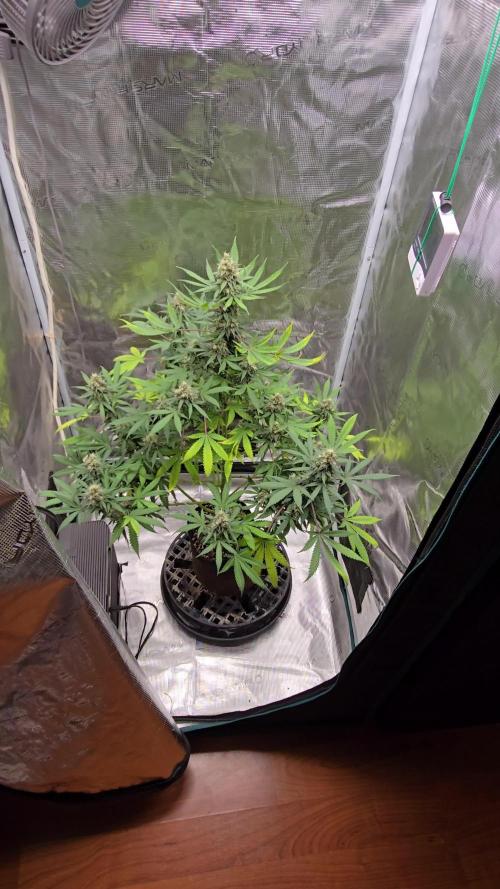
Another week passes and it's official.I will never ever know what strain this is smh .. i feel like she has a few weeks at minimum left so I gave her some green sensation in hopes of helping her bulk up .. hope everyone is doing well.God bless and happy growing ✌️