Likes
Comments
Share
@thonhash
Follow
Subimos algo más los ml de terranabis,buena asimilación y engorde,gracias a enzynabis que busca el equilibrio de todo.
Likes
34
Share
Likes
20
Share
I'ma call her Tracy and she lookin' like dessert She noticin' that I'm stressin' and she asked me, "What for?"♪♪ Feeding 💧 Always foilage with T-rex Shield, MegaKelp+Recharge 25/5 Water 8L+Si 2ml+BioGrow 8ml+TrexGrow 8ml+Calmag 4ml+Whiteroot 4ml ppm530 ph6 27/5 Flush ph6.3 ppm27 29/5 Water 8.5L+BioGrow 8ml+ TrexGrow 8ml+ Calmag 8ml+Si 8ml ppm600 ph6.05
Likes
16
Share
@TAXFR33
Follow
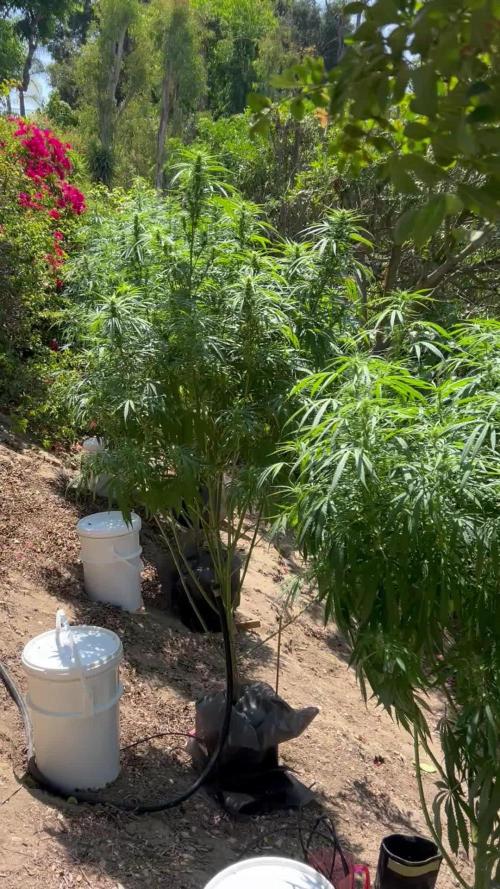
Things are going well, the spot is almost set up. All my 16 auto holes are dug & filled with my super soil - got another 40/50 holes on the other side for my photos and semi autos
Likes
10
Share
@Bud_vista
Follow
Welcome to week 7! She’s doing great in her second week of flowering! She is still stretching and got a bigger defoliation at the end of week 6. For the start she’s getting only ph regulated water from top and some nutrients from bottom. There a little signs on the leaf tip why I skip nutrients for one watering cycle. On mid of week 7 she’s still stretching and first orange pistils shown up. On weekend she’s getting another defloration and another round of nutrients. We are finishing week 7 shortly! She was defoliated once again to ensure more light density in lower conopy. She’s doing still great and she’s not showing any signs of stress or leak of nutrients. It seems that she’s also stopped stretching. Looking forward to the next weeks!
Likes
22
Share
Day 14 she’s loving life. I learned our ph was coming out at ph 8.5 or over so we got that handled and since she’s exploded. I’ve very excited to have her in the arsenal again.
Likes
10
Share
Voltage, also known as electric pressure, electric tension, or (electric) potential difference, is the difference in electric potential between two points. In a static electric field, it corresponds to the work needed per unit of charge to move a test charge between the two points. In the International System of Units (SI), the derived unit for voltage is named volt. The voltage between points can be caused by the build-up of electric charge (e.g., a capacitor), and from an electromotive force (e.g., electromagnetic induction in generators, inductors, and transformers). On a macroscopic scale, a potential difference can be caused by electrochemical processes (e.g., cells and batteries), the pressure-induced piezoelectric effect, and the thermoelectric effect. Since it is the difference in electric potential, it is a physical scalar quantity. A voltmeter can be used to measure the voltage between two points in a system. Often a common reference potential such as the ground of the system is used as one of the points. A voltage can represent either a source of energy or the loss, dissipation, or storage of energy. Dropping the temps will slightly raise the humidity, air holds less % water the colder it is. Lights on 25-35rh% the same water content will spike to 50rh% + at night just by dropping the temps. At night all the juice photosynthesis has been storing up is mashed and mixed up to make all the goodies we need for bud, water is used to transport all these things everywhere, like little solvent transport devices, once a nutrient/protein has been delivered to destination the plant needs to get rid of all this excess water molecules it was using to transport. The only solution at night is to spit it back out into the air at night. During the peak of flower, this can catch a grower unaware, with a 4x4 full tent it can be a challenge to control all that moisture exhaust overnight especially if you're really pushing the limits. We live in a water world, above or below, our misconception is we live on dry land, we don't live in less watery conditions than above or below. We fit into a very narrow band of moisture that just so happens to be full of lots of air and everything else required for life. Got my first full whiff of the smell of purple lemonade, always surprises me how accurately the smell fits names, the dominant terpenes in the Purple Lemonade weed strain are carene, linalool, limonene, and myrcene. Carene gives this strain its sweet, citrus flavor and some woody notes, whereas the linalool I recognize so well from Granddaddy Purp. Myrcene has been shown to have sedative qualities while bringing musky, earthy elements to the flavor profile. Trichome production started to ramp up, and the plant that grew taller/closer to UV showed noticeably thicker coatings. The taller plant shows slight yellowing of lower leaves, and the smaller plant is green and lush but the buds are slightly less progressed, interesting. I super-cropped the main stem of the tall one just over a week ago (clean). I expected it to be the one slightly behind in development. The plant has roughly 10-15% "Total resources" that it keeps in case emergencies arise. Reserves if you will. My rationale behind breaking anything goes hand in hand with slowing things down as production is lost due to the time it takes to repair damage. I recall watching a YouTube video, where a curly hair gentleman would super crop in a manner to damage but not disrupt using a twisting method, using fingers and thumbs placing them close together one goes clockwise other counter clock this varies a lot depending on the thickness of stem but what you wait for is a tiny snap, it may take several rolls to weaken if walls are tough I found. No snapping or bending of the stem, you want just to fracture it but not puncture this way the xylem and phloem channels remain flowing,the damage is repaired almost instantly and the 10-15% is dispatched with very little repair time. Everything in the general vicinity of the stress will now grow stronger so as to prevent further similar damage. This is why I had expected the tall one to lag behind in development once I had cropped it but low and behold it worked and the tall one has slightly more developed buds. The effects of birdsong on plant life may at first glance be far-fetched. Nigh on ten years ago an article appeared in Nexus Magazine on the discovery or invention of a method of growing plants using bird sounds. Christopher Bird and Peter Tompkins describe the development of Dan Carlson’s Sonic Bloom in their book The Secret Life of Plants. Many others have, it seems, recognized the role of birdsong in the growth of plants, and influenced or directly helped Carlson to develop his invention. Dan Carlson’s desire to see that no one need be hungry through shortage of food sought to understand the optimum growth of plants. He discovered that plants also feed from ‘the top down’ as well as the roots. Underneath all leaves are pores called stomata which open to take in nutrients and moisture from the air. Carlson’s observation that the more bird life there is on the farm, the more abundant is plant life, has been echoed by farmers throughout history, except in modern times. Where there is little bird life, plants are stunted, and dwarfed. Nature has the birds sing at dawn and dusk, which dilates the stomata, and so feeds the plants. One can immediately see the importance of trees. The development of Sonic Bloom was to create birdsong, which is played to the plants, while a foliar nutrient is sprayed onto the plants at the same time as they are being stimulated by the sound, to enhance their growth. This method produced fantastic results in the amount of abundantly nutritious produce from one plant, often in poor soils and in drought conditions. Carlson showed that the breathing leaves of plants are the source of the nutrient intake for growth. This of course is also true for humans—the breath is food. We shall discourse on this on another occasion. Plants transfer nutrients to the soil via this breathing, and Carlson showed that his plants improved the soil and helped earthworms proliferate. The secret of Sonic Bloom was the development of the music of the same frequency as the dawn chorus of the birds. With the help of a Minneapolis music teacher, Michael Holtz, a cassette was prepared. It seems that both birds and plants found Indian melodies called ragas delightfully suitable. This is actually quite profound, although the American farmers, especially women, who had to endure this music whilst it was played to the plants, found it irritating. Holtz found the “Spring” movement of Vivaldi’s The Four Seasons appropriate and concludes: “I realized that Vivaldi, in his day, must have known all about birdsong, which he tried to imitate in his long violin passages. Holtz, it is related by the authors Bird and Tompkins, also realized that the violin music dominant in “Spring” reflected Johann Sebastian Bach’s violin sonatas broadcast by the Ottawa University researchers to a wheat field, which had obtained remarkable crops with 66 percent greater yield than average, with larger and heavier seeds. Accordingly, Holtz selected Bach’s E-major concerto for violin for inclusion on the tape. “I chose that particular concerto,” explained Holtz, “because it has many repetitions but varying notes. Bach was such a musical genius he could change his harmonic rhythm at nearly every other beat, with his chords going from E to B to G-sharp and so on, whereas Vivaldi would frequently keep to one chord for as long as four measures. That is why Bach is considered the greatest composer that ever lived. I chose Bach’s string concerto, rather than his more popular organ music, because the timbre of the violin, and its harmonic structure, is far richer than that of the organ. Birdsong has long been loved but also studied with reference to the musical scale and harmonics. As Holtz deepened his study he said, “I began to feel that God had created the birds for more than just freely flying about and warbling. Their very singing must somehow be intimately linked to the mysteries of seed germination and plant growth. The spring season down on the farms is much more silent than ever before. DDT killed off many birds and others never seem to have taken their place. Who knows what magical effect a bird like the wood thrush might have on its environment, singing three separate notes all at the same time, warbling two of them and sustaining the others. Tree and bird life are essential to Earth's existence, which Carlson, Holtz, and others have shown, but indeed others see and feel. “Plants”, says Steiner, “can only be understood when considered in connection with all that is circling, weaving, and living around them. In spring and autumn, when swallows produce vibrations as they flock in a body of air, causing currents with their wing beats, these and birdsong, have a powerful effect on the flowering and fruiting of plants. Remove the winged creatures, Steiner warns, and there would be stunting of vegetation. Nothing more needs to be added here. It has been said that you cannot hurt the humblest creature or disturb the smallest pebble without your action having a reaction upon something else...You cannot think of an evil thought, no matter how private, without it having an effect upon somebody else. Whatsoever you do in life sets up some form of resonance. When I say the morning chorus of the birds awakens the earth I mean that the characteristic song of the birds sets in motion a series of vibrations which react upon other forms of life. Remember, the soil of the earth is full of living microorganisms. The plants are also living organisms. You, yourselves, are living organisms. Now, this is the beauty and wonder of it all—when one aspect of nature has been moved into a state of resonance it immediately relays its vibrational motion to something else. So when I say the dawn chorus awakens the earth I literally mean what I say. I do not suggest that the earth would come to a standstill without the bird song, but I do mean that life on earth would be sluggish and ineffectual without that first instigating outburst of vibrational power poured forth at just the right pitch and tone to set off a chain effect. I know some of you will say, what happens in those parts of the world where there are no birds? Well, what does happen? Very little, I assure you. The hot deserts and the polar regions where there are few, if any, birds are not renowned for their wonders of nature. It is as though they are asleep. Nothing grows, few things live. Little resonates and there is a great stillness over everything. You see, that outburst of sound just before dawn is like the little lever that works the bigger lever which turns the wheel which moves the machine…and so on. Never underestimate small things. Animals are blessed with instantaneous and unthought-out wisdom. They are in direct contact with God and they act and live as though they are fully aware of it. Men are also in contact with God, but most of them act as though they have never heard of God because they are largely veiled from their divine center by their own thinking minds of which they are so proud.
Likes
20
Share
16/01/2022 - Day 91 - First day of the 14th week. Small one being "eaten" by WPM [see snow video], not much I can do, RIP Big one still on the grind, confirmed that it's like she has been topped, there are two main stems but she did all by her self. She is suffering WPM, too, of course, but being a little bigger and stronger I'm removing as much as possible. Wish me good luck and let's hope in sunny mild days 🤞☀️ - DD
Likes
9
Share
Our weather has completely deteriorated, the snow has already broken in the morning, so I see no reason to further torment the plant, and I decide to harvest. Moreover, she almost stopped dialing - as we say "MYEMO SHO MYEMO"😄 Come back in a few days, I will summarize and draw conclusions. Glory to Ukraine! 🇺🇦
Likes
6
Share
Going good so far, starting to show some frost. Draining the ac Infinity self watering bases every other day. The grow dots seem to be giving it what it needs. Added the ac Infinity s24 with the Evo 4 in a 3x3 today giving the tent 500 watts. Day 52 she's looking great, nice bud sites forming. I can't believe early on I almost gave up on her because she was so small but she has really turned it up and will be a 4 ounce plant easy.
Likes
Comments
Share
Done with drying, I cut her bud sites and placed them into a mason jar. I bought the boveda packs that are 62% RH. Now time to sit and wait 2-3 weeks and see what the finished product is like. Again everyone thank you for watching the grow up! 🙌🏾🔥🌱 I do have another diary with 5 auto berry’s, if anyone would like to continue watching the grow up. 🙌🏾🔥🌱 I have a lot more confidence in the autos just because this grow was my first time grow. Now I know the basics and everything else on what to do, so better and bigger buds on my next grow. ✊🏾😎
Likes
9
Share
@Soskar69
Follow
This strain had a very strange behaviour. It was the first to germinate, and at first had the fastest growth. But at the 3rd week she started flowering. I've done some LST, but after entering in flower, the plant stopped entirely to grow, and I was left with only 5 branches. On the other hand, now the colas are very big, the biggest I had ever grown. They are very thicc, sticky and dense. The smell it's very delicate, a lil minty I would describe it.
Likes
15
Share
@Uwish
Follow
we continue the run with the slowing down of the stretch and the beginning of the beautiful flowers. This week my EC indicated me some things... It was at 1.8 and went up to 1.9, so I added water to lower the ec to 1.6. When my ec goes back up it tells me that I have enough nutrients in my solution. Now, the ph is back to 1.7, I will add more water to bring it down to 1.5. We can observe on some leaf tips a beginning of over-fattening, this is what I'm talking about above, I'll let you know next week if I lower the ec or if I keep 1.5. I did one last defoliation and it was needed! If you look at my vitals, it's not crazy, 70% humidity at this time of the year can become problematic, so I'm going to take the dehumidifier out and set myself at 55%.
Processing
Likes
13
Share
Pretty slow week... no added nutrients or changes. Sticking with a light watering every few days or so. Other than that, just admiring and watching them- letting them do their thing :)
Likes
Comments
Share
Vamos familia, actualizamos la sexta semana de floración de estas Sagrada amnesia de Seedstockers, salieron las 5 de 5, 100% ratio éxito. Aplicamos varios productos de Agrobeta, que son increíbles para aportar una buena alimentación a las plantas.( Justo esta variedad 2 de 3 son bastante sensibles y marcan en las hojas exceso pero no están las puntas quemadas) Temperatura y humedad dentro de los rangos correctos dentro de la etapa de floración. La tierra utilizada es al mix top crop, por cambiar. De 5 ejemplares seleccioné los 3 mejores para completar el indoor y trasplanté directamente a macetas de 7 litros, el fotoperiodo a 12/12, también aplique una buena poda de bajos, se ven bien sanas las plantas, tienen un buen color y progresan a muy buen ritmo por el momento, ya progresan las flores, llevan ya una tricomada… increíble. Agrobeta: https://www.agrobeta.com/agrobetatiendaonline/36-abonos-canamo Hasta aquí todo, Buenos humos 💨💨
Likes
10
Share
Raíces bien pobladas, trasplántadas a maceta definitiva de 7 litros, utilizamos micorrizas Myco Jordan 1gramo por planta y fertilízanos con enraizante deeper underground.. daremos algunos días más de vegetación y pasaremos a fotoperiodo 12/12 👨‍🌾🏾
Likes
17
Share
Watering has jumped up to every 2 days ph 6.3-6.8 with 20% runoff Flower Fuel has been added to AP,GG and ZK watering's. Lights have been lowered to 24-28 inches. White Widow just started flower at end of the week. Still waiting on the Cream Cookie. Doing light Defoliation to expose bud sites to the lights.