


Likes
Comments
Share


@Weedganja420
Follow
Ha sido una de las mas productivas de las 8 que tenia en el pequeño armario.
Voy a repetir esta cepa en mi siguiente cultivo ya que me ha encantado.

Likes
15
Share


@tokesly
Follow
Realized just how intense manual feeding for coco is. Takes up to 3 hours to mix the nutrients, water, and wait to empty the saucers. And I'm just doing this once a day, imagine the experienced growers feeding 3+ times a day. Definitely would be ideal to have a drip/drain system installed in the future. Pheno 2 got so lanky and heavy it fell over! A scrog and bamboo sticks would've helped a ton. Placed a peony cage to support the branches but it's hard to get it angled properly with the branches grown out. Boosted the PK again this week and halved the Bloom Nutes.

Likes
6
Share


@Blunt
Follow
20/06/22 - 26/06/22
Plants are growing well, very frosty. Turned light up to 85% and increased the flow of water.
Been lightly defoliating as necessary to expose those bud sites
Decreased Dual Fuel to 1.25ml/L, stopped root hormones as well.

Likes
6
Share
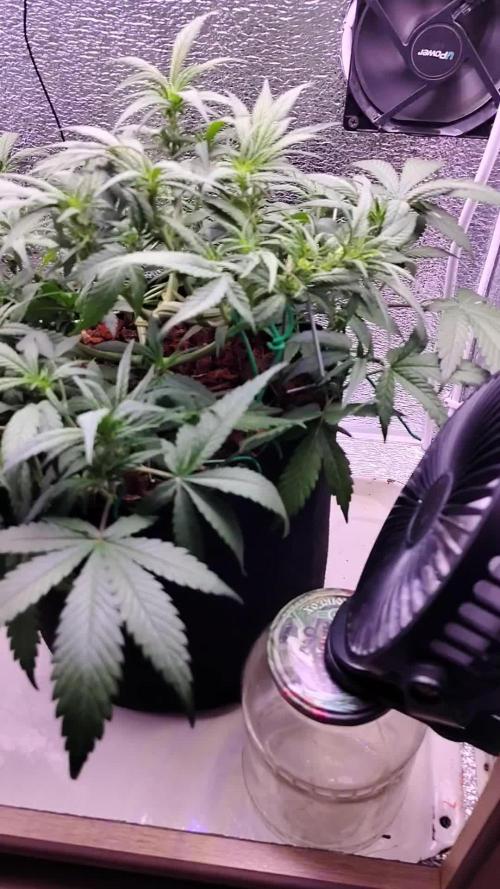

@Meo0ow
Follow
There are clearly some minor issues with the tips of some leaves, but we'll manage. A mistake was made during one of the previous waterings; I mixed up the bottles. Instead of the usual watering, it was given full-fledged pro-organic flowering food, and the soil before watering had more than enough food until at least mid-flowering. We're expecting a crazy transformation in the next week; it's rapidly gaining purple hues, so we'll keep an eye on it. There's a war going on in my country, and unfortunately, we're starting to have power problems again as winter approaches. Today, for the first time, the power went out for four hours without warning. I don't have any independent power sources, so there could be major problems; they're predicting long blackouts in the winter. I really hope we'll be able to harvest before the hard times come.

Likes
4
Share


@IamCy
Follow
Week 2. Just the normal stretch. Nothing eventful. After this week, I'll be giving random weekly updates due to my busy schedule.
Processing
Likes
15
Share


@Hawaiian
Follow
First grow ever in my life. I hope I’m doing it right. Any help would be greatly appreciated
Likes
12
Share


@eldruida_lamota
Follow
Que pasa familia.
Noticias buenas y malas, de 3 ejemplares, uno nos salió hermafrodita. Empezó a formar plátanos esta semana y al estar tirándolos en ramas distintas, cortamos por lo sano y ADIÓS.
Quedan 2 subimos cantidad de comida, pegaron buen estirón, y las flores están formando sin problema alguno.
Dejo muchas imágenes y vídeos de esta semana, y ya deducen ustedes.

Likes
14
Share


@MG2009
Follow
03/03/2022
Down to one Lemon OG, one Biscotti Skunk, and three Grape Skunk all looking super vigorous
including Lemon OG .
Very happy with the genetics so far trimmed up the legs a bit lots of potential clones!
Ps.
Forgot picture of Biscotti Skunk it's lights out so that will get done tomorrow.

Likes
127
Share


@DutchFarmer
Follow
Weekly Update on the Runtz 🌱
Hey everyone! Just wanted to share how the Runtz is coming along. She's thriving under the care of the Plagron nutrients 🌿, reacting beautifully to every feed. Since my last update, she’s sprouted several new nodes and is showing incredible growth!
https://plagron.com/en/tools/grow-schedule-calculator
She’s definitely growing like a sativa 🌳, with those long, stretchy branches. To manage that, I’m planning to enforce some solid training techniques to keep her short and wide, just the way I like it 💪✨.
I’m loving the whole experience so far, it’s been such a rewarding journey 💚. I’ve attached plenty of pictures for you all to check out 📸. Please drop a like, leave a comment, and share any feedback or tips you’ve got! 🌟🙌

Likes
3
Share


@I_roll_my_own_420
Follow
Flushing started. All looking fantastic and smells even better. The biggest bud of Amnesia Bilbo is 18cm long and 7cm wide. Cant wait to try it after curing. So now only clean water is given. Peace and love 💚


Likes
19
Share


@DeepRootsGrowTrees
Follow
DREAM SHERBERT AUTO / KANNABIA
WEEK #11 OVERALL
WEEK #6 FLOWER
This week she's doing good nothing negative to report this week, she's got a nice aroma to her, buds are looking dense she's got nice structure to her. Stay Growing!!
Thank you for stopping by and taking a look it's much appreciated!!
Thank you KANNABIA 😊!!
Kannabia.com DREAM SHERBERT AUTO

Likes
59
Share


@AsNoriu
Follow
Day 64. Another week without issues .... UK got cold wave, so night's 17, days 19-20 , this girl is OK with it , vegging sisters develops very slow tho ...
Decided to go without any feed, gave her weaker light, just to boost younger sisters.
Girl look well maybe even overfed ;))))
Day 65. 120 ml 6.3 pH water in .
Happy Growing !!!

Likes
21
Share

@MG2009
Follow
01/01/2022
Potting up and amending with
5-2-4 to give a little kick before mid flower
#6 is first girl to show herself, also got two different males and only difference is that one is lighter green and other darker green
(also dark green one seems to drink more than lighter green) 💚. Other than that structure is very similar I wonder which is a better breeding male? I guess I might pollinate and LABEL TWO BRANCHES ON each female one for each male. and find out.🙏🏻
01/06/2022
#3 showed today, reppoted and into flowering closet, along with#6,who showed earlier this week lights at 14-10 see how they respond to that schedule, which should help use up the 5-2-4 going into week 3 should help with her stretch. Which isn't really that much I believe maybe double her current height, which I will check at lights on.Week ,#3 if I think of it I'll give a good fungal dominant tea.


Likes
70
Share


@Insaniac_0
Follow
All feeds with nutes use either a whole ratio or combination of "Veg Mix" and "Bloom Mix"concentrates DILUTED in water until a total ppm of add in is reached using a (Total Dissolved Solids)TDS Meter measured in PPM (parts per million). The "Veg Mix" concentrate will eventually be added in smaller ratios and "Bloom Mix" concentrate what will eventually replace the "Veg Mix" concentrate entirely with the ppm and ratios listed when I feed. Veg mix recipe is on week 3. Bloom Mix recipe is on week 5.
Day 49
VPD is okay now - temps at 75F RH also now at 65% with ILVent at 50% = VPD of 1.04 -
ppfd also same as yesterday mostly 480 to 490 around the ring with 510 and 520 in the center
Took ph readings as well - 3 readings 6.43, 6.48, and 6.37 to avg 6.426
Which is good because she's starting to show signs of stress after the topping and defoliation from a couple days ago. The leaves are starting to curl at the tips and the bronze color stripping is happening again - however this time seems to be a slower progression so Im hoping that having the correct ph this time will help while she's re-routing her resources. I 'did notice also that the growth tips seem to be growing at a slower rate than before - I think she's at her limit in colas and the roots are having to find more space to spread, may even be too big for the 5 gallon pot. I have no plans to change her out just yet, but will monitor.
Soil is drier today - so I will be watering tomorrow with de-chlorinated water at 6.4ph
Day 50
VPD was good at 74/64 with the tent open while I feed that I left it open for a bit and took time in feeding and cleaning - after all that still good at 74F/61%RH/50%ILV
ppfd was checked after water and setting back - same as yesterday as most of the newest growth is still coming from the new colas - most seem to be adjusting 1 at a time in each split but both are showing growth now on all cuts.
Started feed by making new ph buffer solutions, calibrating/testing both meters. The have about a .15 variance between the two.
Checked weight and made 1.5 gallons of feed. started at 228ppm added 450ppm veg and 150ppm bloom for a total of 833ppm feed/epsom salt - splashed h2o2 and ph'd to about 6.4- I fed via watering can and spray and fed the whole amount slowly since I was feeding until bottom drip and she took it all before starting to bottom drip. Afterwords I let her drain (about a quart came out) and checked ppm from runoff at 2500 (telling me she's okay but isnt eating as much as before her topping yet) ph is a mystery - I show 3 readings from top level of 6.62, 6.57, and 6.57 for an avg 6.586 but 2 separate readings from 2 meters (4 readings total) on the bottom runoff showed 5.3 and 5.6 then confirmed later. I expected a variance since the wood ash probably stuck to the top side of the soil - but I didnt expect that much of a difference. I will monitor but honestly dont know what I should do, if anything other than watch.
made a video of the fan movements and runoff drip
Day 51
What I am calling "stress burn" is progressing as expected. I am monitoring the ph from the top as I did before, but again, not much I can do other than over water, so I'll just watch for now and compare rate of spread until she fixes her resource pathways. It seemed to take about a week to clear up after the ash treatment last time, so I am on day 3 of 7 for now with no treatment. Looking for a spurt of new growth to show and then I'll know she's better.
Adjusted the lights to accommodate a week 6 level of 500 to 600 ppfd - that means I can raise the lights to the top of the tent and increase power. So now set at 3 tick up and 37 inches from the soil or 26" from the plant top. Now her ppfd reads about 540 on both of the center colas and 500 to 510 on the surrounding ring.
Adjusting lights meant I had to adjust the fans up to medium power and re-directed them to blow at the edges of the pot; made a video.
VPD is steady, but still warmer than typical (only by a couple degrees nothing too much) 76F/61%RH/50%ILV for 1.15 kpa on room VPD
Day 52
VPD is higher now that I have the lights to the top of my tent and the fans on the lights blowing down at the pot. I moved the IL Vent to the top sucking out with the motor and vent outside the tent now.
I also opened two lower air holes with my heater set for fan on the opposite side of the tent than the vent. Currently, I am at a max of 1.2 room VPD and ranging down to 1.0 so I'll take it until it does something else. 74F/65% RH/75%ILV - I will monitor to ensure it's stable.
ppfd is same as yesterday as there's little growth still.
Spots are still progressing on the oldest leaves at the same rate as before - however the newest leaves are not showing signs yet, so I will continue to monitor.
Day 53
ppfd was a little changed today, showing that there's growth coming back now. lowest on outer ring was 500 with most at 520 and 530 highest, center colas were tested at 540 and 560ppfd. VPD was stable as I watched it most of the day since I made changes yesterday. Temps were 74 to 76 and RH was 61% to 68%. ILV was set to 33% with the bottom heater on fan to draw in air.
lockout continues on the oldest fan leaves at the last top nodes. New growth is already marked in a couple of spots. I have about 6 gallons of tap water burning off chlorine now and will use about 2 gallons to flush at 8ph. I plan to dunk this weekend with feed so this will allow time to dry out and hopefully reset the ph and lower my ppm readings at the lower part of the pot before then.
Day 54
Took Control pics measured VPD and ppfd
Lights are at the top of the tent and second tick from highest power level. Lights to soil is 37 inches and lights to plant is 12 inches shorter so 25 inches leaves to light. currently ranging 530 to 550 around the ring and 575/580 ppfd at center (after feed and replaced).
Moving the lights (day 51) made the tent hotter so I changed my ILVent to suck out at the top and fresh air in at the bottom - I have been fighting to keep temps under 78 managed to hit 74 to 75 with the heater being set just to fan for the bottom air vents- I did also raise humidity to a setting of 65% a day before moving the lights, so Im hitting 61 to 68% between power cycles on the humidifier. Overall Tent VPD is 1.0 to 1.2 as max.
Took controls for feed. Weight 16lbs 11oz. tested and calibrated 2 meters and took 4 ph readings of 6.55, 6.77, 6.53, 6.85 to avg 6.675. from top of soil (last runoff measured 5.6 and 5.3 on two meters)
prepared 2 gallons of feed at 500 ppm over tap. (burned chlorine off overnight) starting ppm was 217 - added 75/25 veg/bloom ratio. ph balanced to 7.8 and 7.63 on separate meters (rinsed and retested to be sure got 7.79 and 7.63 again)
I used 4 knitting needles in the soil about 3 inches from the plant center. Poured feed water over the needles until it pooled slightly on top of the soil, I then pulled the needle out a little to allow the water to drain into the holes better. I did this in 8 different spots. As soon as she started dripping water from the bottom I poured a little on the leaves and then moved the plant to another drip pan to finish pouring the rest over the top of the soil without dripping any over the sides. Took videos of the drip and waited 10 min before putting her on another clean drip pan and back in the tent.
Runoff from second drip pan was measured twice at 5.8ph and 2410 ppm - and first pan 5.85 and 2670ppm (expected higher ppm since I moved perlite on the bottom with the needles)
Defoliated the oldest leaves before lights out.
Day 55
She mostly looks like she appreciated the clippings and ph balance from yesterday - slower progression of the lockout issue and largest new growth since topping day.
So speaking of new growth, I plan to use LST in the next few days to set these colas in what will hopefully be their last bind around the ring.
VPD is steady at 75F to 77F and RH is between 63 and 68%. My ILV have been set to 33% and the lower fan blowing rather than heat.
top soil ph was measured with 3 readings, on a tested and calibrated meter. 6.47, 6.7, 7.12 to avg 6.763 (kinda wild in those readings so I double checked them all twice and got the same in each hole)

Likes
1
Share


@Ganjagrandaddy
Follow
Day 28: The Girlies are doing well. C Banana is forming some nice buds and node stacking but is still a lot less productive than her stablemate. She is getting g a tacky feel to her and has been stripped out to get some air and light to the mains forming.
Monster Zkittelz is keeping her namesake at the front of her plan and is growing daily. She is a very good producer so far and her nodes are less stacked but plentiful. They are taking the feed at a very good rate now and I am having to refill the res twice a week now. Buds are stacking up on these girls nicely and forming long looking main colas all over the place. I think C Bananas poor start has certainly held her back.
Likes
63
Share


@Wicked_Stix
Follow
Day 14 for the frozen diesel and she is doing her thing. Topped her on day 11 and she's branching out. Upped the maxigro a little.


Likes
40
Share


@Kitties_and_Colas
Follow
~_~_~_~_~_~_~_~_~_~_~_~_~_~_~_~_~_~_~_~_~_~_~_~_~_~_~_~_~_~_~_~_~_~_~_~_~_~_~_~_~_~_~_~_~_~_~_~_~_~_~_~_~_~_~_~_~_~_~_~_~_~_~_~_~_~_~_~_~_~_~_~_~_~_~_~_~_~_~_~_~_~_
❤️💡🌱😽💨
We finally got our calmag order, these girls were begging for it..the color is a little limey on 1:2 but she should be just fine.. plants are praying a lot, i take this as a good sign. Buds are forming fast and given the node spacing I think they'll be nice and long.. We removed most the top fans and cleared the bottom 1/3 growth from all plants this week, light penetration is awesome , we're still at 75% power with the Solux 350 but this seems to be more than adequate for now (we're trying to keep power consumption low between 4 active tents to avoid anymore power issues).. The Solux 350 is surprisingly cool, i genuinely thought we would be fighting heat with driver inside but is as cool as all other tents in the room.. not too much else to report, its been a great week!..Thanks as always for dropping by and happy harvests folks!!
⚡Hortibloom/Solux 350⚡
Specifications ⚙️:
Diodes: Samsung LM281 Pro / Osram DR (1,440 total)💡
Driver: Inventronics 350 watt🔌
PPF: 1015 μmol/s ☢️
PPE: 2.9 µmol/j 〰️〰️
Lifespan: 50k+ hrs ⌛
Weight: 14.3lbs lbs (6.5kg)
Veg Coverage: 5 x 5 ft 🌱
Flowering Coverage: 4 x 4 ft 🌼
-Uses an aluminum heatsink (no fan), quiet while operating 👂⬇️
-IP65 waterproof ratings, tolerant to high humidity grow environments 💦
-May be daisy-chained via RJ14 and managed from a single controller 💡~💡~💡~💡~💡
🌎 https://hortibloom.com/products/solux-350-led-grow-light
~_~_~_~_~_~_~_~_~_~_~_~_~_~_~_~_~_~_~_~_~_~_~_~_~_~_~_~_~_~_~_~_~_~_~_~_~_~_~_~_~_~_~_~_~_~_~_~_~_~_~_~_~_~_~_~_~_~_~_~_~_~_~_~_~_~_~_~_~_~_~_~_~_~_~_~_~_~_~_~_~_~_


Likes
89
Share


@Gunnen
Follow
So another week and some more thickening and ripening. The smell is like blueberry on one and the others are sweet as well. Slightly different smell to each. Watering when dry still at pH 6-6.6 and monitoring overall plant trichomes. At this point it's autopilot to the end. No more feeding with slow release and will slowly flush the remaining food out next few weeks. I like my trichomes to have some amber, not too much but mostly cloudy with some amber. Seems like most will be dense, except one plant I've called corona virus. It has smaller buds but are really resinous and smelly. Cheers and happy growing!
