


Likes
Comments
Share


@Sti_Cazz
Follow
I hardly watered, tried to feel their water need and only gave a bit of regular tap water (left out for 48hrs)...not doing nutes until I see def.

Likes
8
Share

@Pot_Portraits
Follow
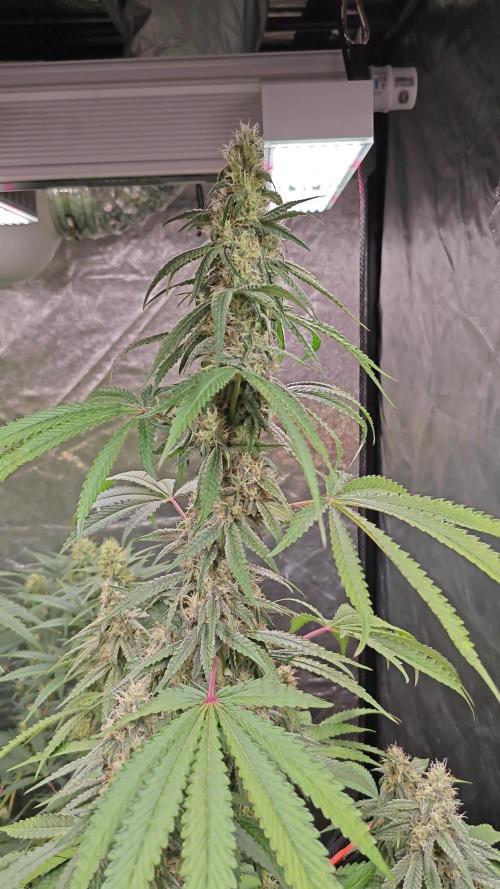
Third one in the video, candy kush express, beautiful compact plant, she is growing fast and has a beautiful structure. She won't need long to finish her flower cycle ⚡

Likes
6
Share


@Mr_Maes
Follow
This girl is by far the healthiest plant I have ever had at this stage. By healthy I mean she is the biggest, the greenest, and has the thinckest stem I have grown yet. Today is day 28 from seed and she is as thick as a marker lol. I grow in small 5 gallon pots. My stem is normally as round as a milk jug cap. I feel like this could do better.


Processing
Likes
16
Share


Likes
35
Share


@ISCA_Abi_In_Da_HOoD
Follow
Im Come back .
Je suis de retour comme Gandalf .
Fillere selam .
Sweet Seed
Mandarine Zikittlez Fast
Strawbery Cola Sherbet Fast
Non game no pain
Likes
1
Share

@PapaTerps
Follow
Zu-Tang Clan - N.Y.Ceeds
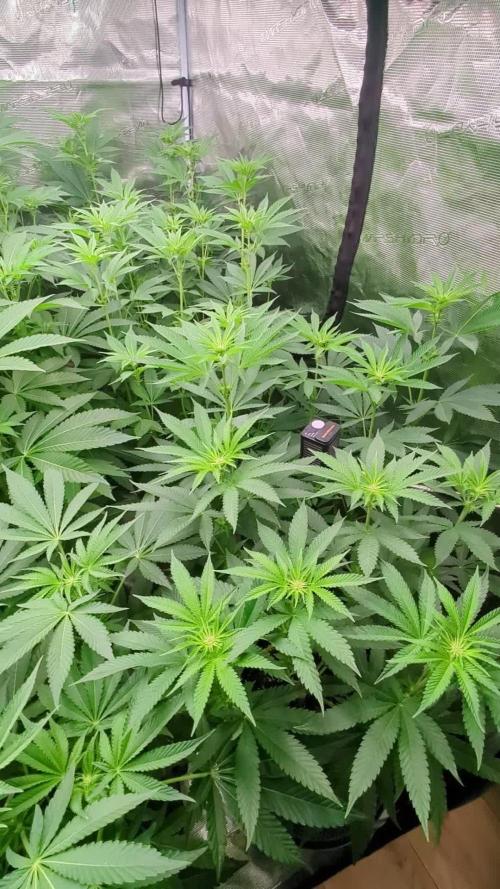
Week 2 of Bloom
🚿 Watered every three days this week, with 3L of RO water, with nutrients mixed individually, in order and then finally, I pH'd the solution to 6.3. I've increased her bloom nutrients again, and I will continue to do that over the next few weeks to keep up with her growth requirements 👍🏻
✂️ No work on her this week, I tend to leave my girls alone during the first and second week of bloom.
🌸 Week 2 of bloom and she's doing great, she's stretching really well and her budsites have the beginnings of flower, so she's well and truly into bloom now! Soo. I'll have start managing the odour, as the tent begins to fill with that beautiful scent 🙌🏻
PS: Sorry for the generic photos, I didn't want to move the girls around for pics - the Zu-Tang is at the center back; the tallest plant 👍🏻
💡 PPFD: ~700
♒ VPD: 1.28kPa
PH: 6.3
🌱 Days from seed: 70
🌸 Days in Bloom: 11
Likes
111
Share


@Cyrusdavirus
Follow
Kannabia Seed , Columbian Jack
High everyone 👋 another week in the books and the ladies are looking pretty good 👍 I'm not sure on training for them yet but it's almost time to start 😀 I'll have to decide what I'm doing very soon.
I received and installed the new UR45 from Mars Hydro they are UV-IR supplement light bars designed to fit the Fc6500 and Fc8000 I'm excited about having them in my growroom. Check out my Instagram if you want to see closer pictures of them installed.
Mars-Hydro.com discount code " Cyrus "
Thank you Mars Hydro and Kannabia Seed Company

Likes
6
Share


@Lazuli
Follow
Buds are very dense and hairs start to go brown it smells amazing
I lowered the nutrients strength a bit i aim for a 800ppm runoff

Likes
19
Share

@Kirsten
Follow
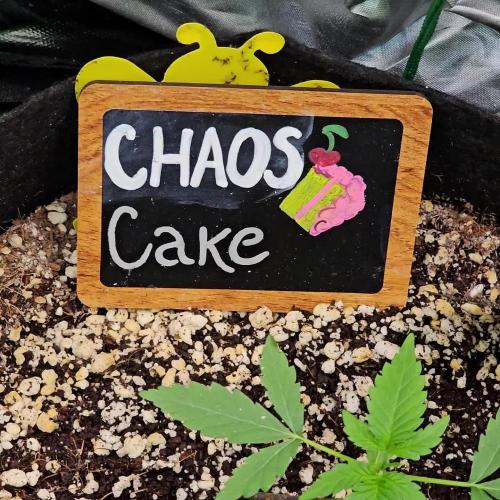
Unfortunately, I've let the Chaos Cake become too dry due to the fungus gnats, I had watered it too much, and afterwards, I just got a huge increase in the amount of fungus gnats.
So, I thought it was best to let it dry out for a while.
I think, however, I might have left it a little bit too long because it was incredibly dry.
So when I watered it, it actually made the plant fall over. So I've had to prop it up with some metal garden pegs.
Hopefully, she'll rectify herself if I make sure that the medium is properly. Watered.
Other than that, the plant is doing well. Hopefully, she'll start becoming a little bit more sturdy next week! 😅
I have added an additional 100Watt UVA/UVB lamp, as the uppermost canopy of Acapulco Gold is blocking pretty much everything in the tent.
Hopefully, this will aid the shorter plants in surviving until I can harvest it. There will be so much more space and lighting. Can't wait! 😅
Here is what I did this week.
28.9.25:
I watered with 1.5L of dechlorinated water PH'd to 6.2 with;
💜 Sea K .5TSP
💜 Biosys .5TSP
PH: 6.2
PPM: 565
The fungus gnats have really increased since I did a watering of the whole tent.
I have some more sticky traps set out, and I will not water for several days.
Once it has dried the top soil, I will add some more Diatomaceous Earth to the top 5cm.
Thanks for checking in this week, and see you in the comments 👌💚🙌🧡😁

Likes
2
Share


@Ninjabuds
Follow
Ive got two Skunk Apple Runz plants(tossed 1 when I repotted the plants) with exotic-looking leaves and some great genetics. These are seeds I made and both the parents were top notch. They're both about five inches tall and growing strong they both seem to have the growth strength from the ricky bobby Unfortunately, one of them might not make it because of some damage or mutation im not sure, it just seems to have stop growing upward correctly but the other one's looking really healthy.
Happy late turkey day grow diaries world!!!! It's now day 24 from seed for all the seedlings I have going. The past few days the plants have really started to take off. There roots have really started to dig in. Every other water I am still giving 2ml per gal of fox farm grow big. I keep having to tell myself not to add any more nutes other than that. I don't want to fry my plants but I also want they to start jumping. I'm quite excited for the coming week, I think the next 7 days or so is when the plant really starts to transform and look more like a pot plant than just some random little green thing.
A few days ago I decided to move the plants from under my 55w cheep amazon light to under my spider farmer 100w newer version light with the good leds in it. The plants will hopefully be ready to up pot them here soon and get them in the large tent.
Sometimes when growing multiple different strains it can be really hard to balance giving to much or to little light. You don't want the faster growing plants to get to stretched out waiting on the slower plants to catch up
I spend Thanksgiving day morning transplanting the plants into 2gal pots. I am useing spme promix potting soil it's my 1st time tring this soil. It is actually doing really well the roots were all white and nice looking. I think next time I'm going to add some worm casting, kelp, granular mycos, and a little bit extra perlite. I just didn't have the money with christmas coming to splurge for all the extra stuff. I got rid of 2 plants 1 of the bubble og and 1 skunk apple runtz. There is only room for 10 pots in the 2x4 tent. I will peob only bring 8 of them to flower, always good to have back ups. Yesterday I also stuck the plants back under the 500w medicgrow mini sun 2 in my 2x4 tent. They did great under it the 2nd half the day I was happy they didn't get stressed. I had put them under that light a little early about 10 days ago or so. I am expecting in a week these plants will ge going crazy with growth
Likes
167
Share


@DeepWaterGrower
Follow
⭐ TrolMaster tracking ⭐
I started to track my crop during week 15, when I got the Tent-X TCS-1 by TrolMaster. First impression was: this is too professional for me, I can't handle setting it up and using it well. Then I started reading some posts on Instagram, I visited their site and in 5 minutes my cultivation experience took a huge step forward with disarming simplicity, I couldn't believe it.
I have uploaded tracking videos from the TrolMaster app for each week from the 15th to the 19th, as well as the two weeks of drying stage.
⭐ Controller Chronicles ⭐
Day after day I appreciated the clarity and precision for data, access to all settings and instant readings by connecting a WIFI router to the controller's LAN port. I loved the possibility to dim my lamps remotely, or even automatically based on the temperature in the box!
🌱 GERMINATION (2 days)
Seeds in a glass of EC 0.4 tap water for 10 hours, then in root riots and under the lamp. They sprouted after 48 hours from dry seed.
🌿 GROWING STAGE (10 weeks and half)
I decided to give these plants a long vegetative growth and this allowed me to do a lot of training on both.
Starting from the 4th veg week I started with defoliation sessions every two weeks, for a total of four during the entire vegetative phase. The last defoliation was done a couple of days before the switch, in order to allow the lower parts of the plant to get as much light as possible.
Furthermore I did Topping on week 6, cutting the apical branch, then on week 8 I did Topping again on several sites, as well as SuperCropping on the highest branches to make the canopy uniform.
The light cycle I used is 18/6 and the last two veg weeks I lowered the light hours to 16/8 first and 14/10 then.
During the veg stage I made 4 DWC change, PH was always between 5.5 and 6, about EC I started with 0.6 and was 1.4 on the last veg week.
🌸 FLOWERING STAGE (9 weeks)
I started this phase after 36 hours of darkness, I then changed the DWCs solution (adding a flowering stimulator).
Then I mounted the ScrOG-net about 50 cm from the base of the plants and I wove the phenotype #1 through the net occupying at least 60% of the available space; the phenotype #2 stretched shortly after the switch and I used the net only to widen the central branches.
They showed the pre-flowers two weeks after the switch, then I made two defoliations on week 3 and 5 flo.
During the last four weeks of flowering (weeks 6-9) I simply paid attention to the PH-EC levels to provide the roots with optimal conditions. I then kept the TEMP-RH-VPD-PPFD values under control and this also thanks to the Tent-X controller by TrolMaster which allows me to provide optimal conditions also above.
I chopped them when trichomes were about 85% milky and 15% amber.
During the flowering stage PH was always between 5.8 and 6.2, about EC I started with 2 and was 2.3 on the last week before flush.
✅ HARVEST
- From dry seed to harvest: 140 days (2 days germination + 75 days veg + 63 days flo).
- Chopped after 4 days flush and 48 hours in dark;
- Wet trim, removed fan leaves.
✅ DRYING STAGE
- Time: 14 days;
- Average: 20° C - 50% RH.
- After that I made a dry trim, removed branches and sugar leaves.
⚖️ DRY WEIGHT
- Phenotype #1: 230 gr buds + 25 gr larf;
- Phenotype #2: 105 gr buds + 50 gr larf.
So, the overall dry weight is: 335 gr buds + 75 gr larf.
✅ CURING STAGE
- Curing is done after 30 days with Boveda 62%.

Likes
3
Share


@SelfCultivationGrower
Follow
I think 2 more weeks of flower for the normal phenos and a lot more weeks for my long veg. Pheno of Fat Banana
Likes
2
Share

@eldruida_lamota
Follow
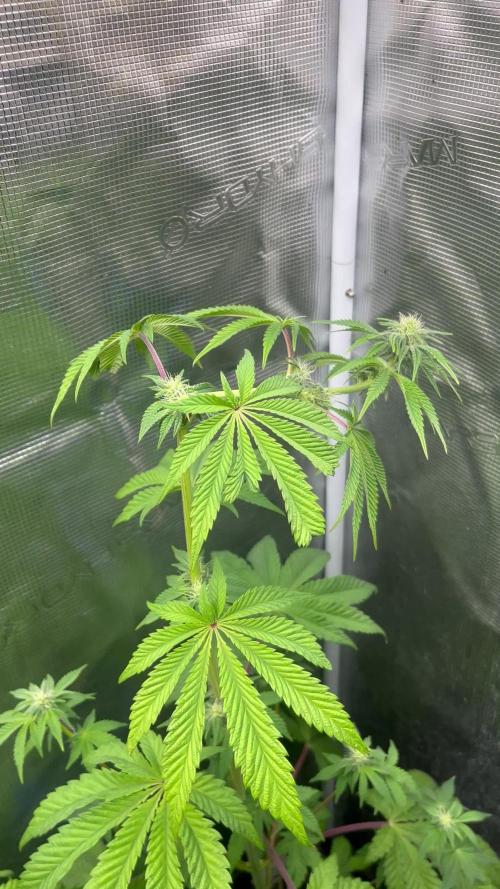
Que pasa familia, vamos con la tercera de floración de estas Pink Sunset feminizadas de silentseeds.
Vamos al lío ,se trasplantaron en macetas de 7 litros definitivamente.
El ph se controla en 6.0 , la temperatura la tenemos entre 24/20 grados y la humedad ronda el 50%.
El ciclo de floración puse 12h de luz, el foco está al 80% de potencia.
De momento van creciendo a buen ritmo y tienen un buen color.
Agradecer Agrobeta por el envío de un kit para la temporada, son unos jefes.
- os dejo por aquí un CÓDIGO: Eldruida
Descuento para la tienda de MARS HYDRO.
https://www.mars-hydro.com
Hasta aquí todo, Buenos humos 💨💨💨

Likes
16
Share


@SirBudAlotts
Follow
So this week was just a few adjustments in regards to environmental conditions...done abit of defoliation for air movement and prevention of extra moisture...The aim is no mold or bacteria having any chance to multiply or even exist..absolutely not! I ain't about to ruin this ladies!
Other than that...no issues..just maintain the process and environment. I do not want any major changes in that regards, especially during the early flowering stage.
I would like to thank all the Grommies for checking out this grow and showing love.🌿

Likes
34
Share


@Northern_Ent
Follow
Sep 21: Bruce here is in third place for flowering pace but she should be close to done in time. Added some potassium sulphate to the water.
Sep 26: buds are getting bigger but the cold weather is getting closer. Not many more days available.
Likes
23
Share


@NSCanna
Follow
The Black Devil's OG is trucking along without issue, while the Northern light is a tad on the droopy side at night and is likely expecting earlier night hours. I will likely adjust my light schedule to reduce the stress.
The videos posted came out pretty well, considering they came out of a cell phone camera. 400x ends up being really blurry as the phone can't focus properly to compensate, but you can still see all the bacteria dancing around. Some nematodes and ciliates there too.


Likes
16
Share


@Mrs_Larimar
Follow
Everything looks fine Her the Planties have established in their
Growingarea
showing strong leaves and good little stems.
💀👽
Iam having Problems to upload the video and some Pictures too😨
website for for my Fertilisers:
https://greenbuzzliquids.com/en/shop/
Code: mrs_larimar
Breeder Info:
👉Black Sugar is an indica dominant hybrid of Black Domina, L. A. OG and Critical.
It has kept the medicinal properties of L. A OG, a good flowering rate on the Black Domina lineage,
and the compact size of the classic Critical strain. With its small growth, the strain produces large yields
of up to 600gr/m2 on bushy branches. The buds are very dense and stinky.
Black Sugar has a high THC level. The variety has a fruity citrus aroma. Dense smoke gives the effect of relaxation and body buzz.
Good for Smoking before going to bed. It can become one of your favorite Seedsman strain
Genetics Black Domina x L.A OG x Critical
Harvest 450 - 500 g/m²
Flowering 50 - 55 days
THC 20.0%
CBD 1.0%


Likes
40
Share


@GardenOfHerbs
Follow
- she was harvested this morning on day 75, all pics are right before/during/after harvest
- flushed for 12day, there was a slight fade but she was still pretty green, didn't want to wait any longer though
- now drying in my cardboard box, harvest report will be up in 10 to 14 days as usual when everything is nice and dry
- added 2 video's of her frosty ass haha
Likes
33
Share


@FlavoursUk
Follow
Had great results, especially when i upgraded to RO water.. if theres one thing i could of changed it would of been using the reverse Osmosis water sooner.
The rest of the grow was pretty easy, didn't even plant train as this was suppose to be a hassle free run. It was just that. Some good genetics from seedstockers too.
Good stuff!
