Likes
Comments
Share
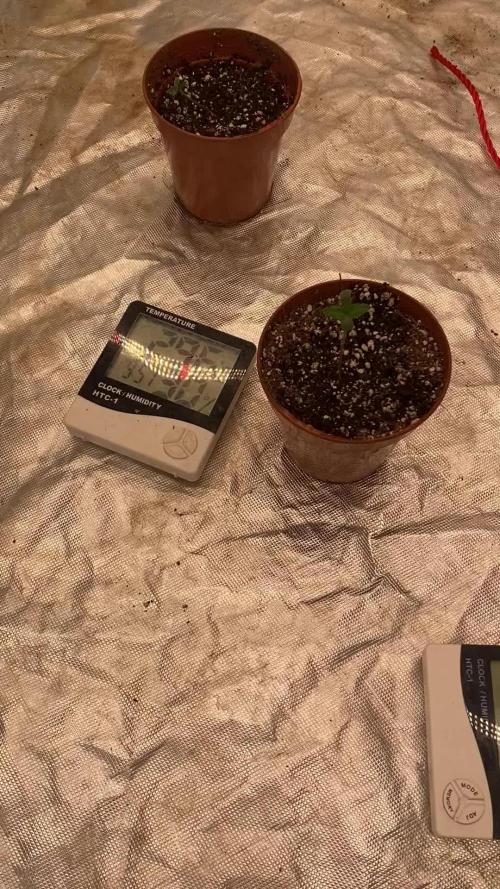
Beautiful looking ladies, after 17 days from seed no issues at all, great performance by this 2 ladies, let's see how they keep developing and how big they get before flower! 💚❤️💛👨‍🌾
Likes
17
Share
8/23 I WATERED THE NATURAL MK ULTRA AND THE 10TH PLANET IN THE BACK WITH A GALLON AND THE TWO TENS SPLIT A GALLON. It's hotter today and the wind is picking up. I wish I had gotten rid of that plant when I thought to. Oh well. I'm going to have to bite the bullet and treat things. Smell is increases as well as flower size. However I'm noticing more leaves that are yellowing and falling off. Smell has intensified. The special kush in late flower doesn't seem to be producing trichomes like it should. Or maybe it's still early. I see some but by this time I would think it would be frosty as hell! It's rained like once this summer. I've put tons of work into defoliating. I'm not sure if I'll try a controlled spray trying to avoid buds or if I should use a sponge and just hit every leaf. At least I'm seeing that the buds are still expanding and smelling despite these invisible Bastards. It's not like I see them. Even my traps only caught like one. I'll update as I go. EDIT: WATERED THE TENTH PLANET AND THE LATE SOECIAL KUSH 1 GAL. PLAN ON FEEDING TOMORROW. I DID A SHIT TON OF DEFOLIATION. I DONT SEE ADULT THRIPS BUT I SEE THE EGGS AND SHIT IN THE CREVICE AND SOMETHING IS COMING AND EARING SMALL LOWER FOLIAGE. I RIPPED TWO INTERIOR BRANCHES OFF THE PLANTS I TREATED BEFORE WITH CITRIC ACID BECAUSE I FOUND A COUPLE STOPS OF MOLD ON THE STEM. AFTER RESEARCHING THRIPS WITH A.I. UNTIL IT LITERALLY CHANGED PROTOVAL AND STOPPED HELPING ME SAYING IT DANT HELP CULT8VATE CANNABIS AFTER GIVING ME SEVERAL DIFFERENT INSTRUCTIONS AND OPTIONS. I SCREENSHOTTED THEM THOUGH. I USED THE SAME MIXTURE OF CITRIC ACID AMD DAWN ONLY HALF STRENGTH AND HIT THE 10TH PLANET AND PINK KUSH THAT ARE PATIENT ZERO. THEN I TOOK A SPONGE AND EITHER DEFOLIATED OR WIPED THE LEAVES WITH A SPONGE AND SAME CONCOTION ON THE SPECIAL KUSH IN THE TEN. I DEFOLIATED MORE AND THEN "SPOT TREATED" A FEW LEAVES ON A BOTTOM BRANCH OF THE 10TH PLANET WITH MITE X. I'M WAITING UNTIL THE MORNING TO SEE THE RESULTS AND BEFORE I MOVE FORWARD. I HAVE ORGANOCIDE BEE SAFE AND I KNOW IT WORKS GOOD BUT IT SMELLS LIKE SHIT. IM HOPING ILL FIGURE THIS OUT. 8/24 Didn't have time to do a video or take any pictures. I pit a lot of work in the garden yesterday. I removed a couple small branches that had mold on the stem. If I had listened to my intuition and moved that plant (instead of listening to my dad) I probably could've negated this mess. Windy as hell yesterday. Maybe that's why I don't see mich damage from the thrips. The runt in the 50 has some silver ingredients on it. I'm considering using spinosad. Those are way earlier in flower and that shit WORKS. WATERED TODAY;BIG MK ULTRA 1.5, THREE IN THE BACK ROW, CHEMDOG AND TENTH PLANET ALL GOT 1 GALLON. THE TWO TENS SPLIT A GALLON. I THEN FED EVERYTHING WITH A QUART OF FOOD. I'll keep an eye out on the dosage and see what the can handle. I left out plant doctor as I'm dealing with thrips. Took a leaf that looked like sep off the pink kush in the 50 with half used soil. I didn't have much time to look around but I will when I get back and I'll put some vids/pics up. The plants that I treated with citric acid looked no worse for the wear and actually BETTER than they hadcthe day before. The other 10th planet and the Pink kusg in the ten are the worst. If I can't beat it I may junk them. I'm planning on treatingvtge plants I didn't yesterday tonight. I may use a different treatment I'm not sure. EDIT: Went back over and took a few pics and a video. I defoliated a SHIT TON of leaves. I can just tell the ones that the thrips have been sucking and laying eggs. It's windy as hell. Plants are going crazy. I'm wondering if the wind will hurt the thrips. Maybe I should've just stood with the wind at my back and throw a buNch of D.E. in the air and have it coat the plants. I'm scared of using d.e. because it absorbs so much water. It's like 80%! The year I had fusarium I put a bunch of d.e. on the soil and it retained water like a mofo. The plants I treated showed no I'll effects. I'm th8nkobg I'm going to remove patient zero and isolate it. And I'm considering using spinosad on the pink kush. What would you do? If you had to use something in the middle of flower or loss your crop which would you choose? I'll probably just use citric acid or the rubbing alcohol. I don't know. I'll keep it updated. UPDATE: WENT OVER AROUND FIVE AND DEFOLIATED. I CHECKED THE PLANTS I TREATED AND THE ONE IN THE TEN HAD A FEW LEAVES THAT LOOKED LIKE SEP. ITS EXTREMELY WINDY SO I DECIDED AGAINST SPRAYING TONIGHT. I LOOKED ONLINE FOR PREDATORS BUT IT APPEARS TO BE TO LATE OR EXPENSIVE. I MAY LOOK FOR AN OVERNIGHT SHIPMEBT OF LOST COAST PLANT THERAPY OR SOMETHING BUT WILL THAT WORK SUBSTANTIALLY BETTER THAN A DIY VERSION? ILL EITHER ORDER SOMETHING TONIGHT OR PICK UP THE LAST FEW INGREDIENTS I NEED TOMORROW. LOOKING THROUGH THE GARDEN THOUGH EVERYTHING LOOKS GREAT! I WISH THE TRICOMES WOULD DEVELOP A LITTLE FASTER ON THE EARLY SPECIAL KUSH BUT IT IS WHAT IT IS. THESE GIRLS HAVE BEEN THROUGH HELL AND BACK ARE REAL TROOPERS.
Likes
170
Share
@nonick123
Follow
Día 54 (10/03) Riego 1,25 Litro H20 + Wholly Base 2,5 ml/l + Solid Green 2 ml/l + Early Flower 1,25 ml/l de Gen1:11 TDS 1033 PPMs - pH 6,51 Día 55 (11/03) Defoliation time! Con la increíble ayuda de @miyaguiokpolilla, @dogdoctorofficial y @growwithflow420 hice la defoliación recomendada exactamente después de 21 días cambiada a 12/12 Consejos de defoliación - Elimine menos del 20% de las hojas de abanico y solo las hojas de abanico - Retirar el tercio inferior de la planta, incluidas las ramitas. - Retirar las hojas en forma de abanico dirigidas hacia el interior de la planta. - Retire las hojas de abanico que dan sombra a los futuros cogollos. Día 56 (12/03) Esperando algo de estrés tras la defoliación... Han crecido 2 centímetros en 24 horas 😍🚀 Día 57 (13/03) Riego 1,25 Litro H20 + Wholly Base 2,5 ml/l + Solid Green 2 ml/l + Early Flower 1,25 ml/l de Gen1:11 TDS 1043 PPMs - pH 7,0 Las plantas muestras una ligera deficiencia de CalMag. Voy a subir el pH a 7.0 en este riego para mejorar la biodisponibilidad Día 58 (14/03) Siguen con su crecimientos, los cogollos formándose y las hojas de azúcar empezando a llenarse de resina Parece que la corrección de la deficiencia de CalMag ha sido muy efectiva! No hay más manchas y las plantas no paran! Día 59 (15/03) Como mañana me voy a Spannabis 😍 voy a adelantar 1 día el riego reduciéndolo a 1 litro Riego 1 Litro H20 + Wholly Base 2,5 ml/l + Solid Green 2 ml/l + Early Flower 1,25 ml/l de Gen1:11 TDS 1080 PPMs - pH 6,57 Día 60 (16/03) Spannabis time! 🚀 Día 61 (17/03) Spannabis time! 🚀 💦Nutrients by Gen1:11 - www.genoneeleven.com 🌱Substrate PRO-MIX HP BACILLUS + MYCORRHIZAE - www.pthorticulture.com/en/products/pro-mix-hp-biostimulant-plus-mycorrhizae
Likes
13
Share
Estava sem celular, perdi várias mídias da semana passada e dessa semana
Likes
10
Share
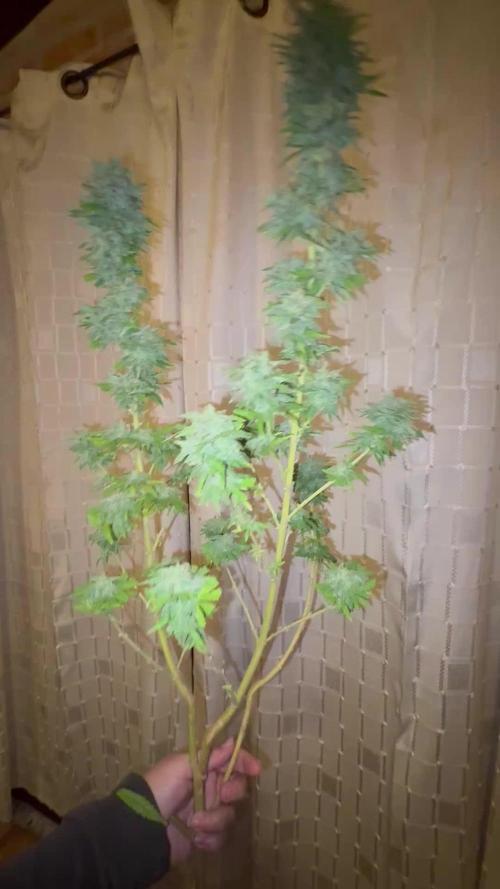
Super dense colas 💪🏽💪🏽💪🏽
Likes
6
Share
@Ruthlez
Follow
Blütetag 42 Der Geruch nimmt stark zu und die buds werden immer "giftiger" 🤩 Noch ca.14-20 Tage bis Ernte.
Likes
2
Share
We become aware at such times of man's wonderful ability to bring seemingly unrelated elements into harmonic balance, and receive a glimpse into a world where everything exists in conscious sympathetic attunement to everything else. When we listen to a piece of music that seems to strike a beautiful chord somewhere inside us, or view a painting that simply glows with harmonic awareness well executed, we probably do not spare much time to contemplate the wonderfully intricate combination of vibrations that our sensors make it possible for us to perceive. We tend to appreciate the relationship between the parts of something by an awareness of the harmony or dissonance of the whole. This ability enables us to say "what a beautiful house!" instead of "analysis has proven that this collection of building materials exhibits certain elements of harmonic proportion." While this ability to instinctively appreciate the beauty of true harmony has an important role to play in evolution, a more analytical understanding of the laws involved can be most useful. This is especially so if we wish to create works of art where each part exists in true harmony, not only with the other part of that particular whole, but with the universe within which the creator and the created exist. Everything vibrates. From the most dense matter to the most subtle cosmic rays, everything which our senses allow our thoughts to become aware of, can be specified in terms of wavelength or frequency of vibration. These two terms define the same thing, but from different points of view. The following are the approximate wavelengths of various energy carriers: Cosmic rays 0.000,000,001 mm Gamma rays 0.000,000,1 mm X rays 0.000,500 mm Ultraviolet rays 0.003 mm Visible light 0.006 mm Infrared 0.01 mm Sound waves 1 meter Radio waves 300 meters Violet light 400 nm to 450 nm Blue light 450 nm to 500 nm Green light 500 nm to 570 nm Yellow light 570 nm to 590 nm Orange light 590 nm to 610 nm Red light 610 to 700 nm 1 nanometer (nm) = 0.000,000,1 cm = 1/10,000,000 cm If a guitar string is plucked and we hear a sound, it is not too difficult for the human mind to associate this sound with the vibration of the guitar string. With color it is quite different. It is difficult for us to conceive that the color of a substance is not an inherent property of the substance itself, but an indication picked up by our senses of that substance's ability to absorb or reflect the light which happens to be shining on it at that moment. Neither the matter nor the light is colored. What happens is that the brain learns to differentiate between the frequencies reflected or transmitted by the substance the eyes are focused on. The same thing happens with sound. When we say "Oh! Listen, they're playing my favorite song," what we really mean is: "My brain has stored within it a particular pattern of frequencies. I have compared the new information being received with this stored pattern and have deduced the answer that the two patterns are similar within certain specified tolerances." The 'pleasure' involved could have something to do with our running the pre-recorded pattern at the same time, in 'sympathy' with the new pattern as it is received. The word sympathy describes very well our ability to appreciate color and sound. It also describes the reason behind certain elements of harmony. For instance, if a substance vibrating at 100 cycles per second (tone 1) is in the proximity of another substance vibrating at 200 cycles per second (tone 2), we could perceive, if we had the right equipment, a certain sympathetic relationship between the two. We will see from this that there is a uniform doubling of the first tone seen in the second. At various points along the waves, the two are the same in amplitude. At other points, they are at opposite poles to each other. This doubled frequency has more points of similarity to the original than any other frequency except the original itself. If the equipment we had available for measuring these two frequencies was a soundboard amplifier and a pair of ears, then we would hear what would sound to us like one tone. If we had the opportunity to hear one at a time, we would hear that although they sound the same, one is higher in pitch than the other. This characteristic of 'the same but different in pitch', musicians have called the octave. Any two tones produced where one has exactly doubled the frequency of the other is called an octave. Speaking in ratios, an octave would appear then as the ratio 2:1 or 1:2, depending on whether we are talking of an octave up or down. A single note produced by almost any instrument will contain more than one wavelength or frequency. It will have a dominant frequency, the wavelength of which we would call the note's 'fundamental' or 1st harmonic. It will also have a varying number of upper harmonics, gradually fading in intensity into infinity or silence. Natural harmonics always have the same pattern of intervals between them. The interval between the 1st and 2nd harmonic is a perfect octave; between the 2nd and 3rd a perfect fifth; between the 3rd and 4th a perfect 4th; and so on, the intervals becoming smaller and smaller until they lose any relationship with the western 12 tone scale as it exists at the moment. Just as an octave has certain elements of sympathy with its fundamental, so some intervals have been noted to be more perfectly in sympathy with the fundamental than others. The ratio of the 'perfect 5th' or interval of 7 semitones, as it occurs in the harmonic series, is 3:2 or 2:3, while that of the 'perfect fourth" is 4:3 or 3:4. All the tones in the western 12 tone scale can be expressed in terms of the ratio between the upper tone and its fundamental. This would seem to be an ideal way of generating a scale from any given fundamental and several attempts have been made to do this, the Pythagorean system being probably the most well known. Although when working with a single tone instrument playing on its own, the Pythagorean formula works wonderfully well, if we had several instruments tuned this way together and asked them to play almost any western music, we would find that at times they sounded quite out of tune to each other. The lack of flexibility of the various scale systems based on the harmonic series has led to what is known as the 'tempered' scale. This uses as its primary unit of interval the ratio of the octave or 2:1. It then proceeds to divide the interval between any fundamental and its upper octave into 12 smaller intervals by applying the ratio: two to the one-twelfth power, to one (21/12:1). This equals 1.059463094, so by multiplying any frequency by this number, we will obtain the tempered semitone next up from our fundamental. We will also find that any tone twelve semitones up from any other tone, in a scale generated in this way, will have exactly double the frequency. If we took the note middle C on a piano and halved the wavelength, we would have the note C one octave above. If we halved this, we would have the C above, and so on. However, within about 6 octaves, we would find that although a 'sound' was being produced, no human ear could perceive it. If we kept on going, halving and producing upper octaves of our fundamental C, we would proceed through the infrared band, into the visible light spectrum. If we happened to be outside during the day, we would, for one octave only, see the note C with our eyes. The next octave above would already be in the ultraviolet band, and outside the eye's sensitivity range. If we can think of color as being an indication of a substance's vibratory rate or wavelength, we may begin to see a relationship that could exist between the color and sound spectrums. The logical extension of what has so far been said is that there exists a scale in the color spectrum that corresponds exactly to the scale in the sound spectrum, each color tone being an octave of the equivalent note in the sound range. This is not the end of the story but only the beginning. If we can for the moment accept that any wavelength in one band has upper and lower octave stretching out to infinity, then the next question is 'fine, but what shall we use as our fundamental? A particular color? A particular sound frequency?' The musicians among us will probably say 'A 440'. This means that the note A should vibrate at 440 Hertz, or 440 times per second. They would tell us that this is standard pitch has been adopted by most orchestras around the world; pianos are tuned to it, instruments are constructed to formulas based on it, and so to them it would probably seem the most appropriate place to begin. Some of these musicians may know of the battle that is still raging with regards to this being the standard, but few would know why A = 440 Hz was chosen except that it worked when it was set to be a suitable compromise between the many different pitches in use at the time. 432 Hz is said to be mathematically consistent with the patterns of the universe. Studies reveal that 432 Hz tuning vibrates with the universe’s golden mean PHI and unifies the properties of light, time, space, matter, gravity, and magnetism with biology, the DNA code, and consciousness. When our atoms and DNA start to resonate in harmony with the spiraling pattern of nature, our sense of connection to nature is said to be magnified. Another interesting factor to consider is that the A=432 Hz tuning correlates with the color spectrum, while the A=440 Hz is off. Audiophiles have also stated that A = 432 Hz music seems to be non-local and can fill an entire room, whereas A=440 Hz can be perceived as directional or linear in sound propagation. Once you adopt the idea that sound (or vibration in general) can have an equalizing and harmonizing effect (as well as a disturbing effect), the science of harmony can be applied to bring greater harmony into one's life or tune to specific energies. There is a form of absolute and relative harmony. Absolute harmony can, for example, be determined by the tuning of an instrument. The ancients tuned their instruments at an A of 432 Hz instead of 440 Hz - and for a good reason. There are plenty of music examples on the internet that you can listen to in order to establish the difference for yourself. Attuning the instrument to 432 Hz results in a more relaxing sound, while 440 Hz slightly tenses up the body. This is because 440 Hz is out of tune with both macro and micro cosmos. On the contrary, 432 Hz is in tune. To give an example of how this is manifested microcosmically: our breath (0,3 Hz) and our pulse (1,2 Hz) relate to the frequency of the lower octave of an A of 432 Hz (108 Hz) as 1:360 and 1:90. It is interesting to note that 432 Hz was the standard pitch of many old instruments and that it was only recently (19th and 20th century) the standard pitch was increased. This was done in order to be able to play for bigger audiences. Bigger audiences (more bodies) absorb more of the lower frequencies, so the higher pitch was more likely to “cut through”. One of the oldest instruments of the world is the bell ensemble of Yi Zeng (dated 423 BC), tuned to a standard F4 of 345 Hz, which gives an A= 432 Hz. The frequency of 345 Hz is that of the platonic year! Similarly, many old organs are tuned in A=432 as well; for example, St. Peter’s Capella Gregoriana, St. Peter’s Capella Giulia, S. Maria Maggiore in Rome. Maria Renold’s book “Intervals Scales Tones and the Concert Pitch C=128 Hz” claims conclusive evidence that 440 Hz and raising concert pitch above scientific “C” Prime=128 Hz (Concert A=432 Hz) disassociates the connection of consciousness to the body and creates anti-social conditions in humanity. The difference between concert pitch A=440 Hz and Concert A=432 Hz is only 8 cycles per second, but it is a perceptible difference of awareness in the human consciousness experience of the dream we share called existence.
Likes
63
Share
@Roberts
Follow
Strawberry Amnesia is growing well. She had a solution change today. She is gonna get some defoliation come next week. Everything is going great. Thank you Herbies seeds, Athena, and Spider Farmer. 🤜🏻🤛🏻🌱🌱🌱 Thank you grow diaries community for the 👇likes👇, follows, comments, and subscriptions on my YouTube channel👇. ❄️🌱🍻 Happy Growing 🌱🌱🌱 https://youtube.com/channel/UCAhN7yRzWLpcaRHhMIQ7X4g.
Likes
18
Share
Well, after 6 weeks of veg and 1 week of flower, things are looking great! Gave them an extra boost of both bloom and veg to get them into stretch and bloom formation. Next feeding will concentrate more on bloom. Lowered temperatures by 5 degrees all round. It's now 25°-27°C throughout the day and down to 23° at night. Hoping to lower the temperature to 18° during the last week to bring any colours out.
Likes
19
Share
@Naujas
Follow
I finally came back from vacation, and I already visited it:) it doesn't look bad, a few higher branches look like the leaves are on fire, a lot of leaves were cut off yesterday so that the plant would devote more energy to the flowers:) I think the flowers will burst and expand within a week:)
Likes
38
Share
Info: Unfortunately, I had to find out that my account is used for fake pages in social media. I am only active here on growdiaries. I am not on facebook instagram twitter etc All accounts except this one are fake. Have fun with the update. Hey everyone 😃. Another week of beautiful growth goes by 😀. She continues to develop very well and beautifully. All shoots were topped up again. I think I'll go back a few more times do topping before it goes into bloom :-). The tent was cleaned and the humidifier refilled 👍. Otherwise nothing exciting happened this week. I wish you all the best and have fun with the update 👍. Stay healthy 🙏🏻 You can buy this Strain at : https://www.zamnesia.com/de/4532-zamnesia-seeds-gorilla-glue-feminisiert.html Type: Gorilla Glue ☝️🏼 Genetics: Chem's Sister x Chocolate Diesel 50% Sativa/50% Indica 👍 Vega lamp: 2 x Todogrow Led Quantum Board 100 W 💡 Bloom Lamp : 2 x Todogrow Led Cxb 3590 COB 3500 K 205W 💡💡☝️🏼 Soil : Canna Coco Professional + ☝️🏼 Fertilizer: Green House Powder Feeding ☝️🏼🌱 Water: Osmosis water mixed with normal water (24 hours stale that the chlorine evaporates) to 0.2 EC. Add Cal / Mag to 0.4 Ec Ph with Organic Ph - to 5.5 - 5.8 .
Likes
2
Share
@Luke_Lee
Follow
——————————————— WEEK 13/ DAY 86-92 BLOOM WEEK 6/DAY 36-42 Mars Hydro FC-E3000 Floragard Professional GrowMix 11L fleece bags Light: 50cm Schedule: 12/12; PPFD: 1050umol/m2/s DLi: 45mol/m2/d 24° C - 60RH 3L per Plant Hesi Bloom Complex (2ml/1L water) Hesi Phosphor Plus (1ml/1L water) BioBizz CalMag (1ml/1L water) PH 6,5 Fan, extractor and pump ON 24/0. ———————————————————— •Day-86 / Bloomday-36 The sixth flowering week begins. The ladies are looking good so far. Here and there are a few brown / rusty spots on the leaves, so they have been rinsed to wash the salts out of the soil. Each plant was then watered with 1 liter of water with 2 ml Hesi Bloomcomplex, 1 ml Hesi Phosphor Plus and 1 ml BioBizz CalMag. •Day-92/ Bloomday-42 The sixth flowering week comes to an end. One of the OG Kush still shows defects on the leaves (brown/rust spots). Since it has been flushed it can't be salt buildup in the soil so it will probably be a nutrient deficiency so it will get a full fertilizer dose next week.
Likes
18
Share
@Chucky324
Follow
Hello. This is the end of week 9 and I'll be harvesting in a few days. I figured out why plant #2 has so many yellow and dead leaves.... 50% of it trichomes are amber It's done. The plant could have been cut down at 8 weeks, but who knew? This is the test to find out. 😉 The other 2 plants aren't quite as far along as plant #2... So it will work out. So I'll change my plans and cut them down in a few days, after a couple of days of dark These plants have great smells. It sweet and sorta desert type of smell with some musk and citrus hints thrown in. Back in a few weeks with the harvest report. OK. Keep growing Straight. Chuck.
Likes
2
Share
Likes
17
Share
Bueno esta semana es la última de vida de nuestras pequeñas, un tamaño reducido y muchas juntas... pero una calidad.. dureza y resina... envidiables.. Esta semana usamos solamente agua con un ph de 6,2 y líquido solo usamos la final solution de b.a.c para limpiar nuestras raíces, al igual que aumentamos la cantidad de agua por riego para ir lavando bien nuestras raices. El olor es muy fuerte pero un aroma apetecible a más no poder... en cuanto abro el armario para los riegos y cuidados sale un olor... que si no fuera por el generador de ozono apestaría la casa!😍😋 En grandes rasgos una variedad de floración relativamente corta.. y con unos resultados impecables.. Hay una media de 5 puntas por planta y algunas incluso más!😍
Processing
Likes
8
Share
Buenas noches fumetillas, de nuevo volvemos, y es que estas green ak xL se están poniendo increíbles, son bastante delicadas a los cambios de temperatura y a las variantes en los nutrientes , hay que ser muy estable y cuidar en los cambios climáticos, si se consigue salen unas flores enorme y llenas de tricomas. Ph controlado, temperatura y humedad dentro de los parámetros correctos, 1 de los 2 ejemplares que quedan recibirá un lavado de raíces pronto, la otra seguiremos abonándola una o 2 semanas más. La próxima semana nos vemos familia.
Likes
16
Share
Runtz is heading into the final stage — this is her last week, so I’m watering daily with plain water only 💧 She smells absolutely amazing, and I really enjoy it every time I open the tent — she easily overpowers the aroma of Lemon AK and Break-Up 🍓🔥 Break-Up and the Lemon AK plants still have about two to three weeks to go, and they’re growing without any issues. Break-Up is stacking a lot of buds — she’s completely covered, and I’m really curious to see how she’ll turn out 😄🌸 And the last photos are tomatoes… 😄🍅 it’s a full-on jungle at this point — I probably started them a bit too early, but oh well, it happens. The greenhouse is already completely full too… 😄🌿 I’m thinking I might keep updating this journal from time to time with how the tomatoes and perennials are doing — just for fun 🍅.
Likes
6
Share
@Daw33d41
Follow
Trochu citrus, trochu cookies:) Uprimne jsem necekal ze tam tech 58g bude.
Likes
29
Share
Now we're growin'! Buds popping out everywhere, only two Viper Cookies still apparently in veg. The Lamb's in the 10 gal is really spreading her wings, I've had to adjust the pots a little to compensate for the overcrowding (a problem which I am happy to have). Chemdog is really budding strong, I like what I'm seeing but I hope they plump up. The smaller plants are making up for their size with an abundance of pretty little future nugs. Even the two Lemon OG's (not listed here, ran outta room for strains) are looking good and they were kinda a last minute addition. Had some bug issues--just minor though. Worse damage than that was done by me and my slightly over-zealous LST. The foliage is lookin good, rich and green. I've had to pull a good deal of yellow leaves lately, but I'm pretty sure they've just been used up and aged out. Lots of humid weather now, of course. No problems yet, though. As a preventative measure I've defoliated a little heavier than before, making sure every part of the plant can breathe. I use the morning dew as a guide-- with my location the wind almost always blows and by about 8 am I can see any patches of growth that might be too thick because they still have a lot of dew. So far this method has worked, and I don't see any major slow downs in growth from the haircuts. Been watching a lot of DGC and thinking Recharge might be useful, but I'm pretty stuck with what I got this year (too damn rooted to do much with the soil any more). Awesome place for info though-- the more I learn the more I want to learn. 8/22 -- Bud worms. Bastards. Heavy neem spraying will hopefully bring it under control. Been watching these girls constantly (lot of time on my hands at the right time of year), and the buggers sure made headway fast. Been finding a few, like one or two, each day. Today I checked and found over a dozen on one plant. I neemed the bulk of the plants, leaving two of the smaller ones un-sprayed. I couldn't spray the very tops of the bigger plants very well because they're topping 7 - 8 feet and too close together to fit the ladder (planning-- live and learn). I moved the smaller unsprayed plants to the side of the garden and I'm hoping that if they're really hell bent on infesting something they'll take the bait and at least leave the bigger girls alone. Meanwhile, remnants of the hurricane are headed this way keeping shit really really moist all around. So far so good for bud rot still, but it's prime time. 8/23-- Hmmm. What could tip a 5 gal bag, saturated, supported with lines, with a 7 1/2 ft flowering female in it, without breaking or even bending the plant? I want to believe it's not a human pest......but thinking my pest tried to grab her and couldn't get it past the lines. I'm all ears if anyone has other ideas (wind- no. deer- no.) So assuming I have an asshole in the neighborhood, it's back to old school. I really liked the idea of not worrying about them so much, I thought poeple might be better these days, but I guess not. Time for stakeouts and hidden cams. 8/25-- Had to spray BT for the damn caterpillars. Not a lot of damage so far, but keeping an eye on it. Fortunately the buds are still tiny so easy to spot damage. I'm really pleased with the number of bud sites in general, especially on the Lamb's Bread. I'll have to climb the ladder and see if I can get some good photos next week. No sign of my human infestation. Been watching close and checking cams and nothing. The flash went off a few times, but I was out in less than a minute and saw nothing, and nothing in the photos it took either. Ganja ghosts???