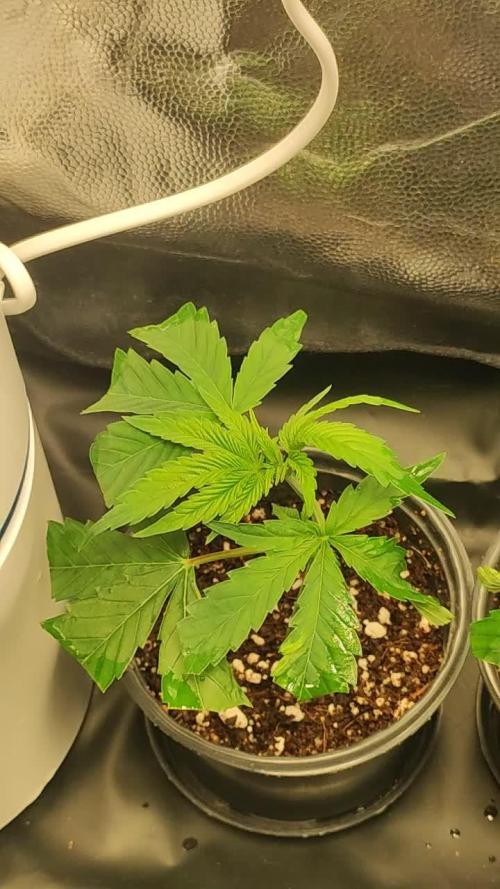
Likes
Comments
Share


@ZombieKushAddicted
Follow
Awe strain, very productive, strong, and i’m In love with this terps🤪🤤🤤🤤

Likes
17
Share


@GreenHouseLab
Follow
Day 10 Of 12-12, defoliated 75% of canopy will leave untouched until day 21 Flower. Running 1250 ppms of cropsalts, light dimmed to 75% @15-18” of canopy
Likes
18
Share


@Ultraviolet
Follow
Green light is radiation with wavelengths between 520 and 560 nm and it affects photosynthesis, plant height, and flowering. Plants reflect green light and this is why they appear green to our eyes. As a result, some growers think that plants don’t use green wavelengths, but they actually do!
In fact, only around 5 – 10% of green light is reflected from leaves and the rest (90 – 95 %) is absorbed or transmitted to lower leaves [1].
Green wavelengths get used in photosynthesis. Chlorophyll pigments absorb small amounts of green wavelengths. Light that doesn’t get absorbed is transmitted to leaves that are shaded out from direct light. This means that leaves at the bottom of the canopy get more green light than leaves at the top. A high proportion of green wavelengths compared to other colors tells lower leaves that they are being shaded out, so they are able to react accordingly. Lower leaves may react by opening or closing their stomata or growing longer stems that help the leaves reach brighter light [1, 2, 3].
When it comes to growing cannabis, many cultivators are interested in the quality of light used for the flowering stage. In many plants, flowering is regulated by two main photoreceptors: cryptochrome and phytochrome. Both photoreceptors primarily respond to blue light but can also respond to green, although to a lesser extent. Green can accelerate the start of flowering in several species (although cannabis has yet to be tested) [1, 4, 5]. However, once flowering has begun, it’s important to provide plants with a “full spectrum” light that has high amounts of blue and red light, and moderate amounts of green, in order for photosynthesis to be optimized.
Green light mediates seed germination in some species. Seeds use green wavelengths to decide whether the environment is good for germination. Shade environments are enriched in green relative to red and blue light, so a plant can tell if it is shady or sunny. A seed that senses a shaded environment may stay dormant to avoid poor growing conditions [1]. Some examples of plant species where researchers have documented this response are: ryegrass (a grass that grows in tufts) and Chondrilla (a plant related to dandelion) [1, 6].
Although green wavelengths generally tell plants NOT to germinate, there are some exceptions! Surprisingly, green wavelengths can stimulate seed germination in some species like Aeschynomene, Tephrosia, Solidago, Cyrtopodium, and Atriplex [1, 6, 7].
Of course, light is not the only factor affecting seed germination – it’s a combination of many factors, such as soil moisture, soil type, temperature, photoperiod, and light quality.
When combined with red and blue light, green can really enhance plant growth [1, 8]. However, too much green light (more than 50% of the total light) can actually reduce plant growth [8]. Based on the most current research, the ideal ratio of green, red, and blue light is thought to be around 1:2:1 for green:blue:red [9]. When choosing a horticultural light, choose one that has high amounts of blue and red light and moderate amounts of green and other colors of light.
Not many studies can be found about the effect of green light on cannabis growth or metabolism. However, if one reads carefully, there are clues and data available even from the very early papers.
Mahlberg and Hemphill (1983) used colored filters in their study to alter the sunlight spectrum and study green light among others. They concluded that the green filter, which makes the environment green by cutting other wavelengths out, reduced the THC concentration significantly compared to the daylight control treatment. It has been demonstrated that green color can reduce secondary metabolite activity with other species as well. For example, the addition of green to a light spectrum decreases anthocyanin concentration in lettuce (Zhang and Folta 2012).
If green light only reverses the biosynthesis of some secondary metabolites, then why put green light into a growth spectrum at all? Well, there are a couple of good reasons. One is that green penetrates leaf layers effectively. Conversely red and blue light is almost completely absorbed by the first leaf layer.
Green travels through the first, second, and even third layers effectively (Figure 2). Lower leaf layers can utilize green light in photosynthesis and therefore produce yields as well.
Even though a green light-specific photoreceptor has not yet been found, it is known that green light has effects independent from the cryptochrome but then again, also cryptochrome-dependent ones, just like blue light. It is known that green light in low light intensity conditions can enhance far red stimulating secondary metabolite production in microgreens and then again, counteracts the production of these compounds in high-intensity light conditions (Kim et al. 2004). In many cases, green light promoted physiological changes in plants that are opposite to the actions of blue light. In the study by Kim et al. blue light-induced anthocyanin accumulation was inhibited by green light. In another study it has been found that blue light promotes stomatal opening whereas green light promotes stomatal closure (Frechilla et al. 2000). Blue light inhibits the early stem elongation in the seedling stage whereas green light promotes it (Folta 2004). Also, blue light results in flowering induction, and green light inhibits it (Banerjee et al., 2007). As you can see, green light works very closely with blue light, and therefore not only the amount of these two wavelengths separately is important but also the ratio (Blue: Green) between these two in the designed spectrum. Furthermore, green light has been found to affect the elongation of petioles and upward leaf reorientation with the model plant Arabidopsis thaliana both of which are a sign of shade avoidance symptoms (Zhang et al. 2011) and also gene expression in the same plant (Dhingra et al. 2006).
As mentioned before, green light produces shade avoidance symptoms which are quite intuitive if you consider the natural conditions where the plants grow. Not all the green light is reflected from the highest canopy leaves in nature but a lot of it (50-90%) has been estimated to penetrate the upper leaves at the plant level ((Terashima et al., 2009; Nishio, 2000). For the plant growing in the understory of the forest green light is a signal for the plant of being in the shade of a bigger plant. Then again, the plants growing under unobstructed sunlight can take advantage of the green photons that can more easily penetrate the upper leaves than the red and blue photons. From the photosynthetic pigments in higher plants, chlorophyll is crucial for plant growth. Dissolved chlorophyll and absorb maximally in the red (λ600–700 nm) and blue (λ400–500 nm) regions of the spectrum and not as easily in the green (λ500–600 nm) regions. Up to 80% of all green light is thought to be transmitted through the chloroplast (Terashima et al., 2009) and this allows more green photons to pass deeper into the leaf mesophyll layer than red and blue photons. When the green light is scattered in the vertical leaf profile its journey is lengthened and therefore photons have a higher chance of hitting and being absorbed by chloroplasts on their passage through the leaf to the lower leaves of the plant.
Photons of PPFD (photosynthetic photon flux density) are captured by chlorophyll causing an excitation of an electron to enter a higher energy state in which the energy is immediately passed on to the neighboring chlorophyll molecule by resonance transfer or released to the electron transport chain (PSII and PSI). Despite the low extinction coefficient of chlorophyll in the green 500–600 nm region it needs to be noted that the absorbance can be significant if the pigment (chlorophyll) concentration in the leaf is high enough.
The research available clearly shows that plants use green wavelengths to promote higher biomass and yield (photosynthetic activity), and that it is a crucial signal for long-term developmental and short-term dynamic acclimation (Blue:Green ratio) to the environment. It should not be dismissed but studied more because it brings more opportunities to control plant gene expression and physiology in plant production.
REFERENCES
Banerjee R., Schleicher E., Meier S. Viana R. M., Pokorny R., Ahmad M., Bittl R., Batschauer. 2007. The signaling state of Arabidopsis cryptochrome 2 contains flavin semiquinone. The Journal of Biological Chemistry 282, 14916–14922.
Dhingra, A., Bies, D. H., Lehner, K. R., and Folta, K. M. 2006. Green light adjusts the plastic transcriptome during early photomorphogenic development. Plant Physiol. 142, 1256-1266.
Folta, K. M. 2004. Green light stimulates early stem elongation, antagonizing light-mediated growth inhibition. Plant Physiol. 135, 1407-1416.
Frechilla, S., Talbott, L. D., Bogomolmi, R. A., and Zeiger, E. 2000. Reversal of blue light -stimulated stomatal opening by green light. Plant Cell Physiol. 41, 171-176.
Kim, H.H., Goins, G. D., Wheeler, R. M., and Sager, J. C. 2004.Green-light supplementation for enhanced lettuce growth under red- and blue-light emitting diodes. HortScience 39, 1617-1622.
Nishio, J.N. 2000. Why are higher plants green? Evolution of the higher plant photosynthetic pigment complement. Plant Cell and Environment 23, 539–548.
Terashima I., Fujita T., Inoue T., Chow W.S., Oguchi R. 2009. Green light drives leaf photosynthesis more efficiently than red light in strong white light: revisiting the enigmatic question of why leaves are green. Plant & Cell Physiology 50, 684–697.
Zhang, T., Maruhnich, S. A., and Folta, K. M. 2011. Green light induces shade avoidance symptoms. Plant Physiol. 157, 1528-156.
Wang, Y. & Folta, K. M. Contributions of green light to plant growth and development. Am. J. Bot. 100, 70–78 (2013).
Zhang, T. & Folta, K. M. Green light signaling and adaptive response. Plant Signal. Behav. 7, 75–78 (2012).
Johkan, M. et al. Blue light-emitting diode light irradiation of seedlings improves seedling quality and growth after transplanting in red leaf lettuce. HortScience 45, 1809–1814 (2010).
Kasajima, S., et al. Effect of Light Quality on Developmental Rate of Wheat under Continuous Light at a Constant Temperature. Plant Prod. Sci. 10, 286–291 (2007).
Banerjee, R. et al. The signaling state of Arabidopsis cryptochrome 2 contains flavin semiquinone. J. Biol. Chem. 282, 14916–14922 (2007).
Goggin, D. E. & Steadman, K. J. Blue and green are frequently seen: responses of seeds to short- and mid-wavelength light. Seed Sci. Res. 22, 27–35 (2012).
Mandák, B. & Pyšek, P. The effects of light quality, nitrate concentration and presence of bracteoles on germination of different fruit types in the heterocarpous Atriplex sagittata. J. Ecol. 89, 149–158 (2001).
Darko, E. et al. Photosynthesis under artificial light: the shift in primary and secondary metabolism. Philos. Trans. R. Soc. B Biol. Sci. 369 (2014).
Lu, N. et al. Effects of Supplemental Lighting with Light-Emitting Diodes (LEDs) on Tomato Yield and Quality of Single-Truss Tomato Plants Grown at High Planting Density. Environ. Control Biol. 50, 63–74 (2012).

Likes
11
Share


@Gonach
Follow
Al principio de la semana se subió la luz a 70 cm aproz de la planta, reduciendo la potencia al 50%. Se regó a cada una de manera foliar con Alg-a-mic de biobizz para regularizar la deficencia de nitrógeno. A mitad de semana se regó con 3 ml x litro de biobizz a c/u. Cada planta consume aproximadamente 1.6 lt.
Al final de la semana se cambio el ciclo a 12/12 y los resultados como se puede ver en el video.
Gracias a todos x sus posteos....

Likes
38
Share


@DomanAtrik
Follow
It seems like such a slow process to finish growing. I totally prefer the speed of growing shrooms. However I just finished pruning the girls. I'm not presently using any nutrients. I will be using various Advanced Nutrients in later stages. Any tips would be greatly appreciated.

Likes
19
Share


@Mazgoth
Follow
the plant has built an incredibly strong trunk that with great difficulty you can even shake the plant a little.The cold prevails unfortunately but the plant seems to cope with it and produ flowers

Likes
25
Share


@Fibro_Witch
Follow
Welp, this is not a September plant😆 This girl is still going for at least another week. Pistils are starting to brown but trichs are still clear and cloudy, no amber yet. I'm hoping to get a little more sugar on her before she finishes. Hopefully it doesn't get too cold and rainy before she's done.
All I can say is that I've been impressed with how strong this plant is and I'm looking forward to seeing what kind of numbers she puts out. She's been very healthy and easy to care for so I'm happy so far! She has a little bit of a spicy undertone, so definitely high in Myrcene (which is a pretty safe assumption) and maybe caryophyllene.

Processing
Likes
3
Share


@Greenzfingerz
Follow
Good week all branches tied and bottoms caught up quote small and bushy with quite a few node sites. Try update some better photos soon. Just switched to 12/12 today, been running 600hps was goin to add another but heats alittle much so ive added two 1000w led photos to follow. Hoping to fill out room more withjn a few weeks of stretch to 12/12.
Likes
Comments
Share


@Mr_nugs_lover_David
Follow
She's developing very well maybe not as much as her sisters but she's doing well,I'll start the lst once she stretches her stems a little more

Likes
9
Share

@ZombieKushAddicted
Follow
to view this lamp or any other marshydro product go to: https://instagram.com/marshydro_aliexpress?igshid=YmMyMTA2M2Y=

Likes
8
Share

@Aircoholic
Follow
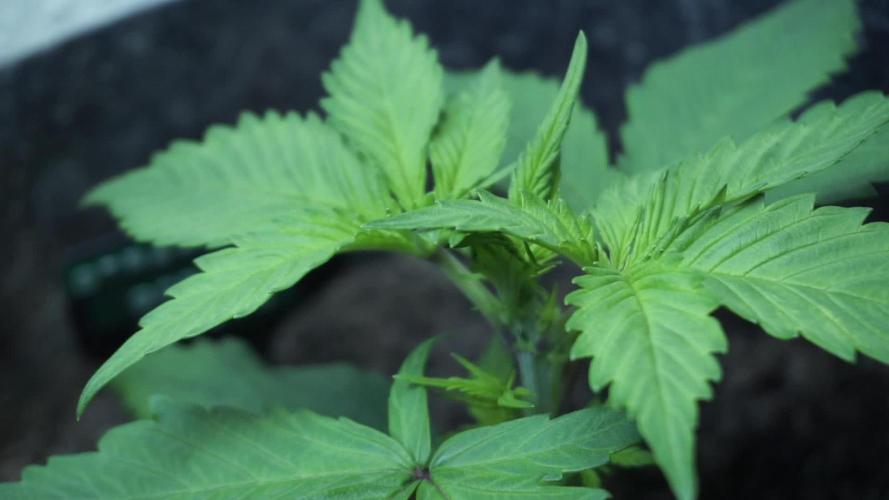
She really seems to like the extra light, after lowering light distance and raising light intensity - and she seems to like the living soil that her roots have reached by now. Her weak stem, that couldn't seem to support her leafy head now is very strong and firm, and since her nodes are growing fast and healthy enough, I've topped her on day 17.
She'll get more photons after a day of recovery from this high stress training, and also some mulch, so the topsoil doesn't dry out too quickly.
Likes
31
Share


@MisterSix
Follow
Finally my QB 240W come and it's incredible bright. i flip it to 12/12 this week to make sure the small tent 90 x 90 x 180 not blowing up.
after 4 day i witness good stretch from the tree and the temp also decrease to 30 celcius average.
I'm happy with my grow so far hope to get 100 gram out of this harvest.

Likes
16
Share


@Mrg7667
Follow
Day 74 and there getting chopped today! I thought the harvest was going to be broken into two separate weeks considering the times on the Choco was listed about 7-10 days sooner then the DD (wich was listed at 70 days for flowering)
However looking at the tricombs on the Chocolate Marshmallow most pheno didnt start getting amber untill the DDs did as well! A couple DD pheno could have maybe gone a couple more days but we will see!
Going for reveg on all the pheno, since i didnt get to take any clones. We will see how it goes!

Likes
7
Share


@Hightable420
Follow
Day #21 Defoliation
Not topped (left) Topped (right).
Super impressed so far.
Likes
1
Share

@psychonaut420
Follow
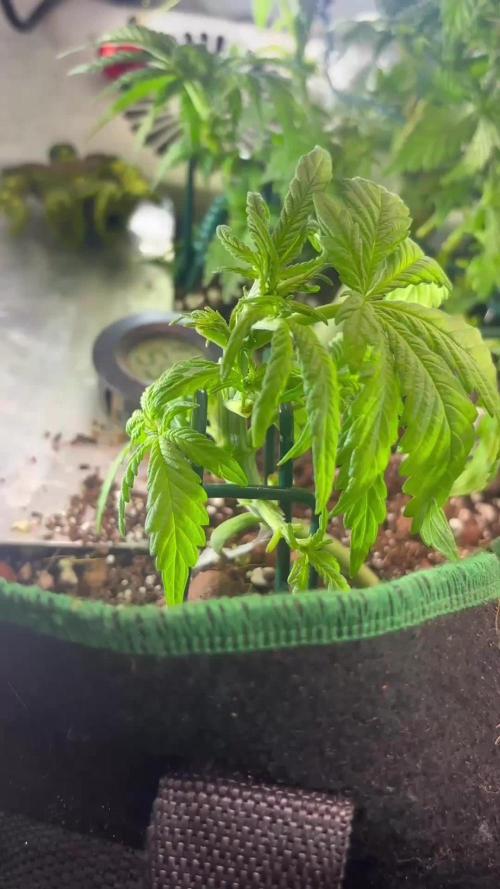
The autoflowers Have been been advancing at a great pace they are just starting to pre flower the first 2 in video is lemon cherry cookies auto then the last one is frozen face auto and the last one has produced sitigmas with white hairs and the lemon cherry cookies is 2days behind physically than the frozen face auto

Processing
Likes
Comments
Share


@Deepgrower
Follow
Las tres primeras plantas del vídeo son gorilla glue 4 y las otras watermelon. Se observa en las watermelon un inicio de floración un poco raro, con malformaciones en las primeras preflores. Seguimos para ver evolución de esta planta!

Likes
469
Share


@love_2_grow
Follow
D43 - At the beginning of the second week of flower and the girls are loving life.
Overall, I'm happy with the flat canopy, but there's one branch higher than the rest on the first girl. I've never super-cropped an auto, so I figured, why not give it a go and see what happens? It's only one branch after all and we still have weeks of flower to go. I also lightly defoliated the girls further. Nothing extreme, just cleaning up here and there.
I've been lazy and haven't brewed any compost tea in a while, so I hand-watered the girls with 1.25-liters of water @ pH 6.3 with 25 ml EM-1 to boost the microbes in the soil. I'll brew some tea in a few days and feed the girls then.
D45 - Minor LST. The first girl is bouncing back nicely from her super cropping.
D46 - I started brewing a compost tea last night using a pretty basic recipe of worm-castings, rock dust, kelp meal, and molasses. Today each girl got 1.25-liters of tea @ pH 6.5.
I set up automation to control the RH in the tent using an Inkbird controller a while ago, where the humidifier and the extraction fan are hooked up to the controller. If the RH goes above the set value, then the fan kicks in to extract the humid air, while if the RH goes below, then the humidifier starts.
With a stable temperature, it works like a ghetto VPD controller where the tent is in the ideal VPD range during the 20 hours of light but still in an acceptable range during the dark hours.
Controlling the environment is always a headache in a tiny tent, but this system works exceptionally well, considering it is cheap and basic.
D49 - We have reached the end of the second week of flower and everything is going great in the tent. The grow is pretty much running itself now that most training is done and the watering system takes care of the irrigation. I'm still dialing in the system though.


Processing
Likes
6
Share


@Ganjman88
Follow
Everything is running great so far. I'm preferring the control of the flower period and all the girls flowering at the same time. It was a real pain with the autoflowers having them all at different stages, so the photoperiods are much better for that
I've started with cal mag from day one to counter the soft water and everything seems to be working perfect up to now. Not a single sign of deficiency or burn


Likes
20
Share

@Oldwied
Follow
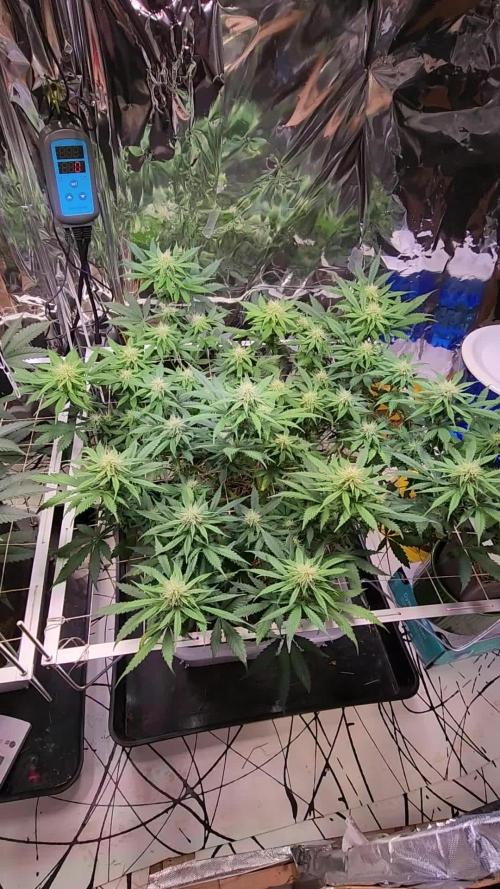
The soil gets a new cover with fresh brewed grass mulch. I brewed hay and 15L water for 48h hours under air bubbles by 23°C.
The remaining compost tea would still be used for watering.
Two days later I waterted with 1,5L sf nematoden.
Light Power: 80%
Day 68
Flower #17
Photoshooting
New mulch
Defoliation
Day 70
Flower #19
Watering with 1,5L sf nematoden
Defoliation
Day 72
Flower #21
Photoshooting