


Likes
Comments
Share


@SurfingIguana
Follow
My first grow 'attempt'.
I am growing in an insulated shipping container. Using two Fluence SpydrX LED 660W lights. Not currently supplementing Co2. Feeding by hand for now but I will set up an automated dripper. Drain to waste. Growing in Pro-Mix HP w/ Mycorrhizae which contains (65%-75%) Peat-Moss, Perlite, Mycorrhizae, pH adjusters, and a wetting agent.
All 5 seeds sprouted!!
3 Peat Pellet, 2 Paper Towel
Light intensity set to lowest setting. (8%)
Feeding every couple days with 160ppm, 6.0 pH.
Overall, pretty good week.
Lights on! Using 18/6 light schedule.
The peat pellets were placed into peat pots and under a dome.
The lights should have been turned on a lot sooner, the seedlings stretched quite tall. Lesson learned there.
They continued to grow quite tall. One fell over, it was replanted slightly deeper to support it. Fingers crossed it survives.
Light intensity set to lowest setting (8%).
A lot to learn.

Likes
14
Share

@LovelyTerps
Follow
July 15 2026
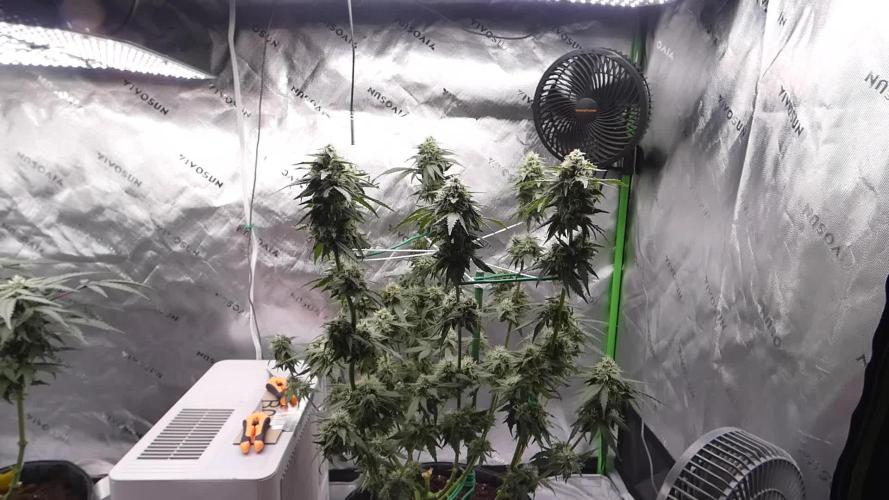
She's finishing up mid-flower by the looks of things. Her buds are rock hard and dense, and her aroma is continuing to mature and lose its sharpness in favor of a candy-floral-earthy aroma. Flowers are beginning to swell, and pistil hairs are starting to die off.
She has been a thirsty gal consistently throughout flower so far. Even with all the big leaves removed she continues to drink like a sailor, with her 2.3 Gallon self-watering base being filled 1-2 times per week. I anticipate that her thirst will slow down now that she's moving into late flower, and then keeping humidity and temps under control will get a little easier.
Light intensity at the top is around 40-42 DLI give or take, and most of the lowers are getting about 26 DLI. I'm targeting 1.5 VPD in the daytime, and during lights off I have my dehumidifier scheduled to turn on and target 40%RH regardless of temperatures (VPD still tends to average around 1.5 right now at night).
I'm still anticipating she'll be ready for harvest in about 3 weeks time, but it will ultimately depend on trichomes.

Likes
26
Share


@datrobspeoria
Follow
Hello. this plant is in the first week of stretch and along with the worms hoping to get to about 5 feet tall.... Thanks for checking out my grow and have a great day!


Likes
49
Share

@squalino
Follow
📝 Journal de Culture : Fin de parcours - Wham Boom Auto
Date : 13 avril 2026
Âge : J+70 (Semaine 11)
Taille : 54 cm (Stable)
🌡️ Paramètres Environnementaux
Éclairage : Pure LED 240W à 100% de puissance.
Humidité : Maintenue à 50%.
Température : 25°C le jour / 21°C la nuit.
💧 Nutrition & Stratégie Finale
Dernier apport : 0,5 Litre de thé de compost (pH 6,3).
Décision : Le thé ne vas pas permettre de rattraper l'état de la plante. À partir de maintenant j'essaiede la faire grossir au niveau des buds , elle ne recevra que de l'eau claire jusqu'à la fin de son cycle . Je pense
⚠️ Mon Analyse (Mon constat personnel)
Il faut se rendre à l'évidence : elle ne va pas mieux et ne se rattrape pas. Je suis convaincu que le problème ne vient pas de la plante ou de la génétique, mais d'une grosse erreur de ma part que je n'ai pas réussi à corriger à temps. Je vais la laisser terminer tranquillement à l'eau pour ne pas aggraver les choses.
🔍 Analyse Visuelle
État du feuillage :
Les feuilles sont très sèches, brûlées sur les bords et recroquevillées vers le haut, confirmant le blocage persistant.
Développement des fleurs :
Malgré le stress majeur du feuillage, les têtes semble gonfler. On remarque des teintes pourpres foncées très marquées au cœur des fleurs.
Résine :
La production de trichomes est bien présente sur les calices et les petites feuilles restantes, ce qui laisse présager une qualité de récolte décente malgré l'aspect général de la plante.
Note finale du cultivateur :
Je m'excuse auprès d'Anesia Seeds pour ce journal. La plante a fait preuve de force, mais mes erreurs de manipulation ont pris le dessus.
la Wham Boom Auto a réussi à produire des fleurs denses et magnifiquement colorées. Cette couleur pourpre est d'ailleurs superbe ! En finissant à l'eau claire, j'essaie de permettre à la plante de se purifier, ce qui améliorera le goût final. La génétique d'Anesia Seeds a montré sa robustesse en ne mourant pas malgré l'asphyxie racinaire.
merci e tous de me suivre et désolé de ne pas avoir pu vous démontrer la qualité de cette variété. je la referais, je n'aime pas rester sur des défaites. bonne journée

Likes
14
Share


@GrowWithTheFlow710
Follow
Long time extractor, first time growing (both s/o and myself). Already starting the next grow.
This was one plant/pheno in a 4x4 sharing a 600w light @ 75% or less the entire time. Only tracking ONE PLANT this harvest but for reference - we pulled just over a lb dry weight total from all 4.
End dry weight - Buds: 104 grams - Sugar Trim - 35 grams
End flower rosin - 14.5 grams (1st press) - 1.2 grams (2nd press) [Press 96 grams] ~15% yield (not great but expected from autoflower)
Chopped a little earlier than desired (10/70/20 amber/cloudy/clear profile) due to a scare of a nanner. Being new growers, we recently learned we could have plucked the nanner off and let it flower another couple weeks. Dried branches at 65-70f/55-60rh for 7 days then stored in grove bags until pressed in 37u micron bag, ~180f, 2.5min.

Likes
19
Share


@valiotoro
Follow
Hello everyone week 4 of flower has passed for this Cherry Cola auto & she’s ready 🍒
For the feeding schedule i stopped feeding Power Roots and Pure Zym and started feeding Green Sensation 0,5/l
Mars hydro FC-E6500 75%
have a great day and wish you all happy growing 😎👨🌾🏻

Processing
Likes
3
Share


@XxBILLZAxX
Follow
Curling is still a problem still :(
A rainy week so high humidity all around... looking tasty though! Buds are getting bigger and sticker!
Likes
48
Share


@MG2009
Follow
Day 69 of flowering and still looking for the elusive Amber trichromes, they are 90% cloudy no amber 10% clear I will patiently wait I want to experience the more indica feel with these last few choice buds.
Update Oct 19th 2017.
Seen my first amber trich today, as I'm getting older I can't see through my loupe to view resin glands, so my wife showed me how too view them through pictures. All I can say is wow! She was able to zoom right in on them to get a good look. Maybe I will have to get a computer to show these fantastic shots I will uploaded ASAP YOU HAVE got to see them gorgeous girls see ya soon peace and love my brothers.

Likes
5
Share


@FourVentiFarms
Follow
So since I had the mold and bud rot problems I had to divide my schedule of harvest and divide the product as well.
- Healthy buds are ones belonging to branches where there are no signs of rot/mold.
-Mid-healthy buds are untouched by disease but still belonging to a branch where there was some disease.
-Last category are the salvaged ones, where I cut them from bigger buds that had disease or they were in some part affected.
These 3 categories each have their own drying space and where harvested in this order to prevent spreading of spores and stuff. For the salvaged buds every time I removed a part with disease I cleaned the scissors with alcohol.
I only removed the sun-leaves + penguin leaves and will be doing a dry trim for the sugar leaves later on.

Likes
43
Share


@Dirty_Hippy
Follow
True Hash plant structure from the moonshine and flowering vigour of the Bruce are just KILLIN it.
The terpene profiles on the parents are fairly similar so it should blend out to something unique.
Seems like a daily battle between fruity and just a funky dank skunk smellwise.
Some paleness and light chlorosis of bottom leaves persuaded application of Terp Tea.
Soil conditions seem optimal since she was healing within a day.


Likes
31
Share


@The_Doctor_Green
Follow
Esta semana he regado solo con oro negro 2ml x litro de agua y organic power 1ml x litro de agua el resto de la semana solo con agua, he medido las ppm y en el drenaje me ha dado 1040.
Me preocupa un poco el color de los tallos de las hojas que están de color morado, pero solo a las de maceta, a la que esta en tierra la veo bien, es mas le he sacado las ramas bajas para que no gaste energía en criar esos coquitos que salen pequeños.
Likes
11
Share


@Eddjack
Follow
Iniziamo il risciacquo delle radici .. è carica di nutrienti ci vorrà un po' per smarrirsi tutti ora speriamo di aver azzeccato i tempi. Due settimane di acqua totale e poi si taglia!!
Likes
15
Share

@Rangaku
Follow
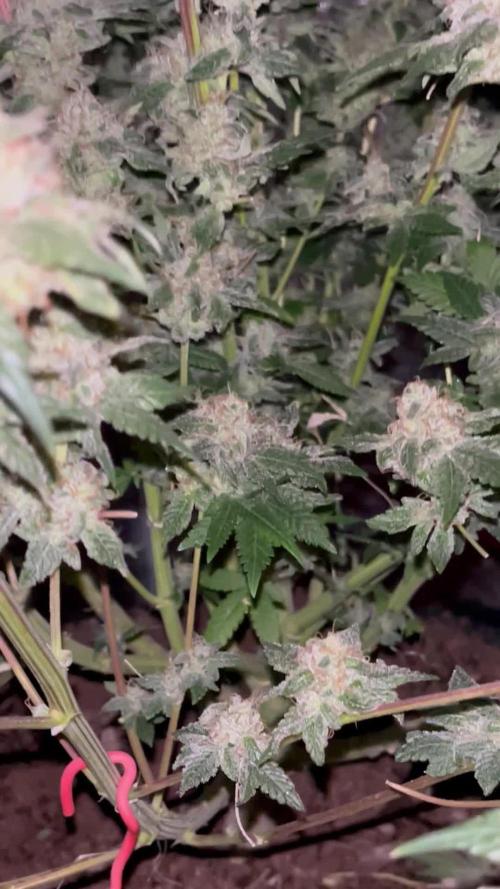
Looking the goods , 1 week to go I’ll start the wind down this week and chop her next weekend. Sticky , dense, smells sweet as . I smoked a lil bud today and it was pretty good , real sweet on the exhale . Anyway one week to go and I’ll have about 10 bags to smoke 😂😂

Likes
7
Share


@Greenislandfr
Follow
7e semaine de floraison,
Application du propolix contre le début du botrytis qui a commencer semaine dernière, la gorilla a du être infecter depuis que le tronc c'est fendu en deux. J'ai pourtant pris les precaution nécessaires, pour l'instant aucun autre départ de botrytis ca a l'air sous contrôle le produit a l'air efficace, j'ai acheter un ventilateur uniquement pour elle j'espère l'aider et non propager le fleau sur mes autres plant..

Likes
10
Share


@Mr_Ewell
Follow
Update 7 weeks old
The girls turned seven weeks Friday and the growth has seemed to finally stop. Little buds are getting bigger. Im doing a little experiment with them to see if i can dial in the nutrients strength. They've been getting 1500 ppm up until yesterday. I upped the feed to 2500 ppm 5 ec. I want my run off ppm to be about even. The run off for 2500 was 1400. I'll back off the first sign of nute burn. Feeding twice a day. I feel i need three. But ya know. Laziness.
Considering eliminating the 4 hr dark period and running them at 24 hrs.. will probably implement that after tonight.
Supercropping helped alot with my canopy and seems to be promoting growth.

Likes
6
Share


@HowtoBubatz
Follow
We’re officially in the final week for my Strawberry Gorilla Automatic from Fast Buds! 🌟
This beautiful girl has had a very quick flowering phase, but looking at the trichomes, they’re right where they need to be so no complaints!
She will be flushed throughout this week and then harvested and hung up to dry next week.
I’m super happy with how she’s developed!😋
Likes
19
Share


@Kagesan
Follow
Hello Grow friends.👋👋
➖➖➖➖➖➖➖➖➖➖➖➖➖➖➖➖
The little one is now in the flowering phase.
She is developing into a pretty little bush. I'm curious to see how much more height it will gain.
➖➖➖➖➖➖➖➖➖➖➖➖➖➖➖
💚💚

Likes
9
Share


@CaptStinkNug
Follow
Sugar cane was very easy to grow with no issues whatsoever. I'm new to growing so they were easy by my standards. It was everything I had hoped it would be, as far as growing and appearance. I hope it will smoke as good as it looks! The aroma is a very mild, sweet smell, but man the frost on these! the Super sticky icky! 🤪 I would have preferred letting these go another week, but had to chop now because of upcoming circumstances.
Didn't see the option to put the dried weight in but out of 3 Sugar cane, I got 9.1oz.
Taking a hit of just dried Sugar Cane nug, I was surprised how smooth it was even before cure. Pine/gassy taste. A couple of hits and it was a very uplifting creative high. Then a creeper wave came on shortly after..... almost like that feeling when an edible kicks in and you forgot you ate one! Lol. I couldn't believe I was that high from a couple of hits! Two hit wonder stuff right here! This should last me quite a while!

Likes
13
Share

@NuclearPyro
Follow
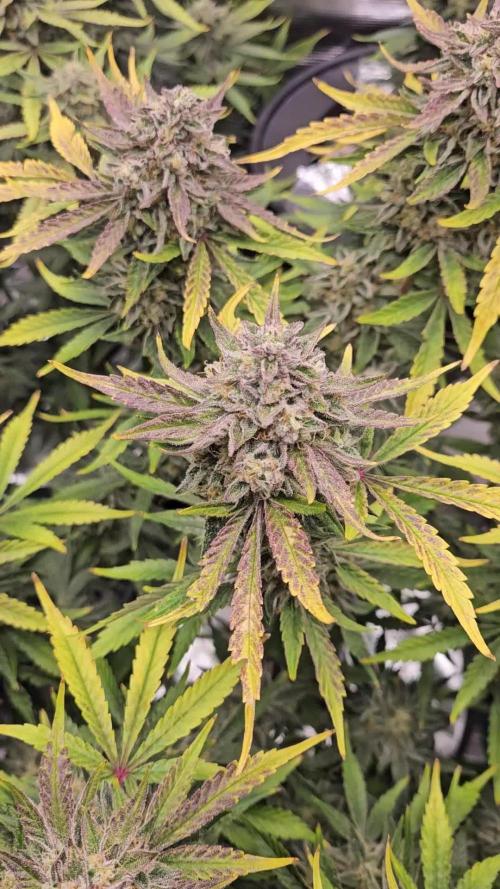
Day 74
Struggling with RH, Temp, and H2O temp. H2O temp cause tent to overheat. Cooled the water down and opened the window to let exhaust out bc it was recirculating warm air. In good range now
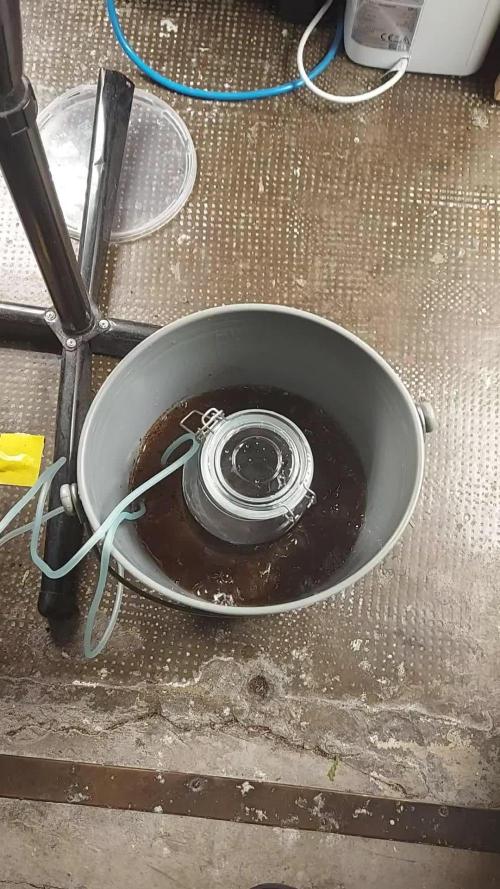
Found salt build up in stones and some biofilm on plastic on the stone disc, changed out res and cleaned with dilute bleach (always use dilute bleach when cleaning res buckets).
All is happy except afraid of reveg bc the last 2 weeks sooo much stress bc the weather.
Trichomes are about 70% cloudy. Within harvest window deff. The lil plant bc of stunted growth, might run 2 more weeks depending on trichomes. All bud sites under the bush have white pistols. Just going for that main cola, thats it
The bottom budsites trichomes are 60% cloudy, so wondering if I do a top harvest, let the popcorn buds go another week than finish harvest. Any help please.
These plants smell sooooo sooo sweet and crazy sticky.