Likes
Comments
Share
@3lementa1
Follow
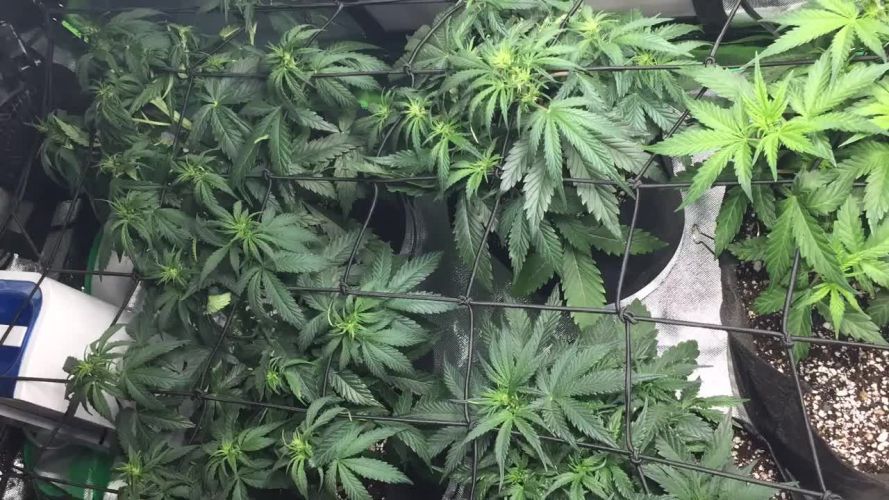
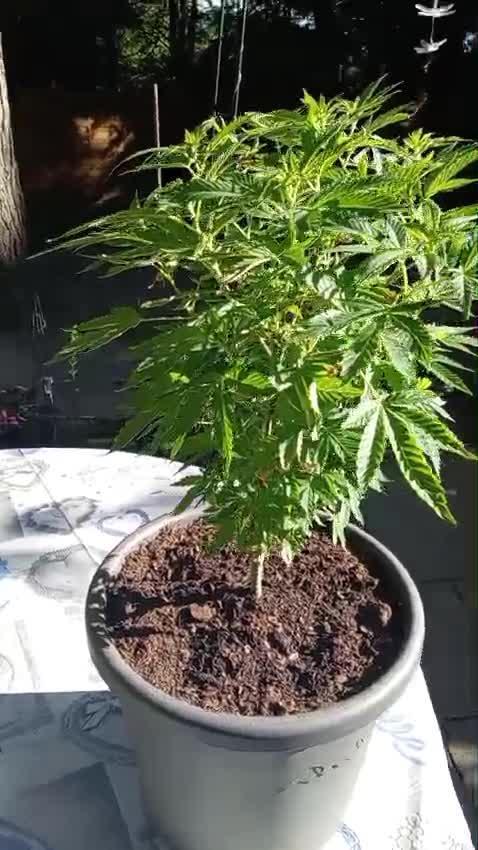
This is the 8th week. Thursday will be 9 weeks of 12/12. Some trichs are amber. They just added a good bunch of girth over the past few days, but most of the pistils are red now. The rest of them have been dropping leaves consistenly but the canopy remains full so they must be putting out more leaves. I just flushed to 80% runoff and found out that I had 1200ppm. I just got an ec meter but my last reading said closer to 600 so idk what happened there. I flushed until I had runoff ppm of about 150. Now they're back in the grow tent. I don't want to keep assaulting them with my microscope. I think they're ready. Just gonna let them settle another day or two to dry out a bit. I took one small branch off the small Wedding Cake plant on Thursday and I've just been watching it dry on my counter. It's been 5 days and the stem snaps but still leaves a fiber connecting. I put it into a small jar with a 64RH thing. I just want to try it. It already smells amazing. The leaves on the big CBD Blue Shark plant are going really yellow and some other colours are starting to come out as well. The buds all fattened up and got more frosty again. I was worried they were foxtailing but they got more calyxes underneath the peaks and have been making more of a pyramid shape. They're really close to peak. Harvest day will be March 17 or 18. March 17 1023pm chopped and hung after lights off all day. RH was 65% before I chopped and 50% after I closed the window and cut the plants off the saturated pots. I did a wet trim to prevent mold. The buds are sticky af. Gonna hang them to dry for 7-9 days before curing in jars :) March 18 : checked the RH when I woke up and it's chilling at 45% 😎 March 19 : just checked to see how they were drying. There are seeds in every plant. RIP I'll update when I put them in jars and again a few weeks later for final review. Overall it was a good grow despite the rocky start and a good introduction to the mainline technique and my new grow space. Next grow I should have everything pretty well dialed in. March 23 They were hanging for 3 days. Rh was around 45, then spiked to 65 overnight when I forgot to turn the fans back on. Temp was high at around 26.they felt wet after 2 days, and bone dry after 4 days. The stems still didn't snap but I put them in jars anyway. A day later, jar RH was 50%. I burped all the jars and there was a smell from the new jars. I took all the weed out, washed out the jars, and did a dry trim on the weed. One of the Wedding Cake plants must have gone hermie. I didn't see any bananas and didn't even realize there were seeds until the very end. The seed pods looked just like calyxes while the plants were growing. Many of the nugs are unusable. Under the sugar leaves are just layers and layers of seeds. Some weren't hit that badly. The CBD Blue Shark is much better off but still has some seeds. I'm trying to stay positive. It's a bit of a shock though. I'm anxious to try the finished product. If the flowers at least taste good and have a good effect, all is not lost.
Likes
10
Share
Cepa difícil de cultivar, hay que estar pendientes de ellas cada día.lástima algunas tienden a salir flor macho, no obstante la calidad está muy bien , pegan de miedo. Red hot cookies x cookies gelato Híbrido (50% indica / 50% sativa). Producción Interior: 450/500 g/m2 . Floración Interior: 8/9 semanas z Thc: 25%/28% . Cbd: bajo . Sabor: afrutado y dulce. Altura interior: 90cms- 140cms . -Origen genético de red hot cookies: Tropicanna Cookies (Girl Scout Cookies x Tangie. -Origen genético de cookies gelato: Girl Scout Cookie X Gelato 33 Posibilidad de conseguir flor roja, porcentaje desconocido. Disponible , tirar chat o Dm instagram.
Likes
6
Share
This 10gal reservoir has been a game changer!!! If you’ve been wasting/going through your nutrients fast I suggest you get one of these and in the comments add Midnitrtoker from IG sent me. Trying to get sponsored and give one of these systems away!! Like I said i filled up the res with 10gal and it has gone 4weeks!!! Today I empty out what’s left and change the feed to flower. That means we up the EC a tad and let it go. If 10gal lasted up 4 weeks we will be using 5gal this time and hope it lasts us the first 3 weeks of flower. I have not experienced any deficiencies the tips are turning purple but that’s because my night temps drop to the low 70s even to 69F. I took cuts of these girls again. Next round we will be using Floraflex or Athena. Same environment different nutrients we will see which company gives us the biggest harvest. See you all at the end of week 1 Flower.
Likes
2
Share
18 hours in seconds, 60x60x18 = 64,800 seconds, now multiply by the 833μMol/s reading off the PAR metre. μMol/s (micromol) is the unit in which P.A.R. is expressed. 64,800x833=53,784,000μMol 53,784,000μMol = 54 Mol 54 DLI @ 800ppm, powerful combination. Pushing photosynthesis to peak capacity, accelerated growth and increased biomass. Applied net, stretching her around for a week. Maintaining a minimum air velocity of 0.3m/s within the inner canopy. E=MC2 looks like a simple multiplication problem; it describes a fundamental physical truth: mass and energy are the same thing. The equation doesn't just calculate a value; it reveals that mass is effectively "congealed" energy. Energy is just numbers. Energy isn't a physical "substance" you can hold or touch. It is essentially an abstract, calculated number that we assign to a system to predict how it will change, interact, or move. A numerical label we attach to matter to track how it behaves. Because the universe runs on laws of symmetry (specifically, that the laws of physics don't change over time), a single global number must be conserved. We call that number "energy". How well a seedling grows is down to how much knowledge one can acquire to increase the level of conversion to occur. Applying knowledge effectively requires intuition, which comes from hands-on experience. A seasoned stoner learns to read subtle signs—like a slight change in leaf turgor (stiffness), subtle color shifts, or the specific texture of the soil—before a textbook diagnosis can be made. Ultimately, growing is the application of botanical science blended with active observation. Knowledge dictates your potential, but adaptability and attentiveness to the plant's immediate environment determine your results. The human eye is capable of distinguishing more shades of green than any other color in the visible spectrum. 1.618 Nature mathematically optimizes quantum energy transfer and light absorption efficiency within the photosynthetic machinery, as it naturally dictates energy scaling hierarchies and resonance dynamics. External vibration or electromagnetic wave that perfectly matches a plant's natural frequency directly influences plant growth. Low-frequency sound waves and targeted electromagnetic fields stimulate cellular processes and boost photosynthetic efficiency. An angular frequency aligned with the Golden Ratio is often used in wave mechanics and quantum physics to optimize energy transfer. Does it produce better yields? All I know is the IVM loves being aligned with it. Here is how I "think" of it to simplify it for myself when I give it thought. Quantum is the firmware, DNA is the software read/write expression. Alignment with that of which already exists. Law of nature, not my opinion: Constructive interference occurs when two or more overlapping waves meet in phase, meaning their crests and troughs perfectly align. Their amplitudes add together, creating a new, amplified wave with greater intensity than the individual components. Constructive interference is the foundational mechanism that establishes a resonance hierarchy across physical, structural, and acoustic systems. "Frequencies utilizing this ratio naturally minimize resistance (or impedance) and allow for highly efficient resonance, which can facilitate an increase in Electron Transfer Reactions (ETR) or energy pathways in molecular structures." Quantum coherence in photosynthesis occurs when a photon of sunlight strikes a leaf; the energy it carries must travel to a reaction center to be converted into chemical energy. This process operates at nearly 100% efficiency. If the energy moved in a traditional "bunching" or random hopping manner, a large portion of it would be lost as heat. Instead, plants utilize quantum superposition. The energy particle (exciton) doesn't just take one path; it exists in a wave state and explores multiple pathways simultaneously. It essentially "chooses" the most efficient route to the reaction center simultaneously. Research shows that molecular vibrations and the specific network arrangements of chlorophyll molecules (like the naturally evolved Chlorophyll A & B ratios) actively protect against energy overflow, optimizing light capture across different light intensities. Enzymes are the biological catalysts that speed up chemical reactions within a plant's cells, allowing them to grow, metabolize, and repair. Rather than relying solely on the classical kinetic energy of molecules colliding, plants use quantum tunneling. Subatomic particles like electrons and protons (hydrogen ions) can literally "teleport" through energy barriers that they normally wouldn’t have the energy to climb over. This makes vital metabolic reactions happen far faster than classical physics could ever explain! Chloryphyll b has peak absorption at 460nm (Blue) and at 647nm(Red). If we take the blue peak wavelength 460nm and a UV-B, UVR8 peak absorption wavelength 285nm, Tryptophan-285 (W285) Sensing protein. 460/285=1.618 Φ If we take chlorypyhll b's Red absorption peak 647nm and a UV-A of 400nm, we get 647/400=1.618 Φ. "Structure of light". The cryptochrome photoreceptor (CRY) is a UV-A/blue light receptor that shares this dual sensitivity with several other biological structures and functions, including significant sequence similarity and a common evolutionary ancestor with DNA photolyase enzymes. These are light-activated enzymes that use blue/UV-A light to repair DNA damage caused by UV-B radiation in plants. Synergistic. Effective quantum efficiency of photosystem II, often denoted as ΦPSII, represents the proportion of light absorbed by Photosystem II (ΦPSII) that is actually used in photosynthetic electron transport. It is a key indicator of how efficiently a plant is using light for photosynthesis, as opposed to losing it as heat or fluorescence. ΦPSII (effective quantum yield of photosystem II) functions primarily as a "multiplier" (a coefficient of efficiency) rather than an additive factor when estimating the overall photosynthetic electron transport rate (ETR). Multipliers are considered far more beneficial than additions because they generate exponential growth, leverage existing resources to their full potential, and create sustainable, self-multiplying capacity, rather than just incremental, linear increases. This fascinating observation is rooted in the intersection of subatomic geometry, fractal scaling, and quantum dynamics. In specific molecular arrangements—such as in conjugated polymer networks or biomolecular architectures—the Golden Ratio (PHI) naturally dictates energy scaling hierarchies and resonance dynamics. Mathematically tied to the fine-structure constant, which defines the strength of the electromagnetic interaction. The Golden Ratio can be mapped geometrically as the Golden Angle (137.5 degrees) in atomic structures, linking the charge of the electron to fundamental quantum constants like Planck's constant. An electromagnetic wave is neither electric nor magnetic, but a combination of both. 137.5 The Golden Angle (137.5) This angle is derived from the Golden Ratio (1.618). It is the smaller of two angles created when a circle is divided such that the ratio of the arcs equals the Golden Ratio. An electromagnetic wave (like light or radio waves) is not a static electric field or a static magnetic field, it is a self-propagating combination of both. An oscillating electric field creates an oscillating magnetic field, which then regenerates the electric field. They feed off each other and travel together through space at the speed of light, carrying energy without needing a material medium. The Fine-Structure Constant Alpha (Α/α): In quantum physics, is the approximate denominator of the fine-structure constant (often represented by the Greek letter Alpha (Α/α). It is a fundamental, dimensionless number that dictates how strongly charged particles (like electrons) interact with the electromagnetic field. Its value has puzzled physicists for over a century, as it bridges quantum mechanics, electromagnetism, and relativity. In quantum mechanics, Omega (Ω/ω) usually represents angular frequency. When applied to "quantum coherence"—the ability of particles to exist in overlapping states without immediately degrading—is key to calculating how long these states last. The Golden Angle, the value 137.5° is the geometric Golden Angle. It is derived from the Golden Ratio (1.618) and is famously responsible for the beautiful, mathematically optimized spiral patterns found in nature (such as sunflower seeds, pinecones, and leaf arrangements). Because of this, theoretical physicists and mathematicians have long speculated about why nature relies so heavily on the number 137 and the golden angle to govern everything from subatomic light interactions to the macroscopic geometry of the universe. Quantum coherence allows particles to maintain superposition and entanglement. In realistic, open environments, interactions with a noisy background typically cause decoherence, destroying the system's quantum information. A major challenge in quantum physics and quantum computing is preventing this decoherence at large scales. In quantum optics and driven systems, the Greek letter Omega (Ω/ω) often represents the Rabi frequency, which dictates the strength of the coherent driving laser or electromagnetic field interacting with the quantum system. The interaction of light and water generates specific Coherent Domains. Trapped electromagnetic fields cause water molecules to vibrate in unison at a coherent frequency, separating the liquid into structured quantum areas and an unstructured phase. When water interacts with hydrophilic (water-attracting) surfaces, the energy from UV and Infrared light can drive the formation of larger, structured layers known as Exclusion Zone (EZ) water. Exclusion Zone (EZ) water represents a structured, negatively charged phase of water critical to cellular biology. Driven by light energy and hydrophilic surfaces, this ordered state acts as a natural biological battery, with far-reaching implications for cell function and human health. In this domain, water molecules arrange themselves into a highly ordered, negatively charged lattice that excludes solutes and particles. At higher energy levels, UV light acts as a catalyst for photochemical reactions. Photons can provide enough energy to break the hydrogen and oxygen bonds in molecules, resulting in free radicals and a plasma of quasi-free electrons. This transfer of electrons forms the fundamental basis for redox reactions and energy metabolism in ALL biological systems. Input: The energy, time, and focus you dedicate. Process: Continuous growing, refining, and learning. Output: A superior, highly polished final product.
Likes
4
Share
Plant is growing well. Transplanted them from a 1 gallon pot into a 3 gallon pot this week.
Processing
Likes
13
Share
Week 5 of flowering for the three ladies went well. A couple of the hairs started turning orange and shriveling. Tricomb production is looking grand, smell just continues to grow stronger and stronger. Stinking the whole house up even with a 4” carbon filter and fan constantly scrubbing the closet. Ph fell down to the lower 6.1-6.2, plants started yellowing and loosing older fan leaves, could have something to do with them Inching closer to harvest time, also probably has something to do with the slight ph drop, either way sugar leaves, new growth, and bud is all thriving so as long as the problem doesn’t continue to get server I’m not worried about the plant using up nutrients and offing some at this point in time useless lower fan leaves. Popsicle cake is giving off a straight gas/diesel fuel smell. The tallest unknown plant is solid lemons and Kush, and the middle sized unknown plant has a semi sweet but yet gassy aroma coming off her. Very exciting leading into week 6 of flower!
Likes
19
Share
Last week guys, rain coming 5 days in a row again.. no point waiting more then tomorrow ✌️🏾 Great colors 🔥 Peace out !
Likes
4
Share
@Hodo420
Follow
The plants are exploding in growth. Especially the gorilla cookies. I need to start doing a better job of watering my girls. I means its hard having to mix up all these nutrients at one time so I water my plants 2 at a time. I water 2 one day then the other 2 the next day. Im trying this method out cause it makes watering not so intense during dlower.
Likes
15
Share
So these girls have gone wild after some lst and one being topped they are just surprising me more and more! The topped one has taking flight to the moon 🚀🚀🚀!! The runt is growing and show her self off as well. The stacking on the topped on is pretty insane much props to fastbuds for these genetics!! Also shout out to growace for the system and it’s been doing it’s job can’t complain about anything major a few little things they can fix which will be said in my final review of the product! Well that’s it for now growmies much love and hope all is blessed
Likes
3
Share
@BLAZED
Follow
Week 21 (4-11 to 10-11) 4-11 Temps: 18.1 to 23.2 degrees Humidity: 50% to 64% 5-11 Temps: 17.3 to 25.4 degrees Humidity: 45% to 61% Watering: Both 700 ml. Strength of the light set from 75% to 80% Dry Weight #1: 3.5 kg. #2: 3.4 kg. 6-11 Temps: 17.4 to 25 degrees Humidity: 49% to 67% Watering: Both 700 ml. Dry Weight #1: 3.7 kg. #2: 3.6 kg. 7-11 Temps: 17.9 to 24.1 degrees Humidity: 49% to 67% 8-11 Temps: 17.4 to 25 degrees Humidity: 49% to 69% Watering: Both 700 ml. Dry Weight #1: 3.8 kg. #2: 3.7 kg. 9-11 Temps: 18 to 25.5 degrees Humidity: 47% to 64% Dry Weight: Both 3.9 kg. 10-11 Temps: 18 to 26.1 degrees Humidity: 47% to 64%
Likes
10
Share
Tent is about to burst 😂 I defoliated but the little Lady just continues doing her thing. 7/26 Scrog started 7/28 Flowering progress on the run
Likes
2
Share
she's a hungry lady and can take a good amount of nutes
Likes
20
Share
This week has been going well, a bit cold in the dark hours! But these girls have been starting to flower nicely and im super excited! Its taken me some time to get the watering down with the living soil but im making it work! Ayeee much love, excited for this northern lights ✨️ happy growing
Likes
28
Share
Info: Unfortunately, I had to find out that my account is used for fake pages in social media. I am only active here on growdiaries. I am not on facebook instagram twitter etc All accounts except this one are fake. Have fun with the update. Flowering day 26 since time change to 12/12. Hey everyone 😃. Another great week goes by. Last week, instead of 2 g of GHSC Powder Feeding, I only gave 1.5 g p l of substrate so that I can give you another 1 g per l of substrate next week so that it lasts until the end :-). It is developing very well and the buds are starting to grow :-). The week was poured 3 times with 1.1 l each time. once of them GHSC Enhancer was added :-). The bottom shoots have now also been removed :-). As always, the humidifier was refilled every day and the lady was checked for her health. I hope you enjoy the update. Stay healthy and let it grow 😊🍀. You can buy this Strain at : https://www.royalqueenseeds.de/feminisierte-hanfsamen/115-amnesia-haze.html Type: Amnesia Haze ☝️🏼 Genetics: Original Amnesia Haze 👍 Vega lamp: 2 x Todogrow Led Quantum Board 100 W 💡 Bloom Lamp : 2 x Todogrow Led Cxb 3590 COB 3500 K 205W 💡💡☝️🏼 Soil : Canna Coco Professional + ☝️🏼 Fertilizer: Green House Powder Feeding ☝️🏼🌱 Water: Osmosis water mixed with normal water (24 hours stale that the chlorine evaporates) to 0.2 EC. Add Cal / Mag to 0.4 Ec Ph with Organic Ph - to 5.5 - 5.8 .
Processing
Likes
14
Share
Day 84 (day 21 flower): Major defoliation on both the Brain Cake and Bakers Delight. Both the ladies are getting sticky! The Brain Cake smell is pretty neutral but the Bakers Delight has a bit more smell and reminds me a bit of a Tangine Kush (Rare Dankness) I grew a while back. Changed the water reservoirs to the flower bloom booster nutrients (Plagron green sensation). Day 86 (day 23 flower): They seem to be coming along nicely, a tiny bit of progression in the buds since defoliating. The Bakers Delight is more sensitive to nutrients so added some tap water to dilute the nutrients a little (TDS 510 -> 470). Day 87 (day 24 flower): Both doing well. The Bakers Delight seems to be reacting positively to the slightly lower nutrient concentration. Both water reservoirs between 5.7 and 6.3 at all times and around 20-21c. Day 89 (day 26 flower): Everything seems fine, water stats are stable, for as far as I can see no deficiencies or excess, bud are growing in height and seem to be producing nice amounts of thc giving the buds a slightly grey color. Some of the pistils are turning orange very early, might be due to stress the past weeks, or the new full spectrum light or just genetics. The Bakers Delight currently has a stronger smell, also a more peppery background. The Brain Cake has a neutral fresh 'plant material' green hash smell, nothing special going on yet with her odor. --> Slowly been hanging the light closer, at 50cm from the Brain Cake and 60cm from the Bakers Delight, will slowly lower till its approx 40cm from the Brain Cake and 50cm from the Bakers Delight (because the BD is 10 cm shorter...). Hopefully this will get the top buds to get even bigger and stronger and hopefully aswell the bottom buds will pull some weight and most importantly the bottom buds need to ripen as fast as the top buds which is usually the main issue when they dont get enough light... Curious to see how it plays out. Might need another minor defoliation around day 40-44.
Likes
8
Share
Likes
11
Share
The plants look very healthy and they have big and dense buds , ill havr to wait anothe week or cuple days until harvest even tho it may be a bit soon for it. One of the plants has started to root its top head of the buds , but i soupose its because of the temp . The air is getting dry cuz of the hot weather even tho im using 250w-400w lights on them . Trichromes look preety good and the bud is frosty . Some of the plants are not ready yet for some reason so i think i have to give them a bit more time
Likes
7
Share
@Coughy
Follow
No trouble week, didn’t do anything to plants. Flower grow starting week 6, at the rate these girls grow, will need to top a lot, to chop a lot of height before they are ready to move. This week I added 100 litres 100% tap water; 33 grams calcium nitrate 26 grams Jack Hydro 30 grams magnesium sulphate 250mL h2o2 90 mL regen-a-root 100mL mighty growth enhancer 100mL fulvic acid 10mL humic acid
Processing
Likes
18
Share
Just gave her a tea last night. The tea consisted of: -1 gallon of water -15ml Be-1 pellets -15ml grokashi -1.5ml Be-2 -5ml slf100 -3ml fish head farms "fish sh!t" -3ml Nourish-L -5ml homemade FPJ -5ml Em1 Brewed for 26 hours She is growing fast and takes well to training. So far I have topped her main stem, then topped again at each end. I removed 2 fan leaves so that the under growth could get more light. And I've tied down the 2 main lines. I don't plan on topping anymore, but i do plan to train and tie down areas to get the biggest and most even canopy for this girl when she's ready to flower. Which should only be a couple weeks from now. Stay tuned and make sure you follow me on Instagram as well.