


Likes
Comments
Share


@Santica_Garden
Follow
So this is how things are looking at the end of Week 8, not much to update, bud sites forming nicely. Uploaded a video which explains better.

Likes
24
Share


@baboone
Follow
Good bit of growth this week, plenty of bud sites forming and she is drinking alot of juice.
I think she is doing really height wise, I only vegged for 4 weeks to keep her height appropriate and I don't want her to stretch too much towards the light so she's growing accordingly. I accidentally split the topped stem during transport when I forgot she was attached to the grow bag but she seems fine and getting on with it.
As soon as all the budsites have formed I'm going to defoliate and get some light on them lower budsites and make her focus on growing some nice colas.
Next time I will leave the LST on until about now cos she's straightened up a lot and it's a bit more crowded lower down than I would have liked. Lots to learn when growing the devil's lettuce though.
Thanks! Any comments or tips are much appreciated. Baboone

Likes
81
Share


@Kitties_and_Colas
Follow
~_~_~_~_~_~_~_~_~_~_~_~_~_~_~_~_~_~_~_~_~_~_~_~_~_~_~_~_~_~_~_~_~_~_~_~_~_~_~_~_~_~_~_~_~_~_~_~_~_~_~_~_~_~_~_~_~_~_~_~_~_~_~_~_~_~_~_~_~_~_~_~_~_~_~_~_~_~_~_~_~_~_~_
💪😺 5th week of flower!!! Things are going great in this tent, a couple brown calcium def spots forming in a few areas and as it goes we're currently out of cal-mag lol, we should have more delivered in about 2 days...I really like the structure of these plants, a few long (fat) colas always make for easy cleaning/drying and the SP-3000 gets in there deep..we could never run this close together under our old LEDs or without bending them sideways but we've had no issues yet keeping everything vertical under the MarsHydro...The temps are a little high and we're still watering this tent more than the others but airflow is really good and the plants seem happy for now....we removed a bunch of lower growth from most of them this week so they'll put that energy towards the stuff on top and minimize "popcorn"..the smell is just amazing, this is a very hearty and beautiful strain..I'm happy we were able to grab a half dozen clones..all the Widow clones we took are well into veg at this point ...💪🐱🌱....we live in zone 5 (US) and are limited on what we can grow outdoors but I think with these being a "fast" strain we could flower them all outside..we'll play it by ear lol..well thanks for taking the time to read my ramblings, we'll update if anything exciting happens midweek...have a safe and happy Memorial Day (US) Growmies!!
❤️💡🌱😽💨
~_~_~_~_~_~_~_~_~_~_~_~_~_~_~_~_~_~_~_~_~_~_~_~_~_~_~_~_~_~_~_~_~_~_~_~_~_~_~_~_~_~_~_~_~_~_~_~_~_~_~_~_~_~_~_~_~_~_~_~_~_~_~_~_~_~_~_~_~_~_~_~_~_~_~_~_~_~_~_~_~_~_~_

Likes
7
Share


@Baboon_Grows
Follow
Topped in last few days 2-3 days ago, was completely overran with life , kids and work so didn’t do SST on Wednesday , nor water as the reservoir is still somewhat half full, I mist the top soil lightly, was everyday , last 4 days every 2-3 days as cover crop retain moisture and probably pull some from the reservoir .
Galaxy Grape 2nd seed sprouted but got ate by mould mites 😂, actually they manage to eat 2 Galaxy grapes and Eden secret sprout 🙈🤣🤣, 100% living soil and only strong will survive 🙈😂😂😂😂 elimination by necessity of nature haha


Likes
Comments
Share


@Growedbypepper
Follow
Primera semana de floración de esta chocofresas, se ve completamente sana, ya que pasan del indoor al exterior cuando pasan a floración
Likes
3
Share


@nag4wa
Follow
Started this week with 1.0 EC and slowly pushed up to 1.4, no signs of overfert. Also added some silicate and dolomite via foliar spray. Trying to find the best setup for this new grow tent

Likes
10
Share


@Elixx
Follow
At the beginning of the week the plants was so dried, maybe near death. I give them water and some nutrients, and in two days It have regeined strength. I'm very curious to see the final weigth.

Likes
5
Share


@LockDownGrow
Follow
Coming along real nice now and starting too show the very start of flower too ,

Likes
145
Share


@Salokin
Follow
Dear Growmies,
With week 13 upon us, the journey with our plant enters an exciting new phase.
The dance of the buds stretching around the colas has come to a natural pause, ushering us into the swelling stage. Each day, we're greeted by buds that are increasingly plump, a clear indication that they're on the right track. As they swell, our plant is starting to exude a sophisticated sweet lemon aroma that fills the air and promises a sensory delight. It's a fragrance that speaks to the complexity of her development and the nuanced profile we can anticipate. Notably, some leaves in the lower canopy are beginning to wilt, a process I view as normal age-related defoliation. It's a natural part of the lifecycle, as the plant focuses her energy on the swelling buds. In our efforts to optimize her environment, the GCX 9 lighting is now set to 100% flower spectrum and 75% veg spectrum. I'm carefully pushing the limits to provide maximum light without imposing stress or damage to our plant. This stage requires a delicate balance, pushing for maximum growth while maintaining the health and well-being of the plant. I
As we watch the buds swell and smell the sweet lemon fragrance developing, it's a moment to reflect on the journey thus far and the growth we've fostered together.
Let's continue this care and attentiveness into the next week, ensuring that our plant not only grows but thrives.

Likes
36
Share


@sandspur
Follow
I'm not going to put in daily updates for this week. It was a slow week but I will highlight the following
- Watered every other day
- Fed twice this week according to Fox Farm feeding schedule
- Checked trichomes on day 62 because Sour Stomper is usually a quick grow. Seems we're a ways off still.
**** I also put up a video for day 60. You can see how crazy looking the Sour Stomper is. The entire top of the plant is bud with tiny leaves. It's turned into a mutant bush. The good news is that the buds are starting to thicken up on the bottom. ****


Likes
3
Share


@PoshGrow
Follow
Welcome to GhostGrow Chapter One by PoshGrow!
🌳 Week #5
2nd week of flowering. Last week LST went as planned, strains recovered fast, so this week I gonna rearange LST and apply home made Scrog net, also I will remove all big fan leaves for better light penetration.
Watering when needed, every other watering I used Fox Farm Big Bloom, Grow Big & Tiger Bloom.
I wont be moving plants around, they will keep their positioning till the end of the grow, so in further pictures I wont put tags with strain names😉✌️
Processing
Likes
3
Share


@I_roll_my_own_420
Follow
Buds are getting heavy, I had to craft a net to hold them up. All smells fantastic, looking good.

Likes
12
Share


@Frosth
Follow
05.10.2022 - feed her with 5ml/lt connoisseur grow A-B. She seem happy with it!
06.10.2022 - a harf defolation applied. Clear all lower branches, nodes and leaves for to make her ready for bloom. Last touches before switch the bloom!
07.10.2022 - feed her with 2ml/lt connoisseur grow A-B. she is okay, growing for to be monster!


Likes
2
Share


@I_Identify_As_A_Dan
Follow
Day 42
Shes really starting to pack on the some size, shes going to be a great yielder i think.
Have a new dehumidifer arriving next week which is needed right now.

Likes
33
Share
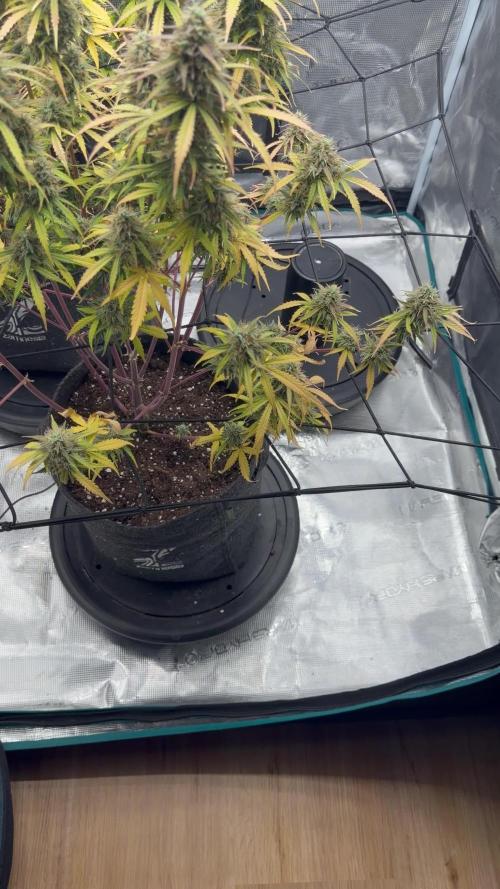

@cangrowz
Follow
Woche 10 Grow Diary Mimosa x 🍊👊🏻 Barney’s Farm
So ihr lieben, beide Damen sind nun geerntet und damit geht dieser Grow offiziell zu Ende. Es hat wirklich extrem viel Spaß gemacht diese Sorte anzubauen und ich kann sie absolut weiterempfehlen. Gerade gegen Ende von Woche 9/10 kamen nochmal richtig schöne Farben durch, die Blätter wurden immer pinker und selbst die Stämme waren teilweise komplett rosa verfärbt was das Ganze nochmal brutaler aussehen lassen hat. Die Buds sind schön frostig geworden und insgesamt lief der Grow echt entspannt durch.
Ein riesiges Dankeschön an Barney’s Farm für die Teilnahme an diesem Grow und natürlich auch danke für den ganzen Support während des Runs. Der nächste Grow wird dann mit Genetik von Green House Seed Co. weitergehen worauf ich schon extrem gespannt bin.
Happy Growing Growmies 🌱💚


Likes
53
Share


@SativaSteve88
Follow
All going well upto now my estimate is another 3 weeks or so till harvest so i will see the diferrence in them this time next week an decide wether its time to start my 2 week flush or not, love how well these tropicana bannana and mimosa evo have grew from the start and it is a strain i will run again sometime given i enjoy the smoke, buds have formed really well and can tell they will all be nice and dense, see you next week for my latest update when we will be 1 week closer to the finish line 😁✌️👊
Likes
17
Share


@Smokwiri
Follow
Development is good, plant smells very nice
Not too skunky, i like it ;)
Plant is loving the nutrients...

Likes
11
Share


@TgOgFaRms
Follow
🌿🔍 Week 7: Trichome Wonderland and Final Push! 🌿🔍
Hey there! Here's your weekly update with all the exciting developments in my grow:
🌸 The Smell is Popping: Week 7 brings a delightful aroma to my grow space. The scents are becoming more pronounced and captivating. 🌬️👃
🌈 Colors Galore: The plants are showing off their vibrant colors as the flowers mature. You'll notice burpling on the leaves and the emergence of orange and red hairs on The Queen plant. LOVE IT ! 🌺🎨
💧 pH and TDS Levels: Throughout the entire flower stage, my pH has remained steady at 6.33. That's great! As for the TDS levels, they currently stand at 750ppm and 1150ppm, providing the necessary nutrients for your plants. ⚖️🌱
⏳ Flowering Progress: The Queen is proving to be a quick finisher, with only 46 days of flowering under her belt. She's looking almost ready, and it's time to grab my handy DIY microscope to examine the trichomes closely. Keep an eye for the desired level of ripeness! 🔍🌿⌛
🍪 Oreo Big Stuff: Although not as far along as The Queen, the Oreo Big Stuff will need an additional week of flowering before she reaches her peak. 🍪⚡
🌿 Zweet Og: The Zweet Og requires a bit more patience. It looks like it will need at least two more weeks before it's ready for harvest. Keep monitoring her progress and let her mature fully. 🕒👀🌿
🧐 Drying Dilemma: Unfortunately, I currently am facing a problem with drying The Queen. She's positioned on the back left side of the grow tent with a scrog, making it challenging to remove her without disturbing the others. It's a tricky situation indeed! 😬🌿🏋️♂️
🌱 Future Plans: Despite this dilemma, overall, I'm extremely happy with how things are going. No herms or other issues have arisen, which is fantastic news. I'm even planning to do another run with The Queen, as I already have six clones ready to be transitioned into flowering immediately after this run. Exciting times ahead, especially since it'll be my first time flowering clones! 🌼🌿🌿
That's all for this week's update. Happy growing, lads, and remember to stay high on positivity! If you need any assistance or have any questions, feel free to ask. 🌿💪🌿✨

