Check the winners The Grow Awards 2026 🏆
Likes
Comments
Share
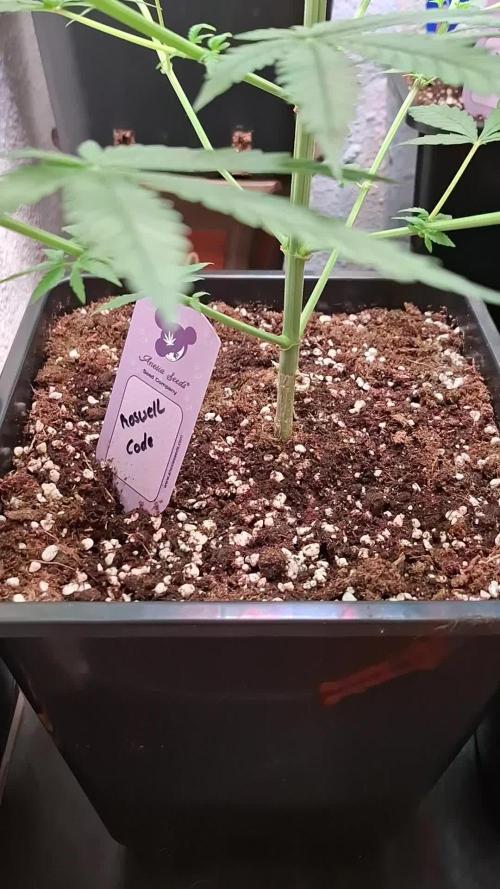
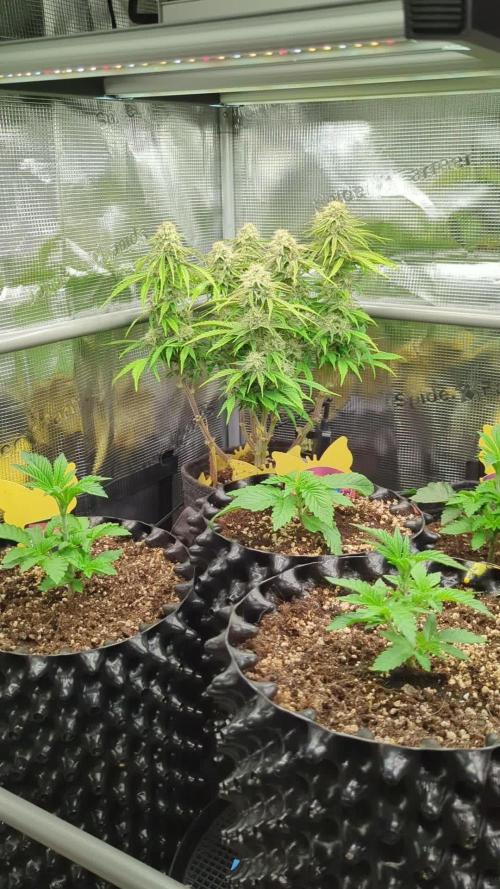
Day 14 : Hi all , hope we are well and healthy. The new Exotic girls are doing their breeder very proud. All have settled in to their pots and are on their 3rd nodes now with upright and straight out leaves. They are all in a good position directly under the sp3000. inhave kept them at a good 24 inches away so far and will see how they reach up during this week. I plan to top them to encourage a wider plant each pot dependant on how they grow. If they stay smaller in height then I may pull them over to create a 5-way manifold for chunky mains. All in all a nice steady week I will be starting to feed them Mega crop in a day or two to get their leaf colour to the most energising I can. I am watering on the outer edges mainly, this should encourage the roots to spread to the whole pot and give a strong foundation for big buds hopefully. Be safe folks.
Likes
8
Share
@Bncgrower
Follow
Another week is coming to an end. I've been writing for the last few days because I've been very busy, but I finally had to put a support on one of them so that the plant wouldn't open. The first one smells really good and apparently it's going to be harvested first and the other two aren't as attractive as I expected but... let's wait and see what happens! Happy growing! 🌱🌱
Likes
7
Share
@Dunk_Junk
Follow
Grown 23cm this week! Entered flowering also!
Likes
19
Share
This was Chop week for Chemdawg 1. Day 77 above ground and down she comes. Next up is the Northern Lights who probably has a week then flush and keep an eye on Trichomes. The Foxtailing Chemdawg won't be far behind she's a genetic mutant Foxtailing from her head to her toes. Should be pretty potent. Chemdawg 3 is flying since being topped but her and the strawberry pie are another story. Just thrown a Tangie Auto in too. Happy Growing Gang Everyday Growing is a Day Learning We would love to see you in the Forums on our website. Sign up and share your ladies today and help build our Growmunity. 💚😈
Likes
5
Share
They dont really strech much its more like cruise control, still not sure if I need nutrients?
Likes
13
Share
Removed the 2 Xs 1500's (300watts) & replaced them with 2 P1000 (200watts) lights, now running 680 watts. These lights fit in better & have air space all around to help cool them, these lights run a lot cooler than the xs 1500s & only get warm not hot. Started some clones.
Likes
170
Share
Bonjour à tous les padawans et les maîtres jedis Jour42 ma plante entre bien en floraison je pratique sur elle une defolliation pour permettre aux têtes de prendre la lumière La floraison des plantes de cannabis La plante de cannabis passe par différentes étapes de vie avant de parvenir à la récolte. Ces étapes sont : la germination, la pré-croissance, la croissance et la floraison. Pour les autofloraisons il n'est pas nécessaire d'avoir de changer le cycle de lumière elle entre en floraison automatiquement voilà d'où elle tient son nom "d'autofloraison" L'origine de l'auto-floraison vient de la sous-espèce "cannabis sativa ruderalis" , qui à l'origine produit de très faibles niveaux de THC. C'est en croisant cette variété de marijuana avec d'autres qui produisent des niveaux de THC plus élevés qu'à vu le jour ce magnifique compromis que sont les variétés auto-fleurissantes avec des taux de THC très satisfaisants. En parallèle, cela a permis d'améliorer la production de ces variétés, qui initialement étaient exceptionnellement basse. Pour des résultats optimaux, en culture Outdoor (extérieur), je recommande que la germination des graines de marijuanaAuto-flo se fasse entre avril et août. En culture Indoor(intérieur), la photopériode idéale que ce soit pour la croissance comme pour la floraison est de 20h de lumière. N'oubliez pas que ces graines ne sont pas tributaires de la photopériode pour passer en floraison. Il est préférable d'utiliser des pots d'une capacité de 10 à 20L dès le début, étant donné que leur cycle de vie est réduit, les auto-flo n'ent pas besoin de plus de volume pour se développer. Vu sa petite taille (et la discrétion) elle fait l'objet d'un bon choix pour la culture de cannabis sur balcons. La première variété de Lowryder auto-floraison a été créé à partir de cannabis indica sativa croisé avec des génétiques de cannabis sativa rudelaris par la banque de graines de marijuana "The Joint Doctor". Puis vinrent la White Dwarf de "Buddha Seeds", la Roadrunnerde "Dinafem", l' Auto Stoned d' "Autofem", la Speed Devil de "Sweet Seeds" , la Maxi Gom de "Grassomatic", la Flash, la Gnomo de Kannabiaet bien d'autres. Jour42 defolliation (video) Avant toute chose n'oublions pas de bien désinfecter ses outils et bien ce laver les mains. Quesque la defolliation ? LES CULTIVATEURS AMATEURS, PRENEZ GARDE, MAIS NE PRENEZ PAS PEUR La défoliation consiste à retirer les feuilles des plants de cannabis en intérieur afin d'accroître le rendementfinal. Le cultivateur amateur doit faire preuve de vigilance lorsqu'il commence à appliquer cette technique de taille. Malgré le débat sans fin entre ceux qui prônent cette technique et ceux qui la dénigre, il n'y aucune raison pour qu'un amateur ne s'y essaie pas afin de voir si ça lui convient ou non. COMMENT DÉFOLIER Que vous tailliez les feuilles ou les branches des plants de cannabis, il vaut mieux utiliser un sécateur stérile qui est confortable en main. Arracher des feuilles à la main manque de finesse et engendre souvent par accident, l'arrachement des couches d'une tige en plus de la feuille. L'objectif principal de la défoliation est de permettre une meilleure pénétration de la lumière et de promouvoir la production de plus grosses têtes. Les feuilles éventails qui font de l'ombre doivent être retirées. Tailler la tige principale et/ou les pousses secondaires n'est pas de la défoliation. La règle d'or lorsque vous donnez à vos plantes un rafraîchissement est de commencer avec les feuilles nourricières les plus grandes et les plus larges, en taillant du bas vers le haut. Il est important de retirer les feuilles stratégiquement et non pas au hasard. Pensez également qu'il vous faut limiter votre rafraîchissement à approximativement 10 à 20 % des feuilles totales de votre pied. Il est très facile de s'emporter durant la taille et de se retrouver avec des plantes chauves. Un excès de taille de feuilles empêchera la photosynthèse et paralysera vos plants. QUAND FAUT-IL DÉFOLIER Il est assez rare d'appliquer la défoliation comme seule technique pour obtenir un fort rendement. La taille des feuilles est généralement associée à d'autres méthodes de tailles et de palissage pour un meilleur rendement telles que le topping ou étêtage, le FIMming, le LST, le manifolding, le supercropping et le ScrOG. Les cultivateurs utilisant la méthode ScrOG auront besoin de retirer toutes les croissances inférieures ainsi que les feuilles et les tiges se trouvant sous le filet. Les plants de cannabis peuvent être défoliés dès lors qu'ils sont passés de la phase de plantule vers la phase de croissance végétative. Cependant, il est recommandé aux cultivateurs amateurs de laisser aux plantes 1 à 2 semaines de croissance végétative avant de s'attaquer à la défoliation de celles-ci. De plus, certaines variétés sont plus sensibles à la taille que d'autres et de ce fait, seront plus stressées par la taille des feuilles. Surveillez minutieusement le comportement de vos plants après la taille. Une période de convalescence de minimum 3 à 7 jours avant de recommencer la défoliation est fortement recommandée pour éviter trop de stress aux plants. Les cultivateurs peuvent également défolier pendant la phase de floraison, ce qui permettra à l'énergie de la plante d'être concentrée vers la production de têtes tout en limitant l'ombre et l'excès d'humidité. Néanmoins, il est important de ne pas défolier trop tard sous peine de simplement blesser ses plants inutilement. LES AVANTAGES DE LA DÉFOLIATION Évidemment, l'avantage numéro un de la défoliation, c'est l'augmentation du potentiel de rendement de cette technique de taille pour tous types de cannabis allant de la photopériode aux variétés autofloraison. Ce n'est pas un secret que les fleurs qui reçoivent plus de lumières deviennent plus grandes et larges que celles dissimulées dans l'ombre des feuilles. De plus, retirer les feuilles intérieures des plants touffus aide à prévenir toutes menaces de moisissure. Les plants très feuillus avec un feuillage intérieur dense produiront une quantité importante de têtes pop-corn. Dans le pire des cas, les branches de têtes et les têtes qui sont denses succomberont au pourrissement. Si vous observez des gouttes d'eau se former sur la surface des feuilles, il est grand temps de penser à faire de la défoliation. Libérer la zone inférieure et médiane des feuilles est un excellent moyen d'améliorer la circulation de l'air. LES DÉSAVANTAGES DE LA DÉFOLIATION Les plants de cannabis en intérieur bénéficient de la défoliation pour deux raisons. La première est parce qu'ils reçoivent la lumière d'une source stationnaire au-dessus d'eux, et la deuxième est parce que les conditions environnementales sont contrôlées par le cultivateur et non Mère Nature. Les plants d'extérieurs eux, n'y gagnent pas beaucoup, car les cas échéants se vérifient pour eux. Le soleil traverse le ciel, illuminant sur sa route, différentes portions de la plante de son lever à son coucher. Les cultivateurs en extérieur n'ont pas besoin de manipuler les plantes afin qu'elles se développent en adoptant une structure plate puisque le soleil est infiniment plus puissant que n'importe quelle lampe de culture et qui plus est, il est toujours en mouvement. Tailler les feuilles des plants extérieurs les rend également plus vulnérables aux conditions humides et brise leurs barrières naturelles contres les nuisibles. De nombreux cultivateurs d'intérieur peuvent, et malheureusement, c'est souvent le cas, réduire le rendement final à cause d'une défoliation faite au mauvais moment et/ou excessive. Tailler les plantules n'est pas conseillé et engendre souvent des plants nains. Scalper les plants matures est encore pire, et au lieu d'obtenir de longues branches de têtes, vous obtiendrez probablement encore moins de fleurs. De même, tailler des plants malades ou en mauvaise santé à n'importe quelle période de la croissance risque de paralyser la croissance plutôt que d'encourager la formation de fleurs denses. Jour44 Arrosage une fois sur 2 topmax de biobizz Jour46 arrosage avec de l'eau ph6.3 à laquelle j'ajoute 0.8g par litre d'eau de feeding enhancer greenhouse. Jour47 léger arrosage. Jour48 léger arrosage
Likes
16
Share
Today on day 17 from date of birth Iam preparing a worm casting tea. In a cheese cloth bag ,Made up of 2 cups of worm castings 2 tablespoons of unsulfured molasses,2 tablespoons of mineralized phosphate (bat shit) ,2 tablespoons of soluble seaweed extract . 2 tablespoons of alfalfa meal 2 tablespoons of all purpose 4-4-4 all Gia green products other than. I also sprinkled in some great white premium mycorrhizae inton2 gallons of water. Tea will brew for 24 hours before applying.
Likes
18
Share
Chemical reactions in which, a single substance splits up into two or more simpler substances are called decomposition reactions. These reactions are carried out by energy, supplied by different sources. The required energy can be supplied by heat (thermolysis), electricity (electrolysis), or light (photolysis). Let’s talk about photolysis reactions (not photosynthesis): Photolysis (also called photodissociation and photodecomposition) is a chemical reaction, in which a chemical (an inorganic or an organic) is broken down by photons and is the interaction of one or more photons with one target molecule. The photolysis reaction is not limited to the effects of visible light, but any photon with sufficient energy (higher than the dissociation energy of the targeted bond) can cause the chemical transformation of the said (inorganic or organic) bond(s) of a chemical. Since the energy of a photon is inversely proportional to the wavelength, electromagnetic waves with the energy of visible light or higher, such as ultraviolet light, X-rays, and γ -rays, can also initiate photolysis reactions. Like all other peroxides, hydrogen peroxide (H2O2) also consists of a relatively weaker O−O bond, which is susceptible to light or heat. The net equation for the reaction is: 2H2O2⟶2H2O+O2 The step-wise reaction mechanism is suggested as follows (Ref.1): H2O2+hν⟶2HO∙ HO∙+H2O2⟶HO−O∙+H2O HO−O∙+H2O2⟶2HO∙+H2O+O2 Using isotope studies it was confirmed that the O2 formed is cleanly derived from H2O2 (Ref.2). Notes: The rate increases rapidly in the presence of catalysts such as MnO2 and KI (Ref.2). The rate of decomposition is slow at room temperature, but it increases with temperature. It is believed to be due to thermal decomposition of H2O2, which seemingly accelerates the photolysis (Ref.3). References: 1.J. P. Hunt, H. Taube, “The Photochemical Decomposition of Hydrogen Peroxide. Quantum Yields, Tracer and Fractionation Effects,” J. Am. Chem. Soc. 1952, 74(23), 5999–6002 (https://doi.org/10.1021/ja01143a052). 2.A. E. Cahill, H. Taube, “The Use of Heavy Oxygen in the Study of Reactions of Hydrogen Peroxide,” J. Am. Chem. Soc. 1952, 74(9), 2312–2318 (https://doi.org/10.1021/ja01129a042). 3.F. O. Rice, M. L. Kilpatrick, “The Photochemical Decomposition of Hydrogen Peroxide Solutions,” J. Phys. Chem. 1927, 31(10), 1507–1510 (https://doi.org/10.1021/j150280a004). Interestingly, as early as 1934 Haber and Weiss (Ref. 1) proposed that HO2∙ is formed in the decomposition of hydrogen peroxide. The subsequent reaction of the transient superoxide radical anion with hydrogen peroxide has been determined to also form the hydroxyl radical (Ref. 2). The higher pH version of the last reaction is, therefore, best represented as: O2∙−+H2O2⟶2HO∙+OH−+O2 And as H++OH−=H2O, the net product formation is not altered. However, alkaline H2O2 is well known to be less stable than acidic hydrogen peroxide (Ref.3) even in absence of light exposure, which accelerates its decomposition (which can involve radical pathways) liberating oxygen! References: 1.Haber Fritz and Weiss Joseph, 1934, The catalytic decomposition of hydrogen peroxide by iron salts. Proc. R. Soc. Lond. A 147: 332–351 http://doi.org/10.1098/rspa.1934.0221 2.TOSHIHIKO OZAWA, AKIRA HANAKI, Reactions of Superoxide with Water and with Hydrogen Peroxide, Chemical and Pharmaceutical Bulletin, 1981, Volume 29, Issue 4, Pages 926-928. https://doi.org/10.1248/cpb.29.926 3.https://www.researchgate.net/figure/Effect-of-pH-on-the-decomposition-of-hydrogen-peroxide-H-2-O-2-0-800-mg-l_fig1_234110563, from Yazıcı, Ersin & Deveci, Haci. (2010). Factors Affecting Decomposition of Hydrogen Peroxide. https://doi.org/10.13140/RG.2.1.1530.0648.
Processing
Likes
2
Share
@ELixer
Follow
Explosive growth this week. Might get a grow net for separation. Decided to top these ladies later. Growing at a good pace.
Likes
3
Share
@SpliffDoc
Follow
Starting this little diary already a week in. This blackberry started flowering at day 16, I dropped the pot and I guess the shock of that started the change. Stick around to see how she turned out.
Processing
Likes
10
Share
End of week 4 and all is going well, had a slight calcium issue on a couple of leaves, but it was corrected and all is good again. This girl is responding well to the nutes, but my run-off is getting a little high, that should change when I cut out the Flora Micro and just feed calmag, Dnectar and KoolBoom for the next couple of weeks. Any comments or suggestions? Wish me luck.... just a few weeks to harvest now.
Processing
Likes
4
Share
So, what a difference ay, I've added rhizotonic & my 600w and WOW!!!!!! All deficiencies are GONE and I'm 1week from flower
Likes
64
Share
🥦Flowering Week 3 Structural Finalization & Early Bud Stacking Eternity Grow Cup 2026 Sticky Broccoli Feminized Stage: Flowering Phase Week 3 Day: ~23 since 12/12 switch 🌡️ Environmental Stability Environmental conditions remained highly stable, allowing the plants to fully transition from stretch into early bud development. -Temperature: ~26°C -Humidity: optimized for early flowering -Light: full intensity (720W) -Airflow: strong and consistent 🌿 Plant Development / End of Stretch The plants are now approaching the end of the stretch phase, with energy shifting into bud formation. Observations: -Vertical growth slowing down -Strong development of upper canopy bud sites -Uniform structure across all four plants -Healthy, vibrant green coloration -Bud sites across the SCROG are now clearly defined and actively developing. ✂️ Final Lollipopping & Defoliation At the beginning of the week, lollipopping was completed, largely up to the SCROG net. Objectives: -Eliminate lower, non productive growth -Redirect energy to top canopy buds -Improve airflow and light efficiency Additionally: -One structured defoliation session -Ongoing removal of individual shading leaves Plant response: No signs of stress were observed. Recovery was immediate, confirming strong plant vitality. 🌸 Bud Development & Early Stacking Following canopy optimization, the plants began to show clear early bud stacking behavior: -Formation of dense bud clusters in the upper SCROG layer -Vertical stacking of flower sites -Improved bud alignment and structure While full swelling has not yet begun, the response to training and pruning is clearly visible. 🍵 Nutrient Strategy / Early Green Sensation Introduction Feeding continued using the Hy-Pro nutrient line (excluding Spraymix), with a key strategic addition: Plagron Green Sensation introduced early at 1 ml/L This was applied one week earlier than manufacturer recommendations to: -Enhance early flower development -Support metabolic activity during transition -Prepare for upcoming bud swelling phase Plant response: Excellent , no signs of overfeeding, deficiency, or stress. The plants remain in perfect health. 🌱Strain Observation Sticky Broccoli Sticky Broccoli continues to impress with: -Exceptional genetic stability (all four phenotypes highly uniform) -Strong resilience to stress and training -Efficient nutrient uptake even under shared root space (4 plants / 30L soil) -Balanced and symmetrical canopy development The consistency across all plants highlights the quality and stability of the genetics. 🧠 Weekly Reflection & Forward Plan Focus this week: Final structural optimization and transition into early bud stacking. All interventions were executed successfully, with the plants responding vigorously and without stress. Next steps: -Monitor onset of bud swelling -Continue evaluating response to Green Sensation -Maintain optimal canopy conditions -Transition fully into Main density and resin production phase 📸 Weekly Summary Flowering Week 3 marks the end of structural work and the beginning of true flower production. With lollipopping completed, canopy optimized, and early bud stacking visible, the plants are now entering the most critical phase of the cycle. The early introduction of Green Sensation, combined with strong plant health and genetic uniformity, sets the stage for a high-performance flowering phase. See you in Flower Week 4 Bud Development Intensifies 🌸✨
Likes
14
Share
Day 107 (f45) update: Runtz is doing amazing!!! 😍😍😍 Her buds are thickening up, even the mid section buds are coming along nicely! 😛 She smells very lovely, gaining complexity in smell with some 'deeper' background smells most likely coming from the gelato parent! Brought down the nutrient dosage from 1.6-1.8 EC to 1-1.2 EC and she is handling it very well. Still at least 2 weeks left, probably 3 weeks till harvest!!! Can't wait!!! 😝 >>>> Using Botanicare TEA and SWEET RAW (carbohydrates for hydro) to hopefully gain a more complex flavor profile 😜 as the plants of the last run were lacking in terpenes 😥
Likes
15
Share
I harvested when go began to see some amber trichomes, the plant grew very well, the maturation of trichomes was quite slow. The buds are nice and full bodied and the scent is very sweet and pleasant, reminiscent of gesolmino and strawberry bubblegum.