


Likes
Comments
Share


@LapsekiliTayfur
Follow
Day in and exit fan 15 min off 15 min on Van is full on
Night in and exit fan 30 min off 15 min on Van is full on



Likes
113
Share


@Anonymous_2022
Follow
Thanks for stopping by.. Please hit the like button if you like what you see and ill be sure to check you out too Growmies 🌱
First of all would like to give a BIG shout out to my sponsors for providing me with the necessary items for this grow 👍
🌟🌟🌟🌟Mars Hydro FC4800🌟🌟🌟🌟
Powered By Samsung LM301B Diodes: The Mars Hydro FC 4800 480-watt LED grow light is installed with high-performance Samsung LM301B chips, the top-bin horticultural diodes, to provide a high Photosynthetic photon efficacy efficiency of 2.85 μmol/j and a long-lasting color rendering capability, supporting indoor plants to grow and thrive.
High PPF Output and Uniform Light Distribution: FC4800 provides a high PPF of 1,366 μmol/S. The multi-light bar design and the dense diode layout facilitate an even distribution of grow lighting making PPFD optimized for Photosynthesis to achieve consistent growth in every part of the coverage range.
Exclusive Recipe Of Full Spectrum Lighting: The full spectrum is enhanced with blue and red light, in which the blue light stimulates plant growth and promotes the accumulation of plant-based phytochemicals; the abundant red light improves the maturing process and flower quality of the plants.
🌟🌟🌟 FastBuds Purple Lemonade FF ⭐️ ⭐️⭐️
Arising from a cross between purple and citrus Cali genetics, Purple Lemonade FF (Fastflowering) offers a complex high made up of perfectly balanced cerebral and body effects that are ideal for daytime use. Expect an extremely enjoyable high that boosts your mood while deeply relaxing your whole body and getting rid of muscle pain. This meticulous cross produces up to 550 g/m2 of some of the most beautiful purple buds, with pinkish and reddish hues that will catch everyone’s attention. The beautiful purple buds are ready for harvest in 7-8 weeks and come hand-in-hand with unbelievably sugary citrus terps that are just as refreshing as a cold lemonade on a hot Summer day. It’s the ideal variety for the sweet-tooth stoner seeking strains that deliver both in quality and quantity of resin
——————————————————————————————
👊👊👊👊Down to Business 👊👊👊👊
Week 8 from seed and week 3 flower
So shes moving beautifully and already starting to get abit of frost 😎
Cant wait to see if she throws out some pretty colours 🤞
No complaints at all with this girl all is good and she smells sweet like candy 🍭
Thanks for stopping bye 🙏🙏🙏

Likes
9
Share


@BeanCrop420
Follow
This girl really is coming along beautifully her buds are bulking and she producing more of a smell every day! This week I have been diluting/flushing the reservoir by just adding water at ph 6.2 before I do a full reservoir change for the full flush. Im hoping to see her really bulk up during these last few weeks.
Happy growing 🌱

Processing
Likes
41
Share


@Hawkbo
Follow
Day 42, everything is chuggin along pretty healthy. Definitely some seeds in most of them which bugs me. The whole tent reeks tho which is nice. Some of the citradellics look like they are gettin pretty close so I'll start keeping an eye on them. I had to take the pics again and was strugglin so they arent my best. I have to go thru them still so I got the video up and tmm or as soon as possible I'll get the still shots up✌️
2 and 3 look pretty good but 1 is on another level right now shes sweatin like a hoe in church. The aromas coming off her take over the room like rotten citrus it's one of my favorite smells. 1 and 2 have more awkward looking bud structures but still decent. 1 was so under wated before last nights feed it was flopping over everywhere nearly dead but after an hour showed improvement, it just dries out so much quicker than everything else it's hard to keep up with.

Likes
139
Share


@yan402
Follow
🌸🍊✨🍭🌸🍊✨🍭🌸🍊✨🍭🌸
Back at it with Kannabia — huge thanks for the NEW EXCLUSIVE Upcoming Kannabia's seed Launch 🙏🍨🍊
Grateful for the trust and for everyone following along, I’ll run her clean and showcase what she can do.
Dessert-party goals: berry–citrus sherbet terps, creamy finish, tight stacks, easy trim, zero drama.
Veg 24/0, clean manifold + LST, flip on a happy, even canopy.
Coco’s fresh, seed goes in now. 🚀
Added on 12.10.2025
🌞 Light conditions: Limited direct light for the first 4 weeks — ~4 h/day on weekdays and ~10–11 h on weekends due to tent sharing and work schedule.
🌸🍊✨🍭🌸🍊✨🍭🌸🍊✨🍭🌸
💭❗💭❗💭❗💭❗💭❗💭❗💭
❗Events & thoughts worth noting❗
💭❗💭❗💭❗💭❗💭❗💭❗💭
10.08.25 GW1 Sowed seed, soaked starter pot with #1
12.08.25 GW1 Seed popped hip hip hurray
28.08.25 VW2 Stopped using GreenBuzzBloom, took it out of the schedule.
01.09.25 VW3 TriPartMicro 10→30ml, TriPart bloom 10→30ml
12.09.25 VW4 Applied nemadodes against thrips and fungus gnats.
20.09.25 VW6 topped and trained for first time, decided against a full manifold as I lost a few weeks already.
26.09.25 VW7 Topped her one more time for 8 mains
27.09.25 VW7 Topped up the pot with perlite instead of clay pebbles this time, just trying things out, TriPartMicro 30→40ml , TriPartBloom 30→20ml
10.10.25 VW9 have her a haircut, umm be trimming the side shoots tomorrow, rest in the video 📹
12.10.25 VW9 done some extra trimming to clean up a bit and chose two extra side shoots to nurture info mains, so kept the 8 original mains plus 2 rest in the video 📹
17.10.25 VW9 FfJ/fpj fish mix 30 → 60 ml
20.10.25 VW10 Feed tweak: added 3 g Calcium Nitrate/ 30 L (≈ 15 ppm N + 10 ppm Ca)
24.10.25 VW11 did a defoliation and trimming session 📹
27.10.25 VW11 Epsom Salt 0 → 2.5, Calcium Nitrate 3 → 9 g
🌱💦🌱💦🌱💦🌱💦🌱💦🌱
🌿 Day to day tasks & actions 🌿
🌱💦🌱💦🌱💦🌱💦🌱💦🌱
24.10.25 VW10 – Fed 5l of #1 → 2l runoff
25.10.25 VW11 -- Fed 3l of #1→ 1l runoff
26.10.25 VW27 -- Fed 3l of #1→ 1l runoff
27.10.25 VW27 -- no feed no water
28.10.25 VW27 -- Fed 5l of #1→ 2l runoff
29.10.25 VW27 -- Fed 5l of #1→ 2l runoff
30.10.25 VW27 -- no feed no water
31.10.25 VW27 -- no feed no water
(*RUNOFF reused for tomato plants)
💧💦💧💦💧💦💧💦💧
💧 Nutrients in 30 L #1 (updated) 💧
💧💦💧💦💧💦💧💦💧
💧 TriPart Micro: 10 → 30 → 40 ml
= 0.33 → 1.00 → 1.33 ml/L
💧 TriPart Grow: 0 ml
= 0.00 ml/L
💧 TriPart Bloom: 10 → 30 → 20 ml
= 0.33 → 1.00 → 0.67 ml/L
💧 Cal-Mag: 60 ml
= 2.00 ml/L
💧 Home-made FFJ/FPJ (new batch): 30 → 60 ml
= 1.00 → 2.00 ml/L
💧 Calcium Nitrate (Calcinit): 3 → 9 g (≈ 15 → 45 ppm N + 10 → 30 ppm Ca) ⬆️
💧 Magnesium (Epsom Salt / MgSO₄·7H₂O): 0 → 2.5 g (≈ 0 → 10–12 ppm Mg) ⬆️
💧 pH Down: Citric acid (BuxXtrade) — adjust to ~pH 5.8 – 6.0
📦 TOTAL: ≈ 160 → 170 ml liquids + 3 → 11.5 g solids per 30 L
≈ 5.9 → 6.4 ml/g active mix per L
💧💦💧💦💧💦💧💦💧
⚙️✂️⚙️✂️⚙️✂️⚙️✂️⚙️
✂️ Tools & equipment ✂️
⚙️✂️⚙️✂️⚙️✂️⚙️✂️⚙️
✂️ 2× MarsHydro SP3000
⚙️ MarsHydro 150mm ACF Ventilator
✂️ Trotec dehumidifier (big unit)
⚙️ Mini no-name dehumidifier
✂️ Kebab skewers (LST – stainless)
⚙️ Wire + roast skewers (LST assist)
✂️ Scissors (HST)
⚙️ Vacuum (for spills & cleanup)
✂️⚙️✂️⚙️✂️⚙️⚙️✂️⚙️✂️⚙️✂️⚙️
---
🍊🍧🌬️🍬🍊🍧🌬️🍬🍊🍧🌬️🍬 Mystery seed (Kannabia Seeds) — NEW EXCLUSIVE
🍊🍧🌬️🍬🍊🍧🌬️🍬🍊🍧🌬️🍬
Species: Hybrid (GF / swift-flowering line)
Genetics: TBA (breeder sheet pending)
THC: TBA
Effect: Euphoric, relaxed, creative (target profile)
Flavor: Berry–citrus sherbet, sweet candy, creamy finish
Flowering (indoors): ~6–7 weeks target (GF)
Resistance: High (aim: no drama)
Indoor yield: TBA
Outdoor yield: TBA
Structure: TBA
Notes: Brand-new exclusive from Kannabia’s GF line — I’ll update specs when the breeder card drops. Goal is rich sherbet terps (berry–citrus + cream), low leaf-to-calyx, easy trim. Stage harvest stays on the table if tops finish early.
YouTube Link: https://youtube.com/-m8h?si=A7x4Zlr2kj-_ga31

Likes
5
Share

@ElCapitol
Follow
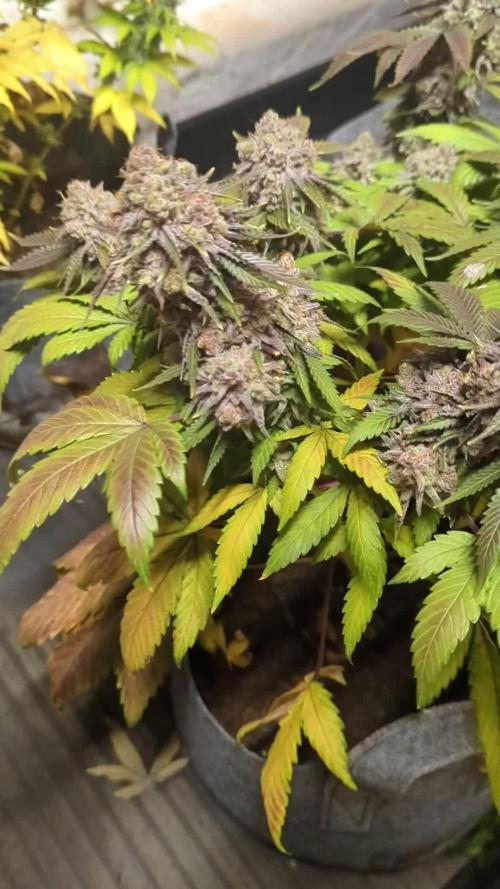
Well it's almost time, buds have got so heavy the plants struggling to support them :) The smell on these AK47 is intense. They've been on plain water for a couple of weeks with a little calmag added. Looking forward to harvest. Thanks for watching, I appreciate it.

Likes
2
Share


@High_Grade_Dadli
Follow
Week went smoothly cant complain....cutting are doing well also took 4 cutting of seed(think it's from applelicious) they already rooted n transplanted going to veg for a lil n send to flower to see if it's worth

Likes
6
Share


@sa2_gr
Follow
Hey guys !
finaly half/one more week to go, i'll push them into 61 days of flowering
The Zake#1 is already done (30% amber), but i have to cut the whole squad since im drying inside the growbox.
See you in 1 week for the last half flowering week ✌️
Happy Christmas to everyone

Likes
Comments
Share

@Dr_Zauberer
Follow
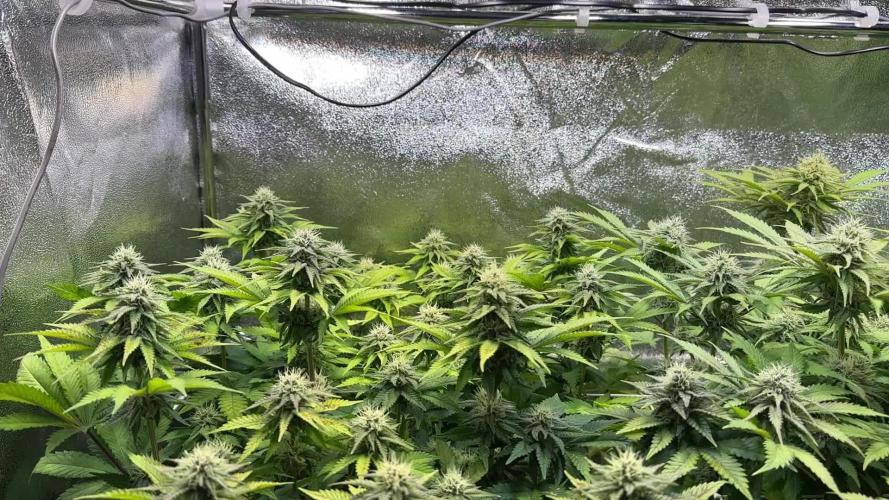
Day 57-63
My fungus problem again! Or is it?
Please let me know if u guys know those signs of problems on ur leaves and if u could figure out what it is. Thats why i am all about neemoil! Whenever i use it, this sort of stuff never happens tbh. Neemoil for the win baby. This time i didnt use it :(


Likes
7
Share


@eldruida_lamota
Follow
Que pasa familia, vamos con la cosecha de estas Black Muffin F1 de Sweetseeds.
Esta variedad me resultó bastante sencilla de cultivary es bastante resistente, si no la maltratáis crece mucho y bien sana, la flor se ve increíble, tiene una cantidad de resina considerable y unos tonos rojos oscuros muy peculiares, se ven genial.
El olor que desprende es bastante frutal con toques cítricos, no pinta nada mal, las flores están prietas.
No da mayores problemas, el ciclo no es largo, cuiden con la altura ya que se desmadran un poco.
IMPORTANTE destacar: En las fotos comprobaréis que ya no hay botes de cristal con sobres de bóveda, ahora hay Grovebags.
Que son una especie de sobres o bolsas que retienen el peso, previene la aparición de moho y mantiene intacto el terpeno, para que el curado sea más óptimo.
Hasta aquí todo, Buenos humos 💨💨💨

Likes
Comments
Share


@undermink
Follow
Her buds are growing and growing.. There are still about 4 weeks until harvest but her buds look awsome just now : I hope I can wait until she's finished, hehe
She's looking beautiful at the end of week 9.

Likes
21
Share


@Roberts
Follow
The plant grew pretty well. She smells of pine and oranges. Very frosty colas on her as well. The last Blue Dream I grew was a awesome smoke. Thanks again Medic Grow, Athena, and Spliff Seeds. 🤜🏻🤛🏻🌱🌱🌱
Thank you grow diaries community for the 👇likes👇, follows, comments, and subscriptions on my YouTube channel👇.
❄️🌱🍻 Happy Growing 🌱🌱🌱
https://youtube.com/channel/UCAhN7yRzWLpcaRHhMIQ7X4g.

Likes
2
Share


@CuriosityWebster
Follow
Loving how these girls are growing
Fastbuds mystery #1 finally catching up, and may possibly in the end being a better producer than the RQS plant, which is surprising to me because of how badly I stunted this plant. Got me curious how good this plant could’ve been

Likes
122
Share


@deFharo
Follow
Bienvenidos cultivadores de marihuana clandestinos, y también, a los que tienen la fortuna de no serlo!🖐️👨🌾
Tercera semana de floración, la planta ha estirado los últimos 2cm, ahora, con la fiesta de la flor comienza el gran juego de los pecados capitales, gula para engordar, avaricia de espacio, más adelante vendrá la lujuria en su esplendor y la soberbia para dominar, la pereza de manicurar y finalmente la ira cuando me la fume toda, no espero a la envidia...
Bueno, la planta vive feliz en su esquina, es una glotona, además de dos riegos esta semana he hecho un aporte de enmiendas secas cocinadas con Microorganismos, 4g/litro de sustrato, rodeada de luz, las ramas se muestran poderosas y capaces de soportar el peso de cualquier cogollo por muy grande que sea, los brotes inmaculados resaltan como estrellas, aunque esta planta por su morgología perdió el lugar central de la carpa de cultivo, sigue siendo la reina de mi jardín de la alegría... aleluya!
==================
Info de la cepa Mendo T: https://www.thehighchameleon.com/es/shop/mendo-t-6#attr=202
- 85% Indica, 15% Sativa. THC: 18%. Floración: 8 Semanas. Terpenos: Lavanda picante.
- Genotipo inverso masculino: limon t
Cruce: Lemon Tree x Cookies & Cream F2. 2019 - The High Chameleon - EUR
- Genotipo femenino: Mendocino Purps Reg Selección de THC
1996 - Piratas de CSI Humboldt, California - EE.UU.
==============
Hasta pronto... 🖐️👨🌾
SALUDOS A TODOS!!
=================================


Processing
Likes
2
Share


@UnknownT58
Follow
Couple days ago the Autoflower started producing couple pistils.
Likes
3
Share

@RebelSeedBank
Follow
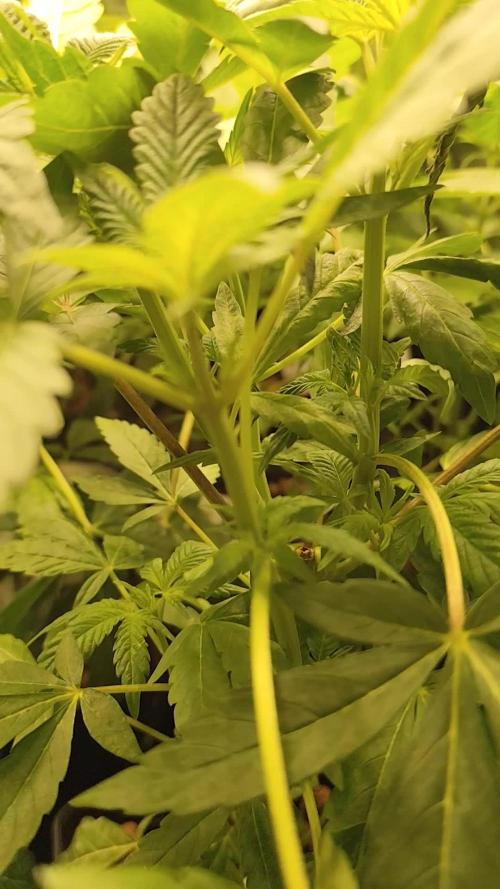
Si no haces nada especial para ti y actualizaremos para ti también y para siempre 😂
Likes
8
Share


@Shellshocked
Follow
Well looked at the trics and I seen about 40% ambers so I put her in dark for 2 days before I harvested her pulled her out or the dark checked the trics. again and seen zero ambers while I was confused I knew she was not ready so I had a space in my veg. Tent so I threw her in there for her last week or 2. She looks so bad as I let her dry out big time and with the ph issues I had earlier in the grow there's not a leaf on her that's not got part of it dying off. Hopefully this is last week of flower as it's week start of week 10 and I really wanna try her out although most will go to concentrates as this grow was not ideal and the frost is minimal compared to other gg4 I got flowering right now.

Likes
7
Share


@skunkch
Follow
The heatwave is unfortunately coming back,
Currently removing yellow drying leaves day by day.
Trichomes are ready in a few days, so it won't be a problem.
Chop day is coming 👽

Likes
56
Share


@Ultraviolet
Follow
What's in the soil? What's not in the soil would be an easier question to answer. 16-18 DLI @ the minute. +++ as she grows.
Probably not recommended, but to get to where it needs to be, I need to start now.
Vegetative @1400ppm 0.8–1.2 kPa 80–86°F (26.7–30°C) 65–75%, LST Day 10, Fim'd Day 11
CEC (Cation Exchange Capacity):
This is a measure of a soil's ability to hold and exchange positively charged nutrients, like calcium, magnesium, and potassium. Soils with high CEC (more clay and organic matter) have more negative charges that attract and hold these essential nutrients, preventing them from leaching away.
Biochar is highly efficient at increasing cation exchange capacity (CEC) compared to many other amendments. Biochar's high CEC potential stems from its negatively charged functional groups, and studies show it can increase CEC by over 90%. Amendments like compost also increase CEC but are often more prone to rapid biodegradation, which can make biochar's effect more long-lasting. biochar acts as a long-lasting Cation Exchange Capacity (CEC) enhancer because its porous, carbon-rich structure provides sites for nutrients to bind to, effectively improving nutrient retention in soil without relying on the short-term benefits of fresh organic matter like compost or manure. Biochar's stability means these benefits last much longer than those from traditional organic amendments, making it a sustainable way to improve soil fertility, water retention, and structure over time. Needs to be charged first, similar to Coco, or it will immobilize cations, but at a much higher ratio.
a high cation exchange capacity (CEC) results in a high buffer protection, meaning the soil can better resist changes in pH and nutrient availability. This is because a high CEC soil has more negatively charged sites to hold onto essential positively charged nutrients, like calcium and magnesium, and to buffer against acid ions, such as hydrogen.
EC (Electrical Conductivity):
This measures the amount of soluble salts in the soil. High EC levels indicate a high concentration of dissolved salts and can be a sign of potential salinity issues that can harm plants.
The stored cations associated with a medium's cation exchange capacity (CEC) do not directly contribute to a real-time electrical conductivity (EC) reading. A real-time EC measurement reflects only the concentration of free, dissolved salt ions in the water solution within the medium.
98% of a plants nutrients comes directly from the water solution.
2% come directly from soil particles.
CEC is a mediums storage capacity for cations. These stored cations do not contribute to a mediums EC directly.
Electrical Conductivity (EC) does not measure salt ions adsorbed (stored) onto a Cation Exchange Capacity (CEC) site, as EC measures the conductivity of ions in solution within a soil or water sample, not those held on soil particles.
A medium releases stored cations to water by ion exchange, where a new, more desirable ion from the water solution temporarily displaces the stored cation from the medium's surface, a process also seen in plants absorbing nutrients via mass flow. For example, in water softeners, sodium ions are released from resin beads to bond with the medium's surface, displacing calcium and magnesium ions which then enter the water. This same principle applies when plants take up nutrients from the soil solution: the cations are released from the soil particles into the water in response to a concentration equilibrium, and then moved to the root surface via mass flow.
An example of ion exchange within the context of Cation Exchange Capacity (CEC) is a soil particle with a negative charge attracting and holding positively charged nutrient ions, like potassium (K+) or calcium (Ca2+), and then exchanging them for other positive ions present in the soil solution. For instance, a negatively charged clay particle in soil can hold a K+ ion and later release it to a plant's roots when a different cation, such as calcium (Ca2+), is abundant and replaces the potassium. This process of holding and swapping positively charged ions is fundamental to soil fertility, as it provides plants with essential nutrients.
Negative charges on soil particles: Soil particles, particularly clay and organic matter, have negatively charged surfaces due to their chemical structure.
Attraction of cations: These negative charges attract and hold positively charged ions, or cations, such as:
Potassium (K+)
Calcium (Ca2+)
Magnesium (Mg2+)
Sodium (Na+)
Ammonium (NH4+)
Plant roots excrete hydrogen ions (H+) through the action of proton pumps embedded in the root cell membranes, which use ATP (energy) to actively transport H+ ions from inside the root cell into the surrounding soil. This process lowers the pH of the soil, which helps to make certain mineral nutrients, such as iron, more available for uptake by the plant.
Mechanism of H+ Excretion
Proton Pumps: Root cells contain specialized proteins called proton pumps (H+-ATPases) in their cell membranes.
Active Transport: These proton pumps use energy from ATP to actively move H+ ions from the cytoplasm of the root cell into the soil, against their concentration gradient.
Role in pH Regulation: This active excretion of H+ is a major way plants regulate their internal cytoplasmic pH.
Nutrient Availability: The resulting decrease in soil pH makes certain essential mineral nutrients, like iron, more soluble and available for the root cells to absorb.
Ion Exchange: The H+ ions also displace positively charged mineral cations from the soil particles, making them available for uptake.
Iron Uptake: In response to iron deficiency stress, plants enhance H+ excretion and reductant release to lower the pH and convert Fe3+ to the more available form Fe2+. The altered pH can influence the activity and composition of beneficial microbes in the soil. The H+ gradient created by the proton pumps can also be used for other vital cell functions, such as ATP synthesis and the transport of other solutes. The hydrogen ions (H+) excreted during photosynthesis come from the splitting of water molecules. This splitting, called photolysis, occurs in Photosystem II to replace the electrons used in the light-dependent reactions. The released hydrogen ions are then pumped into the thylakoid lumen, creating a proton gradient that drives ATP synthesis.
Plants release hydrogen ions (H+) from their roots into the soil, a process that occurs in conjunction with nutrient uptake and photosynthesis. These H+ ions compete with mineral cations for the negatively charged sites on soil particles, a phenomenon known as cation exchange. By displacing beneficial mineral cations, the excreted H+ ions make these nutrients available for the plant to absorb, which can also lower the soil pH and indirectly affect its Cation Exchange Capacity (CEC) by altering the pool of exchangeable cations in the soil solution.
Plants use proton (H+) exudation, driven by the H+-ATPase enzyme, to release H+ ions into the soil, creating a more acidic rhizosphere, which enhances nutrient availability and influences nutrient cycling processes. This acidification mobilizes insoluble nutrients like iron (Fe) by breaking them down, while also facilitating the activity of beneficial microbes involved in the nutrient cycle. Therefore, H+ exudation is a critical plant strategy for nutrient acquisition and management, allowing plants to improve their access to essential elements from the soil.
A lack of water splitting during photosynthesis can affect iron uptake because the resulting energy imbalance disrupts the plant's ability to produce ATP and NADPH, which are crucial for overall photosynthetic energy conversion and can trigger a deficiency in iron homeostasis pathways. While photosynthesis uses hydrogen ions produced from water splitting for the Calvin cycle, not to create a hydrogen gas deficiency, the overall process is sensitive to nutrient availability, and iron is essential for chloroplast function.
In photosynthesis, water is split to provide electrons to replace those lost in Photosystem II, which is triggered by light absorption. These electrons then travel along a transport chain to generate ATP (energy currency) and NADPH (reducing power). Carbon Fixation: The generated ATP and NADPH are then used to convert carbon dioxide into carbohydrates in the Calvin cycle. Impaired water splitting (via water in or out) breaks the chain reaction of photosynthesis. This leads to an imbalance in ATP and NADPH levels, which disrupts the Calvin cycle and overall energy production in the plant. Plants require a sufficient supply of essential mineral elements like iron for photosynthesis. Iron is vital for chlorophyll formation and plays a crucial role in electron transport within the chloroplasts. The complex relationship between nutrient status and photosynthesis is evident when iron deficiency can be reverted by depleting other micronutrients like manganese. This highlights how nutrient homeostasis influences photosynthetic function. A lack of adequate energy and reducing power from photosynthesis, which is directly linked to water splitting, can trigger complex adaptive responses in the plant's iron uptake and distribution systems.
Plants possess receptors called transceptors that can directly detect specific nutrient concentrations in the soil or within the plant's tissues. These receptors trigger signaling pathways, sometimes involving calcium influx or changes in protein complex activity, that then influence nutrient uptake by the roots. Plants use this information to make long-term adjustments, such as Increasing root biomass to explore more soil for nutrients. Modifying metabolic pathways to make better use of available resources. Adjusting the rate of nutrient transport into the roots. That's why I keep a high EC. Abundance resonates Abundance.