


Likes
Comments
Share


@Homegrown93
Follow
This week I can already tell she’s starting to swell, I’m excited to see how much! I think this might be her last week or so until I start flushing, we’ll see about that. Humidity has been great and temperatures also are under control.

Likes
21
Share


@m0use
Follow
***Sponsored Grow*** = Medic || https://medicgrow.com || Grow = ***Sponsored Grow***
This week was fun, realized I was giving my plants close to 60DLI vs 40DLI so I lowered the lights back down to 80% they should be within the range of 38-42DLI depending on specs, I lack a tools to monitor this in house so have to go off of specs and calculations I have from manufacture and other people who reviewed the lights online. main big one is 2.8 vs 2.2 effectivity on the diodes. Noted that the white dandruff coming out the runoff was indeed spring tails. looks like they have made a home in my medium and I don't care. must be eating all the dead shit. Still ph'ing my water up to combat the acidic whatever in the pots. maybe this is from the spring tails or bacteria in there. good thing is they eat mold and other nastiness in the soil. I do think I messed up quite a bit on this grow, I am hoping the next one will be better. First time using liquid feed vs dry soil amendments. The seedsman plants are doing quite well vs the others, the spread out habit of this plant is allowing lots of light to hit all the bud sites. and I keep getting different smells off of it depending on the day and the last time I watered. Will know its true profile when I can chop and cure. Guessing this will be about 2-4 weeks out.
Till next week.
***Sponsored Grow***
Official Website: https://medicgrow.com/
Facebook:
https://www.facebook.com/medicgrowled
Twitter:
https://twitter.com/medicgrow
Instagram:
https://www.instagram.com/medicgrow420/
YouTube:
https://www.youtube.com/channel/UCNmiY4F9z94u-8eGj7R1CSQ
Growdiaries:
https://growdiaries.com/grower/medicgrowled
https://growdiaries.com/grow-lights/medic-grow


Likes
3
Share


@Ninjabuds
Follow
My Sticky Rice plant is the second smallest in the tent right now, but it's definitely starting to take off! I decided to keep it a little more compact and only let it branch out on four main stems. It'll be interesting to see how it compares to the others as it grows. Hopefully, it'll catch up soon!
The weather has been absolutely gorgeous this past week! We've been hitting that sweet spot of 70 degrees during the day, perfect for getting outside and soaking up some sun. Then, it cools down to a comfy 50 degrees at night, which is ideal for sleeping with the windows open. I've been loving all the fresh air!
I finally got around to building that little wooden planter for my windowsill. It was a fun project, and now my regular plants have a nice new home. It really brightens up the room, and I'm thinking of adding some herbs to it soon. Maybe I'll even try growing some basil!

Likes
36
Share


@BrigadeDesTerps
Follow
Que dire mise à part que se strain est tous simplement magnifique ? Il porte bien son nom, il commence à être bien Frosty! Et la couleur violet commence à apparaître de plus en plus! Les bud sont beau et dégagent une belle odeur fruité, le plant a une sacré couverture résineuse, je pense qu’elle pourrais être parfaite pour faire des extraction!
Cette semaine je lui ai donné un thé de compost oxygéné, on va voir comment elle va réagir.
Recette du tco pour 20 litres. (Grammes : gr)
50gr biochar
250gr zéolite
3gr granulé Micro-Organisme IT45
10gr pollen d’abeilles
10gr levure de bière
3gr endomychorize
10gr consoude
20gr vers de farine
10gr cendre coque de ricin
12gr ortie microniser
15gr Kelp
10gr spiruline
10gr de cbd living soil
20ml de miel liquide
30ml de mélasse
20ml d’acide humiques et fluvic
Mettre tous les ingrédients (sauf la mélasse ,l’acide h/f et le miel) dans un filtre 400micron, le placer dans un seau avec de l’eau (10litres). Rajoutez le miel et 10ml de mélasse
Y mettre un micro bulleur alimenter sur une pompe à air et faire oxygéné le mélange pendant 24h. Rajout de 10ml de mélasse après 12h le début de la mise en route de la pompe.
A la fin des 24h rajoutez le restant de mélasse et d’acide h/f, mettez y en plus 10litres d’eau au mélange.
Reste plus qu’à arroser!
Pour la Frosty j’y ai incorporé 7litre de mélange
La veille j’ai préparé le pot à l’arrosage avec 500ml d’eau et 2gr de Bacillus IT35 Amyloliquefaciens X5
Bacillus Amyloliquefaciens : rhyzosphère, probiotiques. Aspersion et arrosage. Utilisable pour toutes cultures.
La bactérie Bacillus Amyloliquefaciens se fixe dans la rhizosphère en se nourrissant des exsudats racinaires. En contrepartie, elle stimule la croissance racinaire en sécrétant des métabolites de croissance et solubilise le phosphore en sécrétant des phytases (enzymes).
Effet probiotique consistant en l’utilisation de micro-organismes bénéfiques pour la nutrition et la santé des plantes.
La spiruline, le plus riche et le plus complet des amendements organiques
La Spiruline est une algue aquatique connue comme complément alimentaire, la Spiruline est aussi un amendement organique et écologique très complet.
D'une grande qualité nutritive, elle apporte à vos plantes une quantité de nutriments, dont l'azote, phosphore, potassium, minéraux, acides aminés, vitamines, chlorophylle et protéine.
Le charbon végétal actif est capable d’absorber jusqu’à cinq fois son poids propre en eau ainsi que les éléments nutritifs qui s’y trouvent. Il joue ainsi le rôle de catalyseur et d'amplificateur pour les fertilisants traditionnels, qu'ils soient d'origine organique ou minérale. Ce pourquoi il est idéal pour activer un sol et pour les thés de compost oxygénés.
Le charbon végétal améliore la diffusion et la disponibilité des éléments nutritifs dans le sol et offre des conditions propices au développement des micro-organismes.
Le Biochar peut être introduit dans une grande variété de sols. Il est particulièrement efficace dans les sols pauvres, difficiles et acides.
Pour faire agir rapidement et efficacement sa capacité d’amendement, le charbon végétal est enrichi et biologiquement activé avec des micro-organismes. Le Biochar se comporte ainsi comme un structurateur et un activateur dans le but de valoriser les sols.
Composition :
• Charbon végétal actif 31%
• Matière organique 33%
• Matière sèche 75%
• C/N : 17
• PH : 7,2
• Azote (N) : 2,1 % dont 1,2 % azote organique
• Phosphore (P205) : 0,74%
• Potassium (K20) : 1,18%
• Calcium (Ca) : 6,8%
• Magnésium (MgO) : 0,65%
Le pollen est l'ingrédient de base de la fabrication du miel par les abeilles. Riche en vitamines et minéraux, il est qualifié « d'aliment parfait », y compris pour les plantes !
Les zéolithes sont des roches cristallines, présentant des capacités d'adsorption particulièrement importantes vis à vis des polluants que l'on rencontre dans l'eau et dans certains liquides, ainsi que dans l'air et les gaz. Elles sont extrêmement poreuses comme les charbons activés et elles peuvent être chargées électriquement pour opérer comme des échangeurs d'ions.
La zéolithe est un produit naturel qui respecte notre environnement. Utilisé dans le milieu industriel depuis de longues années déjà, ce minerai aux propriétés filtrantes particulières commence à se vulgariser dans le domaine de la piscine privée, de l'aquariophilie, des bassins d'agrément, de la récupération des eaux de pluie, ou encore de la culture des bonsaïs et autres plantations diverses par exemple...
4 points techniques majeurs :
- Grâce à leur propriété hydrophile, les zéolithes peuvent adsorber l'eau jusqu'à 30% de leur poids total et sans aucune variation de volume : pas de gonflement en présence d'eau ni de craquement en cas de déshydratation comme certaines argiles. Les zéolithes sont d'ailleurs de puissants agents anti-mottant (anti-agglomérant). Cette propriété est très appréciée dans le cas des terrains de golf et autres aires de jeux.
- Les zéolithes ne captent pas l'eau de façon irréversible, elles se comportent comme une réserve au voisinage des racines. Celles-ci peuvent capter l'eau en fonction de leur besoin. Les zéolithes permettent ainsi de réduire les besoins d'arrosage jusqu'à 35 %.
- Une zéolithe se comporte comme une "Zone de Stockage" qui retient l'azote et les éléments minéraux nutritifs au voisinage des racines et les relâche lentement en fonction des besoins de la plante. Cela se traduit par une croissance harmonieuse mais rapide du végétal.
- La capacité d'adsorption et l'énorme rapport surface/volume des zéolithes, vont permettre à la fois la rétention de la solution du sol et une bonne oxygénation au voisinage du système racinaire. Les zéolithes favorisent donc l'organisation biologique des sols en contribuant au développement de la micropopulation. L'apport en nutriments (N, P, K) est réduit de 20 à 25 %. Ces derniers, adsorbés par la zéolithe, sont beaucoup moins sensibles au lessivage et à l'évaporation.
Composition minéralogique :
* Chabasite 70 %
* Phillipsite 2 %
* Feldspath 5 %
* Augite 3 %
* Illite - Mica 2%
Analyse atomique:
* Sio2 52 %
* AL2o3 17 %
* CaO 5,7 %
* K2O 6,1 %
* MgO 2 %,
* Na2O 0,6 %
* Fe2O3 3,6 %
Amendement calcaire, dolomie et gypse avec préparation microbienne à base de Bacillus Amyloliquefaciens IT45 et Saccharomyces cerevisiae LYCC6420
Formulation : micro granulés (1 – 1,6 mm) à base de rhizobactéries favorisant la croissance des plantes qui se multiplient et colonisent rapidement la zone des racines, et de levures Saccharomyces cerevisiae souche LYCC ayant un effet probiotique.
Les PGPR produisent des enzymes qui solubilisent le phosphore à partir de complexes inorganiques et organiques dans le sol et stimulent la croissance des racines efficaces augmentant ainsi la zone d'interception des éléments nutritifs. Les levures LYCC permettent une occupation de la rhizosphère par une flore bénéfique.
Composition :
• Matière sèche : 96,8%
• Matière organique : 91,5%
• N total : 6,6% dont N soluble dans l'eau 0,17%
• P total : 2%
• K total : 1,7%
Micro-granulés :
• Oxyde de calcium (CaO) total : 30%
• Oxyde de magnesium (MgO) total : 7%
• Anhydride sulfurique (SO3) : 13%
La levure de bière est une matière vivante qui permet un meilleur fermentation pour les thés de compost oxygénés notamment conseillé pour accompagner les croissances ou apporter un gros coup de pousse pendant la floraisons.
La levure stimule la vie des sols également à l'arrosage direct en apportant tout aussi bien que dans le TCO sa population l'espèce micro-bactérienne positive pour votre sols ainsi que des oligo-éléments et diverse vitamines.
Composition :
• 2,8% (N) total dont 1% (Norg),
• 2,3% (P205)
• 1,6% (K20)
• 35% de MO
• C/N : 8. PH : 8,4.
Sous forme de poudre mouillable. Il contient des spores du champignon mycorhizien Rhizophagus Irregularis MUCL57891 avec des levures inactivées spécifiques. 2000 spores/gramme d’endomycorhize Rhizophagus Irregularis MUCL57891 et Saccharomyces Cerevisiae LYC6420 inactivée. Se connecte efficacement au système racinaire et forme un vaste réseau souterrain de filaments, qui agissent comme des extensions pour atteindre les nutriments et l’eau au-delà de la rhizosphère
Composition :
• Poudre contenant 2000 spores/g. d’endomycorhizes Rhizophagus irregularis
La Consoude (Symphytum Officinale) est une plante présentant de nombreuses propriétés.
Particulièrement riche en Potassium (K) organique, la consoude est une alliée idéale pour les périodes de floraison. La consoude a tout pour plaire : riche en vitamine B12, elle agira également comme stimulateur racinaire, mais aussi comme biostimulant cellulaire, grâce aux alcaloïdes, aux allantoïnes et jusqu'à 30% de protéine !
100% déjection de vers de ténébrions.
Très riche en microorganismes, le guano de vers de farine est une matière directement composté par les vers. En effet, c'est bien la digestion de matières végétales par des larves, insectes ou autres arthropodes qui valident le processus de compostage, que ce soit en zone de production de cultures d'insectes, pour le compost maison ou la dégradation de litière forestière.
Les bactéries et autres champignons obtenus grâce au système digestif de nos vers, permettent la dégradation accélérée des éléments nutritifs dans vos supersoils, et les symbioses permettant l'assimilation des éléments nutritifs.
Cette bio-activation intense mettra dans vos sols, à la disposition de vos plantes, un panel tellement varié de nutriments frais qu'il nous est aujourd'hui technologiquement impossible de pouvoir tous les nommer et de les compter.
Le guano de vers de farine fournit une grande polyvalence. Très équilibré, il s'utilise en entretien ou en apport ciblé seul ou en complément de d'autres amendements ou fertilisants organiques.
Il agit comme un puissant activateur de sol et/ou de substrat.
Cendre coque de ricin NPK 0,1-18,6-16,5. 0,1% (N-Azote), 18,6% (P205-Phosphore), 16,5% (K2O-Potasse), 11,7%(Ca0), 9,1 (Mg0) - Origine : Inde
ACTION SOL • rend rapidement accessible au sol Phosphore, Potasse, Magnésium et Calcium.
ACTION PLANTE • Apport aux stades agronomiques propices. • Produit riche en éléments fertilisants : combinaison NPK 35%. • Régularité de l’apport, milieu et fin de floraison. . Favorise la sénescence.
Analyse chimique :
• NPK 0,1-18,6-16,5
• N-Azote 0.1%
• P205-Phosphore 18,6%
• K2O-Potasse 16,5%
• CaO-Calcium 11,7%
• MgO-Magnésium 9,1%
Ortie bio micronisée Stimule la vie du sol et la végétation.
Composition :
• 2,8% (N) total dont 1% (Norg),
• 2,3% (P205)
• 1,6% (K20)
• 35% de MO
• C/N : 8. PH : 8,4
KELP poudre
ascophyllum nodosum
- amendement sol
Croissance et floraison - Meilleure germination - Meilleur développement racinaire Meilleure assimilation - Résistance aux stress osmotiques - Augmente la production de chlorophylle = plantes plus vertes = lumière mieux captée - Lutte contre le stress osmotique - Développement des Micro-Organismes dans le sol – Riche en vitamines, fer, iode, oligo-éléments, hormones de croissance auxines et cytokinines - Idéal en épandage et pour les thés de compost oxygénés.
Important : notre Kelp est un goémon noir mais il n'est pas le varech bien moins fertile de la même famille qui est l'algue qui pullule et pollue la Bretagne, notre algue pousse uniquement à plus de 50 mètres de fond dans les grands courants froids au large de la Norvège.

Likes
5
Share


@rkomaaa
Follow
It's been an exciting journey training my plants, and I'm happy with the progress they've made. I've been implementing various training techniques to encourage healthy growth and maximize yields. The plants have responded positively to the training, and I'm hopeful that they will continue to thrive and develop as planned. Fingers crossed for a successful outcome!

Likes
Comments
Share


Likes
8
Share


@pzwags420
Follow
Started off week 6 off by adding 5ml of Flying Skull Z7 to reservoir and adjusted reservoir PH to 6.0. I've got the blumats nearly dialed in and keep making small adjustments every 24 hours. I am holding off a few days on the nutrients to see what the plant tells me. The clawing seems to have improved(combo of over watering and not getting runoff on hand watered nutrients I believe). When I apply nutrients going forward I will make sure there is plenty of runoff so I don't repeat the same mistakes. 😬 on day 2 I applied 1 gal of nutrients and watered until runoff. On day 3 I defoliated the bottom of my plants to improve the air flow. On day 6 I added 5ml of flying skull Z7 to the reservoir. I noticed a possible calcium deficiency on one plant so on day 7 I applied my 1 gal of nutrients with the addition of calmag and silica. Ive only used calmag once growing in coco and it burned my plants...so I assumed there was enough from my tap water and nutrients. I know this goes against all advice.. I think it finally caught up with me LOL.LIve and learn to buffer your coco. Next grow I will buy buffered coco and use a calmag product 😅 I defoliated the center of my plants to increase airflow and expose light deeper into the canopy.


Likes
1
Share

@Dennisgrow03
Follow
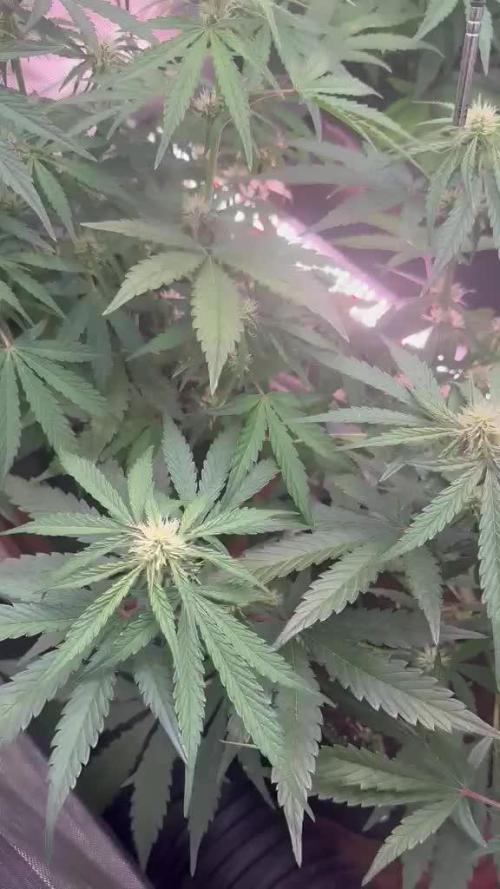
Woche 6 ppfd ca. 650 bis 850, vpd bei 1,1 bis 1,4
Ich musste die Pflanzen Deflorieren, die Papaya Zoap kommt in ein paar Tagen auch drann.
Auf 2 Blätter sind so rote/braune Flecken. Also nur ganz wenig, ich vermute mal Magnesium mangel da dass Leitungswasser recht hart ist. Ab jetzt wird ab und zu mit Bittersalz gearbeitet.
Bin recht zufrieden wie der bisherige Stand ist.
Was denkt ihr bezüglich der Flecken?


Likes
53
Share

@Green_Claws
Follow
🗓️ Week 6 (Flower): Sticky Broccoli #1 — The Chromatic Transition & The 10ml/L Seaweed Offensive 🍋🌋
The Data Dump: We have officially hit the Week 6 milestone, and the Sativa-dominant Sticky Broccoli #1 is putting on a masterclass in late-stage floral maturation. We are moving past the "growth" phase and into a high-intensity period of secondary metabolite synthesis and biomass consolidation.
🎨 The Chromatic Spectrum: Terminal Senescence
The Autumnal Fade: The canopy is currently undergoing a stunning physiological shift. We are seeing a spectrum of yellows, oranges, and deep reds. This is more than just a "fade"—it’s the degradation of chlorophyll unmasking the plant's latent anthocyanins and carotenoids.
Nutrient Translocation: This color shift confirms that the plant is strategically cannibalizing its remaining mobile nutrient reserves and relocating that vital energy into the swelling floral clusters. It’s the ultimate "last stand" to maximize bud density.
🍋 Terpene Profile & Resin Saturation
The Limonene Surge: The olfactory intensity has reached a critical level. We are dealing with an aggressive, dominant citrus profile—a sharp, "lemon-cleaner" punch that signals a massive concentration of Limonene.
Trichome Lamination: The sugar leaves are officially "dripping." Instead of just a light frost, we are seeing a total saturation of glandular capitate-stalked trichomes. The resin is so thick it’s practically laminating the floral surfaces, creating a protective barrier of pure potency.
The 10ml/L Phytohormonal Blitz
We’ve made a bold tactical adjustment by pushing the Cold-Pressed Seaweed Juice to a massive 10ml/L.
The Logic: At this concentration, we aren't just "feeding" the plant; we are overwhelming the Rhizosphere with complex carbohydrates and cytokinins. This acts as a biological "turbocharger" for our Microbe Army.
Metabolic Support: By super-charging the soil life, we ensure the Green Sensation and FFJ are being processed and delivered with zero latency. This keeps the metabolic "gears" turning even as the plant enters its final autumnal phase.
🚀 Strategic Forecast: Structural Consolidation
We are ignoring the trichome color for now—it's far too early for cloudy/amber data. Instead, we are monitoring structural markers:
Calyx Swell: Watching for the individual calyxes to "crown" and harden, merging the loose stacks into solid blocks of flower mass.
Pistil Recession: The engine stays at full throttle as long as we see those active, bright white pistils. Once they begin to recede and wither, we'll know we're in the endgame.
💧 The Week 6 High-Octane Cocktail (Per Liter)
🌊 Seaweed Juice: 10ml/L (The Metabolic Catalyst)
🍌 Banana & Jaggery FFJ: 4ml/L (Organic P/K Energy)
💥 Green Sensation: 1ml/L (Mineral P/K for Density)
🍯 Sugar Royal: 1ml/L (Amino-driven Resin Synthesis)
🌸 Power Buds: 1ml/L (Bio-stimulant for Stacking)
Silica Tea: 2ml/L (Vascular Armor)
CalMag Boost: 1ml/L (Secondary Nutrient Buffer).
Thank for stopping by ✌️💚

Likes
4
Share


@Jaschkoo0
Follow
On Day 85 i mixed 6l of water with 20ml of Lab some melasse and some supervite and gave each plant 3l of it
On Day 87 i gave mixed 2l of water with 5ml of phospor plus some supervite and ec 0.8 ph 6.6. I gave each plant 1l of this thrue the underpot. Then i mixed 3l of water with 6ml of blüh boost some supervite 3ml of calmag and some alg a mic. I gave the left plant 1l and the right 2l of this solution.
On Day 89 i mixed 3l of water with some supervite and 3ml ofcalmag. And gave the left one 1l and the right one 2l.

Likes
17
Share


@Naujas
Follow
To tell the truth, I am very surprised myself, how amazing she is FastBuds Gorilla cookies, she copes well with a small space:) she drinks 1 liter every day :) everything looks better than expected:) good luck to everyone.


Processing
Likes
27
Share


@Silverback_Guerilla
Follow
4/5:
Took 4 cuttings from the shortie
4/12:
All 4 are rooted and growing!
5/1:
Transplanted from 1gallon pots to 5 gallon pots.
5/3:
Decided to grow one of them in my tiny tent and the other 3 will go outdoors.
5/4:
Took 2 of them outdoors under the 270w and sunshine.
5/6:
Trained all of them today and fed some boomerang along with the kelp, molasses, big bloom, and silica. Foliar fed and took the last one outdoors.
The one in the tent is really flourishing!
5/7 - 5/17:
Excellent growth! The supplemental lights are making all the difference.👍
Did some more training on all of them early in the week.
The one in the closet is spreading out nicely and budding up pretty quickly...but what's very cool is that all 4 clones outdoors are flowering?!?!? I sure hope they go ahead and finish rather than starting to revegetate as the days continue to get longer.
Much rain for the past few days, but it let up long enough for me to install another 200w of waterproof 3000k LED lights a couple of feet above them. Very intense lighting, great bang for the buck. So now, I've got 350w of 3000k and 120w of 6500k in the outdoor garden. That's gonna have to do it, as I also am using 1400w in my indoor gardens, plus a/c..bills are getting ridiculous.
5/18 - 5/28:
The clone in the tent is still stacking up really well. I guess the ones outdoors are too, but next to the seedling plants, they seem puny. Many buds though...
Since they decided to flower early, I sprayed them all down with a product that is loaded with hormones and auxins and stuff that's supposed to retard vertical growth and promote branching. It's also supposed to speed arvest time by as much as a week. I hope they can finish before the summer solstice (June 21), otherwise they might try to reveg instead of finishing..
Hopefully it helps keep them from stretching so much that I'll have to supercrop them. Their mamma was a shortie, so they really shouldn't get too tall anyway.
I also foliar fed them several times this week with something called MicroLife Maximum Blooms, Pow! They love the stuff!
5/28 - 5/31:
I did some training on a two of the outdoor clones early in the week between rain showers, and foliar fed with Microlife maximum bloom formula. She was looking a little N deficient, so I assume the dry amendments have petered out. They were dry enough, so I top-fed her with another couple tablespoons of cavern culture and on the 31st. I gave them big bloom, tiger bloom, grow big, beastie bloomz, silica, endoboost, signal, humic acid, liquid kelp/fish emulsion, and liquid molasses. The indoor clone is looking awesome. I fed her heavily on the 30th.
It just feels so strange that I'll be harvesting outdoor photos in June!?!
That's it for week 8-
6/1 - 6/8:
Early in the week I gave them about a half gallon of water with liquid molasses, cal-mag, silica, and beastie bloomz only.
I foliar fed them a couple of times during the week, right at daybreak.
I fed them on Saturday, the 6th..about a gallon each..beastie bloomz, microlife maximum blooms, cal-mag, humic acid, grow big, big bloom, sweet & sticky, and signal.
They are looking very good..buds galore. The indoor clone got the same nutes, but on different days. She's also covered in buds, and they are beginning to fatten up.👍
6/9-7/4:
Busy with other gardens, so not many updates...
Indoor clone got to spend the last 2 weeks of her life in my closet under the quantum boards and UVB. I harvested and washed her buds on 6/28, let her hang dry and weighed and jarred her up on the 4th of July. She came in a 111g of cola and 45g of lower bud with only about 5g of larf. Nice!👍
She smells just like her mommy and has the same uber-dense buds. She was topped, so the buds aren't as mighty as the mamma's, but much more plentiful.👌
Outdoor clones:
I had a massive spider mite attack, and during the same week, I had a grasshopper invasion...I lost a few plants, one of which as a FFT1 clone.
I had just harvested my autos and my indoor clones from the closet, so I moved the remaining two clones in under the quantum boards. I treated them for spider mites several ways for several days and have given them much TLC. Hopefully their buds fatten up some more. They stanky, but they kinda slim...
7/11:
I harvested the last two clones tonight. So sticky!!! I washed them and hung them to dry.

Likes
69
Share


@nonick123
Follow
Día 44 (15/07) Wow! No hay shock de trasplante! 😍💥😁
Todas las ramas se han estirado hacia arriba tras el ajuste de LST y se están formando nuevos nodos rápidamente
Esta combinación de nutrientes de Lurpe + substrato de PRO-MIX HP es una maravilla 😍
Día 45 (16/07) Ayer tuvimos ola de calor (37 ºC) y han aguantado muy bien!
A última hora de la tarde (cuando ya no había sol directo) les apliqué H2O en spray foliarmente para refrescar los estomas
Hoy parece que vuelven las temperaturas estándar para esta época del año: 29 - 30 ºC en las horas centrales del día
Riego con 1 litro de H20 pH 6,5
Día 46 (17/07) Pequeños ajustes de LST
Hay algunas ramas inferiores que no se han formado / estirado mucho
Lo más probable es que haga una buena limpieza este domingo, 7 días después del trasplante, para dejar solo los brotes por encima del 4º nudo
Día 47 (18/07) Riego con 0,5 litro de H20 pH 6,5
Este domingo (día 50) haré limpieza de partes bajas y tal vez también de nuevo topping en las 4-6 ramas principales 😁
Día 48 (19/07) Día de muchísimo calor con 37 ºC. A ver como lo llevan!
Riego con 0,5 litro de H20 pH 6,5
Día 49 (20/07) Para ayudarles a llevar mejor el calor de las horas centrales del día, coloca una malla de sombreo (70%) sobre el invernadero
Lo cierto es que se nota que baja mucho la temperatura debajo de la malla! Van a estar más fresquitas! 😍
Riego con 0,5 litro de H20 pH 6,5
Día 50 (21/07) Training session!
Hago limpieza del tercio inferior de la planta, de todas las ramas y nudos que no superan la línea del dosel marcada por el 4º nudo (1er topping)
También hago topping (2º) a todas las ramas principales
La idea es tener 12 ó 14 colas principales para que no se hagan muy altas
De paso saco unos cuantos clones de las ramas inferiores eliminadas 😁💥
Para superar el estrés, hago las siguientes aplicaciones y riego:
- Riego con 1 Litro de Té Vegetativo de Lurpe Solutions. Preparación: 24 horas con bomba de aire (oxigenación) con ingredientes:
Green Sunrise 8 ml/L + Insect Frass 16 ml/L + Hummus Lombriz 8 ml/L + Melaza 1 ml/L + Kelp Hidrolizado 0,25 g/L
- Aplicación foliar Kelp hidrolizado de Lurpe Solutions a 0,25 ml/l
💦Nutrients by Lurpe Solutions - www.lurpenaturalsolutions.com
🌱Substrate PRO-MIX HP BACILLUS + MYCORRHIZAE - www.pthorticulture.com/en/products/pro-mix-hp-biostimulant-plus-mycorrhizae


