





@kansasscott725
Volgen
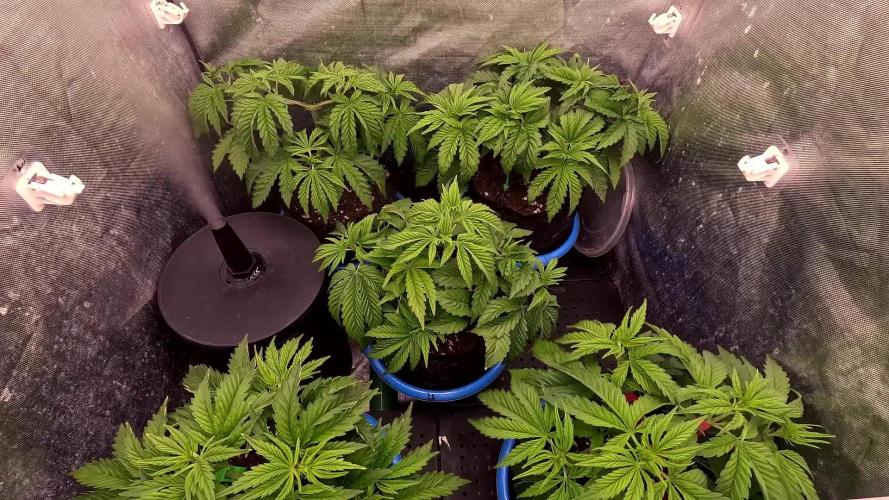
Little bit of a delay. Wanted to get climate perfect before the flip. Upgraded ventilation and have the tent dialed in well at 74 degrees and 60% humidity during day and 70deg/ 55% at night.
Started a second scrog on Day 42. Nervous about the stretch but hopefully I can maintain it (I wish T5 lights could flower...)
Did extensive trimming underneath clearing pretty much anything that will never reach the ceiling of green above it.
Day 45 marks last day of Veg
Day 46 marks first day of flower
AND.
HERE.
WE.
GO.



@gr3g4l
Volgen
We started the week by measuring their height. Now I'm starting to think about when to switch them to flowering.
Time is limited, so we have to cut back where we can.
I don't have much space, so they don't need to stay much longer.
They'll grow considerably in the next few days, and this might be their last week of vegetative growth. A total of 5 weeks.
Six days after the last pruning, I did another pruning of the lower branches and leaves, and now they are ready to change the photoperiod to 12/12h in a few days.
At 33 days I decided to put a mesh over them so I could fill the space better.
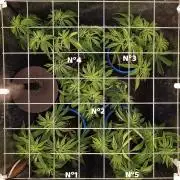
Seeing that numbers 4 and 5 had reached a larger size than the rest, I changed the position of number 3 for number 5.
This week I raised the LEDs, approximately 50 cm or so, increased the wattage to 300W, and added a mesh screen to start a sgrog setup.
Iniciamos la semana midiendo la altura. Llegados a esto ya empiezo a plantearme cuando pasarlas a floración.
El tiempo es limitado y hay que recortar por donde se pueda.
No dispongo de mucho espacio por lo que no necesitan estar mucho más tiempo.
En los próximos dias crecerán notablemente y puede ser esta su última semana de crecimiento. Total 5 semanas.
Pasados 6 dias desde la última poda volví hacerles una nueva poda de ramas y hojas bajeras y así las ya quedan listas para cambiar el fotoperiodo a 12/12h. en pocos dias..
A los 33 dias decidí ponerles una malla y así poder ir llenando mejor el espacio.
Al ver que las números 4 y 5 habian alcanzado un mayor tamaño que el resto cambié de lugar la nº3 por la nº5 .
Esta semana subí los led , apróximadamente unos 50 ctms poco menos, aumenté la potencia a 300W. y puse una malla para empezar con un sgrog


@KingSalomonsWeed
Volgen
03.04. Day 64 Flower 40
Hallo Leute seid mir willkommen zu :
GRAPE APE F1 die einem beim Riechen zum Niesen bringt. Es kribbelt wie Zitronensäure. Die muss sauer sein.
Es gibt immer mehr Lila, auf jeder Traubenaffen F1 die so ca 2 Wochen in Blüte ist.
Schick.
Die Pflanzen an sich bleiben klein, kein Wachstum.
Die Knospen schon 😍.
Sie Pludern sich auf, strecken sich und werden bestimmt hart sein.
Das habe ich nicht getestet, ich will ihre Entwicklung nicht stören.
❤️ Ich liebe Cannabis zu growen.
Das macht so viel Spaß ( wenn es klappt ).
Ich bin zwar Großmeister, und meine Knospen sind herrlich, aber meine Pflanzen sehen immer sehr mitgenommen aus.
Hüstel(geheucheltes Husten, nur wegen der Dramatik) Wenn ich das kann, kannst du das auch. Es ist legal in Deutschland 3 Pflanzen zu haben.
Ich würde sagen Grape Ape auf dem Balkon geht voll klar.
Gute Erde dazu.
Dünger wäre toll, ist aber kein muss.
Die Nachbarn kriegen das auf jeden Fall nicht über den Geruch mit .
1. Dezent
2. Weintrauben
3. Klein
Nur so als Gedanke.
Ich freue mich jedenfalls über ihr Aussehen ( für mich, nicht schlecht ), und diesen Geruch. So Sauer+Trauben+weed.
Ich glaube das ist ne richtige Hardcore INDICA. 😳 Steht ja auch so in der Beschreibung....
👍
04.04. das 65. Die erste Knospe ist wirklich fertig! 😳😍
Wow , das hätte ich nicht gedacht. Komplett milchig, die Hauptknospe.
Mit Licht Gehampel, day 65 ab Keimung, 💪 stark.
Natürlich, wer mich kennt, es gibt noch ein Paar Tage.
2 Gründe, mehr Gewicht, und ich hätte gerne ein wenig Amber Trichs.
Aber sie riecht geil, ihre Knospen sind fest und klebrig.
Ja, und dann kommen ja noch ihre F1 Schwestern.
? Also Wahnsinn. So Schnell.
07.04. dieses eine Blatt hat so krasse Farben. Leuchtend Radioaktiv.
Was wird das für weed?
So, genau ab jetzt hat sie mich.
Die Grape Ape F1.
Diese Farben sind 😍.
Hat zwar etwas gedauert bis ich fan wurde, wegen wo ist sie denn ( sehr klein, die gröste bisher 47 cm. ) .
Aber als sie die Farben änderte, und der Geruch dazu kam fand ich die Interessant.
Ist wichtig, denn ich mag Cannabis als Pflanze sehr, da schnell und schön.
Und im besten Fall, BUNT.
Wie diese hier.
Und ich bin gespannt welche Farben die anderen bekommen. Die sind zwar alle ähnlich, aber im Charakter unterschiedlich.
Also, ich sage es gleich. Viel kommt da nicht runter.
Wie denn auch, ist sehr klein.
21% THC Indica Style. Das geht nur mit kleinen Pflanzen.
Indicas sind halt klein.
Und schlagen hart zu.
Wie Zwerge.
Ich liebe Zwerge ( es sei denn ihr habt eine Audienz bei Hochlord von irgendwo. Ich glaube Zwerge sehen nur einmal in ihrem Leben Wasser. Bei der Geburt.👍 Leute ihr müsst die untern Tisch saufen. Nen Zwerg, das ist hart, dann könnt ihr in Baden, wenn er besinnungslos ist. ) Nur so als Tip.



@Still_Smoq
Volgen
#seedsmanhalloweengrowoff and #SeedsmanSeeds
📆 Week 15, 19-25 February 2025
19-25 Feb - Observed and let the plant grow.
📑 I wonder just how big Black Sugar is going to get. Buds are looking impressively big and thick. Looking forward to seeing to this one to the end. She has two more weeks to go.
- 19 Feb nutrient solution changed
- 19 Feb feeding schedule updated
- Using reverse osmosis water with EC/TDS at 0
- Adjusting PH to 6.2 daily using GH up/down
- Nutrient solution EC 2.2 at 57 degrees F
- Light power at 75%, DLI 40 canopy coverage at 12hrs
- Using PYPABL, Air Pump, 400GPH
That is it for this week. Thanks for the look, read and stopping by.


@Kinghaze
Volgen
This was the last week of veg.
I switched from organic nutrients to synthetic.
For the pipes of the autopot.
I will therefore also flush them for 2 weeks.
In the first week of flowering there will be a dehumidifier in the tent to get around 50% humidity


@BigBadLion
Volgen
Hey guys!
Another week and another update!
At the end of this week I decided to finally start with the main lining and I won't lie... I was extremely nervous haha 😱 but I believe I did it well, without any major issue! I also decided to move the small 4th plant into a new home and it seems she will like the extra space!
This week I also didn't feed my babies as I over watered them 😞 but they still showed some great progress! So I suppose it wasn't that bad! 😊
Soon I'll update the next week, which is also ready and has even more timelapses!
Thanks everyone! :D


@JamMAKEcan
Volgen
#1-germination 100%
#2-Vegetation stage..growth is very fast drinks a lot per day
#3- resilient high. No mold very healthy
#4-structure of branches are great for training or untouched . i topped mine
#5-flowering..im there now im sure i see preflower but old eyes so I'll wait until 100% sure
DOCTORS CHOICE. Is among the other 2 in my book of EXCELLENT GENETICS..
Will be updating as we move.
Highly recommend this strand. This company.. There strands thrive in the outdoors as well as indoors. Win win.


@NanoLeaf
Volgen
Started Training Late!
Was on summer holiday for a week and only started training now. Above are the plants during training as well as a few hours after training.
Autos are definitely more delicate and the two runts are growing slow but yet still showing some progress.
Changed my bulbs back to the CMH set to 400w each (2)
Also gave them a good amount of water as the FloraCaps aren’t covering the whole pot I felt like it was necessary to wet the entire grow medium well for a change.
Some of them were a bit far along for training but I did the best I could.
Also the Purple Lemonade and 2 other plants are showing signs of flowering.


@Gorey
Volgen
they grow fast and are very strong, the branches are thick. a good smell is already emerging. I think the 5 will largely fill the tent. I added led bars on the uprights




@Ultraviolet
Volgen
What's in the soil? What's not in the soil would be an easier question to answer. 16-18 DLI @ the minute. +++ as she grows.
Probably not recommended, but to get to where it needs to be, I need to start now.
Vegetative @1400ppm 0.8–1.2 kPa 80–86°F (26.7–30°C) 65–75%, LST Day 10, Fim'd Day 11
CEC (Cation Exchange Capacity):
This is a measure of a soil's ability to hold and exchange positively charged nutrients, like calcium, magnesium, and potassium. Soils with high CEC (more clay and organic matter) have more negative charges that attract and hold these essential nutrients, preventing them from leaching away.
Biochar is highly efficient at increasing cation exchange capacity (CEC) compared to many other amendments. Biochar's high CEC potential stems from its negatively charged functional groups, and studies show it can increase CEC by over 90%. Amendments like compost also increase CEC but are often more prone to rapid biodegradation, which can make biochar's effect more long-lasting. biochar acts as a long-lasting Cation Exchange Capacity (CEC) enhancer because its porous, carbon-rich structure provides sites for nutrients to bind to, effectively improving nutrient retention in soil without relying on the short-term benefits of fresh organic matter like compost or manure. Biochar's stability means these benefits last much longer than those from traditional organic amendments, making it a sustainable way to improve soil fertility, water retention, and structure over time. Needs to be charged first, similar to Coco, or it will immobilize cations, but at a much higher ratio.
a high cation exchange capacity (CEC) results in a high buffer protection, meaning the soil can better resist changes in pH and nutrient availability. This is because a high CEC soil has more negatively charged sites to hold onto essential positively charged nutrients, like calcium and magnesium, and to buffer against acid ions, such as hydrogen.
EC (Electrical Conductivity):
This measures the amount of soluble salts in the soil. High EC levels indicate a high concentration of dissolved salts and can be a sign of potential salinity issues that can harm plants.
The stored cations associated with a medium's cation exchange capacity (CEC) do not directly contribute to a real-time electrical conductivity (EC) reading. A real-time EC measurement reflects only the concentration of free, dissolved salt ions in the water solution within the medium.
98% of a plants nutrients comes directly from the water solution.
2% come directly from soil particles.
CEC is a mediums storage capacity for cations. These stored cations do not contribute to a mediums EC directly.
Electrical Conductivity (EC) does not measure salt ions adsorbed (stored) onto a Cation Exchange Capacity (CEC) site, as EC measures the conductivity of ions in solution within a soil or water sample, not those held on soil particles.
A medium releases stored cations to water by ion exchange, where a new, more desirable ion from the water solution temporarily displaces the stored cation from the medium's surface, a process also seen in plants absorbing nutrients via mass flow. For example, in water softeners, sodium ions are released from resin beads to bond with the medium's surface, displacing calcium and magnesium ions which then enter the water. This same principle applies when plants take up nutrients from the soil solution: the cations are released from the soil particles into the water in response to a concentration equilibrium, and then moved to the root surface via mass flow.
An example of ion exchange within the context of Cation Exchange Capacity (CEC) is a soil particle with a negative charge attracting and holding positively charged nutrient ions, like potassium (K+) or calcium (Ca2+), and then exchanging them for other positive ions present in the soil solution. For instance, a negatively charged clay particle in soil can hold a K+ ion and later release it to a plant's roots when a different cation, such as calcium (Ca2+), is abundant and replaces the potassium. This process of holding and swapping positively charged ions is fundamental to soil fertility, as it provides plants with essential nutrients.
Negative charges on soil particles: Soil particles, particularly clay and organic matter, have negatively charged surfaces due to their chemical structure.
Attraction of cations: These negative charges attract and hold positively charged ions, or cations, such as:
Potassium (K+)
Calcium (Ca2+)
Magnesium (Mg2+)
Sodium (Na+)
Ammonium (NH4+)
Plant roots excrete hydrogen ions (H+) through the action of proton pumps embedded in the root cell membranes, which use ATP (energy) to actively transport H+ ions from inside the root cell into the surrounding soil. This process lowers the pH of the soil, which helps to make certain mineral nutrients, such as iron, more available for uptake by the plant.
Mechanism of H+ Excretion
Proton Pumps: Root cells contain specialized proteins called proton pumps (H+-ATPases) in their cell membranes.
Active Transport: These proton pumps use energy from ATP to actively move H+ ions from the cytoplasm of the root cell into the soil, against their concentration gradient.
Role in pH Regulation: This active excretion of H+ is a major way plants regulate their internal cytoplasmic pH.
Nutrient Availability: The resulting decrease in soil pH makes certain essential mineral nutrients, like iron, more soluble and available for the root cells to absorb.
Ion Exchange: The H+ ions also displace positively charged mineral cations from the soil particles, making them available for uptake.
Iron Uptake: In response to iron deficiency stress, plants enhance H+ excretion and reductant release to lower the pH and convert Fe3+ to the more available form Fe2+. The altered pH can influence the activity and composition of beneficial microbes in the soil. The H+ gradient created by the proton pumps can also be used for other vital cell functions, such as ATP synthesis and the transport of other solutes. The hydrogen ions (H+) excreted during photosynthesis come from the splitting of water molecules. This splitting, called photolysis, occurs in Photosystem II to replace the electrons used in the light-dependent reactions. The released hydrogen ions are then pumped into the thylakoid lumen, creating a proton gradient that drives ATP synthesis.
Plants release hydrogen ions (H+) from their roots into the soil, a process that occurs in conjunction with nutrient uptake and photosynthesis. These H+ ions compete with mineral cations for the negatively charged sites on soil particles, a phenomenon known as cation exchange. By displacing beneficial mineral cations, the excreted H+ ions make these nutrients available for the plant to absorb, which can also lower the soil pH and indirectly affect its Cation Exchange Capacity (CEC) by altering the pool of exchangeable cations in the soil solution.
Plants use proton (H+) exudation, driven by the H+-ATPase enzyme, to release H+ ions into the soil, creating a more acidic rhizosphere, which enhances nutrient availability and influences nutrient cycling processes. This acidification mobilizes insoluble nutrients like iron (Fe) by breaking them down, while also facilitating the activity of beneficial microbes involved in the nutrient cycle. Therefore, H+ exudation is a critical plant strategy for nutrient acquisition and management, allowing plants to improve their access to essential elements from the soil.
A lack of water splitting during photosynthesis can affect iron uptake because the resulting energy imbalance disrupts the plant's ability to produce ATP and NADPH, which are crucial for overall photosynthetic energy conversion and can trigger a deficiency in iron homeostasis pathways. While photosynthesis uses hydrogen ions produced from water splitting for the Calvin cycle, not to create a hydrogen gas deficiency, the overall process is sensitive to nutrient availability, and iron is essential for chloroplast function.
In photosynthesis, water is split to provide electrons to replace those lost in Photosystem II, which is triggered by light absorption. These electrons then travel along a transport chain to generate ATP (energy currency) and NADPH (reducing power). Carbon Fixation: The generated ATP and NADPH are then used to convert carbon dioxide into carbohydrates in the Calvin cycle. Impaired water splitting (via water in or out) breaks the chain reaction of photosynthesis. This leads to an imbalance in ATP and NADPH levels, which disrupts the Calvin cycle and overall energy production in the plant. Plants require a sufficient supply of essential mineral elements like iron for photosynthesis. Iron is vital for chlorophyll formation and plays a crucial role in electron transport within the chloroplasts. The complex relationship between nutrient status and photosynthesis is evident when iron deficiency can be reverted by depleting other micronutrients like manganese. This highlights how nutrient homeostasis influences photosynthetic function. A lack of adequate energy and reducing power from photosynthesis, which is directly linked to water splitting, can trigger complex adaptive responses in the plant's iron uptake and distribution systems.
Plants possess receptors called transceptors that can directly detect specific nutrient concentrations in the soil or within the plant's tissues. These receptors trigger signaling pathways, sometimes involving calcium influx or changes in protein complex activity, that then influence nutrient uptake by the roots. Plants use this information to make long-term adjustments, such as Increasing root biomass to explore more soil for nutrients. Modifying metabolic pathways to make better use of available resources. Adjusting the rate of nutrient transport into the roots. That's why I keep a high EC. Abundance resonates Abundance.

@Jesperado
Volgen
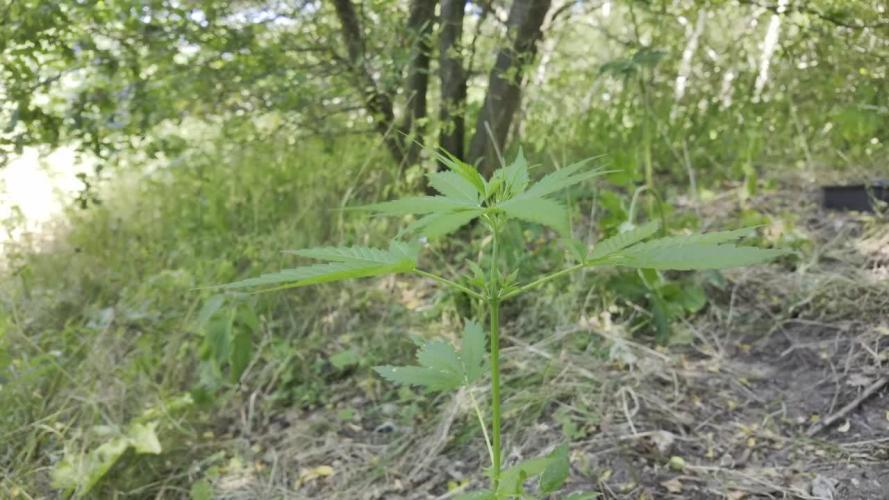
The Goblins are developing painfully slowly, almost certainly because this spot doesn’t get enough sunlight. I know moving them would probably improve their chances, but I’m not willing to compromise my two other guerrilla locations by placing more plants there. For now, they’ll have to stay where they are.
It’s frustrating because I know exactly what they need, but secrecy and ideal growing conditions don’t always go hand in hand. Sometimes the safest location simply isn’t the most productive one.
I’ve added guano as a top dressing and continue watering with molasses, so now I’ll have to see what they can manage with the limited sunlight available.


@HavelGrower
Volgen
First Week of Flower.
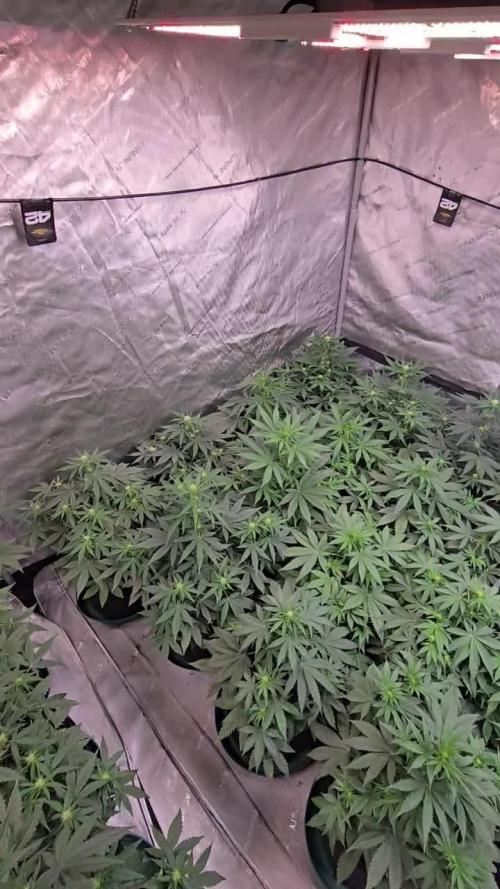
I gave them 36h of darkness before flipping to 12/12 light schedule. Canopy is filled somewhat good and more important is a even canopy.
Installed a second net in the middle of the week. The support will be necessary later.
Did a bit of defoliation but the lollipop will be done in 2 weeks.
Conditions of the Grow:
💡 PPFD: 900 umol/m2/s
☀️ DLI: 38.8 mol/day
🌓 Lightcycle: 12/12 h
💨 Humidity: 50-55 %
🌡️ 🌞Daytime Temp.: 21-23 *C
🌡️ 🌙Nighttime Temp.: 18-19 *C
🌡️🌱Leaf Temperature: 21 *C
🌡️💧Water Temperature: 18-19 *C
Water TDS: 1000ppm | EC: 2000us/cm
🚰Watersource: Rainwater (TDS: 15ppm | EC: 0.03 us/cm
Vegetation Equipment:
🔦 Lamp: Mars Hydro FC-E6500
📤Container: 3x DIY 63L Euro-Box with lid
Pot: Netpot 2 inch
💦Pump: M.R.S. Ultimate Whisper Powerpump 22 bar
🚿Nozzles: 12x 0.3mm
🫧Waterfilter: 150 microns
🌬️Fan: 3x Clipfan
🌪️Duct-Fan: AC Infinity 200 mm with Controller and Carbon Filter
🍶Nutrient Brand: Terra Aquatica
🔬Sensors: Waterstation (EC, TDS, Temp, PH, Salt), CO2, Air Temp. & Humidity (VPD), Temperature-Sensor Root Container


@Ganjagrandaddy
Volgen
Day 63 F: Well here we are at the end of a brilliant grow that has seen totally different mixes of heights and genetics successfully completed under the Mars Hydro fc3000 and my own mix of supersoil. Rhe light managed to keep them all at full tilt even though they were at big , differing canopy heights. If inhad used the middle of the room , I could have covered the canopy a lot better and the light would have easily reached the whole canopy despite their odd height differences. I have a Mars tent that will be perfect for this light to totally fill out with 6 plants once I am back at full production and over this slight delay upcoming.
The soil has been brilliant from the off , even the small Mexican airline #1 that seemed to struggle with the start up and strength of the mix has finished well. I only added ecothrive , eco life cycle and biosys tea throughout the grow with a couple of grams of Megacrop in flower as a booster. The watering in the beds has been very easy to maintain and keep moist and the more shallow depth has helped check at root level and bottom easily. The immobile nature of the bed has meant that using different strains as the 3 is maybe not ideal , workable , but not ideal and needs some forward planning next time out . Besides that , it has been very simple to manage.
The strains have been perfect throughout the weeks with little to no signs of any deficiency. I did remove a lot of fan leaves over the past week to really open the lower parts of the plant to more light for the ripening time . It will also help with the drying time and harvest. There is a lot of really nice colas on these ladies and I cannot recommend the genetics for autos from Fast buds enough. The Strawberry pie finished beautifully and with 2 phenos ro enjoy once dry , I am really looking forward to hitting that one. The six shooter look deadly for the unweary too with their frosty and kush looking purples and reds.
Mexican airline have done a nice job on fattening their buds at the end but the #1 is way less bountiful than her sister. Let's see what a drying period does to their overall yields now. They look so big when 1st hung to dry but it is so disheartening watching them shrink to tiny versions of the originals. The dark period has made them a little more tacky without a doubt and their smells are so obvious going through the plants cutting. Temps are at around 10°c in the room with no lights on so this will be a long ,low and slow dry . I do have the dehumidifier on its highest setting to avoid these fat buds developing any bud rot but the low temps will also be a huge help. I have a nice mix of aromas among these with lemon , fresh cut fruit , candy cane sweet and a spicy fuel . Roll on the harvest and cure now. Hopefully a harvest report will follow within 10-14 days. Be safe and well growmies. The Best Is Yet To Come !


@Chubbs
Volgen
What up Fam. These girls are growing amazing. Now that I can controll the temps a little better they've taken off with growth. Starting the flower period which we all no know what that means. The countdown is on. Over all Happy Growing.


@WeedleyScott
Volgen
Woche 8 geht los, die Lampen stehen auf 100% Grow und 100% Flower, ich habe ein Netz rein gespannt und nach 1–2 Tagen in der letzten Woche alles weggeschnitten, was unterm Netz war sowie einige Seitentriebe. Somit sollte jeder Hauptstrang maximal 4–5 Seitentriebe haben.
Zudem fangen sich die Blüten an zu bilden und es sind deutliche Härchen zu sehen.
Update: Tag 5 Woche 9: Die Blüten werden immer größer und harzen schon auf die umliegenden Blätter 😍


@ConradThePeaceful
Volgen
11/6 Fed and watered. Each took a full gallon.
11/8 They are really drinking up the water. They were dry already so I watered each with a full gallon.
11/10 Watered each with a full gallon
11/13 Watered and fed each with a gallon.
shorts_status_processing


@Yaba_dabber_do
Volgen
It took 80 days from seed to harvest and a further 9 days to dry as i couldn't keep the temp low enough but that was my problem and 352g of dry curable bud back is amazing for an autoflower in my opinion, especially grown in coco


@KingSalomonsWeed
Volgen
Hallo Tag 55/29 Blüte.
Sie lebt!
Ich denke der Ertrag wird sich zwischen 1,5-2 kg trocken ergeben.
Die Knospen sind jetzt schon so gross wie Tennisbälle.
Sämtliche Knospen sind so Klebrig, das mein Insektenproblem beendet ist.
Wie Sonnentau fängt sie die Insekten und verdaut sie.


@Leonardo_DaGrower
Volgen
I noticed a slow down on growth this week. I’m guessing the amendments I added are all used up. Next week will start heavier feeding, especially with the bloom nutrients.
Trichomes are densely populated throughout the plant. One plant has thin unimpressive buds and the other has perfect growth for week number four of flower.


@CanadianFillmore
Volgen
Start of week 8. Week 7 went very well, the buds really filled in and packed on weight. Their are tons of red hairs in this Blue Dream beauty and she's got an amazing smell!
