


Likes
Comments
Share


@Firepharmer
Follow
In to week 7 now starting to flush!!
Very impressed with this run 💚🌱💚🌱
I’m now running the Futur vert 30 W uv led for 5 hours of the 12/12 with the Futur vert flora max series


Likes
3
Share


@I_roll_my_own_420
Follow
And week 5 has began. All looking good. I had to bend over some of the colas, they were too tall. Smells is fantastic.


Likes
90
Share


@AsNoriu
Follow
Day 113. And girls go WILD ;))))) Amazing run, smell, structure, liked even variation in phenos, but . .. i always say they could go a bit longer, but this time , they even SHOULD, but i was asked to move out and i want to squeeze one more grow till first of November ..
One Tangie is so behind others, that i am thinking to kick her out outdoors even to finish up ...
Anyway ; girls got theirs first heavy flush, at least 15 liters of water went through pots ...
They will be chopped 25-26 of August.
Happy Growing !!!

Likes
57
Share


@DudeGrowsWeed
Follow
Auto Lemon is sooo close to harvest now! Gave her Recharge only this week. All trichs are still milky white, no amber yet. Once I start seeing some amber she'll be coming down.😃

Likes
19
Share


@Wenz004
Follow
Bissl fetter geworden, sieht man nur im Zeitraffer etwas. Ansonsten nix passiert.
Und...durch einen Düngerfehler die Spitzen etwas verbrannt👍
Likes
4
Share


@Xabii
Follow
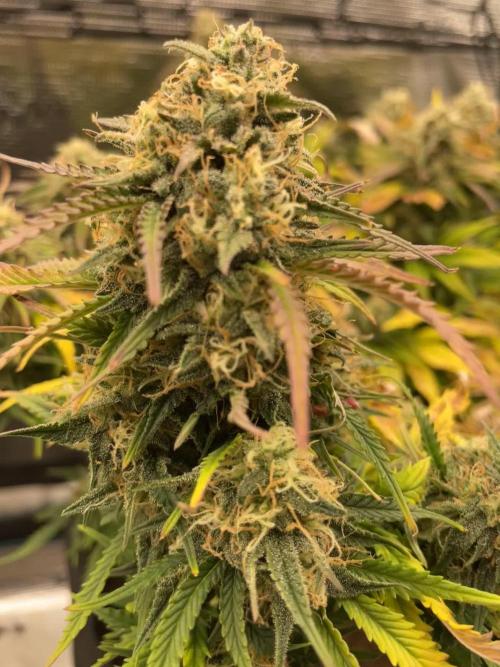
Found litteral balls on the plant, no bananas but full on pollen sacks right at the topping spot, did remove them since I did not see balls anywhere else, hope this is just a one time thing due to topping.
Values are average of the day.
DATE - EC(us/cm)
20250426 1843
20250427 1893
20250428 1961
20250429 1995
20250430 1952
20250501 1649
20250502 1722
DATE - PH
20250426 6.00
20250427 6.00
20250428 5.99
20250429 5.99
20250430 6.03
20250501 6.24
20250502 6.27
DATE - ORP (mV)
20250426 316
20250427 294
20250428 283
20250429 272
20250430 259
20250501 248
20250502 225
DATE - °C - RH% (Tent Temp/RH)
20250426 24.0 51
20250427 25.0 43
20250428 26.1 43
20250429 26.1 38
20250430 25.9 42
20250501 25.4 47
20250502 26.6 48
DATE - °C (Reservoir)
20250426 19.5
20250427 20.0
20250428 20.7
20250429 20.6
20250430 20.4
20250501 20.4
20250502 21.7
DATE - CF
20250426 18.43
20250427 18.93
20250428 19.61
20250429 19.95
20250430 19.52
20250501 16.49
20250502 17.22



Likes
60
Share


@BOMbolenath
Follow
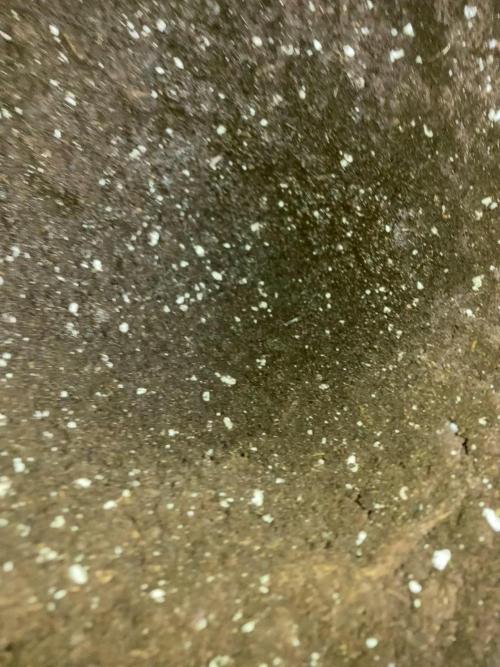
The plant is developing well after pruning. its branches grew well. I removed the first node as they were small.


Likes
Comments
Share


Likes
2
Share


@Ultraviolet_
Follow
We become aware at such times of man's wonderful ability to bring seemingly unrelated elements into harmonic balance, and receive a glimpse into a world where everything exists in conscious sympathetic attunement to everything else. When we listen to a piece of music that seems to strike a beautiful chord somewhere inside us, or view a painting that simply glows with harmonic awareness well executed, we probably do not spare much time to contemplate the wonderfully intricate combination of vibrations that our sensors make it possible for us to perceive. We tend to appreciate the relationship between the parts of something by an awareness of the harmony or dissonance of the whole. This ability enables us to say "what a beautiful house!" instead of "analysis has proven that this collection of building materials exhibits certain elements of harmonic proportion." While this ability to instinctively appreciate the beauty of true harmony has an important role to play in evolution, a more analytical understanding of the laws involved can be most useful. This is especially so if we wish to create works of art where each part exists in true harmony, not only with the other part of that particular whole, but with the universe within which the creator and the created exist.
Everything vibrates. From the most dense matter to the most subtle cosmic rays, everything which our senses allow our thoughts to become aware of, can be specified in terms of wavelength or frequency of vibration. These two terms define the same thing, but from different points of view.
The following are the approximate wavelengths of various energy carriers:
Cosmic rays 0.000,000,001 mm
Gamma rays 0.000,000,1 mm
X rays 0.000,500 mm
Ultraviolet rays 0.003 mm
Visible light 0.006 mm
Infrared 0.01 mm
Sound waves 1 meter
Radio waves 300 meters
Violet light 400 nm to 450 nm
Blue light 450 nm to 500 nm
Green light 500 nm to 570 nm
Yellow light 570 nm to 590 nm
Orange light 590 nm to 610 nm
Red light 610 to 700 nm
1 nanometer (nm) = 0.000,000,1 cm = 1/10,000,000 cm
If a guitar string is plucked and we hear a sound, it is not too difficult for the human mind to associate this sound with the vibration of the guitar string. With color it is quite different. It is difficult for us to conceive that the color of a substance is not an inherent property of the substance itself, but an indication picked up by our senses of that substance's ability to absorb or reflect the light which happens to be shining on it at that moment. Neither the matter nor the light is colored. What happens is that the brain learns to differentiate between the frequencies reflected or transmitted by the substance the eyes are focused on. The same thing happens with sound. When we say "Oh! Listen, they're playing my favorite song," what we really mean is: "My brain has stored within it a particular pattern of frequencies. I have compared the new information being received with this stored pattern and have deduced the answer that the two patterns are similar within certain specified tolerances." The 'pleasure' involved could have something to do with our running the pre-recorded pattern at the same time, in 'sympathy' with the new pattern as it is received.
The word sympathy describes very well our ability to appreciate color and sound. It also describes the reason behind certain elements of harmony. For instance, if a substance vibrating at 100 cycles per second (tone 1) is in the proximity of another substance vibrating at 200 cycles per second (tone 2), we could perceive, if we had the right equipment, a certain sympathetic relationship between the two.
We will see from this that there is a uniform doubling of the first tone seen in the second. At various points along the waves, the two are the same in amplitude. At other points, they are at opposite poles to each other. This doubled frequency has more points of similarity to the original than any other frequency except the original itself. If the equipment we had available for measuring these two frequencies was a soundboard amplifier and a pair of ears, then we would hear what would sound to us like one tone. If we had the opportunity to hear one at a time, we would hear that although they sound the same, one is higher in pitch than the other. This characteristic of 'the same but different in pitch', musicians have called the octave. Any two tones produced where one has exactly doubled the frequency of the other is called an octave. Speaking in ratios, an octave would appear then as the ratio 2:1 or 1:2, depending on whether we are talking of an octave up or down.
A single note produced by almost any instrument will contain more than one wavelength or frequency. It will have a dominant frequency, the wavelength of which we would call the note's 'fundamental' or 1st harmonic. It will also have a varying number of upper harmonics, gradually fading in intensity into infinity or silence.
Natural harmonics always have the same pattern of intervals between them. The interval between the 1st and 2nd harmonic is a perfect octave; between the 2nd and 3rd a perfect fifth; between the 3rd and 4th a perfect 4th; and so on, the intervals becoming smaller and smaller until they lose any relationship with the western 12 tone scale as it exists at the moment. Just as an octave has certain elements of sympathy with its fundamental, so some intervals have been noted to be more perfectly in sympathy with the fundamental than others. The ratio of the 'perfect 5th' or interval of 7 semitones, as it occurs in the harmonic series, is 3:2 or 2:3, while that of the 'perfect fourth" is 4:3 or 3:4. All the tones in the western 12 tone scale can be expressed in terms of the ratio between the upper tone and its fundamental. This would seem to be an ideal way of generating a scale from any given fundamental and several attempts have been made to do this, the Pythagorean system being probably the most well known. Although when working with a single tone instrument playing on its own, the Pythagorean formula works wonderfully well, if we had several instruments tuned this way together and asked them to play almost any western music, we would find that at times they sounded quite out of tune to each other.
The lack of flexibility of the various scale systems based on the harmonic series has led to what is known as the 'tempered' scale. This uses as its primary unit of interval the ratio of the octave or 2:1. It then proceeds to divide the interval between any fundamental and its upper octave into 12 smaller intervals by applying the ratio: two to the one-twelfth power, to one (21/12:1). This equals 1.059463094, so by multiplying any frequency by this number, we will obtain the tempered semitone next up from our fundamental. We will also find that any tone twelve semitones up from any other tone, in a scale generated in this way, will have exactly double the frequency.
If we took the note middle C on a piano and halved the wavelength, we would have the note C one octave above. If we halved this, we would have the C above, and so on. However, within about 6 octaves, we would find that although a 'sound' was being produced, no human ear could perceive it. If we kept on going, halving and producing upper octaves of our fundamental C, we would proceed through the infrared band, into the visible light spectrum. If we happened to be outside during the day, we would, for one octave only, see the note C with our eyes. The next octave above would already be in the ultraviolet band, and outside the eye's sensitivity range. If we can think of color as being an indication of a substance's vibratory rate or wavelength, we may begin to see a relationship that could exist between the color and sound spectrums.
The logical extension of what has so far been said is that there exists a scale in the color spectrum that corresponds exactly to the scale in the sound spectrum, each color tone being an octave of the equivalent note in the sound range.
This is not the end of the story but only the beginning. If we can for the moment accept that any wavelength in one band has upper and lower octave stretching out to infinity, then the next question is 'fine, but what shall we use as our fundamental? A particular color? A particular sound frequency?' The musicians among us will probably say 'A 440'. This means that the note A should vibrate at 440 Hertz, or 440 times per second. They would tell us that this is standard pitch has been adopted by most orchestras around the world; pianos are tuned to it, instruments are constructed to formulas based on it, and so to them it would probably seem the most appropriate place to begin. Some of these musicians may know of the battle that is still raging with regards to this being the standard, but few would know why A = 440 Hz was chosen except that it worked when it was set to be a suitable compromise between the many different pitches in use at the time.
432 Hz is said to be mathematically consistent with the patterns of the universe. Studies reveal that 432 Hz tuning vibrates with the universe’s golden mean PHI and unifies the properties of light, time, space, matter, gravity, and magnetism with biology, the DNA code, and consciousness. When our atoms and DNA start to resonate in harmony with the spiraling pattern of nature, our sense of connection to nature is said to be magnified.
Another interesting factor to consider is that the A=432 Hz tuning correlates with the color spectrum, while the A=440 Hz is off. Audiophiles have also stated that A = 432 Hz music seems to be non-local and can fill an entire room, whereas A=440 Hz can be perceived as directional or linear in sound propagation.
Once you adopt the idea that sound (or vibration in general) can have an equalizing and harmonizing effect (as well as a disturbing effect), the science of harmony can be applied to bring greater harmony into one's life or tune to specific energies. There is a form of absolute and relative harmony. Absolute harmony can, for example, be determined by the tuning of an instrument. The ancients tuned their instruments at an A of 432 Hz instead of 440 Hz - and for a good reason. There are plenty of music examples on the internet that you can listen to in order to establish the difference for yourself.
Attuning the instrument to 432 Hz results in a more relaxing sound, while 440 Hz slightly tenses up the body. This is because 440 Hz is out of tune with both macro and micro cosmos. On the contrary, 432 Hz is in tune. To give an example of how this is manifested microcosmically: our breath (0,3 Hz) and our pulse (1,2 Hz) relate to the frequency of the lower octave of an A of 432 Hz (108 Hz) as 1:360 and 1:90.
It is interesting to note that 432 Hz was the standard pitch of many old instruments and that it was only recently (19th and 20th century) the standard pitch was increased. This was done in order to be able to play for bigger audiences. Bigger audiences (more bodies) absorb more of the lower frequencies, so the higher pitch was more likely to “cut through”. One of the oldest instruments of the world is the bell ensemble of Yi Zeng (dated 423 BC), tuned to a standard F4 of 345 Hz, which gives an A= 432 Hz. The frequency of 345 Hz is that of the platonic year! Similarly, many old organs are tuned in A=432 as well; for example, St. Peter’s Capella Gregoriana, St. Peter’s Capella Giulia, S. Maria Maggiore in Rome.
Maria Renold’s book “Intervals Scales Tones and the Concert Pitch C=128 Hz” claims conclusive evidence that 440 Hz and raising concert pitch above scientific “C” Prime=128 Hz (Concert A=432 Hz) disassociates the connection of consciousness to the body and creates anti-social conditions in humanity.
The difference between concert pitch A=440 Hz and Concert A=432 Hz is only 8 cycles per second, but it is a perceptible difference of awareness in the human consciousness experience of the dream we share called existence.


Likes
16
Share


Likes
2
Share

@Swanbergs
Follow
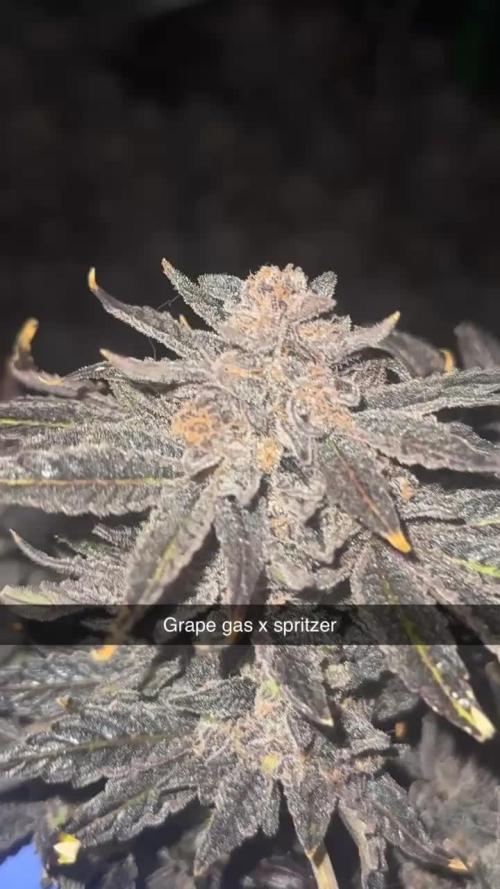
This grow is looking phenomenal. Can’t wait to wash for rosin! Freezing as of now update: test run of bubble this shit is fucing crazy gas. So pungent and full of flavor. Tried some wet Melt in the Puffco it hits like crazy. Great effects and gas flavor. Will be pressing asap update did a 2nd wash tonight of all the trim from plant 3. I’d say 600 wet grams. Yielded great and awesome color

Likes
2
Share

@Jardineiro_Br
Follow
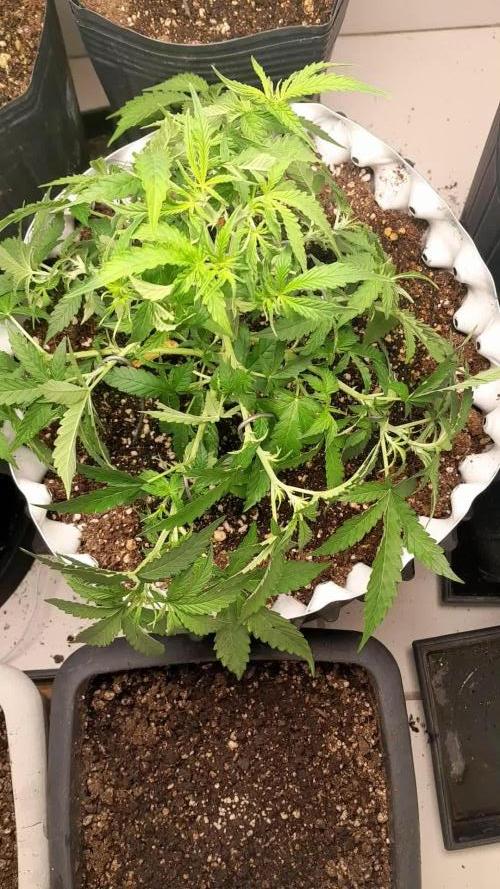
A planta está bem saudável, numa fase de Pré Floração, ja comecei a incluir fertilizante de Floração, fiz uma desfoliação de Pré Floração e ajustei os ganchos abrindo mais os galhos.
Likes
15
Share


@MrGrowMan
Follow
Week 13-14
1 nutrient water
1 non nutrient water
LsT and Scrog
Diesel and Mimosa (front 2) auto
day 62 start 12/12 light period
2 break up cake day 67 start flowering
Mimosa and Diesel (front 2) Flush 30.01


Likes
38
Share


@MariRemediesLLC
Follow
Nothing to report. Seedling. I use chop sticks to hold up the plants until they are strong. Prevents them from blowing over.

Likes
7
Share


@Cogollo_eu
Follow
**Encontrarás la traducción a español al final de la descripción**
From/Desde: 15/03/19 || To/Hasta: 21/03/19
From day/Desde día: 22 || To day/Hasta día: 28
You can find the Gorillas Diary here:
** Podéis encontrar el diario de las Gorilla aquí:**
https://growdiaries.com/diaries/25675-makingmoney-with-gorilla-mm-vs-gorilla
-----IMAGES & VIDEOS-----
Video 1:
Exactly the same video as 2 but accelerated +300% to fix it to 1 minute for instagram.
Video 2:
4 days (25~28) TimeLapse, 1 image each 60 secs @ 30 fps
Video 13:
General video of the 4 plants and it's trainings, i'm sorry for being so repetitive with the music.
Video 16:
Video of the main Money
Video 19:
Video of the secondary Money
Photo 22:
Last main branches toppings
-----WEEK SUMMARY-----
This week i will just say, an image worths more than a million words... so now let's talk about a video 👊
-----WATERING CALENDAR-----
18/03/19 - 400 ml with all "LAST" week nutrients @ 0.95 E.C. PH5.9 (i had some rests from the last watering)
- Also i applied a foliar irrigation with the same mix as the last week
20/03/19 - 1.000 ml with all week nutrients @ 0.9 E.C. PH5.9
*****ESPAÑOL*****
-----IMÁGENES & VÍDEOS-----
Vídeo 1:
TimeLapse, exactamente el mismo vídeo que el 2 pero acelerado a un poco más del 300% para ajustarlo a 1 minuto para Instagram.
Vídeo 2:
4 días (25~28) TimeLapse, 1 imagen cada 60 segundos @ 30 fps, vídeo increíble en el que se ve com responde la Gorila al Man Lining, en aproximadamente el minuto 2 podo y entreno un poco a la otra Gorila y la principal de las Money Makers, al final del vídeo podaré la última Money Maker.
Vídeo 13:
Vídeo general de las 4 plantas y sus entrenamientos, siento la repetitividad de la música entre los vídeos.
Vídeo 16:
Video enfocado a la Money principal
Photo 10:
Los cortes nombrados (Top&Bottom) de la foto 11
Photo 22:
Los toppings de las ramas principales.
-----SUMARIO SEMANAL-----
Como una imagen vale más que mil palabras, ahí os dejo varios vídeos 👊
-----CALENDARIO DE RIEGO----
18/03/19 - 400 ml contodos los nutrientes de la "ÚLTIMA" semana @ 0.95 E.C. PH5.9 (me quedaba un resto del útlimo riego)
- También he hecho un riego foliar con un resto del ultimo riego foliar
20/03/19 - 1.000 ml con todos los nutrientes de la semana @ 0.9 E.C. PH5.9

Likes
15
Share

@Bunterbiber
Follow
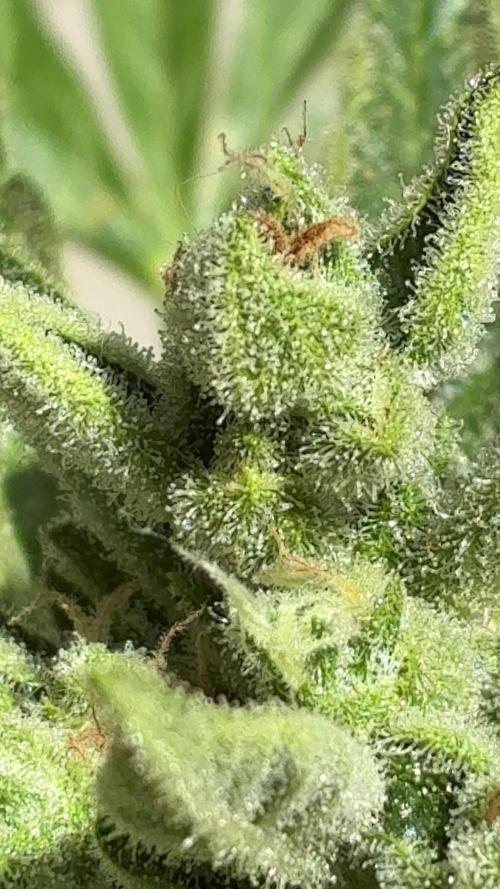
We’ve officially hit Week 11, and it has been a beautifully smooth and steady week. The weather stayed consistently warm and dry, with the humidity sitting around 40% RH — good conditions for the final days of flowering.
The Verdict:
I’ve been keeping a very close eye on the trichomes, and they are now almost entirely milky across the board. Because of this, the final countdown is on: I will be harvesting her over the next couple of days....perhaps also a week ;-)!
Looking back at this run, she has been an incredibly beautiful plant to grow. The striking contrast of her dark leaves is unmatched, and the aroma she’s putting off right now is just superb. I can honestly, highly recommend this strain to anyone looking for a unique and rewarding grow. I’m already looking forward to the cure and the first smoke test!
While I get my trimming scissors ready, her sister is going to enjoy the sun for a bit longer. Make sure to check out my profile to see the final stages of the Purple Haze Auto!

Likes
36
Share


@MrJoint
Follow
⏰PP #1 is really late.
✨PP #2 and #3 are pretty nice.
🌴 I made an LST on PP #1 to try to ensure reasonable performance with main line, despite delay from this girl.
⭐️I’ll start a new diarie for PP #1.
✌️🎃Thank you for checking my cultivation.