
Likes
14
Share
@PlantGod
Follow
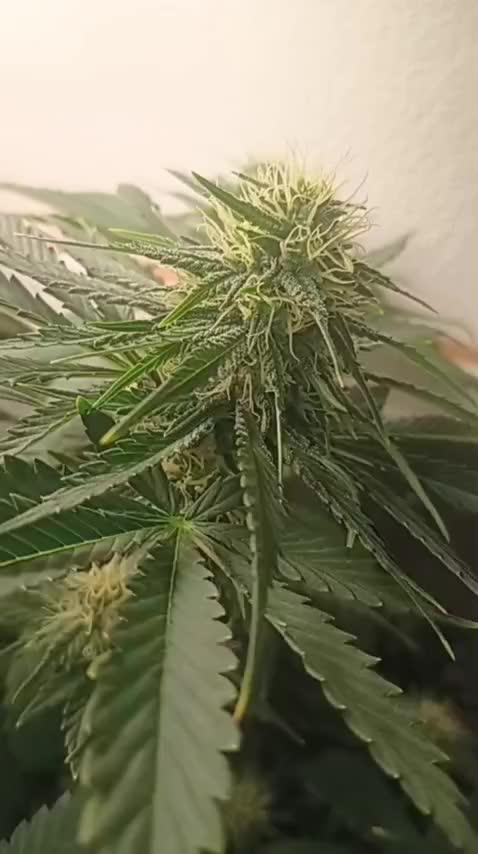
Today March 10th is day 50! I spend a few hours of work every other day to tie branches and manipulate leaves -white pistols are showing -will secure netting and stop using pipe cleaners to tie down at the end of the week -I have been using nutrients about every other watering -1.5 tsp micro .5tsp grow 1.5 tsp bloom in about 2 Litres of water After 2 weeks. Royal Gorilla is the fastest blooming followed by the Green Gelato. The LSD is slower. The HulkBerry I started 4 days later is blooming ok
Likes
19
Share
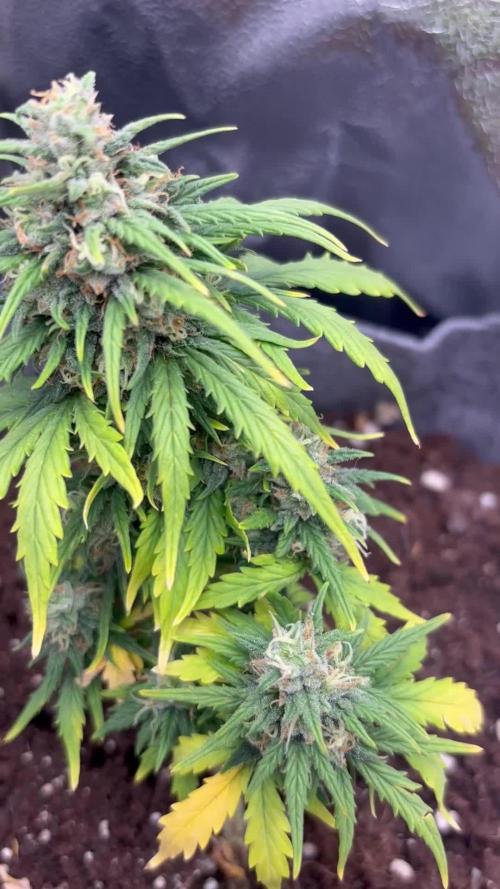
Flowering underway but can't help but think how small my plant is looking. I'm I being para or is something up that I'm not noticing. Comments appreciated.
Likes
32
Share
@Borberad
Follow
Nochmal ca 5 bis 6 Pollenbeutel gefunden und vor Panik wieder vergessen Fotos zu machen. Ab Ende der Woche gibt es wieder UV-b auf die Mütze.
Likes
8
Share
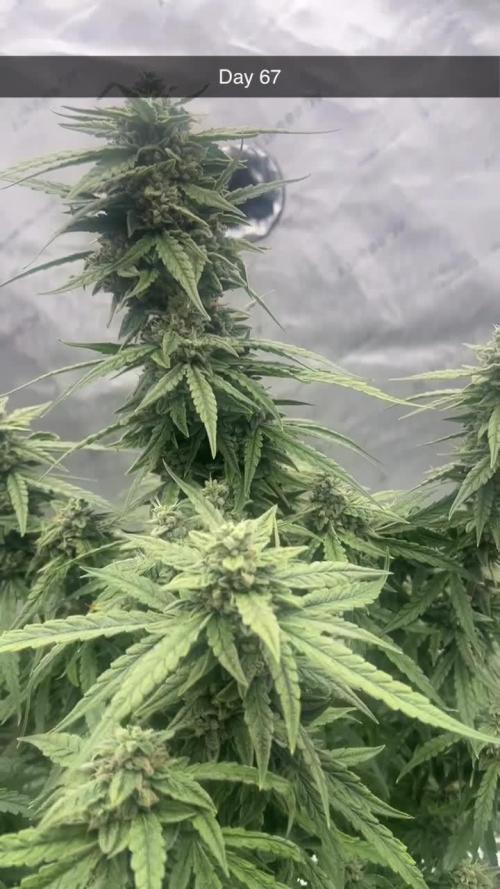
Days 67 - 73 (from seed) 4/8/24 - 4/14/24 Lamp distance: 12" @ 75% power (estimate 800+ PAR from highest point of canopy) VPD: leaf surface temperature averaging 68-72 degrees - humidity set to 45% Feed schedule: Each plant receiving slowly downward now to 1/3 gallon water daily + once a week feeding schedule and additional FPE every third day IPM: visual inspection only, no foliar Notes: Flowers are really swelling up this week. All plants in the tent now showing signs of senescence with Cookies & Berries just barely fading. As the week went on their need for water has slowly diminished back down to roughly 1/3 gallon a day, but a day or two in there they also received their 1/2+ gallon daily. Usually can tell how much watering they need by lifting the pots and determining by weight/feel, or if there's any water run-off but that is quite uncommon/undesirable. Hot Damn! currently reeking the most out of them all, lots of sweet funk when you just get near it. Vanilla Fizz has a very mellow smell check until you do rub it then it's a cheesy/funk bomb. Cookies & Berries seems to have the lightest appearance of resin coverage and the least nose out of the tent - but when you rub it the resin is very very tacky and smells of chemical citrus fruit, maybe pine. Mango Sky is fairly mellow too but after touching the flowers it's bold and sticky, smells like menthol (to me, but not unanimous) and tropical fruits.
Likes
24
Share
Bueno ya creo que para la próxima semana estás nenas estaran listas para cortar, ya llevamos 1 semana con solo agua y final flus
Likes
8
Share
When I started growing I set two goals for myself. I was the first to make 1 gram-1€ and I was very close. This grow cost me 52€ (that includes electricity, seeds, biobizz...) but unfortunately I had to buy nematodes (+ 9€) for a total of 61€. That means he would have succeeded if I hadn't had a fly infestation from the ground. I told you that I was very close to the goal. The second one is to make 1w-1gram, considering my setup and my "knowledge"🙈, I think it's impossible. However, I must admit that I am very satisfied with 53 grams. HAPPY GROW EVERYONE AND GOOD LUCK GUYS.
Likes
19
Share
@Wenz004
Follow
Reifung schreitet voran. Trichome schau ich mir erst Ende der nächsten Woche an.
Likes
3
Share
@DannyGNYC
Follow
Oh boy, what a week have they got Sick PH was very high. Didn’t know what to do so the last week and a half. I’ve been flushing them bringing the pH down little by little trying to go gentle eventually the last flash show PH at 6.8. Which is OK anything between six and seven is considered optimal range for cannabis plant. Today I shut Lemon cherry Gelato. PH after runoff is 6.8 I used 1gal added 4ml of Gold leaf
Likes
5
Share
@BombBuds
Follow
Letzte Woche! Einmal noch gießen aber nur wenig damit die bissl trockenstress haben und trichome nochmal anziehen. Keinen Dünger mehr und nur noch ph neutrales Wasser. Geruch ist super geil! Aussehen ist auch ne 10/10. bin sehr gespannt aufs Endprodukt!
Likes
6
Share
I did a defoilation this week to expose budsites and direct energy towards colas that have more potential for better buds. Everything is actually going much better than expected now she stretched so much. -
Likes
36
Share
Gonna keep an eye out for crosses with face off OG! Good outcome for 1st grow👽 BHO made made with whip it premium after about 3 days in freezer with column. Didn't run w dry ice🤷🏼‍♂️ evap then vac with as little agitation as possible. -Dosido 22-16 has a earthy sweet cream well rounded berry cookies nose & a funky diesel undertone -Effects are hard hitting and euphoric, can put you down for an indica nap or keep you fine, groovy & grounded depending on the dosage. -An ideal indica IMO for anyone looking to ground mental health state from anxiety -Also helps with pain from stomach pain to a migraine, insomnia, appetite , Post workout recovery. Overall This strain is potent indica, Calms the mind & body putting you in a nice place
Likes
24
Share
In week 12 the humidity inside my HOMEBOX-tent is unfortunately still VERY HIGH (maximum of 73%). The combination of big buds and high humidity is BAD...I fear bud-rot. The 12 AK-47 plants from SERIOUS SEEDS continue to THRIVE! They all have a healthy green color and produce buds all over. All branches have formed HUGE colas at this point...its AMAZING to see how big the AK-47 can get. Every watering I add MILLS-nutrients following the feeding schedule of Mills from their website and the plants LOVE IT. The trichome production is INSANE, they are FROSTY AS HELL NOW! 😎 I cant wait to try this amazing smelling strain and see how good it works against my chronic back pain. The VERY STRONG aroma reminds me of Sandalwood end is THICK and HEAVY at this stage of flowering. The two SANlight Q5W-Gen.2 LED-lamps are doing an EXCELLENT job until now, the spectrum is PERFECT for cannabis. Both LEDs are dimmed to 100% now in week 8 of flowering, because FULL-POWER mode is needed for abundant flower production.I LOVE THOSE LEDs 😍 and I can only strongly recommend to every grower to give them a try!
Likes
12
Share
Checkout my Instagram @smallbudz to see the Small budget grow setup for indoor use, low watt, low heat, low noise, step by step. 21/12/2019 - Fed her 1.5l of 6.4PH water with 0,5ml of each: Grow, Bloom and Max, and 1ml of each: Heaven, Alga-mic and Vera, noticed almost no run off, I use about 1/3 of the nutrient dosage on the chart, to achieve about 200/300PPM (500 scale). Did some light pruning also.
Likes
1
Share
@Ninjabuds
Follow
Discount code NINJABUDS: Air cube GROwACE.com Discount code NINJABUdS: ELUfAH Everything looks healthy for now. Nothing big to update yet I have not chosen which 6 plants I’m going to keep yet. I’m only going to keep one plant of each strain
Likes
47
Share
2nd net is up. Early bud formations are promising. holding up to the extremes pretty well, some leaves taking minor damage, but overall, she is holding up, gave her 1 night at 50F see how she would react, stressful. Not advised as it messes with her metabolism, but I want to see if it triggers any anthocyanin response. Love to see her purp up but no signs yet. Remember, For every molecule of glucose produced during photosynthesis, a plant needs to split six molecules of water. This process provides the hydrogen needed for synthesizing glucose and other organic compounds, while oxygen is released as a byproduct. Homework. If Rubisco activity is impaired and it cannot properly function or regenerate its substrate, the plant's leaves are likely to turn a pale green or lime green, a condition known as chlorosis. Essentially, Rubisco activity is highly regulated and susceptible to various environmental and metabolic factors that can cause it to become inhibited, leading to an apparent failure in RuBP regeneration due to a lack of consumption. Rubisco regeneration is intrinsically linked to nitrogen supply because Rubisco is a major sink for nitrogen in plants, typically accounting for 15% to over 25% of total leaf nitrogen. The regeneration phase itself consumes nitrogen through the synthesis of the Rubisco enzyme and associated proteins (like Rubisco activase), and overall nitrogen status heavily influences the efficiency of RuBP regeneration. RuBisCO is a very large enzyme that constitutes a significant proportion (up to 50%) of leaf soluble protein and requires large investments in nitrogen. Insufficient nitrogen supply limits the plant's ability to produce adequate amounts of RuBisCO, thereby limiting the overall capacity for photosynthesis and carbon fixation. Maintaining the optimal, slightly alkaline pH is crucial for the proper function and regeneration of Rubisco. Deviations in either direction (too high or too low) disrupt the enzyme's structure, activation state, and interaction with its substrates, leading to decreased activity and impaired RuBP regeneration. (Lime/yellowing) Structural Component: Nitrogen is an essential building block for all proteins, and the sheer abundance of the Rubisco protein makes it the single largest storage of nitrogen in the leaf. Synthesis and Activity: Adequate nitrogen supply is crucial for the synthesis and maintenance of sufficient Rubisco enzyme and Rubisco activase (Rca), the regulatory protein responsible for maintaining Rubisco's active state. Nitrogen deficiency leads to a decrease in the content and activity of both Rubisco and Rca, which in turn limits the maximum carboxylation rate, Vmax, and the rate of RuBP regeneration Jmax, thus reducing overall photosynthetic capacity. Nitrogen Storage and Remobilization: Rubisco can act as a temporary nitrogen storage protein, which is degraded to remobilize nitrogen to other growing parts of the plant, especially under conditions of nitrogen deficiency or senescence. Nitrogen Use Efficiency (NUE): The allocation of nitrogen to Rubisco is a key determinant of a plant's photosynthetic nitrogen use efficiency (PNUE). In high-nitrogen conditions, plants may accumulate a surplus of Rubisco, which may not be fully activated, leading to a lower PNUE. Optimizing the amount and activity of Rubisco relative to nitrogen availability is a target for improving crop NUE. Photorespiration and Nitrogen Metabolism: Nitrogen metabolism is also linked to the photorespiration pathway (which competes with carboxylation at the Rubisco active site), particularly in the reassimilation of ammonia released during the process. To increase RuBisCO regeneration, which refers to the process of forming the CO2 acceptor molecule Ribulose-1,5-bisphosphate (RuBP) during photosynthesis, the primary methods involve optimizing the levels and activity of Rubisco activase (Rca) and enhancing the performance of other Calvin-Benson-Bassham (CBB) cycle enzymes. Biochemical and Environmental Approaches: Optimize Rubisco Activase (Rca) activity: Rca is a crucial chaperone protein that removes inhibitory sugar phosphates, such as CA1P (2-carboxy-D-arabinitol 1-phosphate), from the Rubisco active site, thus maintaining its catalytic competence. •Ensure optimal light conditions: Rca is light-activated via the chloroplast's redox status. Adequate light intensity ensures Rca can effectively maintain Rubisco in its active, carbamylated state. •Maintain optimal temperature: Rca is highly temperature-sensitive and can become unstable at moderately high temperatures (e.g., above 35°C/95F° in many C3 plants), which decreases its ability to activate Rubisco. Maintaining temperatures within the optimal range for a specific plant species is important. •Optimize Mg2+ concentration: Mg2+ is a key cofactor for both Rubisco carbamylation and Rca activity. In the light, Mg2+ concentration in the chloroplast stroma increases, promoting activation. •Manage ATP/ADP ratio: Rca activity depends on ATP hydrolysis and is inhibited by ADP. Conditions that maintain a high ATP/ADP ratio in the chloroplast stroma favor Rca activity. Enhance Calvin-Benson-Bassham (CBB) cycle enzyme activity: The overall rate of RuBP regeneration can be limited by other enzymes in the cycle. •Increase SBPase activity: Sedoheptulose-1,7-bisphosphatase (SBPase) is a key regulatory enzyme in the regeneration pathway, and increasing its activity can enhance RuBP regeneration and overall photosynthesis. •Optimize other enzymes: Overexpression of other CBB cycle enzymes such as fructose-1,6-bisphosphate aldolase (FBA) and triose phosphate isomerase (TPI) can also help to balance the metabolic flux and improve RuBP regeneration capacity. Magnesium ions, Mg2+, are specifically required for Rubisco activation because the cation plays a critical structural and chemical role in forming the active site: A specific lysine residue in the active site must be carbamylated by a CO2 molecule to activate the enzyme. The resulting negatively charged carbamyl group then facilitates the binding of the positively charged Mg2+ion. While other divalent metal ions like Mn2+ can bind to Rubisco, they alter the enzyme's substrate specificity and lead to dramatically lower activity or a higher rate of the non-productive oxygenation reaction compared to Mg2+, making them biologically unfavorable in the context of efficient carbon fixation. The concentration of Mg2+ in the chloroplast stroma naturally increases in the light due to ion potential balancing during ATP synthesis, providing a physiological mechanism to ensure the enzyme is activated when photosynthesis is possible. At the center of the porphyrin ring, nestled within its nitrogen atoms, is a Magnesium ion (Mg2+). This magnesium ion is crucial for the function of chlorophyll, and without it, the pigment cannot effectively capture and transfer light energy. Mg acts as a cofactor: Mg2+ binds to Rubisco after an activator CO2 molecule, forming a catalytically competent complex (Enzyme-CO2-Mg2+). High light + CO2) increases demand: Under high light (60 DLI is a very high intensity, potentially saturating) and high CO2, the plant's capacity for photosynthesis is high, and thus the demand for activated Rubisco and the necessary Mg2+ cofactor increases. Mg deficiency becomes limiting: If Mg2+ is deficient under these conditions, the higher levels of Rubisco and Rubisco activase produced cannot be fully activated, leading to lower photosynthetic rates and potential photo-oxidative damage. Optimal range: Studies show that adequate Mg2+ application can enhance Rubisco activation and stabilize net photosynthetic rates under stress conditions, but the required concentration is specific to the experimental setup. Monitoring is key: The most effective approach in a controlled environment is to monitor the plant's physiological responses e.g., leaf Mg2+ concentration, photosynthetic rate, Rubisco activation state, and adjust the nutrient solution/fertilizer to maintain adequate levels, rather than supplementing a fixed "extra" amount. In practice, this means ensuring that Mg2+ is not a limiting factor in the plant's standard nutrient solution when pushing the limits with high light and CO2. Applying Mg2+ through foliar spray is beneficial to Rubisco regeneration, particularly in alleviating the negative effects of magnesium (Mg) deficiency and high-temperature stress (HTS). While Mg can be leached from soil, within the plant it is considered a mobile nutrient, particularly in the phloem. Foliar-applied Mg is quickly absorbed by the leaves and can be translocate to other plant parts, including new growth and sink organs. Foliar application of: NATURES VERY OWN MgSO4 @ 15.0g L-1 in a spray bottle. For those high-intensity workouts when 1 meal a day is just not enough! Foliar sprays are often recommended as a rapid rescue measure for existing deficiencies or as a supplement during critical growth stages, when demand for Mg is high. Application in the early morning or late evening can improve absorption and prevent leaf burn. The plant was getting a little limey yellow in the centre. Shortly thereafter, she was back in business, green mostly regenerated. The starting point [of creativity] is curiosity: pondering why the default exists in the first place. We’re driven to question defaults when we experience vuja de, the opposite of déjà vu. Déjà vu occurs when we encounter something new, but it feels as if we’ve seen it before. Vuja de is the reverse—we face something familiar, but we see it with a fresh perspective that enables us to gain new insights into old problems. Confidence is evidence... nothing more. You are confident because you have driven 10,000 times, you are confident because you have spoken 10,000 times. People think confidence is a feeling, but it's not. If you want more confidence, then you need to create evidence, take more shots, collect more data, build more experiences, take more risks; fail, confidence doesn't come first; it is the reward you get for doing the work. no one else wants to do.