


Processing
Likes
Comments
Share


@MagnoliaFrost
Follow
10/5
Day 28 - LED lamp now on 24h
-
Water: Both plants got 1L of water with nutes.
Summary for the day:
I still do some LST but truing to do less and focusing on spreading the tops. LED in 40cm full effect. Did some defoliation today but not sure if I'm doing right.
-
12/5
Day 30 - LED lamp now on 24h
-
Water: Both plants got 1L of water with nutes increased to 1.5ml because it's been 10 days since I started with giving them 1ml each time they got water.
Now I started to see they drink much more. Last time it was 3 days between watering. This time it was only 1 day since they got 1L water. Maybe increase 1L to 1.5L next time.
Summary for the day:
I still do some LST but truing to do less and focusing on spreading the tops. LED in 40cm full effect. Did some defoliation today as well.
-
14/5
Day 32 - LED lamp now on 24h
-
Water: Nothing
Maybe increase 1L to 1.5L next time.
Summary for the day:
I still do some LST but truing to do less and focusing on spreading the tops. LED in 40cm full effect. Did some defoliation today as well.
-
15/5
Day 33 - LED lamp now on 24h
-
Water: Both plants got 1L of water with 1.5ml nutes x2 (A+B)

Processing
Likes
46
Share


@PureMedicin
Follow
Nice growth and bud developtment. Hps still doing its thing while im sitting back and relaxing. Got to keep an hawk eye on watering. I feed full strenght going over to full canna so they were transplanted into soil. Clones doing good but the Lemon skunk clone dont feel to good. Lets see what the week will bring.

Likes
15
Share


@Luckydope69
Follow
Dies ist die letzte Woche der Vegetation. Ich habe zu Beginn noch einmal etwas defoliert und werde es nun die ganze Woche wachsen lassen. Der Triebwuchs ist sehr schön und es wird einen Haufen Spitzen geben.
Likes
18
Share


@Nazgul420
Follow
Holky jsou připraveny na sklizeň dva dny tma a hurá na to😁🤨😉🍨🍧🍦
Každá je jiná těším se .🚀🚀🚀

Likes
4
Share


@the_big_pink_place
Follow
Weeks going good, soon to be separating and starting to veg in there own tents. Today the day I'm updating is mid week and the growth from when I took those pictures are insane wait till next week's update. They monstered out on me.
Processing
Likes
22
Share


@eldruida_lamota
Follow
De nuevo familia traigo la cuarta semana de floración de estas critical a granel, que me regaló grow barato.
Aunque sean a granel tampoco vamos a desecharlas, ya que aun así podemos conseguir muy buenas flores.
Este cultivo va fenómeno también. Ya empiezan a desprender su aroma tan característico, buen porte predominante indica 55/65 días están.
.
La humedad esta al 45% la temperatura está entre 21/25 grados , y como siempre el ph , ya que es de lo más importante,está en 5,8/6,0.
.
AgroBeta:
1 ml x L Flowering black line , vía radicular.
0,2 ml x L Beta shark, vía radicular.
0.5 gr x L mega PK , vía radicular.
0,8 ml x L Terminator, vía radicular.
0,5 gr x L Engordacogollos, vía radicular.
0,3 ml x L Tucán , vía radicular.
0,1 ml x L Betazyme, vía radicular.
0,3 ml x L Tricoma, vía radicular.
0,05 ml x L Gold Joker, vía radicular.
0,2 ml x L Silver, vía radicular.
.
Hasta aquí todo familia 🕸️ , un saludo y buenos humos fumetillas💨💨💨.

Likes
18
Share


@Bread_n_Buds
Follow
Now we've reached day 41
Our Watermelon Candy, as we expected, has become the queen of the growbox full of F1 Hybrids. Large, vigorous, grows quickly and fills the flowers very quickly along the entire length of the arm, in my opinion once filled they will be very beautiful and full.
The appearance is really important, you can see that it is a healthy plant that grows at a great rate and allows us to enjoy a wonderful view.
The situation becomes very interesting from here on out we will see some good things.
Site Description
ZAMNESIA SEEDS - WATERMELON CANDY F1 HYBRID AUTOMATIC: BUDS BURSTING WITH FLAVOR
If you've been looking for a flavorful strain with superb genetics that's effortless to cultivate, the hunt is over. Thanks to reliable F1 hybrid genetics, Watermelon Candy F1 Automatic showcases the highest degree of productivity and efficiency. This strain takes everything you know and love about the original, and packages it in a plant with even greater potential.
GROWING WATERMELON CANDY F1 HYBRID AUTOMATIC
Derived from Watermelon, Candy Kush, and ruderalis, Watermelon Candy F1 Automatic is a finely tuned medley of genetics. This cultivar is fast to flourish and reliable to grow, no matter where you choose to grow. Taking just 9–10 weeks from germination to harvest, she provides a uniform growing experience culminating in a huge haul of buds for her size.
Reaching heights of 65–80cm, Watermelon Candy F1 Automatic stays pretty grounded, making her perfect for smaller growing areas where space is a commodity. It also means you can fit more plants in if you have the room! Once ready to yield, growers will see a return of 400–450g/m² indoors and up to 100g/plant outdoors. Moreover, Watermelon Candy F1 Automatic is highly resistant to pests and disease, making it an ideal strain for newcomers and fans of low-maintenance cultivation.
AROMAS, FLAVORS, AND EFFECTS OF WATERMELON CANDY F1 HYBRID AUTOMATIC
If we haven't already sold you on the power of F1 hybrid genetics, the proof is in the pudding. Watermelon Candy F1 Automatic is teaming with terpenes and cannabinoids, making for a lively high coupled with huge flavors. Just one hit is all it takes to sample rich fruitiness mixed with sweet candies and a slight earthiness to back it up. And with an average THC content of 23%, the effects are euphoric at the start but settle into deep relaxation soon after. Whether you're chilling alone or with friends, Watermelon Candy F1 Automatic will see you right.
So seeds of all brands, in addition to these great F1 Hybrids and the entire Zamnesia line, fertilizers and everything related to the world of cannabis, you should buy them from the best online store in the sector
www.zamnesia.io


Likes
18
Share


@KirosWS94
Follow
12/4
4th week now, the girls are full on flowering mode, every day they are bigger and bigger.
14/4
Today water with 1050PPM and Run-Off was 1150PPM.
They smell very sweet, and they are super frosty and sticky.
Likes
21
Share


@Backtotheroots2222
Follow
Hello, now the second week has begun.. the little helpers are slowly coming out of their holes and the first roots are already taking out of the small 1 liter pot and already two root ends have dried up again, which is not so desirable with AF genetics. every cell and every day counts to achieve good results in the end... This week there is another drop of alpha boost and that's it for additives. The soil is saturated with nutrients that are released now and then, it should fully supply this little AF throughout its cycle. vll at the end a dollop of molasses. Time will tell. let's give her another week, then there's something to look at... temp fits again at night it is also OK around 12- 15°... today and tomorrow even up to 30° during the day... So it can only get better. Although she put everything away with engraving.. great genetics that don't buckle right away if one or two days the conditions don't fit... It's growing! PS i add a little bit off Humus to the top layer..the helper seeds stretch a bit to much

Likes
41
Share


@MMSC16
Follow
Jan 4 - Had some high temps in the morning. Plant is growing with buds fattening. Less green on base of calyx' means there's probably less than a week to go. Some wilting occurring as senescence comes to an end.
Jan 5 - Watered at 3.30PM. Calyx Trichomes still show clear. Defoliated two wilting leaves to provide better airflow for the next week.
Jan 5 - HARVEST UPDATE (7 Days Drying) - First plant showed signs of first small branches snapping. I've snipped buds (with sugar leaves) into a jar to cure. I'll manicure once I ensure the humidity level is ideal.
Jan 6 - 11.30PM Calyx' are finally showing amber, and quite a few! There's still clears, but this likely means harvest is close. Removed 1 wilting fan leaf.
Jan 7 - 5.00AM Harvested remaining plant, removed fan leaves and left sugar leaves. Hang drying at 60F and 60%RH, will check on in a week.
Jan 17 - Jarred both plants at 63%-64%RH. Dry weight for first plant 17.4g is and Second plant after trim is 25.9g. Total harvest is 43.3g dry.
Likes
43
Share


@Just_Weed
Follow
Last week of veg,
Ppm runoff 1800 and ph 6.6
I don't like this SCROG net very much, I am thinking about removing it for the flower but we will see.
Also noticed some pests ( thrips, spider mites) but very little on some leaves at the bottom so I sprayed her
with neem diluted in water with soap used as an emulsifier ( made 5 l solution, sprayed around 0.75l until she was
soaking wet and with rest of the solution watered water)

Likes
18
Share


@CanadianFillmore
Follow
Not much to report, DS1 is the bigger of the two, both smell nice, very frosty and lots of purple. Will update in 7-10 days with initial smoke report and dry weight.
Thanks for checking out my grow! 👽🌳🔥💚
Update 01/26 - dry weight is 141 minus a few grams for smoke test. I don't find divine storm to be very potent, has a mild taste of earth, wood and nutty.
Likes
19
Share


@GoldenWeedGrower
Follow
Legend
Timestamp: 📅
EC - pH: ⚗️
Temp - Hum: 🌡️
Water: 🌊
Food: 🍗
pH Correction: 💧
Actions: 💼
Thoughts: 🧠
Events: 🚀
Media: 🎬
D: DAY, G: GERMINATION, V: VEGETATIVE, B: BLOOMING, R: RIPENING, D: DRYING, C: CURING
________________________________
📅 D91/B29 - 14/02/24
⚗️ EC: 0.9 pH: 5.8
🌡️ T: 19-25 °C H: 50-70 %
🌊 6L
🍗 CalMag - Bloom A-B - B52 - Bud Candy - Big Bud
💧
💼 I filled up all available space in the pot, preparing all for 3 days out. I'll be back on Sunday the 18th of February
🧠
🚀 I'm preparing all for 3 days out
🎬 Added timelapse video and screenshots
________________________________
📅 D92/B30 - 15/02/24
⚗️
🌡️ T: 18-23 °C H: 50-80 %
🌊
🍗
💧
💼
🧠
🚀 First day out
🎬
________________________________
📅 D93/B31 - 16/02/24
⚗️
🌡️ T: 18-23 °C H: 50-80 %
🌊
🍗
💧
💼
🧠
🚀 Second day out
🎬
________________________________
📅 D94/B32 - 17/02/24
⚗️
🌡️ T: 19-23 °C H: 40-70 %
🌊
🍗
💧
💼
🧠
🚀 Third and last day out
🎬
________________________________
📅 D95/B33 - 18/02/24
⚗️ EC: 0.8 pH: 5.8
🌡️ T: 19-23 °C H: 40-70 %
🌊 1L
🍗 CalMag
💧
💼
🧠
🚀 I'm baaaackkkk !!! 😎😎😎
🎬 Big job on media. I edited the cumulated time lapse videos and splitted day by day. Also uploaded the screenshots from the TrolMaster App for each day out. Great!
________________________________
📅 D96/B34 - 19/02/24
⚗️ EC: 0.8 pH: 5.6
🌡️ T: 19-23 °C H: 40-70 %
🌊
🍗
💧
💼
🧠
🚀
🎬 3 pics and a video added. Added timelapse video
________________________________
📅 D97/B35 - 20/02/24
⚗️ EC: 0.8 pH: 5.3
🌡️ T: 20-24 °C H: 50-65 %
🌊 5L
🍗 CalMag - Bloom A-B - B52 - Bud Candy - Big Bud
💧
💼 Some defolation
🧠
🚀 First signs of ripening
🎬 Added timelapse and screenshjots. I also prepared a timelapse of the entire week with some music 🎵🎵🎵 and weekly rate of T-H and VPD 📈📈📈

Likes
13
Share

@Huntablunt
Follow
High!
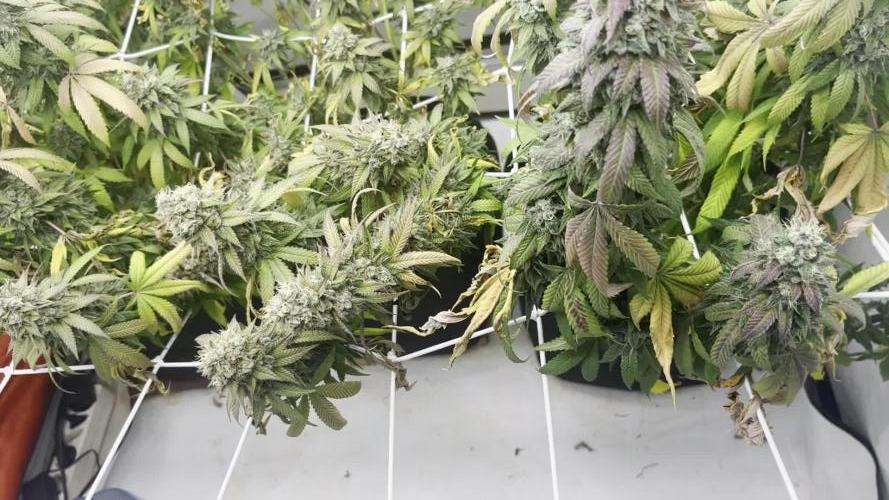
The final courtain fell today.............I am amazed and will report again after curing......smell, looks is just amazing. After ripping of the leaves of these resinous buds I had 1,5g of hash in my hand.....


Likes
Comments
Share


@mihixd
Follow
D8: PPFD to 400
D9: PPFD to 475
D10: PPFD to 550, 300ml water (saturation of 1l pot)
D11: PPFD to 620
D13: 300ml water
D14: Transplant day!! 75L fabric pot, bottom 5cms filled with hydro pebbles.
Soil mix: 50% soil, 30% perlite, 20% worm castings. Watered in with 1L +calmag and power roots

Likes
13
Share

@Roberts
Follow
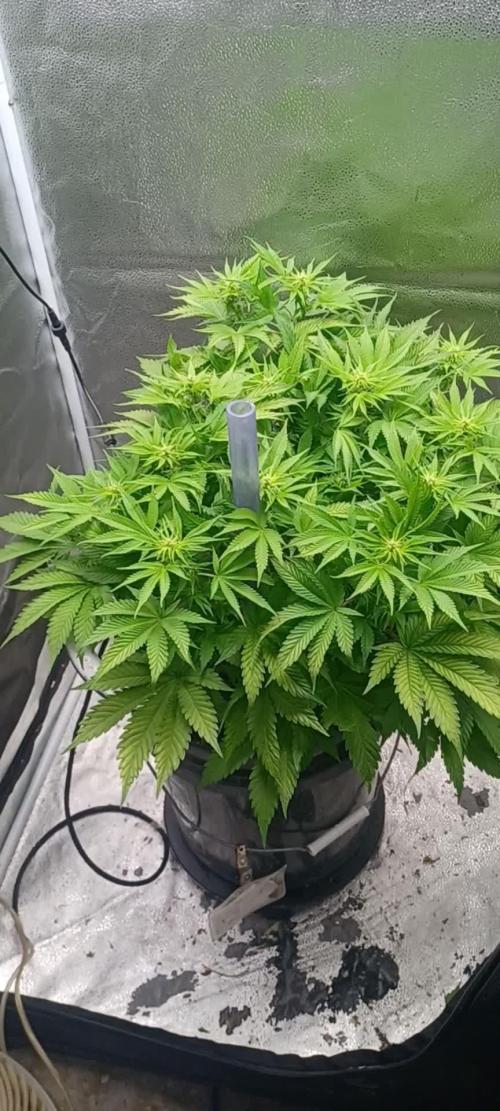
Mintz Runtz automatic is doing good, I should of changed the solution last update, but I did today. She is starting to form her colas, hopefully she stretches more so I can turn on the Saturn under canopy light. Everything is looking good for the most part. Thank you Elufah, Spider Farmer, and Spliff Seeds. 🤜🏻🤛🏻🌱🌱🌱
Elufah (Power by Growpros solutions) UAP1500,Die-cast radiator and featuring an optical lens design(Uniform PPFD),150W,PPE3.0μmol/J,PPFD1500umol/s/m²,Use the verified commercial-grade spectrum;Full/Epar Boost Spectrum adjustable,A very excellent grow light;
By entering the discount code, you can enjoy an additional 10% price reduction when making the purchase.
Amazon discount code:SAVEURCASH10
product Link:https://a.c1ns.cn/uap1500
Thank you grow diaries community for the 👇likes👇, follows, comments, and subscriptions on my YouTube channel👇.
❄️🌱🍻 Happy Growing 🌱🌱🌱
https://youtube.com/channel/UCAhN7yRzWLpcaRHhMIQ7X4g.

Likes
21
Share


@TheStrainAlchemist
Follow
To me the ladies always look so small but they grow at an impressive pace.
I’m in love with those nutrients, is my first full organic grow and Guanokalong is impressive, I never seen a similar root development, I transplant the plant from a 0,5L pot to a 1,5l and in 3 day I moved them again to the final 20L Plastic pot because already clogged.
Enjoy fellow growers , I wish abundant harvest ☮️♥️

Processing
Likes
4
Share


Likes
7
Share


@Snooziecheesecake
Follow
So many new nodes coming in after LST and topping, starting to become a sea of leaves. I am experimenting on all 4 with different training types in order to see which gives me the best result in my set up. The largest I gave LST and topped the 6th node, gave one only LST, one with only topping, and one with no training. Getting pretty hyped on what’s still to come
