


Likes
Comments
Share


@russrahl
Follow
A month in now to flowering and all is still good. Stretch has stopped and the 2nd net is on about 1 foot above the first. I would have liked to have done a bit more defoliation earlier on in flowering but it was a busy few week. Still kept her on the lower side for nutrients and notice the one plant that got locked out earlier in the month was not as pretty as the rest and showing signs of deficiency still on her leaves but the buds are developing normal like the others, bigger even maybe...lol all in all it’s still looking good at this point. Cheers 💨

Likes
3
Share


@Ogbangbang2981
Follow
it's only the beginning on week 6 and are in flower stage, tree looks good loving her feed, loving her space just loving life. Today I decided to put her outside in the sun such a beautiful Sunday it was, I'll keep this updated with more pics by Saturday on the closing of week 6 .


Likes
15
Share

@RelaeX
Follow
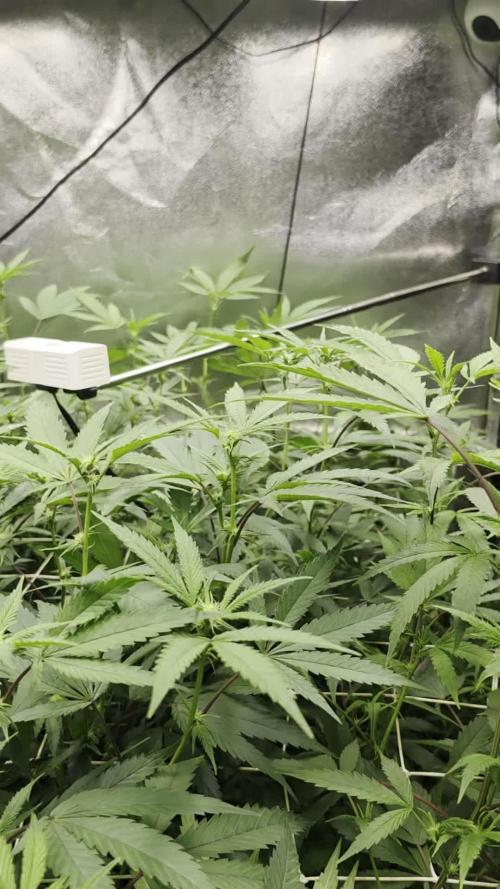
Week 20: Flowering Week 3 – Lollipopping, Climate Control & Heavy Water Intake 🌸🌸
Relax! Hey, it's Week 20—Flowering Week 3 is officially underway!
We are entering the final stretch of the stretch phase, and the canopy is looking dense, lush, and super active. The Screen of Green (ScrOG) net, which was installed at the start of Week 18, is doing an amazing job keeping everything level and evenly spread out across the tent.
Environment & Climate Adjustment 🌡️💧
With the massive canopy and high transpiration, humidity started spiking. To keep the environment safe and prevent any mold risks in this critical phase, we installed a dedicated A/C unit with a dehumidification function.
Day Temperatures: Ranging steadily between 21 °C and 27 °C.
Relative Humidity: Kept under control between 54 % and 78 %.
Plant Training & Maintenance ✂️
Lollipopping & Defoliation: This week, we performed a thorough lower-canopy trim (Lollipopping) in the main tent. Removing the weak lower growth ensures the plants divert 100% of their energy to the top sites. Combined with regular defoliation, airflow through the ScrOG net is top-tier.
Canopy Height: Total plant height is sitting right around 1.40 m (including our 30–35 cm pots).
Light Distance: The lights are dialed in at roughly 40 cm from the canopy.
Strains Progress 🌿
High Society: Absolute monster growth! It has reached impressive height and filled its section of the ScrOG screen completely.
Zupernova: Catching up nicely, building compact and dense bud sites across the screen.
Side Tent (Mothers): In the neighboring tent, the two mother plants are chilling under reduced light, growing slowly and steadily at a manageable pace.
Feeding & Watering 💧
Water consumption has surged massively this week—the plants are drinking non-stop!
Total Volume: We are currently going through roughly 100 Liters of plain water per week, plus an additional 20 to 40 Liters (2–4 10L watering cans) mixed with nutrients.
pH & Stability: After a short temporary fix with citric acid (which drifted up to pH 7.5 after settling), we are back to a rock-solid, stable setup using phosphoric acid to keep our water dialed in at a steady pH 6.5.
Nutrient Mix: The flowering tents are receiving Hesi Bloom Complex, Root Complex, and SuperFit to keep up with the heavy demand during this key phase.
Everything is primed for the buds to stack up over the coming weeks! Stay tuned and see you all next week! 🚀

Likes
24
Share


@Firepharmer
Follow
Flushed and Chopped everything in the last 7 days, very happy with both strains my best grow to date with the futur vert flora max 660watts led. Adding another futur vert Flora max 660watts for the next grow shit going to get crazy then .. the monkey berries with be trimmed Friday more pics to come them


Likes
5
Share

@LveR
Follow
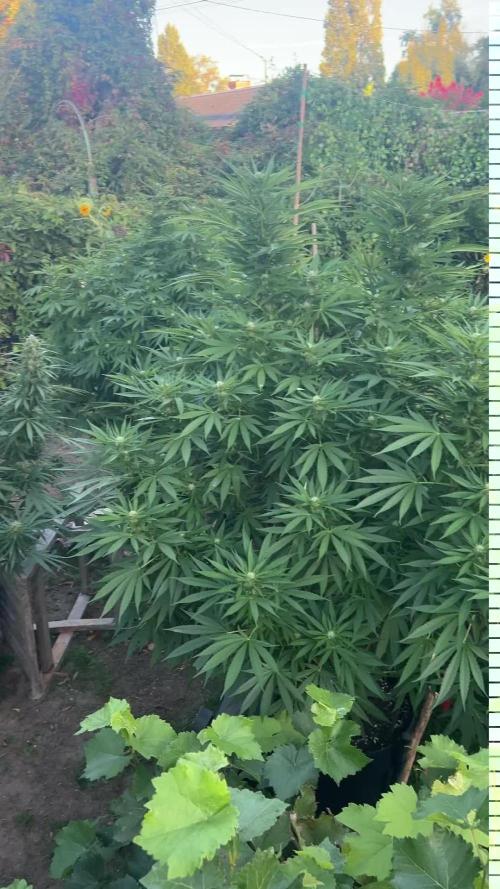
Indian summer, with sunny weather and temperatures over 30° - Still 11 hours of direct sunlight last week but i will loose 10 minutes a day from now (1 hour week)
2 more weeks to go for the most avanced pheno, Orange Sherbert according to the heavy orange smell


Likes
55
Share


@Ultraviolet
Follow
What's in the soil? What's not in the soil would be an easier question to answer. 16-18 DLI @ the minute. +++ as she grows.
Probably not recommended, but to get to where it needs to be, I need to start now.
Vegetative @1400ppm 0.8–1.2 kPa 80–86°F (26.7–30°C) 65–75%, LST Day 10, Fim'd Day 11
CEC (Cation Exchange Capacity):
This is a measure of a soil's ability to hold and exchange positively charged nutrients, like calcium, magnesium, and potassium. Soils with high CEC (more clay and organic matter) have more negative charges that attract and hold these essential nutrients, preventing them from leaching away.
Biochar is highly efficient at increasing cation exchange capacity (CEC) compared to many other amendments. Biochar's high CEC potential stems from its negatively charged functional groups, and studies show it can increase CEC by over 90%. Amendments like compost also increase CEC but are often more prone to rapid biodegradation, which can make biochar's effect more long-lasting. biochar acts as a long-lasting Cation Exchange Capacity (CEC) enhancer because its porous, carbon-rich structure provides sites for nutrients to bind to, effectively improving nutrient retention in soil without relying on the short-term benefits of fresh organic matter like compost or manure. Biochar's stability means these benefits last much longer than those from traditional organic amendments, making it a sustainable way to improve soil fertility, water retention, and structure over time. Needs to be charged first, similar to Coco, or it will immobilize cations, but at a much higher ratio.
a high cation exchange capacity (CEC) results in a high buffer protection, meaning the soil can better resist changes in pH and nutrient availability. This is because a high CEC soil has more negatively charged sites to hold onto essential positively charged nutrients, like calcium and magnesium, and to buffer against acid ions, such as hydrogen.
EC (Electrical Conductivity):
This measures the amount of soluble salts in the soil. High EC levels indicate a high concentration of dissolved salts and can be a sign of potential salinity issues that can harm plants.
The stored cations associated with a medium's cation exchange capacity (CEC) do not directly contribute to a real-time electrical conductivity (EC) reading. A real-time EC measurement reflects only the concentration of free, dissolved salt ions in the water solution within the medium.
98% of a plants nutrients comes directly from the water solution.
2% come directly from soil particles.
CEC is a mediums storage capacity for cations. These stored cations do not contribute to a mediums EC directly.
Electrical Conductivity (EC) does not measure salt ions adsorbed (stored) onto a Cation Exchange Capacity (CEC) site, as EC measures the conductivity of ions in solution within a soil or water sample, not those held on soil particles.
A medium releases stored cations to water by ion exchange, where a new, more desirable ion from the water solution temporarily displaces the stored cation from the medium's surface, a process also seen in plants absorbing nutrients via mass flow. For example, in water softeners, sodium ions are released from resin beads to bond with the medium's surface, displacing calcium and magnesium ions which then enter the water. This same principle applies when plants take up nutrients from the soil solution: the cations are released from the soil particles into the water in response to a concentration equilibrium, and then moved to the root surface via mass flow.
An example of ion exchange within the context of Cation Exchange Capacity (CEC) is a soil particle with a negative charge attracting and holding positively charged nutrient ions, like potassium (K+) or calcium (Ca2+), and then exchanging them for other positive ions present in the soil solution. For instance, a negatively charged clay particle in soil can hold a K+ ion and later release it to a plant's roots when a different cation, such as calcium (Ca2+), is abundant and replaces the potassium. This process of holding and swapping positively charged ions is fundamental to soil fertility, as it provides plants with essential nutrients.
Negative charges on soil particles: Soil particles, particularly clay and organic matter, have negatively charged surfaces due to their chemical structure.
Attraction of cations: These negative charges attract and hold positively charged ions, or cations, such as:
Potassium (K+)
Calcium (Ca2+)
Magnesium (Mg2+)
Sodium (Na+)
Ammonium (NH4+)
Plant roots excrete hydrogen ions (H+) through the action of proton pumps embedded in the root cell membranes, which use ATP (energy) to actively transport H+ ions from inside the root cell into the surrounding soil. This process lowers the pH of the soil, which helps to make certain mineral nutrients, such as iron, more available for uptake by the plant.
Mechanism of H+ Excretion
Proton Pumps: Root cells contain specialized proteins called proton pumps (H+-ATPases) in their cell membranes.
Active Transport: These proton pumps use energy from ATP to actively move H+ ions from the cytoplasm of the root cell into the soil, against their concentration gradient.
Role in pH Regulation: This active excretion of H+ is a major way plants regulate their internal cytoplasmic pH.
Nutrient Availability: The resulting decrease in soil pH makes certain essential mineral nutrients, like iron, more soluble and available for the root cells to absorb.
Ion Exchange: The H+ ions also displace positively charged mineral cations from the soil particles, making them available for uptake.
Iron Uptake: In response to iron deficiency stress, plants enhance H+ excretion and reductant release to lower the pH and convert Fe3+ to the more available form Fe2+. The altered pH can influence the activity and composition of beneficial microbes in the soil. The H+ gradient created by the proton pumps can also be used for other vital cell functions, such as ATP synthesis and the transport of other solutes. The hydrogen ions (H+) excreted during photosynthesis come from the splitting of water molecules. This splitting, called photolysis, occurs in Photosystem II to replace the electrons used in the light-dependent reactions. The released hydrogen ions are then pumped into the thylakoid lumen, creating a proton gradient that drives ATP synthesis.
Plants release hydrogen ions (H+) from their roots into the soil, a process that occurs in conjunction with nutrient uptake and photosynthesis. These H+ ions compete with mineral cations for the negatively charged sites on soil particles, a phenomenon known as cation exchange. By displacing beneficial mineral cations, the excreted H+ ions make these nutrients available for the plant to absorb, which can also lower the soil pH and indirectly affect its Cation Exchange Capacity (CEC) by altering the pool of exchangeable cations in the soil solution.
Plants use proton (H+) exudation, driven by the H+-ATPase enzyme, to release H+ ions into the soil, creating a more acidic rhizosphere, which enhances nutrient availability and influences nutrient cycling processes. This acidification mobilizes insoluble nutrients like iron (Fe) by breaking them down, while also facilitating the activity of beneficial microbes involved in the nutrient cycle. Therefore, H+ exudation is a critical plant strategy for nutrient acquisition and management, allowing plants to improve their access to essential elements from the soil.
A lack of water splitting during photosynthesis can affect iron uptake because the resulting energy imbalance disrupts the plant's ability to produce ATP and NADPH, which are crucial for overall photosynthetic energy conversion and can trigger a deficiency in iron homeostasis pathways. While photosynthesis uses hydrogen ions produced from water splitting for the Calvin cycle, not to create a hydrogen gas deficiency, the overall process is sensitive to nutrient availability, and iron is essential for chloroplast function.
In photosynthesis, water is split to provide electrons to replace those lost in Photosystem II, which is triggered by light absorption. These electrons then travel along a transport chain to generate ATP (energy currency) and NADPH (reducing power). Carbon Fixation: The generated ATP and NADPH are then used to convert carbon dioxide into carbohydrates in the Calvin cycle. Impaired water splitting (via water in or out) breaks the chain reaction of photosynthesis. This leads to an imbalance in ATP and NADPH levels, which disrupts the Calvin cycle and overall energy production in the plant. Plants require a sufficient supply of essential mineral elements like iron for photosynthesis. Iron is vital for chlorophyll formation and plays a crucial role in electron transport within the chloroplasts. The complex relationship between nutrient status and photosynthesis is evident when iron deficiency can be reverted by depleting other micronutrients like manganese. This highlights how nutrient homeostasis influences photosynthetic function. A lack of adequate energy and reducing power from photosynthesis, which is directly linked to water splitting, can trigger complex adaptive responses in the plant's iron uptake and distribution systems.
Plants possess receptors called transceptors that can directly detect specific nutrient concentrations in the soil or within the plant's tissues. These receptors trigger signaling pathways, sometimes involving calcium influx or changes in protein complex activity, that then influence nutrient uptake by the roots. Plants use this information to make long-term adjustments, such as Increasing root biomass to explore more soil for nutrients. Modifying metabolic pathways to make better use of available resources. Adjusting the rate of nutrient transport into the roots. That's why I keep a high EC. Abundance resonates Abundance.
Processing
Likes
14
Share


@JerMeds
Follow
Well I'm pretty sure they are done stretching. I had to adjust lights and LTS main stems but I made them fit. I have never grown this many big girls at one time so this is a new experience.
I really wish I had some better lights for them. I have 650 true watts over 4 plants (Is it enough?) and the 5th has 250 watt so shes good.
Other then that they seem to be really happy and don't seem to mind the lack of wattage. They are starting too smell awesome and all those bud sites........its crazy.

Likes
2
Share

@StartGrowingShxt
Follow
Week 11
August 11
—- Breeding Project—-
We recently had a run of Sour Diesel and I decided to take the only male from that batch and cross it to some clones, one being the Cerezaz strain.
The goal of this cross is to find faster flowering (45-55 days) plants and also increase yield as the Cerezaz is a timid producer and Sour Diesel is generally a medium to high yielded.
Other characteristics we are looking for are: sour, berries, cherries, diesel, gas on the nose ( although unique combinations are welcome), decrease light sensitivity( Sour diesel was sensitive to light intensity) as well as breed in some resistance to heat from the Cerezaz as she did outstanding in 90+ heat indoors.
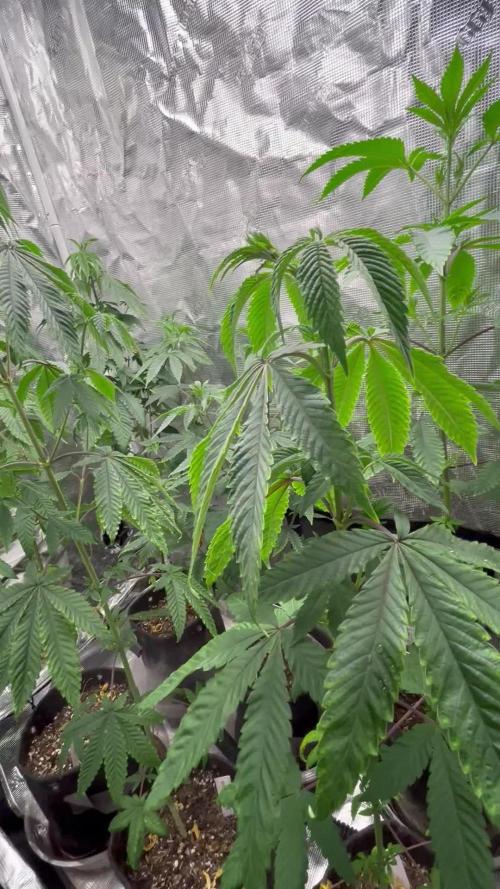
Currently this batch of Polyhybrid F1s are exhibiting mostly the sour diesel traits:
generally more tall and lanky, leaves closer to the main stem and drooping( as seen in some landrace sativas) and the stem rub is chemical, soap astringent with a slight savory berry backend with large fat fingered leaves.
The other pheno is squat with very good lateral side branching and grows slower height wise medium sized leaves and the fingers are neither skinny nor fat but generally on the thicker side. Similar nose on these but more Cerezaz leaning so the berry, cherry sweet is more noticeable.
With all that being said these ladies are top dressed and just got flipped into flower! So come along for the ride! 💪🏾
Likes
15
Share


@gottagrowsometime
Follow
Welcome to my Lemon Drizzle sponsored by Spider-Farmer & Barneysfarm with their New SE brand, (upgraded 2023 Spectrum) and 1 of 5 of Barneysfarm new Releases I was given.
Veg Days 2-9 Days 8-14 Week 2
Plant grew really well in week 2. Rapid growth, holding pace with the 1st weeks explosive growth. Her roots are amazing. And it'll be getting uppotted soon. Running on a Full compliment of Natural Line Plagron with others in their line. Will be adding everything they have, in their range of course. New "Power Buds" and Green Sensation, SR, and idk why but I added Terpinator. And, its not an ideal nutrient to use in a sensitive range where PH mistakes cause big issues. She did do good this week but, this is the last of good week. As Co2 growing with young plants is new to me. My co2 is too high and lux is too low, I've taken out Runtz and put GDP auto back at floor. And I've upped the Lux and Will be lowering the light for ripening for my plant and dropping co2 back to 800.
Thanks to all who viewed. And to Bella from Spider-Farmer for the opportunity to work with them. And for the 2nd Yr in a row. Barneysfarm have let me pick 5 of their new Releases. Highly appreciated, that also goes to all who stopped by to view, like, &/r comment. Thanks and I look forward to seen your work. Either way. Thanks again for stopping by.

Likes
Comments
Share


@Organic473
Follow
It's about time for her to go in the ground. I've been defoliating the younger leaves which gave her height within the last two weeks. No complaints thus far, she is very healthy.

Likes
8
Share

@GERGrowDesigns
Follow
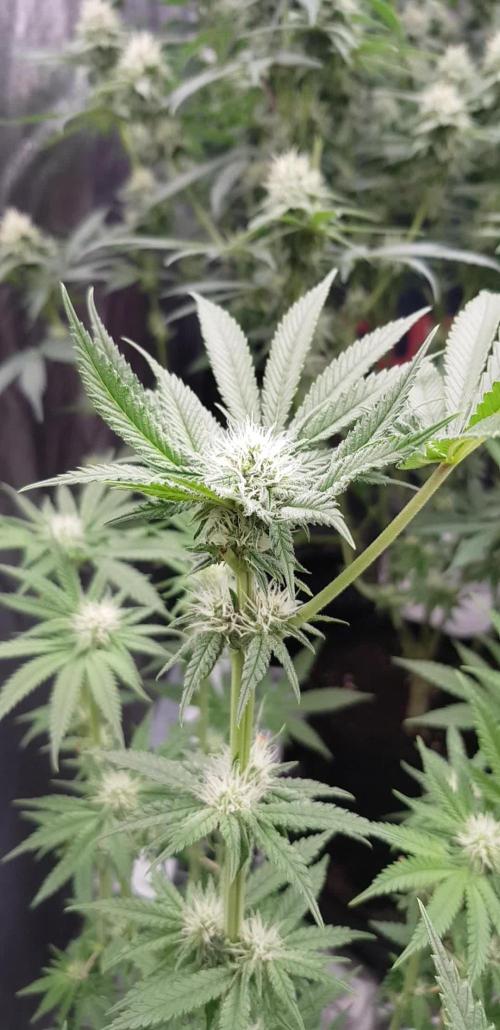
Welcome to Flower week 3 of Fast Buds LemonPaya
I'm excited to share my grow journey with you from my
FastBuds Project . It's going to be an incredible ride, full of learning, growing, and connecting with fellow growers from all around the world!
For this Project , I’ve chosen the Feminized Photo strain Lemonpaya :
Here’s what I’m working with:
• 🌱 Tent: 120x60x80
• 🧑🌾 Breeder Company: Fast buds
• 💧 Humidity Range: 50
• ⏳ Flowering Time: 58 Days
• Strain Info: 30%THC
• 🌡️ Temperature: 26
• 🍵 Pot Size: 16l
• Nutrient Brand: Narcos
• ⚡ Lights : 600W x 2
A huge thank you to Fast Buds for allowing me to try my Best with this amazing collection from Automatic and Photo Strains they managed to Sponsore . Big thanks for supporting the grower community worldwide! Your genetics and passion speak for themselves!
I would truly appreciate every bit of feedback, help, questions, or discussions – and of course, your likes and interactions mean the world to me as I try to stand out in this exciting competition!
Let’s grow together – and don’t forget to stop by again to see the latest updates!
Happy growing!
Stay lifted and stay curious!
Peace & Buds!
Likes
39
Share


@SirBudAlotts
Follow
This week I decided to start feeding her some nutes.
She went through some serious lollipopping aswell 😳..😆!!
So she basically received a bloom booster ( 1: 12:12 ), I also added some potassium booster ( 0:0:35 ).
I think she loves her nutes alot! She gave me a good stretch and formed much more bud sites which has me all excited 😊..
Likes
29
Share


@TheCannaProphet
Follow
----------------------------------
~SEEDSMAN PEYOTE FORUM~
----------------------------------
Characteristics
BREEDER/BRAND: Seedsman
GENETICS: GSC Forum Cut x Peyote Purple
VARIETY: Indica / Sativa
FLOWERING TYPE: Photoperiod
SEX: Feminized
THC CONTENT: 20%+
GROWS: Indoors, Outdoors
FLOWERING TIME: 65 days
MEDICAL CONDITIONS: Glaucoma, Headaches, Migraines, Stress
MEDICINAL PROPERTIES: Yes
EFFECT: Powerful
__________________________________________________________________________________________________________________________________________________________________________________________________________________________________________________________________________________________________________________________________________________________________________________________________________________________________________________
~🤩This run is part of a Seedsman Seeds sponsored PEYOTE FAMILY COOPERATIVE GROW, I'm also cultivating a Peyote Gorilla and Peyote Zkittles that each have their own diaries.💚~
'Peyote Forum is an Indica-sativa hybrid cross between the legendary taste sensation Forum Cookies, a phenotype of GSC (Girl Scout Cookies), and the highly potent Peyote Purple cannabis strains. This is a must-have strain for your collection which produces very high THC content..
Forum Cookies is a 75% sativa strain which retains the qualities of the original Girl Scout Cookies while adding extra cerebral sativa effects. Despite the dominance of sativa the buds it produces are very dense and rich in resin-exuding trichomes which glisten against the forest green bud-leaves and orange pistils. Some plants may display purple colors in the buds and smaller leaves at maturity.
While yields aren't enormous they are certainly decent and the sheer quality more than makes up for this fact. Flowering takes 65 days give or take. Flavors are pungent and similar to the original GSC showing a pungent Skunk character with notes of nuts and sweet spices and suggestions of earth and pine. THC production will vary between 19 - 28% depending on conditions, lighting intensity and the skill of the grower. The effect is physically relaxing while offering a cerebral twist which is uplifting, relieving stress while also helping with the symptoms of glaucoma, migraines and headaches.
Peyote Purple, however, is an Indica-dominant strain with 90% Indica genetics. Its ancestry can be traced from a single purple phenotype which was back-crossed for several generations in order to stabilize its qualities. This plant takes 8 - 9 weeks of flowering before it is ready to harvest producing average yields of way-above-average weed. The THC content is very high with plants reaching between 18 - 28%. Its name is attributed to its headiness as this Indica offers some pronounced cerebral effects with a relaxing yet uplifting high which can leave smokers sleepy and somewhat unfocused with heavier use. Therapeutically it is recommended for the treatment of chronic pain, cramps, Insomnia, muscle spasms and stress.
Brought together in Peyote Forum growers can expect some very potent, tasty dank buds with high levels of THC and an uplifting high.'
*description credit to Seedsman Seeds
__________________________________________________________________________________________________________________________________________________________________________________________________________________________________________________________________________________________________________________________________________________________________________________________________________________________________________________
THE SETUP:
~Planted into Jiffy Peat Pellets that were hydrated with de-chlorinated water with SuperThrive added then ph'd to 6.0 @ 80℉
~Grown 100% organic in 10g fabric pots with Mother Earth 70/30 Coco/Perlite medium amended with 2tbs/g of Down To Earth 4-4-4 / 2 cups/g of Earthworm Castings / 1tbs/g of Dr. Earth Flower Girl 3-9-4, 1tbs/g of Dr. Earth Bat Guano, 3/4 cup of Down To Earth Azomite and 1 tsp/g Down To Earth Fish Bone Meal.
~24hr light cycle during Germination / 19/5 light cycle for Vegetation and 12/12 for Flower
~Straight water ph'd @ 6.2-6.8 when needed and weekly Compost Tea's.
__________________________________________________________________________________________________________________________________________________________________________________________________________________________________________________________________________________________________________________________________________________________________________________________________________________________________________________
WEEKLY UPDATES:
10/4- Week Eight of flower is here and we're almost ready to wrap thing up with this girl!
Her flowers are continuing to bulk up and are covered in glistening trichomes. She appears to be starting to fade which is exactly what I'm hoping to see, meaning that she's just about used up the nutrients in her medium.
I watered today with 1.5g of de-chlorinated water which was then ph'd to 6.6 @ 72℉ turned her pot and shot a few pictures of her.
10/6- Today I watered her with 1.5g of her usual straight de-chlorinated water that's ph'd to 6.5 @ 72℉ and turned her pot.
She's definitely starting to fade, is still stacking her flowers, bulking up and has an incredible amount of trichomes which I'm beginning to monitor daily.
10/8- The routine of watering every other day continues like clockwork. Yesterday was a 'no water' day and I did a basic check over of the plant, removed a couple of yellowed lower leaves and turned her pot.
Today she got the usual 1.5g of straight de-chlorinated water that's ph'd to 6.5 @ 72℉ and had her pot turned. I've also begun to check her trichome development with a digital USB microscope to try to identify the ideal harvest time which will be in the next 12-14 days +/-.
10/10- Well, Week Eight has come, gone and has been a trial once again of my patience with this Ten Week cultivar!
She's beginning to really get frosty now and I know from experience, good things come to those who wait... then wait a bit more. I anticipate that she's not going to make the 65 days in flower 'suggested' by the breeder and will probably go a bit longer, closer to 70 +/- days, but we'll have to see what her trichomes have to say!
I've cut the wattage back on the HLG 650R to 500w at the wall now to simulate the way that sunshine becomes weaker as fall approaches due to the lower angle of the sun in the sky. This helps outdoor plants to know that winters on the way and they need to hurry up and complete their life cycle. Cutting the wattage back creates the same effect on the indoor plants, especially when coupled with lowered temperatures in the tent.
I have also noticed that her water uptake has slowed. After her heavy watering on the 8th, her pot still had some weight to it and she was looking great so I went ahead and skipped watering her today, watering her tomorrow at lights on with her usual.
Next week promises to be exciting so don't forget to check in! Harvest time is right around the corner and I'm getting stoked to see the results! 😎🙏💚
~Thanks for stopping in! This epic run is in the home stretch with harvest fast approaching...Stay lifted and be Blessed! 😎🙏~

Likes
107
Share


@Tropicannibis_Todd
Follow
💩Holy Crap Growmies We Are Back💩
Code Name FBT2309
Well growmies we are at 21
days in and everything is going great 👌
👉 So the low stress training👈 has been going great she's gonna be a big girl, shes in the Pre-flower Stretch 👌
Lights being readjusted and chart updated .........👍rain water to be used entire growth👈
👉I used NutriNPK for nutrients for my grows and welcome anyone to give them a try .👈
👉 www.nutrinpk.com 👈
NutriNPK Cal MAG 14-0-14
NutriNPK Grow 28-14-14
NutriNPK Bloom 8-20-30
NutriNPK Bloom Booster 0-52-34
I GOT MULTIPLE DIARIES ON THE GO 😱 please check them out 😎
👉THANKS FOR TAKING THE TIME TO GO OVER MY DIARIES 👈
Likes
293
Share


@Ju_Bps
Follow
Hello growmies 👩🌾👨🌾🌲🌲,
👋 Veg is now over and let's go for the flowering, girls start to stretch and look happy 😊.
💪 Continuing Defoliation, lst, preparing scrog and daily fighting with this big leaves 😅
💧 Give water each 2/3 day
And vaporise plant with water + Plagron Roots (1ml/l)
1.5 l Water + Roots + Bloom + Zym + Sugar Royal (1 + 3 + 1 + 1 ml/l)
PH @6
💡Mars Hydro - FC 3000
50% 45 cm
Mars Hydro Fan kit
Setting 5
Have a good week and see you next week 👋
Thanks community for follow, likes, comments, always a pleasure 👩🌾👨🌾❤️🌲
Mars Hydro - Smart FC3000 300W Samsung LM301B LED Grow Light💡💡
https://www.mars-hydro.com/fc-3000-samsung-lm301b-led-grow-light
Mars Hydro - 6 Inch Inline Fan And Carbon Filter Combo With Thermostat Controller 💨💨
https://www.mars-hydro.com/6-inch-inline-duct-fan-and-carbon-filter-combo-with-thermostat-controller
Fast Buds - Gorilla Cookies FF🌲🌲
https://2fast4buds.com/us/seeds/gorilla-cookies-fast-flowering
Processing
Likes
3
Share


@420cfm
Follow
The tent smells great this week. Very sweet, pineapple citrus. Buds continue to grow with new pistals daily. Lots of crystal showing now too. I didn’t defoliate as much as I’d hoped due to hermie sighting in week 3; but they’re looking good and I’m happy with grow three so far. So much learned, so much progress. Hopefully the results speak for themselves...
Likes
14
Share

@El-Ecko
Follow
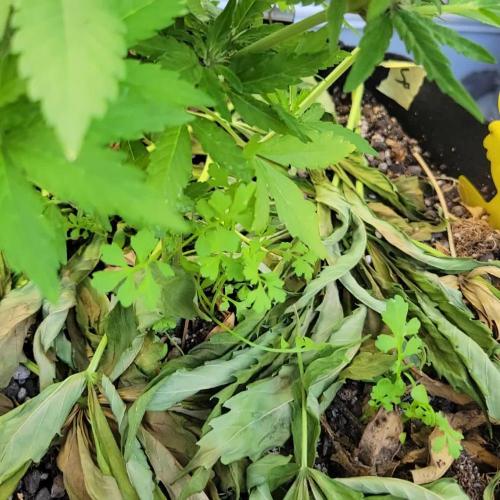
Week 3 of Flowering
It was a very good week for all the plants.
We had temperatures above 30 degrees all week long. ☀️🔝 But since the sunlight only hits my balcony until around 2 p.m., the strong sun isn’t really a problem.
The flowers are steadily filling out, and the coloration is getting more and more beautiful.🌸? The scent is still very subtle.
It’ll remain a small plant, which really doesn’t bother me at all.
It just looks great.😋🌱


